

|
시장보고서
상품코드
2118239
신뢰 실행 환경(TEE) 관리 시장 : 시장 점유율 분석, 업계 동향 및 통계, 성장 예측(2026-2031년)Trusted Execution Environment Management - Market Share Analysis, Industry Trends & Statistics, Growth Forecasts (2026 - 2031) |
||||||
 Mordor Intelligence
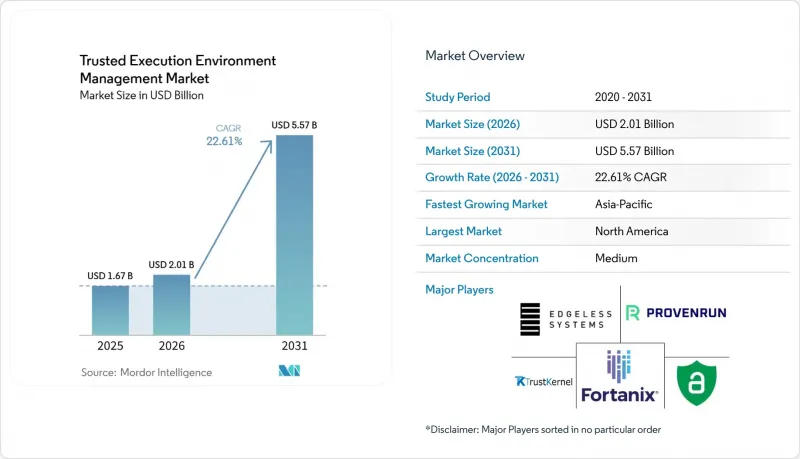
Mordor Intelligence에 의하면, 신뢰 실행 환경(TEE) 관리 시장 규모는 2025년에 16억 7,000만 달러로 평가되었고, 2026년 20억 1,000만 달러에서 2031년까지 55억 7,000만 달러에 이를 것으로 예측되며, 2026-2031년 예측 기간 CAGR은 22.61%를 나타낼 전망입니다.
본 보고서는 구성 요소별(하드웨어, 소프트웨어, 서비스), 배포 모델별(클라우드, 하이브리드, 온프레미스), 용도별(모바일 보안, 디지털 결제 등), 기업 규모별(대기업, 중소기업), 최종 사용자별(IT 및 통신, BFSI 등) 및 지역별로 분류되어 있습니다. 시장 예측은 금액(달러) 기준으로 제시되어 있습니다.
세계의 신뢰 실행 환경(TEE) 관리 시장 동향 및 인사이트
증가하는 사이버 보안 위협과 데이터 유출로 인한 비용
보안 사고로 인한 경제적 영향이 신뢰 실행 환경(TEE) 관리 시장의 성장을 견인하고 있습니다. IBM 보고서에 따르면, 2025년 전 세계 평균 데이터 유출 비용은 444만 달러인 반면, 미국에서는 1,022만 달러에 달했습니다. 버라이즌은 2025년 보고서에서 1만 2,195건의 확인된 데이터 유출을 기록했으며, 사고의 44%에서 랜섬웨어가 확인되었습니다. 동 보고서에 따르면, 데이터 유출 사고의 30%에 제3자가 연루된 것으로 밝혀졌으며, 이는 공급업체 및 인프라의 전체 신뢰 체인에 존재하는 취약점을 여실히 드러내고 있습니다. 또한 IBM의 조사에 따르면, AI 관련 보안 사고를 경험한 조직의 97%가 적절한 AI 접근 제어를 갖추지 못한 것으로 나타났습니다. TEE 관리 플랫폼은 모델 가중치와 추론 워크로드를 격리하는 동시에, 키에 대한 접근을 인증 증거와 연동할 수 있습니다.
데이터 보호 및 디지털 복원력 규정
사이버 보안 요구 사항이 정책 선언에서 제품 및 운영상의 관리 조치로 전환됨에 따라, 신뢰 실행 환경(TEE) 관리 시장은 그 혜택을 누리고 있습니다. ‘사이버 회복탄력성법’으로 알려진 EU 규정 2024/2847은 2024년 12월 10일에 발효되었습니다. 실제로 악용된 취약점에 대한 보고 의무는 2026년 9월 11일부터 적용되며, 제품 수명 주기 전반에 걸친 요건은 2027년 12월 11일부터 적용됩니다. 스웨덴 개인정보보호 당국은 2026년 5월 TEE 도입에 관한 GDPR(EU 개인정보보호규정) 지침을 발표하며, 적절하게 구현된 TEE를 제32조에 따른 기술적 보호 조치로 간주했습니다. 이 지침에서는 인증 및 암호화 키를 관리하는 당사자에게 설명 책임이 부과됩니다. 이러한 요건으로 인해 하드웨어 기반 증거는 의료, 금융 서비스, 자동차 및 기타 규제 대상 사용자에게 더욱 중요해지고 있습니다.
통합의 복잡성과 기술 인력 부족
신뢰 실행 환경(TEE) 관리 시장은 강력한 보안 가치를 지니고 있음에도 도입의 어려움이 해소되지 않아 단기적인 제약에 직면해 있습니다. Intel TDX, AMD SEV-SNP, ARM TrustZone 및 RISC-V 엔클레이브는 각각 서로 다른 API, 인증 프로세스, 위협 모델을 채택하고 있습니다. 보안 팀은 많은 경우 이러한 환경을 여러 개 동시에 지원해야 합니다. ESET의 조사에 따르면, 2026년에 클라우드 보안은 중소기업이 두 번째로 많은 투자를 계획하는 분야로 나타났습니다. 그러나 TEE 구현에는 일반적인 클라우드 보안 교육만으로는 습득할 수 없는 고도의 기술이 요구됩니다. 관리형 인증 서비스나 기밀 컨테이너를 활용하면 이러한 부담을 줄일 수 있지만, 전담 보안 엔지니어를 보유하지 않은 조직의 경우 도입 속도는 여전히 더딘 상태를 유지할 것입니다.
부문 분석
2025년, 소프트웨어는 신뢰 실행 환경(TEE) 관리 시장의 64.82% 점유율을 차지했습니다. 하이퍼바이저가 침해될 경우 소프트웨어만을 통한 인증이 훼손될 가능성이 있으므로 실리콘 기반의 신뢰성은 여전히 중요하지만, 보안 칩, 임베디드 하드웨어 보안 모듈, 시스템 온 칩(SoC)의 보안 기능은 주로 기반이 되는 투자 계층으로 기능하고 있습니다. ISO 26262 및 ISO/SAE 21434를 준수하는 자동차용 임베디드 하드웨어 보안 모듈인 Rambus CryptoManager RT-648,FIPS 203, 204, 20을 준수하는 포스트 양자 알고리즘 등, 첨단 하드웨어가 계속해서 보급되고 있습니다. 그러나 시장의 대부분을 차지하는 것은 소프트웨어이며, 이 다양한 TEE 하드웨어가 실제로 대규모로 가동될 수 있도록 하는 데 필수적인 정책 관리, 키 오케스트레이션 및 기밀 컨테이너 도구를 제공합니다.
서비스 시장은 2026-2031년 연평균 성장률(CAGR) 24.73%를 나타낼 것으로 예측됩니다. 많은 사용자가 하드웨어, 워크로드, 보안 정책의 연동에 대한 지원이 필요하기 때문에 관리형 인증 및 전문 통합 서비스가 TEE(신뢰 실행 환경) 관리 시장의 성장을 주도하고 있습니다. 하드웨어 분야의 ‘신뢰 실행 환경(TEE) 관리 시장’ 규모는 포스트 양자암호화에 대한 대응 상황에도 영향을 받을 것입니다. NIST는 2024년에 최초의 3가지 포스트 양자암호화 표준을 최종 확정하여, 암호화 유연성이 부족한 장치의 교체 주기를 초래했습니다. 업데이트 경로와 양자 내성 지원을 통합한 벤더는 혜택을 볼 수 있는 반면, 모듈식 업그레이드 기능을 갖추지 않은 시스템은 조기 교체를 피할 수 없을 가능성이 있습니다.
2025년에는 클라우드 배포가 매출의 68.41%를 차지했습니다. Intel TDX 및 AMD SEV-SNP를 채택한 기밀 가상 머신을 통해, 하드웨어 기반 격리 컴퓨팅에 기존에 필요했던 설비 투자가 절감되었습니다. 인프라에 대한 직접적인 제어가 필요한 에어갭(air-gapped) 방식의 정부 기관 및 국방 기관 환경에서는 온프레미스 모델이 여전히 중요하게 여겨지고 있습니다. 또한 클라우드 플랫폼은 서버 클러스터를 구축하지 않고도 TEE 수준의 격리가 필요한 조직에게 신뢰 실행 환경(TEE) 관리 시장으로 진입할 수 있는 현실적인 경로를 제공합니다.
하이브리드 배포는 2026-2031년 연평균 성장률(CAGR) 23.84%를 나타낼 것으로 예측됩니다. 조직들은 인증 파이프라인 및 암호화 제어를 통해 기밀성이 높은 온프레미스 데이터를 클라우드 규모의 AI 추론과 연계하고 있습니다. 인텔(Intel)의 TD Preserving Architecture는 수 분에 달하는 재시작 시간 없이 밀리초 단위로 TDX 모듈의 런타임 업데이트를 지원합니다. 이 기능을 통해 99.999%의 가용성이 계약상 요구 사항인 프로덕션 AI 환경을 지원할 수 있습니다. Edgeless Systems는 신뢰 실행 환경(TEE) 관리 시장에서 고객 측의 쿠버네티스 관리자조차 용도 데이터에 접근할 수 없도록 하는 기밀성이 높은 컨테이너 오케스트레이션을 제공합니다.
지역별 분석
2025년, 북미는 신뢰 실행 환경(TEE) 관리 시장에서 34.62%의 점유율을 차지했습니다. 미국 연방 정부의 조달에서는 국방 및 정보 관련 워크로드를 위해 하드웨어 기반 보안 인증이 지원되고 있습니다. 엔터프라이즈용 클라우드 도입이 집중되어 있어, 기밀 가상 머신의 도입이 상업적으로 현실화되고 있습니다. IBM 보고서에 따르면, 2025년 미국의 평균 보안 침해 비용은 1,022만 달러로, 세계 평균의 2.3배에 달할 전망입니다. 이러한 격차로 인해 이사회 차원에서 검증 가능한 컴퓨팅 격리에 대한 관심이 높아지고 있습니다.
유럽은 신뢰 실행 환경(TEE) 관리 시장에서 2위 규모를 자랑하는 지역이며, ‘사이버 복원력법’에 따른 보고 의무는 2026년 9월에 만료됩니다. 스웨덴의 개인정보 보호 감독 기관은 2026년 5월, TEE 도입에 관한 GDPR(EU 개인정보보호규정) 지침을 발표했으며, 다른 유럽연합(EU) 규제 당국들도 이를 검토하고 있습니다. Edgeless Systems는 자사의 ‘Privatemode AI’가 독일의 ePA 시스템 내에서 가동되며 5,000만 명의 환자 데이터를 보호하고 있다고 보고했습니다. 프랑스의 ProvenRun은 ProvenCore 및 ProvenHSM을 중심으로 높은 보증 수준의 인증 체계를 구축했습니다.
아시아태평양은 2026-2031년 연평균 성장률(CAGR) 23.68%를 나타낼 것으로 예측됩니다. 일본의 산업기술종합연구소(AIST)는 자동차 및 산업용 IoT의 수명 주기 관리를 위한 IETF TEEP의 노력을 지원해 왔습니다. 한국은 커넥티드카 조사를 지원하고 있는 반면, 인도의 데이터 보호 규정은 주권형 AI 도입을 뒷받침하고 있습니다. 중국에서는 기밀성이 높은 도입을 위한 RISC-V 기반 접근 방식을 통해 국내 생태계가 확대되고 있습니다. 남미, 중동 및 아프리카는 도입 초기 단계에 있는 지역으로, BFSI(은행 및 금융 및 보험) 분야의 규정 준수, 디지털 ID 프로그램, 데이터 거주지법, 브라질의 LGPD(일반 데이터 보호법), 그리고 주권형 클라우드에 대한 투자가 AI 보급을 촉진할 가능성이 있습니다.
기타 혜택 :
- 엑셀 형식 시장 예측(ME) 시트
- 3개월간의 애널리스트 지원
자주 묻는 질문
목차
제1장 서론
제2장 조사 방법
제3장 주요 요약
제4장 시장 구도
제5장 시장 규모 및 성장 예측
제6장 경쟁 구도
제7장 시장 기회 및 향후 전망
AJY 26.09.03According to Mordor Intelligence, the trusted execution environment management market size was valued at USD 1.67 billion in 2025 and estimated to grow from USD 2.01 billion in 2026 to reach USD 5.57 billion by 2031, at a CAGR of 22.61% during the forecast period 2026-2031.
This report is Segmented by Component (Hardware, Software, and Services), Deployment Model (Cloud, Hybrid, and On-Premises), Application (Mobile Security and Digital Payments, and More), Enterprise Size (Large Enterprises, and Small and Mid-Sized Enterprises), End Users (IT and Telecommunication, BFSI, and More), and Geography. The Market Forecasts are Provided in Terms of Value (USD).
Global Trusted Execution Environment Management Market Trends and Insights
Rising Cybersecurity Threats and Data-Breach Costs
The financial impact of security incidents supports the Trusted Execution Environment Management Market. IBM reported a global average breach cost of USD 4.44 million in 2025, while the U.S. average reached USD 10.22 million. Verizon documented 12,195 confirmed breaches in its 2025 report and found ransomware in 44% of incidents. The same report found third-party involvement in 30% of breaches, which highlights weaknesses across supplier and infrastructure trust chains. IBM also found that 97% of organizations that experienced an AI-related security incident lacked proper AI access controls. TEE management platforms can isolate model weights and inference workloads, while linking key access to attestation evidence.
Data Protection and Digital Resilience Rules
The Trusted Execution Environment Management Market benefits as cybersecurity requirements move from policy statements into product and operational controls. Regulation EU 2024/2847, known as the Cyber Resilience Act, entered into force on December 10, 2024. Reporting obligations for actively exploited vulnerabilities apply from September 11, 2026, and full product lifecycle requirements will apply from December 11, 2027. Sweden's privacy authority published GDPR guidance on TEE deployments in May 2026 and treated properly implemented TEEs as a technical safeguard under Article 32. The guidance places accountability with the party that controls attestation and encryption keys. These requirements make hardware-backed evidence more relevant to healthcare, financial services, automotive, and other regulated users.
Integration Complexity and Skills Scarcity
The Trusted Execution Environment Management Market faces a near-term constraint because strong security value does not remove implementation difficulty. Intel TDX, AMD SEV-SNP, ARM TrustZone, and RISC-V enclaves use different APIs, attestation processes, and threat models. Security teams must often support multiple of these environments simultaneously. ESET found cloud security was the second-highest planned investment area for small and mid-sized businesses in 2026. However, implementing TEE requires skills beyond typical cloud security training. Managed attestation services and confidential containers can reduce this burden, but adoption will remain slower where organizations lack dedicated security engineers.
Other drivers and restraints analyzed in the detailed report include:
- Cloud, Edge, and Connected Device Expansion
- Mobile Payments and Digital Identity Growth
- Performance Overhead and Limited Workload Fit
For complete list of drivers and restraints, kindly check the Table Of Contents.
Segment Analysis
Software held 64.82% of the Trusted Execution Environment Management Market share in 2025. Although silicon-based trust remains critical because a compromised hypervisor may undermine software-only attestations, secure chips, embedded hardware security modules, and system-on-chip security functions act primarily as the foundational investment layer. Advanced hardware, such as the Rambus CryptoManager RT-648, an automotive embedded hardware security module with ISO 26262 and ISO/SAE 21434 support, as well as post-quantum algorithms aligned with FIPS 203, 204, and 20, continues to proliferate. It is, however, software that commands the majority of the market by providing essential policy management, key orchestration, and confidential container tools that enable this diverse TEE hardware to actually operate at scale.
Services are projected to grow at a 24.73% CAGR from 2026 to 2031. Managed attestation and professional integration are driving growth in the Trusted Execution Environment Management Market because many users need help connecting hardware, workloads, and security policies. The Trusted Execution Environment Management Market size for hardware will also be affected by post-quantum readiness. NIST finalized its first 3 post-quantum cryptography standards in 2024, creating a replacement cycle for devices that lack cryptographic agility. Vendors that embed update paths and quantum-resistant support can benefit, while systems without modular upgrades may face earlier replacement.
Cloud deployment held 68.41% of revenue in 2025. Confidential virtual machines using Intel TDX and AMD SEV-SNP have reduced the capital investment previously needed for hardware-isolated computing. The on-premises model remains important for air-gapped government and defense settings that require direct infrastructure control. Cloud platforms also offer a practical route into the Trusted Execution Environment Management Market for organizations that need TEE-grade isolation without building server fleets.
Hybrid deployment is projected to grow at a 23.84% CAGR from 2026 to 2031. Organizations are connecting sensitive on-premises data with cloud-scale AI inference through attestation pipelines and cryptographic controls. Intel's TD Preserving Architecture supports runtime TDX Module updates in milliseconds rather than reboot windows that can last minutes. This capability supports production AI environments where 99.999% availability is a contractual requirement. Edgeless Systems offers confidential container orchestration that keeps application data inaccessible even to customer-side Kubernetes administrators in the Trusted Execution Environment Management Market.
Complete Report Scope:
- By Component
- Hardware
- Software
- Services
- By Deployment Model
- Cloud
- Hybrid
- On-Premises
- By Application
- Mobile Security and Digital Payments
- IoT and Edge Security
- Automotive Security
- Industrial and Operational Technology Security
- Confidential Computing and Data Privacy
- Government and Defense
- Other Applications
- By Enterprise Size
- Large Enterprises
- Small and Mid-sized Enterprises
- By End Users
- IT and Telecommunication
- BFSI
- Automotive and Transportation
- Healthcare and Life Sciences
- Retail and E-Commerce
- Industrial Manufacturing
- Other End Users
- By Geography
- North America
- United States
- Canada
- Mexico
- South America
- Brazil
- Argentina
- Rest of South America
- Europe
- Germany
- United Kingdom
- France
- Russia
- Spain
- Rest of Europe
- Asia-Pacific
- China
- Japan
- India
- South Korea
- Southeast Asia
- Rest of Asia-Pacific
- Middle East and Africa
- Middle East
- Saudi Arabia
- United Arab Emirates
- Rest of Middle East
- Africa
- South Africa
- Nigeria
- Rest of Africa
- Middle East
- North America
Geography Analysis
North America held 34.62% of the Trusted Execution Environment Management Market share in 2025. U.S. federal procurement supports hardware-attested security for defense and intelligence workloads. The concentration of enterprise cloud deployments makes confidential virtual machine adoption commercially practical. IBM reported an average breach cost of USD 10.22 million in the United States in 2025, 2.3 times the global average. This gap is increasing board-level interest in verifiable compute isolation.
Europe is the second-largest region in the Trusted Execution Environment Management Market, and Cyber Resilience Act reporting obligations are due in September 2026. Sweden's privacy authority issued GDPR guidance on TEE deployments in May 2026, which other European Union regulators are studying. Edgeless Systems reported that its Privatemode AI operates within Germany's ePA system and protects the data of 50 million patients. France's ProvenRun has built high-assurance credentials around ProvenCore and ProvenHSM.
Asia-Pacific is projected to grow at a 23.68% CAGR from 2026 to 2031. Japan's AIST has supported IETF TEEP work for automotive and industrial IoT lifecycle management. South Korea has supported connected-vehicle research, while India's data protection rules are encouraging sovereign AI deployments. China's domestic ecosystem is expanding through RISC-V-based approaches for sensitive deployments. South America, the Middle East, and Africa are early-stage regions where BFSI compliance, digital identity programs, data-residency laws, Brazil's LGPD, and sovereign cloud investments can support adoption.
- Fortanix, Inc.
- ProvenRun S.A.S.
- TrustKernel Technology Co., Ltd.
- Trustonic Limited
- Anjuna Security, Inc.
- Edgeless Systems GmbH
- Scontain GmbH
- Secretarium Limited
- Decentriq AG
- Secure-IC S.A.S.
- Rambus Inc.
- Intrinsic ID B.V.
- Licel Corporation
- Safeheron Pte. Ltd.
- Oasis Labs, Inc.
- CryptoNext Security SAS
- Confidential AI, Inc.
- XaiTEE, Inc.
- QLAD, Inc.
- Automata Network Pte. Ltd.
Additional Benefits:
- The market estimate (ME) sheet in Excel format
- 3 months of analyst support
TABLE OF CONTENTS
1 INTRODUCTION
- 1.1 Study Assumptions and Market Definition
- 1.2 Scope of the Study
2 RESEARCH METHODOLOGY
3 EXECUTIVE SUMMARY
4 MARKET LANDSCAPE
- 4.1 Market Overview
- 4.2 Market Drivers
- 4.2.1 Rising Cybersecurity Threats and Data-Breach Costs
- 4.2.2 Regulatory Mandates for Data Protection and Digital Resilience
- 4.2.3 Expansion of Cloud, Edge, and Connected Devices
- 4.2.4 Growth of Mobile Payments and Digital Identity
- 4.2.5 Confidential AI and Privacy-Preserving Analytics Adoption
- 4.2.6 Demand for Portable Attestation Across Heterogeneous Compute
- 4.3 Market Restraints
- 4.3.1 High Integration Complexity and Skills Scarcity
- 4.3.2 Performance Overhead and Limited Workload Fit
- 4.3.3 Cross-Vendor Attestation and Interoperability Gaps
- 4.3.4 Long-Lived Device Fleets and Post-Quantum Migration Uncertainty
- 4.4 Impact of Macroeconomic Factors on the Market
- 4.5 Industry Value-Chain Analysis
- 4.6 Technology Outlook
- 4.7 Regulatory Landscape
- 4.8 Porter's Five Forces Analysis
- 4.8.1 Threat of New Entrants
- 4.8.2 Bargaining Power of Suppliers
- 4.8.3 Bargaining Power of Buyers
- 4.8.4 Threat of Substitutes
- 4.8.5 Intensity of Competitive Rivalry
5 MARKET SIZE AND GROWTH FORECASTS (VALUE)
- 5.1 By Component
- 5.1.1 Hardware
- 5.1.2 Software
- 5.1.3 Services
- 5.2 By Deployment Model
- 5.2.1 Cloud
- 5.2.2 Hybrid
- 5.2.3 On-Premises
- 5.3 By Application
- 5.3.1 Mobile Security and Digital Payments
- 5.3.2 IoT and Edge Security
- 5.3.3 Automotive Security
- 5.3.4 Industrial and Operational Technology Security
- 5.3.5 Confidential Computing and Data Privacy
- 5.3.6 Government and Defense
- 5.3.7 Other Applications
- 5.4 By Enterprise Size
- 5.4.1 Large Enterprises
- 5.4.2 Small and Mid-sized Enterprises
- 5.5 By End Users
- 5.5.1 IT and Telecommunication
- 5.5.2 BFSI
- 5.5.3 Automotive and Transportation
- 5.5.4 Healthcare and Life Sciences
- 5.5.5 Retail and E-Commerce
- 5.5.6 Industrial Manufacturing
- 5.5.7 Other End Users
- 5.6 By Geography
- 5.6.1 North America
- 5.6.1.1 United States
- 5.6.1.2 Canada
- 5.6.1.3 Mexico
- 5.6.2 South America
- 5.6.2.1 Brazil
- 5.6.2.2 Argentina
- 5.6.2.3 Rest of South America
- 5.6.3 Europe
- 5.6.3.1 Germany
- 5.6.3.2 United Kingdom
- 5.6.3.3 France
- 5.6.3.4 Russia
- 5.6.3.5 Spain
- 5.6.3.6 Rest of Europe
- 5.6.4 Asia-Pacific
- 5.6.4.1 China
- 5.6.4.2 Japan
- 5.6.4.3 India
- 5.6.4.4 South Korea
- 5.6.4.5 Southeast Asia
- 5.6.4.6 Rest of Asia-Pacific
- 5.6.5 Middle East and Africa
- 5.6.5.1 Middle East
- 5.6.5.1.1 Saudi Arabia
- 5.6.5.1.2 United Arab Emirates
- 5.6.5.1.3 Rest of Middle East
- 5.6.5.2 Africa
- 5.6.5.2.1 South Africa
- 5.6.5.2.2 Nigeria
- 5.6.5.2.3 Rest of Africa
- 5.6.5.1 Middle East
- 5.6.1 North America
6 COMPETITIVE LANDSCAPE
- 6.1 Market Concentration
- 6.2 Strategic Moves
- 6.3 Market Share Analysis
- 6.4 Company Profiles (includes Global Level Overview, Market Level Overview, Core Segments, Financials as available, Strategic Information, Market Rank/Share, Products and Services, Recent Developments)
- 6.4.1 Fortanix, Inc.
- 6.4.2 ProvenRun S.A.S.
- 6.4.3 TrustKernel Technology Co., Ltd.
- 6.4.4 Trustonic Limited
- 6.4.5 Anjuna Security, Inc.
- 6.4.6 Edgeless Systems GmbH
- 6.4.7 Scontain GmbH
- 6.4.8 Secretarium Limited
- 6.4.9 Decentriq AG
- 6.4.10 Secure-IC S.A.S.
- 6.4.11 Rambus Inc.
- 6.4.12 Intrinsic ID B.V.
- 6.4.13 Licel Corporation
- 6.4.14 Safeheron Pte. Ltd.
- 6.4.15 Oasis Labs, Inc.
- 6.4.16 CryptoNext Security SAS
- 6.4.17 Confidential AI, Inc.
- 6.4.18 XaiTEE, Inc.
- 6.4.19 QLAD, Inc.
- 6.4.20 Automata Network Pte. Ltd.
7 MARKET OPPORTUNITIES AND FUTURE OUTLOOK
- 7.1 White-Space and Unmet-Need Assessment


