

|
시장보고서
상품코드
2124158
임베디드 보안 시장 : 점유율 분석, 업계 동향과 통계, 성장 예측(2026-2031년)Embedded Security - Market Share Analysis, Industry Trends & Statistics, Growth Forecasts (2026 - 2031) |
||||||
 Mordor Intelligence
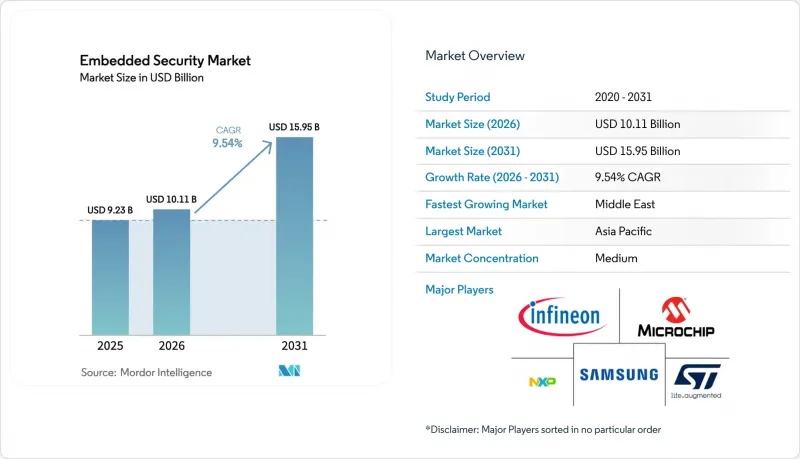
Mordor Intelligence에 의하면, 임베디드 보안 시장 규모는 2025년 92억 3,000만 달러, 2026년 101억 1,000만 달러에서 2031년까지 159억 5,000만 달러로 확대한다고 예측되고 있어 2026년부터 2031년까지 연평균 복합 성장률(CAGR)은 9.54%를 나타낼 전망입니다.
본 보고서는 구성 요소 유형(하드웨어, 소프트웨어, 서비스), 용도(결제, 인증, 컨텐츠 보호 등), 최종 사용자 산업(자동차, 의료, 소비자 가전, 통신, 항공우주 및 방위 등), 도입 형태(On-Premise, 클라우드), 지역(북미, 유럽 등)별로 분류되어 있습니다. 시장 전망은 금액(달러) 기준으로 제시되어 있습니다.
세계 임베디드 보안 시장 동향 및 인사이트
자동차용 ECU의 급속한 전동화와 ADAS 보급
배터리식 전기차 플랫폼에는 최대 100개의 전자 제어 장치(ECU)가 탑재되어 있으며, 각 장치는 보안 부팅, 암호화된 펌웨어 업데이트 및 인증된 무선(OTA) 패치 지원을 필수로 하고 있습니다. Tier 1 공급업체들이 배터리 관리 및 존형 아키텍처에 AURIX TC4x 디바이스를 통합함에 따라, 인피니언은 자동차용 보안 컨트롤러 매출이 연평균 18% 성장하고 있음을 확인했습니다. 테슬라의 ‘Hardware 4’와 같은 중앙 집중식 컴퓨팅 설계는 암호화 처리 워크로드를 통합하여 차량 1대당 반도체의 부가가치를 높이고 있습니다. 첨단 운전자 보조 시스템(ADAS) 센서는 이더넷 백본을 통해 안전에 중요한 데이터를 교환하기 때문에 각 OEM 업체들은 침입 감지 펌웨어가 탑재된 보안 게이트웨이를 도입하고 있습니다. 스텔란티스와 ST마이크로일렉트로닉스는 전용 보안 요소를 통합한 V2G(차량에서 전력망으로) 모듈을 공동 개발하고 있으며, 이는 양방향 충전이 차량 내부를 넘어 보안 범위를 확대하고 있음을 보여줍니다.
EMVCo의 카드 및 POS 단말기용 비접촉 결제 요건
EMVCo의 ‘Contactless Kernel 3.0’에서는 2025년 1월 이후 출하되는 새로운 결제 단말기에 대해 릴레이 공격 완화 조치와 생체 인증 구현이 의무화되어 있으며, NFC 컨트롤러를 탑재한 듀얼 인터페이스 보안 엘리먼트의 채택이 요구되고 있습니다. 마스터카드에 따르면, 비접촉식 결제의 보급률은 유럽에서 78%, 아시아태평양에서 65%인 반면, 북미는 42%에 그치고 있어 하드웨어 업데이트가 시급한 상황입니다. PCI PTS 7.0은 동시에 물리적 변조에 관한 규제를 강화하고 있어, 단말기 공급업체들은 범용 프로세서에서 인증된 보안 칩으로의 전환을 요구받고 있습니다. NXP는 인도의 RuPay 카드 도입과 브라질의 Pix 확대에 따라 보안 결제용 IC 매출이 전 분기 대비 12% 증가했습니다. 임베디드 보안 요소는 eSIM 지원 스마트폰에서 토큰화된 지갑의 기반이 되기도 하며, 이 부문의 출하량은 2024년에 12억 대에 달했습니다.
비용에 민감한 IoT 분야에서 범용 마이크로컨트롤러와의 높은 평균 판매 가격(ASP) 격차
보안 MCU의 가격이 1.50-3달러인 반면, 범용 부품은 0.30-0.50달러로, 이러한 가격 차이가 소비자용 IoT의 매출 총이익률을 압박하고 있습니다. Arm TrustZone이 통합된 STM32L5 및 STM32U5 디바이스를 사용할 수 있음에도 불구하고, 스마트 홈 액세서리에서의 탑재율은 25% 미만으로 머물러 있습니다. 또한, 정지 전류가 크기 때문에 배터리 수명이 최대 30% 단축됩니다. 마이크로칩의 PIC32CM LS00(가격 0.85달러)는 이러한 격차를 좁혀주고 있지만, 그럼에도 불구하고 제품의 재인증이 필요합니다.
부문 분석
2025년에는 하드웨어 분야의 임베디드 보안 시장 규모가 총 매출의 거의 절반에 달했지만, 조직들이 12-18개월에 이르는 공통 기준(Common Criteria) 평가에 직면함에 따라 서비스 분야의 성장이 더욱 가속화되고 있습니다. 성숙한 결제 및 SIM 부문에서는 하드웨어의 이익률이 압박을 받고 있는 반면, 양자 보안에 대응하는 보안 요소 및 TPM은 절대적인 수익을 견조하게 유지하고 있습니다. 정적 분석 도구 및 키 관리 미들웨어와 같은 소프트웨어 도구는 과거 턴키형 펌웨어에 유리했던 격차를 메워, OEM이 지적 재산을 유지할 수 있도록 하고 있습니다.
서비스의 성장은 사이드 채널 전문가 및 공인 평가자의 부족을 반영하고 있으며, 컨설팅 일당을 2,000달러 이상으로 끌어올리고 있습니다. 탈레스, 램버스, 시노프시스는 현재 라이프사이클 관리, 인증 관련 자료, 보안 감사를 정기적인 패키지에 포함시키고 있어, 실리콘 판매와 구독의 경계를 모호하게 만들고 있습니다. 플랫폼 서비스(PaaS) 제공이 성숙해짐에 따라, 임베디드 보안 시장에서는 칩, 펌웨어, 클라우드 대시보드를 단일 계약으로 묶은 하이브리드 수익 모델이 더욱 보급되고 있습니다.
결제 분야는 2025년에도 매출의 36.64%를 차지하며 임베디드 보안 시장을 계속 주도하고 있지만, 피싱 대책으로 패스키 채택이 의무화된 것을 배경으로 인증 분야는 두 자릿수 성장 궤도를 타고 있습니다. 정부와 사이버 보험사는 단일 요소 인증을 통한 로그인에 대해 점점 더 엄격한 조치를 취하고 있으며, 이에 따라 기업들은 FIDO2 하드웨어 토큰이나 기기에 연동된 키의 도입을 추진하고 있습니다. 컨텐츠 보호용 하드웨어는 스튜디오들이 신뢰 실행 환경(TEE) 내의 소프트웨어 기반 멀티 DRM으로 전환함에 따라 수요가 안정화되고 있으며, 기존 셋톱박스에 대한 수요는 감소하고 있습니다.
인증 시장의 성장은 관리 콘솔에 패스키 사용을 의무화하는 클라우드 제공업체와, 전자 건강 기록에 대한 다중 요소 인증 접근을 요구하는 의료 개혁에 의해 더욱 가속화되고 있습니다. 이러한 변화는 기존 키와 격자 기반 키를 모두 저장할 수 있는 하드웨어와의 시너지 효과를 창출하여, 미래를 내다보는 투자의 가치를 높이고 있습니다. 그 결과, 인증과 관련된 임베디드 보안 시장 규모는 특히 비접촉식 결제의 보급이 더딘 지역에서 향후 10년 말까지 결제 시장과의 격차를 좁힐 것으로 전망됩니다.
지역별 분석
2025년, 아시아태평양은 임베디드 보안 시장 매출의 40.42%를 차지했습니다. 대만과 한국은 최첨단 보안 요소용 웨이퍼를 공급하는 한편, 중국의 ‘다단계 보호 체계(MLPS)’에 따라 국내 암호화 기술 IP의 사용이 의무화되어 현지 수요를 끌어올리고 있습니다. 시장 규모는 크지만, 스마트폰과 결제 카드의 보급이 성숙 단계에 접어들면서 추가적인 판매량 증가세가 둔화되어 이 지역의 성장은 완만해지고 있습니다.
중동은 연평균 성장률(CAGR) 11.52%로 가장 빠르게 성장하는 지역이며, 그 원동력은 5억 달러를 초과하는 사우디아라비아의 NEOM 스마트시티 계약과 중요 인프라에 하드웨어 암호화를 의무화하는 UAE의 사이버 보안 법규입니다. 프로젝트는 스마트 그리드, 자율주행 교통, 국민 ID 시스템 등에 이르기까지 다양하며, 산업용, 소비자용, 공공용 기기를 아우르는 보안 요소(secure element)에 대한 수요 창출로 이어지고 있습니다.
북미와 유럽은 합쳐서 매출의 약 45%를 차지하고 있습니다. 두 지역 모두 자동차 및 결제 생태계가 성숙해짐에 따라 성장은 둔화되고 있지만, 포스트 양자 기술의 시범 프로젝트와 산업용 IoT 개조에서 주도적인 역할을 수행하고 있습니다. 유럽의 ‘사이버 복원력 법’은 보안 요소의 탑재를 의무화하고 있지만, 공급이 아시아의 파브에 의존하고 있어 지정학적 위험에 노출되어 있습니다. 미국에서는 국방 규제로 인해 조달처가 DMEA(미국 국방부)가 신뢰하는 파운드리로 제한되어 있어 공급이 부족하지만, 출처의 투명성은 확보되어 있습니다. 남미와 아프리카는 여전히 초기 단계 시장입니다. 브라질의 ‘Pix’ 결제나 나이지리아의 CBDC ‘eNaira’에는 국지적인 기회가 있지만, 세계 순위를 바꿀 정도의 규모에는 미치지 못하고 있습니다.
기타 혜택:
- 엑셀 형식 시장 예측(ME) 시트
- 3개월간의 애널리스트 지원
자주 묻는 질문
목차
제1장 서론
제2장 조사 방법
제3장 주요 요약
제4장 시장 구도
제5장 시장 규모와 성장 예측
제6장 경쟁 구도
제7장 시장 기회와 향후 전망
JHS 26.09.11According to Mordor Intelligence, the embedded security market size is projected to expand from USD 9.23 billion in 2025 and USD 10.11 billion in 2026 to USD 15.95 billion by 2031, registering a CAGR of 9.54% between 2026 to 2031.
This report is Segmented by Component Type (Hardware, Software, and Services), Application (Payment, Authentication, Content Protection, and More), End-User Industry (Automotive, Healthcare, Consumer Electronics, Telecommunications, Aerospace and Defense, and More), Deployment (On-Premises, and Cloud), and Geography (North America, Europe, and More). The Market Forecasts are Provided in Terms of Value (USD).
Global Embedded Security Market Trends and Insights
Rapid Electrification And ADAS Adoption In Automotive ECUs
Battery-electric platforms integrate up to 100 electronic control units, each obligated to support secure boot, encrypted firmware updates, and authenticated over-the-air patches. Infineon confirmed 18% annual growth in automotive security-controller revenue as Tier-1 suppliers embed AURIX TC4x devices in battery-management and zonal architectures. Centralized compute designs such as Tesla's Hardware 4 concentrate cryptographic workloads, lifting per-vehicle silicon value. Advanced driver-assistance sensors exchange safety-critical data over Ethernet backbones, so OEMs insert secure gateways with intrusion-detection firmware. Stellantis and STMicroelectronics are co-developing vehicle-to-grid modules that embed dedicated secure elements, signaling how bidirectional charging extends security beyond the cabin.
EMVCo Contactless Payment Mandates For Cards And POS Terminals
EMVCo's Contactless Kernel 3.0 forces new payment terminals shipped after January 2025 to implement relay-attack mitigation and biometric verification, compelling dual-interface secure elements with NFC controllers. Mastercard reported 78% contactless penetration in Europe and 65% in Asia Pacific, leaving North America at 42% and primed for hardware refresh. PCI PTS 7.0 simultaneously tightens physical-tamper rules, pushing terminal vendors from generic processors toward certified secure chips. NXP saw a 12% sequential lift in secure-payment IC revenue on India's RuPay card roll-out and Brazil's Pix expansion. Embedded secure elements also power tokenized wallets in eSIM-enabled smartphones, a segment that shipped 1.2 billion units in 2024.
High ASP Gap Versus Commodity Microcontrollers In Cost-Sensitive IoT
Secure MCUs cost USD 1.50-3.00 compared with USD 0.30-0.50 generic parts, a premium that squeezes consumer-IoT gross margins. Attach rates stay below 25% in smart-home accessories despite available STM32L5 and STM32U5 devices that integrate Arm TrustZone. Higher quiescent current also shortens battery life by up to 30%. Microchip's PIC32CM LS00, priced at USD 0.85, narrows the gap but still forces product re-certification.
Other drivers and restraints analyzed in the detailed report include:
- Expanding IoT Edge Nodes In Smart-Home And Industrial Settings
- Post-Quantum-Crypto Migration Roadmaps For Long-Life Controllers
- Fragmented Standards Across Verticals
For complete list of drivers and restraints, kindly check the Table Of Contents.
Segment Analysis
The embedded security market size for hardware reached nearly half of total revenue in 2025, yet services are rising faster as organizations confront 12- to 18-month Common Criteria evaluations. Hardware margins compress in mature payment and SIM segments, while post-quantum-ready secure elements and TPMs keep absolute revenue solid. Software tools, such as static analyzers and key-management middleware, close gaps that once favored turnkey firmware and empower OEMs to retain intellectual property.
Services growth reflects a scarcity of side-channel experts and certified evaluators, driving consulting day rates above USD 2,000. Thales, Rambus, and Synopsys now wrap lifecycle management, certification artifacts, and security audits into recurring packages, blurring the line between silicon sale and subscription. As platform-as-a-service offerings mature, the embedded security market welcomes more hybrid revenue models that bundle chips, firmware, and cloud dashboards in a single contract.
Payment still leads the embedded security market with a 36.64% slice of revenue in 2025, but authentication posts a double-digit growth trajectory supported by phishing-resistant passkey mandates. Governments and cyber-insurers increasingly penalize single-factor logins, prompting enterprises to adopt FIDO2 hardware tokens and device-bound keys. Content-protection hardware stabilizes as studios pivot to software-based multi-DRM inside trusted execution environments, trimming demand for legacy set-top boxes.
Authentication's ascent is amplified by cloud providers that require passkeys for administrative consoles and by healthcare reforms that call for multi-factor access to electronic health records. The shift aligns with hardware that can store both classical and lattice-based keys, future-proofing investment. As a result, the embedded security market size tied to authentication is set to narrow the gap with payment by the end of the decade, particularly in regions that lag in contactless penetration.
Complete Report Scope:
- By Component Type
- Hardware
- Software
- Services
- By Application
- Payment
- Authentication
- Content Protection
- Other Applications
- By End-User Industry
- Automotive
- Healthcare
- Consumer Electronics
- Telecommunications
- Aerospace and Defense
- Other End-User Industries
- By Deployment
- On-Premise
- Cloud
- By Geography
- North America
- United States
- Canada
- Mexico
- South America
- Brazil
- Argentina
- Rest of South America
- Europe
- Germany
- United Kingdom
- France
- Italy
- Spain
- Russia
- Rest of Europe
- Asia Pacific
- China
- Japan
- India
- South Korea
- Australia
- Rest of Asia Pacific
- Middle East
- Saudi Arabia
- United Arab Emirates
- Turkey
- Rest of Middle East
- Africa
- Nigeria
- Egypt
- Rest of Africa
- North America
Geography Analysis
Asia Pacific controlled 40.42% of embedded security market revenue in 2025. Taiwan and South Korea supply leading-edge secure-element wafers, while China's Multi-Level Protection Scheme forces domestic cryptographic IP, lifting local demand. Despite its size, the region's growth moderates as mature smartphone and payment-card penetration reduces incremental volume.
The Middle East is the fastest-growing geography at 11.52% CAGR, fueled by Saudi Arabia's NEOM smart-city contracts exceeding USD 500 million and the UAE Cybersecurity Decree that mandates hardware encryption for critical infrastructure. Projects span smart grids, autonomous transit, and national identity layers, creating a pipeline for secure elements across industrial, consumer, and civic devices.
North America and Europe jointly contribute roughly 45% of revenue. Both regions face slower growth due to mature automotive and payment ecosystems, but they lead post-quantum pilots and industrial-IoT retrofits. Europe's Cyber Resilience Act forces secure-element integration yet depends on Asian fabs for supply, exposing geopolitical risk. In the United States, defense restrictions confine sourcing to DMEA-trusted foundries, tightening supply but ensuring provenance. South America and Africa remain early-stage markets; Brazil's Pix payment and Nigeria's eNaira CBDC offer pockets of opportunity yet lack scale to shift global rankings.
- Infineon Technologies AG
- NXP Semiconductors NV
- STMicroelectronics NV
- Microchip Technology Inc.
- Samsung Electronics Co.
- Texas Instruments Inc.
- Renesas Electronics Corp.
- Qualcomm Inc.
- Broadcom Inc.
- Lattice Semiconductor Corp.
- Synopsys Inc.
- Arm Ltd.
- Rambus Inc.
- Verimatrix SA
- Thales Group
- G+D Mobile Security GmbH
- Idemia Group
- Karamba Security Ltd.
- Trillium Secure Inc.
- ESCRYPT GmbH
- Sectigo Ltd.
- Mocana Corp.
- Intellias Ltd.
- Winbond Electronics Corp.
- Nuvoton Technology Corp.
- IAR Systems AB
- Secure-IC SA
- PQShield Ltd.
Additional Benefits:
- The market estimate (ME) sheet in Excel format
- 3 months of analyst support
TABLE OF CONTENTS
1 INTRODUCTION
- 1.1 Study Assumptions and Market Definition
- 1.2 Scope of the Study
2 RESEARCH METHODOLOGY
3 EXECUTIVE SUMMARY
4 MARKET LANDSCAPE
- 4.1 Market Overview
- 4.2 Market Drivers
- 4.2.1 Rapid Electrification and ADAS Adoption in Automotive ECUs
- 4.2.2 EMVCo Contactless Payment Mandates for Cards and POS Terminals
- 4.2.3 Expanding IoT Edge Nodes in Smart-Home and Industrial Settings
- 4.2.4 Post-Quantum-Crypto Migration Roadmaps for Long-Life Controllers
- 4.2.5 EU Cyber-Resilience Act Requiring Hardware Roots of Trust
- 4.2.6 Digital Battery Passports Creating Secure-Element Demand
- 4.3 Market Restraints
- 4.3.1 High ASP Gap Versus Commodity Microcontrollers in Cost-Sensitive IoT
- 4.3.2 Fragmented Standards Across Verticals (GlobalPlatform vs. TCG)
- 4.3.3 Supply-Chain "Ghost-Foundry" Risk Limiting Qualified Sources
- 4.3.4 Shortage of Secure-Element Firmware Verification Skill Sets
- 4.4 Industry Value Chain Analysis
- 4.5 Regulatory Landscape
- 4.6 Technological Outlook
- 4.7 Porter's Five Forces Analysis
- 4.7.1 Threat of New Entrants
- 4.7.2 Bargaining Power of Buyers
- 4.7.3 Bargaining Power of Suppliers
- 4.7.4 Threat of Substitutes
- 4.7.5 Intensity of Competitive Rivalry
- 4.8 Impact of Macroeconomic Factors on the Market
- 4.9 Key Performance Indicators
5 MARKET SIZE AND GROWTH FORECASTS (VALUE)
- 5.1 By Component Type
- 5.1.1 Hardware
- 5.1.2 Software
- 5.1.3 Services
- 5.2 By Application
- 5.2.1 Payment
- 5.2.2 Authentication
- 5.2.3 Content Protection
- 5.2.4 Other Applications
- 5.3 By End-User Industry
- 5.3.1 Automotive
- 5.3.2 Healthcare
- 5.3.3 Consumer Electronics
- 5.3.4 Telecommunications
- 5.3.5 Aerospace and Defense
- 5.3.6 Other End-User Industries
- 5.4 By Deployment
- 5.4.1 On-Premise
- 5.4.2 Cloud
- 5.5 By Geography
- 5.5.1 North America
- 5.5.1.1 United States
- 5.5.1.2 Canada
- 5.5.1.3 Mexico
- 5.5.2 South America
- 5.5.2.1 Brazil
- 5.5.2.2 Argentina
- 5.5.2.3 Rest of South America
- 5.5.3 Europe
- 5.5.3.1 Germany
- 5.5.3.2 United Kingdom
- 5.5.3.3 France
- 5.5.3.4 Italy
- 5.5.3.5 Spain
- 5.5.3.6 Russia
- 5.5.3.7 Rest of Europe
- 5.5.4 Asia Pacific
- 5.5.4.1 China
- 5.5.4.2 Japan
- 5.5.4.3 India
- 5.5.4.4 South Korea
- 5.5.4.5 Australia
- 5.5.4.6 Rest of Asia Pacific
- 5.5.5 Middle East
- 5.5.5.1 Saudi Arabia
- 5.5.5.2 United Arab Emirates
- 5.5.5.3 Turkey
- 5.5.5.4 Rest of Middle East
- 5.5.6 Africa
- 5.5.6.1 Nigeria
- 5.5.6.2 Egypt
- 5.5.6.3 Rest of Africa
- 5.5.1 North America
6 COMPETITIVE LANDSCAPE
- 6.1 Market Concentration
- 6.2 Strategic Moves
- 6.3 Market Share Analysis
- 6.4 Company Profiles (includes Global Level Overview, Market Level Overview, Core Segments, Financials as Available, Strategic Information, Market Rank/Share for Key Companies, Products and Services, and Recent Developments)
- 6.4.1 Infineon Technologies AG
- 6.4.2 NXP Semiconductors NV
- 6.4.3 STMicroelectronics NV
- 6.4.4 Microchip Technology Inc.
- 6.4.5 Samsung Electronics Co.
- 6.4.6 Texas Instruments Inc.
- 6.4.7 Renesas Electronics Corp.
- 6.4.8 Qualcomm Inc.
- 6.4.9 Broadcom Inc.
- 6.4.10 Lattice Semiconductor Corp.
- 6.4.11 Synopsys Inc.
- 6.4.12 Arm Ltd.
- 6.4.13 Rambus Inc.
- 6.4.14 Verimatrix SA
- 6.4.15 Thales Group
- 6.4.16 G+D Mobile Security GmbH
- 6.4.17 Idemia Group
- 6.4.18 Karamba Security Ltd.
- 6.4.19 Trillium Secure Inc.
- 6.4.20 ESCRYPT GmbH
- 6.4.21 Sectigo Ltd.
- 6.4.22 Mocana Corp.
- 6.4.23 Intellias Ltd.
- 6.4.24 Winbond Electronics Corp.
- 6.4.25 Nuvoton Technology Corp.
- 6.4.26 IAR Systems AB
- 6.4.27 Secure-IC SA
- 6.4.28 PQShield Ltd.
7 MARKET OPPORTUNITIES AND FUTURE OUTLOOK
- 7.1 White-Space and Unmet-Need Assessment


