

|
시장보고서
상품코드
2118878
유럽의 5G 기기 : 시장 점유율 분석, 업계 동향 및 통계, 성장 예측(2026-2031년)Europe 5G Device - Market Share Analysis, Industry Trends & Statistics, Growth Forecasts (2026 - 2031) |
||||||
 Mordor Intelligence
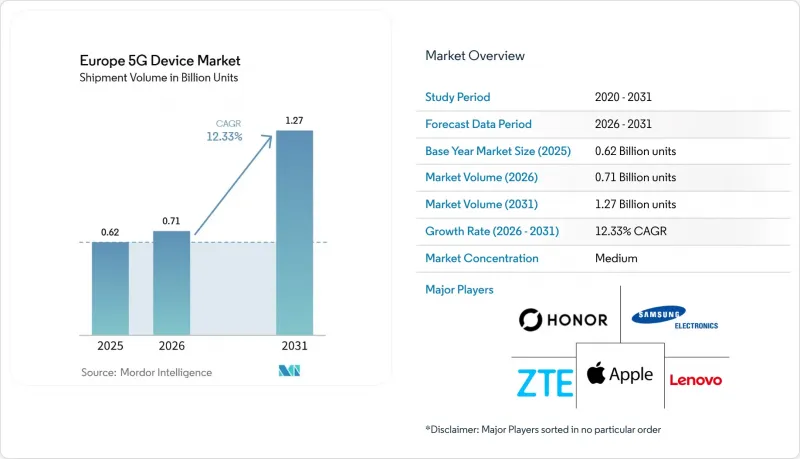
Mordor Intelligence에 의하면, 유럽의 5G 기기 시장 규모(출하대수 기반)는 2025년에 6억 2,000만 대로 평가되었습니다. 2026년 7억 1,000만 대로부터 2031년까지 12억 7,000만 대에 이를 것으로 추정되고 있습니다.
예측 기간(2026-2031년) 동안 연평균 성장률(CAGR)은 12.33%를 나타낼 것으로 전망됩니다.
본 보고서는 폼 팩터(스마트폰, 고객 구내 장비(실내/실외), 기타), 지원 주파수 대역(Sub-6GHz, mm파, 하이브리드(Sub-6GHz 및 mm파)), 최종 사용자 산업(소비자용 전자기기, 산업 및 제조, 기타),용도(고속 대용량 통신(eMBB), 기타), 국가별로 분류되어 있습니다. 시장 예측은 출하 대수(단위) 기준으로 제시되어 있습니다.
유럽의 5G 기기 시장 동향 및 인사이트
5G 독립형(SA) 방식의 전개로 인해 대상 단말기의 업그레이드 주기가 확대
SA(Standalone)형 5G로의 전환은 유럽의 5G 기기 시장의 주요 촉진요인으로 작용하고 있습니다. SA형 네트워크에서는 VoNR(Voice over New Radio), 네트워크 슬라이싱 및 지연 시간 개선에 대응하기 위해 호환 가능한 단말기 및 고객 가정 내 장비가 필요합니다. 2025년 하반기 독립형 네트워크 이용 시간 기준, Movistar는 유럽 통신 사업자 중 3위를 차지했으며, 가입자의 5G 이용 시간 중 35.4%가 독립형 연결로 기록되었습니다. 2026년 4월 기준, 유럽의 5G 연결 중 독립형 아키텍처를 채택한 비율은 2.8%에 불과하여 북미의 32%와 대조를 이뤘습니다. 디지털 네트워크법(Digital Networks Act)은 보다 일관된 주파수 대역 라이선싱을 목표로 하고 있으며, 이를 통해 비독립형 단말기의 도입 확대 및 교체가 촉진될 가능성이 있습니다. 또한, 독립형 아키텍처의 커버리지 범위가 확대됨에 따라 배터리 성능 저하도 소비자가 구형 단말기를 교체하는 직접적인 이유가 될 것입니다.
고정 무선 접속(FWA) 수요가 통신망 사각지대에서 광섬유를 대체하고 있습니다.
고정 무선 접속(FWA)은 스마트폰 교체 주기와는 별개 수요를 창출하고 있습니다. OECD 회원국 전체의 FWA 가입자 수는 2023년 6월부터 2024년 6월까지 17% 증가했으나, 영국에서는 30.4%의 성장률을 기록했습니다. 유럽에서는 EU 회원국 전체에서 108개의 5G FWA 네트워크가 상용화되었습니다. 가입자가 1명 늘어날 때마다 실내 또는 실외용 고객 단말 장비(CPE)가 최소 1대씩 필요합니다. ‘디지털 데케이드(Digital Decade)’ 목표에 따르면, 2030년까지 모든 가구에 최소 1Gbps의 통신 서비스를 제공하는 수단으로 FWA가 자리 잡고 있습니다. 또한, 무선 기기 및 EN 18031 사이버 보안 규정에 따라 2025년 8월 이전에 제조된 기기는 신규 조달에 적합하지 않게 되었습니다.
RF 프런트엔드 부품공급 부족이 프리미엄 및 mmWave 기기공급을 제약
고급 독립형(stand-alone) 방식 및 mm파(mmWave) 설계는 벌크 음향파(BAW) 및 표면 탄성파(SAW) 필터를 포함한 RF 프런트엔드 부품에 의존하고 있습니다. 이러한 첨단 필터공급 기반은 퀄컴, 브로드컴, 무라타 제작소, 스카이웍스에 집중되어 있습니다. 이로 인해 유럽의 조립 제조업체들은 역외에서 내려지는 할당 결정의 영향을 받기 쉬워졌습니다. 갈륨 공급 규제 및 특수 실리콘-게르마늄-비스무트(SiGeBi) CMOS의 생산 능력은 파워 앰프, 트랜시버, 저잡음 증폭기에 위험을 초래합니다. 공급 부족이 발생하면 플래그십 디바이스의 출시가 지연될 뿐만 아니라, 행사장, 캠퍼스, FWA용 공급이 제한될 가능성이 있습니다. 이러한 위험은 고성능, 프리미엄 및 엔터프라이즈용 무선 구성에서 특히 심각합니다.
부문별 분석
2025년, 스마트폰은 유럽의 5G 기기 시장 점유율의 66.51%를 차지하며 유럽 모바일 사용자에게 있어 주요 연결 단말기로 자리매김했습니다. 이러한 위상은 방대한 가입자 기반과 모바일 데이터 서비스의 광범위한 이용을 반영합니다. 통신 사업자의 번들 요금제 덕분에 더 많은 구매자가 프리미엄 5G 모델로 유입되고 있습니다. 또한 이를 통해 통신 사업자는 서비스 계약 기간 동안 가입자에게 독립형(SA) 지원 단말기를 제공할 수 있는 방안도 확보하게 되었습니다. Samsung Electronics는 2026년 3월 11일, 갤럭시 S26 시리즈를 전 세계에 출시했습니다. 갤럭시 S26 울트라는 사전 예약의 70% 이상을 차지했습니다. 통신 사업자들이 FWA를 지방으로 확대함에 따라, 고객 가정 내 장비의 중요성이 높아지고 있습니다.
웨어러블 단말기 및 XR 기기 시장은 2026년부터 2031년까지 연평균 성장률(CAGR) 13.88%로 확대될 것으로 예측됩니다. 도이치 텔레콤(Deutsche Telekom)은 애플 워치 시리즈 11, 애플 워치 울트라 3, 애플 워치 SE 3를 대상으로 독일 내에서 상용 RedCap 서비스를 시작했습니다. GSA는 2025년 9월, 전 세계적으로 6종의 RedCap 칩셋, 17종의 모듈, 7종의 상용 최종 사용자용 기기를 선정했습니다. 화웨이, 노키아, 삼성, TCL, ZTE는 RedCap 지원을 확대되고 있습니다. 이 기술을 통해 웨어러블 기기는 LTE-M과 풀 5G NR 사이의 중간적인 연결 옵션을 확보할 수 있습니다. 산업용 라우터, 자동차용 텔레매틱스 모듈, 5G 지원 노트북, 태블릿, 핫스팟은 별도의 유통 경로를 통해 조달됩니다. 이러한 수요는 스마트폰 수요에 비해 소비자의 교체 주기에 덜 영향을 받는 경향이 있습니다.
2025년에는 Sub-6GHz 기기가 출하 대수 점유율의 63.10%를 차지했습니다. 이 부문은 유럽 시장 전반에 걸친 3.5GHz 대역의 광범위한 커버리지 혜택을 받고 있습니다. 이 주파수 대역은 스마트폰과 FWA(고정 무선 접속) 서비스를 모두 지원합니다. 도이체 텔레콤(Deutsche Telekom)은 독일 국내에서 96,500개 이상의 5G 안테나를 운영하며 인구의 98%를 커버하고 있습니다. 이 회사의 네트워크는 신규 사용자에게 Sub-6GHz가 표준적인 선택지가 되는 이유를 보여줍니다. EN 18031 사이버 보안 요구 사항에 따라 인터넷 연결형 무선 기기의 설계 검토 및 시험 작업이 추가되었습니다. 대량 생산되는 Sub-6GHz 제품 라인은 전용 제품보다 이러한 요구 사항을 충족하기가 더 쉽습니다.
밀리파(mmWave) 기기는 2031년까지 연평균 성장률(CAGR) 14.24%로 확대될 것으로 예측됩니다. 수요는 도시 지역 시설, 경기장, 기업 캠퍼스 및 고정 무선 백홀에서 발생하고 있습니다. 유럽의 주요 시장에서는 기가비트급 서비스를 위해 400 MHz의 주파수 블록을 제공하는 26GHz 대역의 면허가 취득되었습니다. 이를 통해 통신 사업자들은 밀리파를 지원하는 고객 단말기 및 스몰 셀 장치를 도입할 수 있는 기반이 마련되었습니다. 하이브리드 단말기는 Sub-6GHz 대역과 mm파 대역 모두에서 작동합니다. 향후 네트워크 고밀도화에 대응할 수 있어, 하이엔드 스마트폰이나 기업용 라우터에 채택이 확대되고 있습니다. 또한, 3GPP 릴리스 17 및 18의 RedCap은 고효율 산업용 센서, 웨어러블 단말기, 감시 카메라에도 대응하고 있습니다. 밀리파 대역은 여전히 고밀도 지역에 중점을 두고 있지만, 이러한 단말기들을 통해 대상 시장 기반이 확대되고 있습니다.
기타 혜택 :
- 엑셀 형식 시장 예측(ME) 시트
- 3개월간의 애널리스트 지원
자주 묻는 질문
목차
제1장 서론
제2장 조사 방법
제3장 주요 요약
제4장 시장 구도
제5장 시장 규모 및 성장 예측
제6장 경쟁 구도
제7장 시장 기회 및 향후 전망
KTH 26.09.04According to Mordor Intelligence, the Europe 5G device market size in terms of shipment volume was valued at 0.62 billion units in 2025 and is estimated to grow from 0.71 billion units in 2026 to reach 1.27 billion units by 2031, at a CAGR of 12.33% during the forecast period (2026-2031).
This report is Segmented by Form Factor (Smartphones, Customer-Premises Equipment (Indoor/Outdoor), and More), Spectrum Support (Sub-6 GHz, Mmwave, and Hybrid (Sub-6 GHz and MmWave)), End User Industry (Consumer Electronics, Industrial and Manufacturing, and More), Application (Enhanced Mobile Broadband (eMBB), and More), and Country. The Market Forecasts are Provided in Terms of Volume (Units).
Europe 5G Device Market Trends and Insights
5G Standalone Rollout Expands the Addressable Device Upgrade Cycle
The move to standalone 5G is a key driver of the Europe 5G device market. Standalone networks require compatible handsets and customer premises equipment for Voice over New Radio, network slicing, and improved latency. Movistar ranked third among European operators for standalone time on network in late 2025, with subscribers spending 35.4% of their 5G time on standalone connections. Only 2.8% of European 5G connections used a standalone architecture in April 2026, compared with 32% in North America. The Digital Networks Act seeks more consistent spectrum licensing, which could support wider launches and replacements of non-standalone devices. Battery performance can also give consumers a direct reason to replace older devices as standalone coverage expands.
Fixed Wireless Access Demand Replaces Fiber in Coverage Gaps
Fixed wireless access creates demand that is separate from the smartphone replacement cycle. FWA subscriptions across OECD members increased 17% from June 2023 to June 2024, while the UK recorded 30.4% growth. Europe had 108 commercially launched 5G FWA networks across EU member states. Every added subscriber requires at least 1 indoor or outdoor customer premises equipment unit. The Digital Decade objective recognizes FWA as a way to provide every household with at least 1 Gbps by 2030. Radio equipment and EN 18031 cybersecurity rules also make pre-August 2025 equipment less suitable for new procurement.
RF Front End Component Shortages Constrain Premium and mmWave Device Supply
Advanced standalone and mmWave designs rely on RF front-end components, including bulk-acoustic-wave and surface-acoustic-wave filters. The advanced filter supply base is concentrated among Qualcomm, Broadcom, Murata, and Skyworks. This exposes European assemblers to allocation decisions made outside the region. Gallium controls and specialized silicon-germanium bismuth complementary metal-oxide-semiconductor capacity add risk for power amplifiers, transceivers, and low-noise amplifiers. A shortage can delay flagship devices and restrict availability for venues, campuses, and FWA. The risk is most acute in high-performance, premium, and enterprise radio configurations.
Other drivers and restraints analyzed in the detailed report include:
- Private 5G Campus Networks Pull Enterprise Grade Devices into Commercial Procurement
- Operator Subsidies and Bundled Device Plans Accelerate Premium Smartphone Penetration
- Operator Certification and Field Testing Bottlenecks Delay Time To Market
For complete list of drivers and restraints, kindly check the Table Of Contents.
Segment Analysis
Smartphones held 66.51% of Europe's 5G device market share in 2025 and remained the primary connectivity endpoint for European mobile users. Their position reflects large subscriber bases and widespread use of mobile data services. Operator bundles are directing more buyers toward premium 5G models. They also give operators a way to place standalone-capable devices with subscribers over the life of a service contract. Samsung made the Galaxy S26 series available worldwide on March 11, 2026. The Galaxy S26 Ultra accounted for more than 70% of pre-orders. Customer premises equipment is becoming more important as operators extend FWA into rural areas.
Wearables and XR devices are projected to grow at a 13.88% CAGR from 2026 to 2031. Deutsche Telekom launched commercial RedCap services in Germany for Apple Watch Series 11, Apple Watch Ultra 3, and Apple Watch SE 3. GSA identified 6 RedCap chipsets, 17 modules, and 7 commercial end-user devices globally in September 2025. Huawei, Nokia, Samsung, TCL, and ZTE were expanding RedCap support. This technology gives wearables a connection option between LTE-M and full 5G NR. Industrial routers, automotive telematics modules, 5G laptops, tablets, and hotspots are procured through separate channels. Their demand is less exposed to consumer replacement intervals than smartphone demand.
Sub-6 GHz devices accounted for 63.10% of the volume share in 2025. The segment benefits from broad 3.5 GHz coverage across European markets. This spectrum supports both smartphones and FWA services. Deutsche Telekom operated more than 96,500 5G antennas in Germany, covering 98% of the population. Its network shows why sub-6 GHz is the standard choice for new users. EN 18031 cybersecurity requirements have added design review and testing work for internet-connected radio devices. High-volume sub-6 GHz lines can absorb these requirements more easily than specialized products.
mmWave devices are projected to expand at a 14.24% CAGR through 2031. Demand comes from urban venues, stadiums, enterprise campuses, and fixed wireless backhaul. Major European markets have 26 GHz licenses that provide 400 MHz blocks for gigabit-class services. This provides operators with a foundation for mmWave customer-premises equipment and small-cell devices. Hybrid devices support both sub-6 GHz and mmWave operation. They are gaining use in premium smartphones and enterprise routers because they can support future densification. RedCap in 3GPP Releases 17 and 18 also supports efficient industrial sensors, wearables, and surveillance cameras. These devices widen the addressable base even though mmWave remains focused on dense locations.
Complete Report Scope:
- By Form Factor
- Smartphones
- Customer-Premises Equipment (Indoor/Outdoor)
- Industrial Grade Routers/Gateways
- Modules
- Laptops/Tablets
- Hotspots
- Wearables and XR Devices
- By Spectrum Support
- Sub-6 GHz
- mmWave
- Hybrid (Sub-6 GHz and mmWave)
- By End-User Industry
- Consumer Electronics
- Industrial and Manufacturing
- Automotive and Transportation
- Healthcare
- Energy and Utilities
- Enterprise/Commercial
- By Application
- Enhanced Mobile Broadband (eMBB)
- Ultra-Reliable Low-Latency Comms (URLLC)
- Massive Machine-Type Comms (mMTC)
- Fixed Wireless Access
- Vehicle-to-Everything (V2X)
- By Country
- Germany
- United Kingdom
- France
- Italy
- Spain
- Russia
- Rest of Europe
List of Companies Covered in this Report:
- Apple Inc.
- Samsung Electronics Co., Ltd.
- Xiaomi Corporation
- Huawei Technologies Co., Ltd.
- Oppo Mobile Telecommunications Corp. Ltd.
- OnePlus Technology Co. Ltd.
- Google LLC
- Sony Group Corporation
- Motorola Mobility LLC
- HMD Global Oy
- Lenovo Group Ltd.
- HONOR Device Co., Ltd.
- ZTE Corporation
- Cisco Systems, Inc.
- Qualcomm Incorporated
- MediaTek Inc.
- Fibocom Wireless Inc.
- Telit Cinterion S.p.A.
- u-blox Holding AG
- Sierra Wireless, Inc.
Additional Benefits:
- The market estimate (ME) sheet in Excel format
- 3 months of analyst support
TABLE OF CONTENTS
1 INTRODUCTION
- 1.1 Study Assumptions and Market Definition
- 1.2 Scope of the Study
2 RESEARCH METHODOLOGY
3 EXECUTIVE SUMMARY
4 MARKET LANDSCAPE
- 4.1 Market Overview
- 4.2 Market Drivers
- 4.2.1 5G Standalone Rollout Expands the Addressable Device Upgrade Cycle
- 4.2.2 Fixed Wireless Access Demand Replaces Fiber in Coverage Gaps
- 4.2.3 Private 5G Campus Networks Pull Enterprise Grade Devices into Commercial Procurement
- 4.2.4 Operator Subsidies and Bundled Device Plans Accelerate Premium Smartphone Penetration
- 4.2.5 RedCap Enabled Wearables and Low Power Devices Open New Form Factor Demand
- 4.2.6 Cyber Resilience and Radio Equipment Compliance Forces Earlier Replacement Cycles
- 4.3 Market Restraints
- 4.3.1 RF Front End Component Shortages Constrain Premium and mmWave Device Supply
- 4.3.2 Operator Certification and Field Testing Bottlenecks Delay Time To Market
- 4.3.3 Mature Market Replacement Cycles Slow Consumer Volume Growth
- 4.3.4 Dependence on the Asia-Pacific Assembly and Chipset Supply Exposes Europe to Cost and Lead Time Risk
- 4.4 Industry Value Chain Analysis
- 4.5 Regulatory Landscape
- 4.6 Technological Outlook
- 4.7 Porter's Five Forces Analysis
- 4.7.1 Bargaining Power Of Suppliers
- 4.7.2 Bargaining Power Of Buyers
- 4.7.3 Threat Of New Entrants
- 4.7.4 Threat Of Substitutes
- 4.7.5 Intensity Of Competitive Rivalry
5 MARKET SIZE AND GROWTH FORECASTS (VOLUME)
- 5.1 By Form Factor
- 5.1.1 Smartphones
- 5.1.2 Customer-Premises Equipment (Indoor/Outdoor)
- 5.1.3 Industrial Grade Routers/Gateways
- 5.1.4 Modules
- 5.1.5 Laptops/Tablets
- 5.1.6 Hotspots
- 5.1.7 Wearables and XR Devices
- 5.2 By Spectrum Support
- 5.2.1 Sub-6 GHz
- 5.2.2 mmWave
- 5.2.3 Hybrid (Sub-6 GHz and mmWave)
- 5.3 By End-User Industry
- 5.3.1 Consumer Electronics
- 5.3.2 Industrial and Manufacturing
- 5.3.3 Automotive and Transportation
- 5.3.4 Healthcare
- 5.3.5 Energy and Utilities
- 5.3.6 Enterprise/Commercial
- 5.4 By Application
- 5.4.1 Enhanced Mobile Broadband (eMBB)
- 5.4.2 Ultra-Reliable Low-Latency Comms (URLLC)
- 5.4.3 Massive Machine-Type Comms (mMTC)
- 5.4.4 Fixed Wireless Access
- 5.4.5 Vehicle-to-Everything (V2X)
- 5.5 By Country
- 5.5.1 Germany
- 5.5.2 United Kingdom
- 5.5.3 France
- 5.5.4 Italy
- 5.5.5 Spain
- 5.5.6 Russia
- 5.5.7 Rest of Europe
6 COMPETITIVE LANDSCAPE
- 6.1 Market Concentration
- 6.2 Strategic Moves
- 6.3 Market Share Analysis
- 6.4 Company Profiles (includes Global Level Overview, Market Level Overview, Core Segments, Financials as available, Strategic Information, Market Rank/Share, Products And Services, Recent Developments)
- 6.4.1 Apple Inc.
- 6.4.2 Samsung Electronics Co., Ltd.
- 6.4.3 Xiaomi Corporation
- 6.4.4 Huawei Technologies Co., Ltd.
- 6.4.5 Oppo Mobile Telecommunications Corp. Ltd.
- 6.4.6 OnePlus Technology Co. Ltd.
- 6.4.7 Google LLC
- 6.4.8 Sony Group Corporation
- 6.4.9 Motorola Mobility LLC
- 6.4.10 HMD Global Oy
- 6.4.11 Lenovo Group Ltd.
- 6.4.12 HONOR Device Co., Ltd.
- 6.4.13 ZTE Corporation
- 6.4.14 Cisco Systems, Inc.
- 6.4.15 Qualcomm Incorporated
- 6.4.16 MediaTek Inc.
- 6.4.17 Fibocom Wireless Inc.
- 6.4.18 Telit Cinterion S.p.A.
- 6.4.19 u-blox Holding AG
- 6.4.20 Sierra Wireless, Inc.
7 MARKET OPPORTUNITIES AND FUTURE OUTLOOK
- 7.1 White-Space and Unmet-Need Assessment


