

|
시장보고서
상품코드
2118880
남미의 5G 기기 : 시장 점유율 분석, 업계 동향 및 통계, 성장 예측(2026-2031년)South America 5G Device - Market Share Analysis, Industry Trends & Statistics, Growth Forecasts (2026 - 2031) |
||||||
 Mordor Intelligence
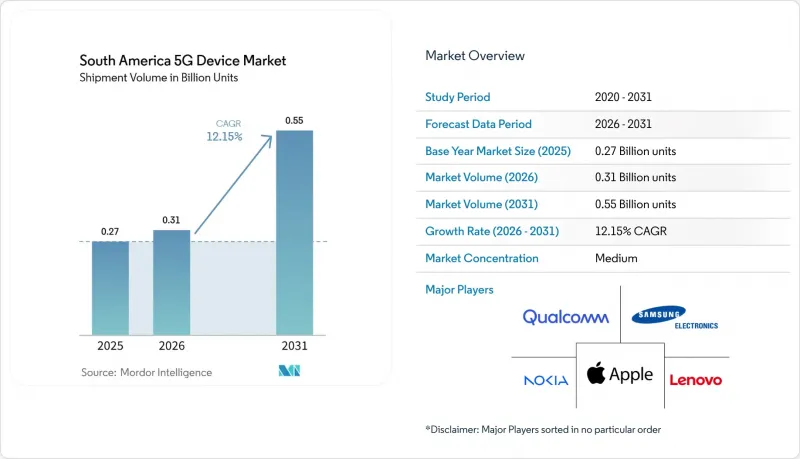
Mordor Intelligence에 의하면, 남미의 5G 기기 시장 규모(출하대수 기반)는 2025년 2억 7,000만 대로 평가되었습니다. 2026년 3억 1,000만 대로부터, 2031년까지 5억 5,000만 대로 확대되고 2026년부터 2031년에 걸쳐 CAGR 12.15%를 기록할 전망입니다.
본 보고서는 폼 팩터(스마트폰, 고객 구내 장비(실내/실외) 등), 지원 주파수 대역(Sub-6GHz, mm파 및 하이브리드(Sub-6GHz와 mm파)), 최종 사용자 산업(소비자용 전자기기, 산업 및 제조 등),용도(고속 대용량 통신(eMBB) 등), 국가별로 분류되어 있습니다. 시장 전망은 출하 대수(단위) 기준으로 제시되어 있습니다.
남미의 5G 기기 시장 동향 및 인사이트
5G 지원 스마트폰의 교체 주기 단축
5G 커버리지 범위가 확대되어 더 많은 소비자가 서비스를 이용할 수 있게 됨에 따라, 2024년 이후 스마트폰 교체 주기가 단축되고 있습니다. 브라질에서는 2025년에 1,820만 건의 5G 연결이 추가되어 총 5,810만 건에 달하며, 전년 대비 46.6%의 성장을 기록했습니다. 이러한 증가는 가입자 수 증가뿐만 아니라, 통신사의 프로모션 기간 동안 4G 단말기에서 5G 단말기로의 업그레이드가 이루어졌음을 보여줍니다. Samsung Electronics는 2025년 4월, 비보(Vivo)와 공동으로 갤럭시 A06 5G를 899 브라질 레알(157 달러)에 출시하며 5G 기기의 기준 가격을 낮췄습니다. 통신 사업자들이 단말기 업그레이드를 추진하는 가운데, 모토로라, 샤오미, 조비도 같은 중저가 시장에서 경쟁하고 있습니다. 5G 기기의 보급이 확대됨에 따라, 네트워크 사용량 증가가 추가적인 네트워크 투자와 데이터 요금제 업그레이드를 촉진할 가능성이 있습니다.
서비스 미비 지역에서의 5G 고정 무선 접속 단말기 수요 증가
광섬유 구축의 경제성과 인구 분포 사이에 발생하는 격차가 고정 무선 액세스(FWA)용 고객 구내 장비(CPE) 수요를 뒷받침하고 있습니다. 브라질 통신부는 CPQD, Qualcomm, Brisanet, Intelbras와 제휴하여 2025년 7월, 리우그란데두노르테주의 3개 농촌 지역 학교에서 5G FWA 실외용 CPE 시험을 완료했습니다. 이 시험 결과, 시험 실시 지점에서 실외용 5G CPE가 광섬유 연결과 동등한 통신 속도를 구현하는 것으로 확인되었습니다. Brisanet과 퀄컴은 2026년 3월, ‘Northeast Connected with FWA’라는 공동 프로젝트를 발표하고, 농촌 지역에 보조금을 지원받은 SDX62 기반 CPE를 공급하기로 했습니다. 또한, Claro Argentina도 2025년에 부에노스아이레스, 코르도바 및 기타 주 수도에서 상용 5G FWA 서비스 제공을 시작했습니다. 교육, 의료, 농업 비즈니스, 금융 서비스 분야에서 공공 연결성을 확보하려는 목표에 따라, 이러한 수요는 소비자의 단말기 구매 결정에 대한 의존도를 낮추고 있습니다.
5G 기기와 4G 기기의 가격 차이
5G 기기와 4G 기기의 가격 차이는 가격에 민감한 소비자층의 보급에 큰 장벽이 되고 있습니다. 브라질 규제 당국의 데이터에 따르면, 2025년 시점에서 5G 스마트폰 가격은 동급 4G 기기에 비해 40%에서 60% 더 비쌉니다. 수입 관세, 환율 변동, 브랜드 위상이 소매 가격을 상승시키는 요인으로 작용하고 있습니다. 이러한 영향이 가장 두드러지게 나타나는 계층은 해당 지역 모바일 연결의 대부분을 차지하는 선불 요금제 가입자들입니다. 통신 사업자와 제조업체는 할부 요금제, 보조금, 저가형 5G 모델 제공 등으로 대응하고 있지만, 이러한 노력은 아직 네트워크 확장을 따라잡지 못하고 있습니다. 이러한 불일치로 인해 단말기 교체 시기가 지연되고, 통신 사업자의 5G 서비스 요금제 수익 창출도 늦어지고 있습니다.
부문별 분석
2025년, 남미의 5G 기기 시장 점유율의 70.80%를 스마트폰이 차지했습니다. 이는 해당 지역의 ‘모바일 퍼스트’ 연결 기반과 구형 4G 단말기에서 신규 기기로의 교체 현상이 반영된 결과입니다. 삼성은 상파울루주 캄피나스와 아마조나스주 마나우스에서의 현지 생산을 통해 출하량을 확대했습니다. 모토로라와 샤오미는 1,000 브라질 레알(174 달러)에서 3,500 브라질 레알(609 달러) 가격대에서 경쟁을 심화시켰습니다. Jovi는 2025년 6월, Claro 및 TIM과의 제휴를 통해 브라질 시장에 진출하여, 통신사 요금제를 통해 V50 Lite 5G를 1,799 브라질 레알(315 달러)에 제공했습니다. 웨어러블 단말기, XR 기기, 핫스팟, 모듈, 노트북, 태블릿의 출하 대수는 낮은 수준을 유지했으나, 모듈의 경우 IoT 및 농업용 자동화 기기에서 사용이 증가했습니다.
고객 구내 장비(CPE)는 2031년까지 연평균 성장률(CAGR) 13.40%로 확대될 것으로 예상되며, 이는 각 폼 팩터 중 가장 빠른 성장률입니다. Brisanet, Claro Argentina, Telecom Argentina는 FWA 프로그램을 확대하고 있으며, 이는 2025년 내내 CPE에 대한 공급 압력을 야기했습니다. 실내 및 실외 CPE는 광섬유 구축이 경제적으로 타당하지 않은 지역에서 광대역 접속을 지원하고 있습니다. 산업용 라우터와 게이트웨이는 기업의 조달 주기가 길기 때문에 비교적 완만한 속도로 성장하고 있습니다. Usiminas, Gerdau 및 Nestle의 Cacapava 공장의 도입 사례는 전용 산업용 연결 기기에 대한 수요가 증가하고 있음을 보여줍니다.
2025년, Sub-6GHz 대역 단말기는 브라질의 독립형 5G 네트워크 아키텍처에 힘입어 남미의 5G 기기 시장 점유율의 66.30%를 차지했습니다. 브라질의 5G 신호 분석에 따르면, 2024년 10월 시점에서 그 99%가 3.5GHz C-밴드에서 비롯된 것으로 나타났습니다. 이러한 네트워크 설계로 인해 수요는 Sub-6GHz를 지원하는 휴대전화 및 CPE에 집중되고 있습니다. mm파 지원 단말기는 상파울루, 리우데자네이루, 브라질리아의 경기장, 공항, 컨벤션 센터 등 고밀도 시설로만 제한되어 있었습니다. 이러한 단말기의 활용은 1제곱미터당 추가 용량에 명확한 가치가 있는 장소와 밀접하게 연관되어 있습니다.
Sub-6GHz와 밀리파를 병용하는 하이브리드 단말기는 2031년까지 연평균 성장률(CAGR) 13.61%로 확대될 것으로 예측됩니다. 고급 스마트폰 제조업체들은 플래그십 모델에 밀리파 지원을 표준화하고 있는 반면, 사설 네트워크 사업자들은 공장 및 항만 자동화를 위해 해당 주파수 대역의 활용을 검토하고 있습니다. 브라질, 우루과이, 칠레에서는 mm파 대역의 주파수 경매가 진행되고 있지만, 광범위한 상용화는 여전히 제한적입니다. Qualcomm과 Ericsson은 2026년 3월 상파울루에서 RHINO H1 핫스팟과 Snapdragon X35 모뎀을 사용하여 5G 독립형 RedCap 테스트를 완료했습니다. 비용 효율이 뛰어난 RedCap 모듈 및 CPE는 Sub-6GHz 생태계 수요를 주도하는 한편, 하이브리드 제품은 부가가치가 더 높은 이용 사례를 지원합니다.
기타 혜택 :
- 엑셀 형식 시장 예측(ME) 시트
- 3개월간의 애널리스트 지원
자주 묻는 질문
목차
제1장 서론
제2장 조사 방법
제3장 주요 요약
제4장 시장 구도
제5장 시장 규모 및 성장 예측
제6장 경쟁 구도
제7장 시장 기회 및 향후 전망
KTH 26.09.04According to Mordor Intelligence, the South America 5G device market size in terms of shipment volume is projected to expand from 0.27 billion units in 2025 and 0.31 billion units in 2026 to 0.55 billion units by 2031, registering a CAGR of 12.15% from 2026 to 2031.
This report is Segmented by Form Factor (Smartphones, Customer-Premises Equipment (Indoor/Outdoor), and More), Spectrum Support (Sub-6 GHz, Mmwave, and Hybrid (Sub-6 GHz and MmWave)), End User Industry (Consumer Electronics, Industrial and Manufacturing, and More), Application (Enhanced Mobile Broadband (eMBB), and More), and Country. The Market Forecasts are Provided in Terms of Volume (Units).
South America 5G Device Market Trends and Insights
Rising 5G-Enabled Smartphone Replacement Cycles
Smartphone replacement cycles have shortened since 2024 as 5G coverage reached levels that allow more consumers to use the service. Brazil added 18.2 million 5G connections in 2025, bringing its total to 58.1 million and representing 46.6% year-over-year growth. The increase points to upgrades from 4G-capable devices during carrier promotions, rather than subscriber growth alone. Samsung introduced the Galaxy A06 5G with Vivo at BRL 899 (USD 157) in April 2025, setting a lower reference price for 5G handsets. Motorola, Xiaomi, and Jovi have competed in the same mid-range range as operators promote device upgrades. As 5G handset ownership rises, higher network use can support additional network investment and data-plan upgrades.
Expansion of 5G Fixed Wireless Access Device Demand in Underserved Areas
The gap between fiber deployment economics and population distribution is supporting demand for fixed wireless access customer-premises equipment. Brazil's Ministry of Communications completed a 5G FWA outdoor CPE trial at 3 rural schools in Rio Grande do Norte in July 2025, in partnership with CPQD, Qualcomm, Brisanet, and Intelbras. The trial found that outdoor 5G CPE delivered speeds comparable to those of fiber connections at the tested locations. Brisanet and Qualcomm announced the Northeast Connected with FWA collaboration in March 2026 to supply subsidized SDX62-based CPE to rural communities. Claro Argentina also began commercial 5G FWA services in Buenos Aires, Cordoba, and other provincial capitals in 2025. Public connectivity objectives in education, health care, agribusiness, and financial services are making this demand less dependent on consumer handset purchase decisions.
Premium Pricing of 5G Devices Versus 4G Alternatives
The price difference between 5G and 4G devices remains a major limit on adoption in price-sensitive consumer segments. Brazilian regulator data indicated that 5G smartphones cost 40% to 60% more than comparable 4G handsets in 2025. Import duties, exchange-rate effects, and brand positioning add to the retail premium. The impact is strongest among prepaid customers, who account for the majority of mobile connections in the region. Operators and manufacturers have responded with installment plans, subsidies, and lower-priced 5G models, but those actions have not yet kept pace with network expansion. This mismatch delays device upgrades and operator revenue from 5G service plans.
Other drivers and restraints analyzed in the detailed report include:
- Network Operator Subsidy Programs for 5G Handsets and CPE
- Enterprise Digitization Driving 5G Routers, Gateways, and Industrial Devices
- Uneven 5G Network Coverage Outside Major Urban Corridors
For complete list of drivers and restraints, kindly check the Table Of Contents.
Segment Analysis
Smartphones accounted for 70.80% of the South America 5G device market share in 2025, reflecting the region's mobile-first connectivity base and the replacement of legacy 4G handsets. Samsung supported shipments through local production in Campinas, Sao Paulo, and Manaus, Amazonas. Motorola and Xiaomi increased competition in the BRL 1,000 (USD 174) to BRL 3,500 (USD 609) range. Jovi entered Brazil in June 2025 through partnerships with Claro and TIM, offering the V50 Lite 5G at BRL 1,799 (USD 315) via carrier plans. Wearables, XR devices, hotspots, modules, and laptops and tablets had lower volumes, though modules saw increased use in IoT and agricultural automation equipment.
Customer-premises equipment is projected to expand at a 13.40% CAGR through 2031, the fastest rate among form factors. Brisanet, Claro Argentina, and Telecom Argentina have expanded their FWA programs, which created supply pressure on CPE during 2025. Indoor and outdoor CPE is supporting broadband access where fiber deployment is not economical. Industrial-grade routers and gateways have expanded more gradually because enterprise procurement cycles are longer. Deployments by Usiminas, Gerdau, and Nestle's Cacapava facility show a growing need for dedicated industrial connectivity devices.
Sub-6 GHz devices held 66.30% of the South America 5G device market share in 2025, supported by Brazil's standalone 5G network architecture. An analysis of 5G readings in Brazil found that 99% originated from the 3.5 GHz C-band in October 2024. This network design has concentrated demand on Sub-6 GHz-compatible handsets and CPE. mmWave devices remained limited to dense venues such as stadiums, airports, and convention centers in Sao Paulo, Rio de Janeiro, and Brasilia. Their use is linked to locations where additional capacity per square meter has clear value.
Hybrid Sub-6 GHz and mmWave devices are expected to expand at a 13.61% CAGR through 2031. Premium smartphone makers are standardizing mmWave support in flagship models, while private network operators are evaluating the band for factory and port automation. Brazil, Uruguay, and Chile have moved ahead with mmWave spectrum auctions, though broad commercial availability remains limited. Qualcomm and Ericsson completed 5G Standalone RedCap trials in Sao Paulo in March 2026 using the RHINO H1 hotspot and Snapdragon X35 modem. Cost-efficient RedCap modules and CPE can drive demand in the Sub-6 GHz ecosystem, while hybrid products address higher-value use cases.
Complete Report Scope:
- By Form Factor
- Smartphones
- Customer-Premises Equipment (Indoor/Outdoor)
- Industrial Grade Routers/Gateways
- Modules
- Laptops/Tablets
- Hotspots
- Wearables and XR Devices
- By Spectrum Support
- Sub-6 GHz
- mmWave
- Hybrid (Sub-6 GHz and mmWave)
- By End-User Industry
- Consumer Electronics
- Industrial and Manufacturing
- Automotive and Transportation
- Healthcare
- Energy and Utilities
- Enterprise/Commercial
- By Application
- Enhanced Mobile Broadband (eMBB)
- Ultra-Reliable Low-Latency Comms (URLLC)
- Massive Machine-Type Comms (mMTC)
- Fixed Wireless Access
- Vehicle-to-Everything (V2X)
- By Country
- Brazil
- Argentina
- Rest of South America
List of Companies Covered in this Report:
- Apple Inc.
- Samsung Electronics Co., Ltd.
- Xiaomi Corporation
- Motorola Mobility LLC
- Lenovo Group Limited
- OPPO Mobile Telecommunications Corp. Ltd.
- Vivo Communication Technology Co., Ltd.
- Huawei Technologies Co., Ltd.
- Nokia Corporation
- Qualcomm Incorporated
- MediaTek Inc.
- Ericsson AB
- ZTE Corporation
- TCL Technology Group Corporation
- Intelbras SA
- Realme Technology (Realme Chongqing Mobile Telecommunications Co., Ltd.)
- TP-Link Technologies Co., Ltd.
- CommScope Holding Company, Inc.
- Cisco Systems, Inc.
- Inseego Corp.
Additional Benefits:
- The market estimate (ME) sheet in Excel format
- 3 months of analyst support
TABLE OF CONTENTS
1 INTRODUCTION
- 1.1 Study Assumptions and Market Definition
- 1.2 Scope of the Study
2 RESEARCH METHODOLOGY
3 EXECUTIVE SUMMARY
4 MARKET LANDSCAPE
- 4.1 Market Overview
- 4.2 Market Drivers
- 4.2.1 Rising 5G-Enabled Smartphone Replacement Cycles
- 4.2.2 Expansion of 5G Fixed Wireless Access Device Demand in Underserved Areas
- 4.2.3 Network Operator Subsidy Programs For 5G Handsets and CPE
- 4.2.4 Enterprise Digitization Driving 5G Routers, Gateways, and Industrial Devices
- 4.2.5 Growing Demand For 5G Devices with Efficient Power Management and Longer Battery Life
- 4.2.6 Local Assembly and Import Diversification of Consumer Electronics
- 4.3 Market Restraints
- 4.3.1 Premium Pricing of 5G Devices Versus 4G Alternatives
- 4.3.2 Uneven 5G Network Coverage Outside Major Urban Corridors
- 4.3.3 Limited 5G Device Affordability in Price-Sensitive Consumer Segments
- 4.3.4 Fragmented Spectrum Readiness and Device Band Compatibility Constraints
- 4.4 Industry Value Chain Analysis
- 4.5 Regulatory Landscape
- 4.6 Technological Outlook
- 4.7 Porter's Five Forces Analysis
- 4.7.1 Bargaining Power of Suppliers
- 4.7.2 Bargaining Power of Buyers
- 4.7.3 Threat of New Entrants
- 4.7.4 Threat of Substitutes
- 4.7.5 Intensity of Competitive Rivalry
5 MARKET SIZE AND GROWTH FORECASTS (VOLUME)
- 5.1 By Form Factor
- 5.1.1 Smartphones
- 5.1.2 Customer-Premises Equipment (Indoor/Outdoor)
- 5.1.3 Industrial Grade Routers/Gateways
- 5.1.4 Modules
- 5.1.5 Laptops/Tablets
- 5.1.6 Hotspots
- 5.1.7 Wearables and XR Devices
- 5.2 By Spectrum Support
- 5.2.1 Sub-6 GHz
- 5.2.2 mmWave
- 5.2.3 Hybrid (Sub-6 GHz and mmWave)
- 5.3 By End-User Industry
- 5.3.1 Consumer Electronics
- 5.3.2 Industrial and Manufacturing
- 5.3.3 Automotive and Transportation
- 5.3.4 Healthcare
- 5.3.5 Energy and Utilities
- 5.3.6 Enterprise/Commercial
- 5.4 By Application
- 5.4.1 Enhanced Mobile Broadband (eMBB)
- 5.4.2 Ultra-Reliable Low-Latency Comms (URLLC)
- 5.4.3 Massive Machine-Type Comms (mMTC)
- 5.4.4 Fixed Wireless Access
- 5.4.5 Vehicle-to-Everything (V2X)
- 5.5 By Country
- 5.5.1 Brazil
- 5.5.2 Argentina
- 5.5.3 Rest of South America
6 COMPETITIVE LANDSCAPE
- 6.1 Market Concentration
- 6.2 Strategic Moves
- 6.3 Market Share Analysis
- 6.4 Company Profiles (includes Global Level Overview, Market Level Overview, Core Segments, Financials as available, Strategic Information, Market Rank/Share, Products and Services, Recent Developments)
- 6.4.1 Apple Inc.
- 6.4.2 Samsung Electronics Co., Ltd.
- 6.4.3 Xiaomi Corporation
- 6.4.4 Motorola Mobility LLC
- 6.4.5 Lenovo Group Limited
- 6.4.6 OPPO Mobile Telecommunications Corp. Ltd.
- 6.4.7 Vivo Communication Technology Co., Ltd.
- 6.4.8 Huawei Technologies Co., Ltd.
- 6.4.9 Nokia Corporation
- 6.4.10 Qualcomm Incorporated
- 6.4.11 MediaTek Inc.
- 6.4.12 Ericsson AB
- 6.4.13 ZTE Corporation
- 6.4.14 TCL Technology Group Corporation
- 6.4.15 Intelbras SA
- 6.4.16 Realme Technology (Realme Chongqing Mobile Telecommunications Co., Ltd.)
- 6.4.17 TP-Link Technologies Co., Ltd.
- 6.4.18 CommScope Holding Company, Inc.
- 6.4.19 Cisco Systems, Inc.
- 6.4.20 Inseego Corp.
7 MARKET OPPORTUNITIES AND FUTURE OUTLOOK
- 7.1 White-Space and Unmet-Need Assessment


