

|
시장보고서
상품코드
2118883
북미의 5G 기기 : 시장 점유율 분석, 업계 동향 및 통계, 성장 예측(2026-2031년)North America 5G Device - Market Share Analysis, Industry Trends & Statistics, Growth Forecasts (2026 - 2031) |
||||||
 Mordor Intelligence
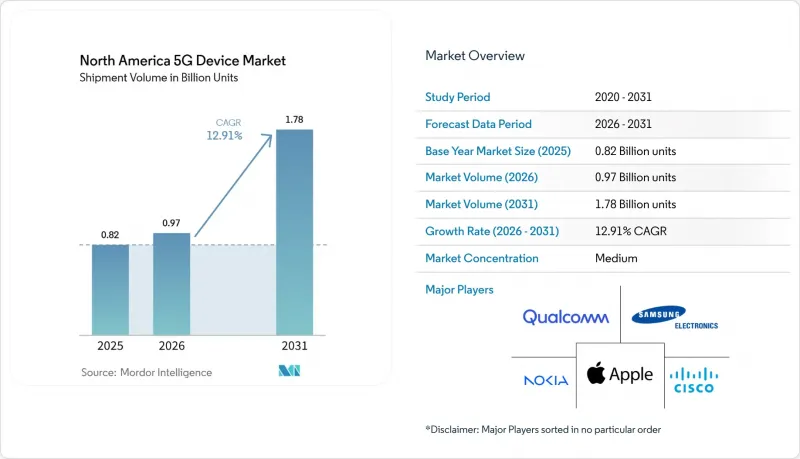
Mordor Intelligence에 의하면, 북미의 5G 기기 시장 규모(출하대수 기반)는 2025년 8억 2,000만 대로 평가되었습니다. 2026년에는 9억 7,000만 대로 확대되어 2031년까지 17억 8,000만 대에 이를 것으로 예상되고 2026년부터 2031년에 걸쳐 CAGR 12.91%로 성장할 전망입니다.
본 보고서는 폼 팩터(스마트폰, 고객 구내 장비(실내/실외), 기타), 지원 주파수 대역(Sub-6GHz, mm파, 하이브리드(Sub-6GHz 및 mm파)), 최종 사용자 산업(소비자용 전자기기, 산업 및 제조, 기타),용도(고속 대용량 통신(eMBB), 기타), 그리고 국가별로 분류되어 있습니다. 시장 전망은 출하 대수(단위) 기준으로 제시되어 있습니다.
북미의 5G 기기 시장 동향 및 인사이트
5G 스마트폰과 프리미엄 요금제의 통신사 번들 제공
미국 3대 통신사 간의 경쟁으로 인해 단말기 보조금은 북미의 5G 기기 시장에서 5G로의 업그레이드를 촉진하는 중요한 수단이 되고 있습니다. T-Mobile은 2026년 2월, ‘Experience Beyond’ 요금제와 연계된 갤럭시 S26 캠페인을 시작했으며, Verizon은 2026년 7월, ‘Simplicity Plan’을 통해 갤럭시 Z Fold8 및 아이폰 17 Pro 번들 요금제를 제공했습니다. 이러한 캠페인을 통해 대상 신규 가입자는 실질적인 초기 비용 없이 플래그십 단말기를 구입할 수 있게 되었습니다. 또한, 이러한 요금제에서는 회선당 월 80-100달러의 요금제에 대해 36개월의 계약 기간이 의무화되었습니다. 이를 통해 얻은 서비스 수익은 네트워크 밀도 향상과 지속적인 단말기 구매 인센티브를 뒷받침하고 있으며, 이로 인해 일반적인 단말기의 노후화 속도를 넘어서는 속도로 교체 주기가 단축되고 있습니다. 또한, Verizon은 ‘Add-a-Line’ 프로모션을 통해 스마트폰, 스마트 워치, 태블릿을 조합함으로써, 통신사 주도의 구매를 통해 더 많은 웨어러블 기기와 태블릿을 시장에 도입했습니다.
기업용 고정 무선 액세스 단말기의 교체 주기
북미의 5G 기기 시장에서 기업용 고정 무선 액세스는 고객 사내 장비의 교체를 비정기적인 구매에서 계획적인 인프라 주기로 변화시키고 있습니다. 에릭슨(Ericsson)은 2026년 4월, 조사 대상인 북미의 모든 서비스 제공업체가 고정 무선 접속을 제공했으며, 그중 89%가 전송 계층으로 5G를 채택하고 있다고 보고했습니다. 동 보고서는 2025년 전 세계 고객 구내 장비 출하량이 3,500만 대로 전년 대비 26% 증가했으며, 출하량의 57%가 5G 지원 제품이었다고 밝혔습니다. 관리형 WAN(Managed WAN) 계약이나 소프트웨어 정의 네트워크(SDN) 계약의 경우, 게이트웨이 교체 주기가 일반적으로 3-5년으로 설정되어 있으며, 이는 기존 기업용 라우터에서 흔히 볼 수 있는 7-10년의 수명보다 짧은 것입니다. 에릭슨은 2025년 2월에 Cradlepoint X20 5G 라우터를 발표했으며, 2025년 4월부터 네트워크 슬라이싱 및 멀티 오퍼레이터 우선 기능을 탑재하여 판매를 시작했습니다. PTCRB 및 GCF의 인증 요건으로 인해 상용화까지 3-6개월이 추가로 소요될 가능성이 있어, 이미 멀티 오퍼레이터 승인을 획득한 기존 공급업체에 유리하게 작용합니다.
4G 대체 제품과 비교한 기기의 높은 평균 판매 가격(ASP)
북미의 5G 기기 시장에서 대부분의 폼 팩터에서 5G 지원 단말기의 평균 판매 가격(ASP)은 동급 4G 제품보다 높은 수준을 유지하고 있습니다. 통신사의 보조금으로 인해 프리미엄 후불 요금제 가입자의 초기 비용은 충당될 수 있지만, 선불 요금제 가입자는 대부분의 경우 가격 차액 전액을 자비로 부담해야 합니다. 이 문제는 멕시코나 가격을 중시하는 미국 고객층에서 특히 두드러집니다. 2025년 수입 관련 비용의 상승은 중저가 스마트폰에 추가적인 가격 압박을 가했으며, 5G 기능만으로는 가격 인상을 정당화할 수 없는 경우 판매 대수에 대한 수요를 억제했습니다. 모듈 및 IoT 기기 분야에서는 4G LTE 제품이 30-40% 더 저렴한 단가로 운영 요구를 충족하고 있는 경우, 기업의 구매 담당자는 교체를 미룰 가능성이 있습니다. 저전력 5G 칩셋이 LTE Cat-1의 가격대에 가까워짐에 따라 이러한 억제요인은 완화될 것으로 예상되지만, 비용은 당분간 기기 교체를 가로막는 중요한 장벽으로 남아 있을 것입니다.
부문별 분석
2025년, 스마트폰은 북미의 5G 기기 시장 점유율의 67.40%를 차지하며 계속해서 주요 소비자 판매 기반을 형성했습니다. 애플의 프리미엄 모델인 iPhone 17 시리즈는 2025년 내내 통신사의 프로모션을 통해 후불 요금제 가입자의 기종 변경 수요를 뒷받침했습니다. 삼성의 갤럭시 A 시리즈는 선불 요금제 이용층 수요를 뒷받침한 반면, 갤럭시 S26 울트라는 2026년 초 출시 후 프리미엄 안드로이드 기기에 대한 관심을 다시 불러일으켰습니다. 모토로라는 애플 및 삼성과의 직접적인 경쟁이 제한적인 400달러 미만 가격대에서 통신사를 통한 매장 판매를 통해 상위 5개 벤더 중 출하량 증가를 기록했습니다. 통신사의 보조금 덕분에 프리미엄 모델이 일상적인 기기 교체 옵션으로 계속해서 채택되고 있으므로, 스마트폰은 앞으로도 북미의 5G 기기 시장의 중심이 될 것입니다.
웨어러블 기기 및 XR 기기는 2031년까지 연평균 성장률(CAGR) 14.35%를 나타낼 것으로 예측되며, 이는 각 폼 팩터 중 가장 높은 성장률입니다. 2026년 초 FDA의 지침에 따라 위험이 낮은 건강 추적용 웨어러블 기기에 대한 규제 장벽이 완화되었으며, 기업에서의 활용 사례로는 증강현실(AR)을 활용한 교육, 현장 서비스, 원격 진단 등이 있습니다. 퀄컴과 삼성은 2026년 7월, 스냅드래곤 플랫폼을 스마트 글래스와 스마트 워치로 확대하여 휴대폰 이외의 제품 카테고리에도 5G를 탑재했습니다. 고객 구내 장비, 산업용 라우터 및 게이트웨이, 모듈, 노트북 및 태블릿, 핫스팟이 출하 대수 측면에서 핵심을 형성하고 있습니다. 이러한 카테고리는 고정 무선 액세스, 사설 네트워크 및 기업용 모바일 브로드밴드로부터의 병행 수요의 혜택을 받고 있습니다.
Sub-6GHz와 mm파(mmWave)를 병용하는 하이브리드 기기는 2026년부터 2031년까지 연평균 성장률(CAGR) 14.80%를 나타낼 것으로 예측됩니다. 이러한 성장은 프리미엄 스마트폰, 엔터프라이즈 라우터, 고정 무선 액세스 게이트웨이 구매자들이 광범위한 커버리지와 높은 처리량 능력을 모두 점점 더 기대하고 있음을 보여줍니다. 인구 밀도가 높은 도시 지역에서 밀리파가 보여주는 성능상의 우위는 이러한 도입 환경에서 하이브리드 모뎀에 대한 프리미엄 가격 책정을 뒷받침하고 있습니다.
Sub-6GHz 지원 기기는 2025년 출하량의 61.85%를 차지하며, 예측 기간 동안에도 커버리지의 기반이 될 것으로 보입니다. 미드밴드 5G는 미국, 캐나다, 멕시코 전역에서 가장 광범위한 실용적 커버리지를 실현하고 있습니다. 애플이 보도한 아이폰 18 프로 시리즈 전략, 즉 미국에서는 밀리파 지원을 위해 퀄컴의 모뎀을 채택하겠다는 방침은 북미 프리미엄 기기 시장에서 밀리파의 중요성을 보여줍니다. T-Mobile, Nokia, Qualcomm은 삼성 갤럭시 S25와 스냅드래곤 X80을 활용한 6캐리어 어그리게이션을 통해 4.3 Gbps의 다운링크 속도를 입증했습니다. 또한, 스냅드래곤 X85가 탑재된 단말기를 사용한 2차 테스트에서는 6.3 Gbps에 도달했습니다. 스탠드얼론형 mm파 단말기는 일반적으로 송신 기지국으로부터 900미터 이내에서만 신호를 이용할 수 있기 때문에 앞으로도 틈새 시장으로 남을 것으로 보입니다. 대도시권 이외 지역의 네트워크 밀도 제약도 판매 대수 증가에 제약을 주는 요인으로 작용하고 있습니다.
기타 혜택 :
- 엑셀 형식 시장 예측(ME) 시트
- 3개월간의 애널리스트 지원
자주 묻는 질문
목차
제1장 서론
제2장 조사 방법
제3장 주요 요약
제4장 시장 구도
제5장 시장 규모 및 성장 예측
제6장 경쟁 구도
제7장 시장 기회 및 향후 전망
KTH 26.09.04According to Mordor Intelligence, the North America 5G device market size in terms of shipment volume is expected to increase from 0.82 billion units in 2025 to 0.97 billion units in 2026 and reach 1.78 billion units by 2031, growing at a CAGR of 12.91% over 2026-2031.
This report is Segmented by Form Factor (Smartphones, Customer-Premises Equipment (Indoor/Outdoor), and More), Spectrum Support (Sub-6 GHz, Mmwave, and Hybrid (Sub-6 GHz and MmWave)), End User Industry (Consumer Electronics, Industrial and Manufacturing, and More), Application (Enhanced Mobile Broadband (eMBB), and More), and Country. The Market Forecasts are Provided in Terms of Volume (Units).
North America 5G Device Market Trends and Insights
Carrier Bundling of 5G Smartphones and Premium Plans
Competition among the three national U.S. carriers has made device subsidies a central lever for 5G upgrades in the North America 5G device market. T-Mobile introduced Galaxy S26 offers tied to its Experience Beyond plan in February 2026, and Verizon offered Galaxy Z Fold8 and iPhone 17 Pro bundles through its Simplicity Plan in July 2026. These offers made flagship devices available with no effective upfront payment for eligible new-line customers. They also tied customers to 36-month billing commitments on plans priced from USD 80 to USD 100 per line each month. The resulting service revenue supports network densification and continued device incentives, which shortens replacement cycles beyond normal handset aging. Verizon also combined smartphones, watches, and tablets in add-a-line promotions, bringing more wearables and tablets into carrier-led purchases.
Enterprise Fixed Wireless Access Device Replacement Cycles
Enterprise fixed wireless access is changing customer-premises equipment replacement from an occasional purchase into a planned infrastructure cycle in the North America 5G device market. Ericsson reported in April 2026 that all surveyed North American service providers offered fixed wireless access and that 89% used 5G as the delivery layer. The report cited 35 million global customer-premises equipment shipments in 2025, 26% higher than the prior year, and stated that 57% of shipments were 5G-capable. Managed WAN contracts and software-defined networking agreements commonly tie gateways to 3-5-year refresh cycles, which is shorter than the 7-10-year life often associated with traditional enterprise routers. Ericsson announced the Cradlepoint X20 5G Router in February 2025 and made it available from April 2025 with network slicing and multi-operator prioritization features. PTCRB and GCF certification requirements can add 3-6 months to the path to commercial readiness, favoring established suppliers that already hold multi-operator approvals.
High Device ASPs Versus 4G Alternatives
Average selling prices for 5G-capable devices remain above those for comparable 4G products across most form factors in the North America 5G device market. Carrier subsidies can cover the upfront cost for premium postpaid customers, but prepaid subscribers often pay the full price difference. This issue is especially relevant in Mexico and in budget-focused U.S. customer groups. Higher import-related costs in 2025 added price pressure to mid-range smartphones, limiting unit demand where 5G features did not justify a higher purchase price. In modules and IoT equipment, enterprise buyers may delay replacement when 4G LTE products meet operational needs at a 30-40% lower unit cost. The restraint is expected to ease as lower-power 5G chipsets move closer to LTE Cat-1 pricing, but cost remains a material near-term barrier to device replacement.
Other drivers and restraints analyzed in the detailed report include:
- Private 5G Network Rollouts in Manufacturing and Logistics
- IoT-Enabled Device Convergence Across Consumer and Industrial Use Cases
- Carrier Spectrum and Coverage Gaps Outside Major Urban Corridors
For complete list of drivers and restraints, kindly check the Table Of Contents.
Segment Analysis
Smartphones held 67.40% of the North America 5G device market share in 2025 and remained the main consumer volume base. Apple's premium iPhone 17 range supported postpaid upgrade activity during 2025 through carrier promotions. Samsung's Galaxy A-series supported prepaid-tier demand, while the Galaxy S26 Ultra renewed interest in premium Android devices after its early 2026 launch. Motorola recorded unit-shipment growth among the top 5 vendors through carrier shelf placement in the sub-USD 400 range, where Apple and Samsung have limited direct competition. Smartphones will remain central to the North America 5G device market because carrier subsidies continue to bring premium models into routine replacement decisions.
Wearables and XR devices are projected to grow at a 14.35% CAGR through 2031, the fastest rate among form factors. Early 2026 FDA guidance reduced regulatory barriers for lower-risk health-tracking wearables, while enterprise use includes augmented-reality training, field service, and remote diagnostics. Qualcomm and Samsung expanded the Snapdragon platform into intelligent eyewear and smartwatches in July 2026, embedding 5G across product categories beyond handsets. Customer-premises equipment, industrial routers and gateways, modules, laptops and tablets, and hotspots form the middle of the volume stack. These categories benefit from parallel demand from fixed wireless access, private networks, and enterprise mobile broadband.
Hybrid Sub-6 GHz and mmWave devices are projected to grow at a 14.80% CAGR from 2026 to 2031. The growth shows that premium smartphone, enterprise router, and fixed wireless access gateway buyers increasingly expect both broad-area coverage and high-throughput capability. The performance advantage of mmWave in dense urban locations supports a premium for hybrid modems in these deployments.
Sub-6 GHz devices accounted for 61.85% of volume in 2025 and will remain the foundation of coverage during the forecast period. Mid-band 5G supports the widest usable coverage across the United States, Canada, and Mexico. Apple's reported approach for iPhone 18 Pro variants, using Qualcomm modems in the United States for mmWave compatibility, shows the importance of mmWave in the North American premium tier. T-Mobile, Nokia, and Qualcomm demonstrated 4.3 Gbps downlink speeds using 6-carrier aggregation with a Samsung Galaxy S25 and Snapdragon X80, and a secondary test with a Snapdragon X85 device reached 6.3 Gbps. Standalone mmWave devices will remain specialized because signals are usually usable within 900 meters of a transmission site. Network density constraints outside large metropolitan areas also limit their contribution to volume.
Complete Report Scope:
- By Form Factor
- Smartphones
- Customer-Premises Equipment (Indoor/Outdoor)
- Industrial Grade Routers/Gateways
- Modules
- Laptops/Tablets
- Hotspots
- Wearables and XR Devices
- By Spectrum Support
- Sub-6 GHz
- mmWave
- Hybrid (Sub-6 GHz and mmWave)
- By End User Industry
- Consumer Electronics
- Industrial and Manufacturing
- Automotive and Transportation
- Healthcare
- Energy and Utilities
- Enterprise/Commercial
- By Application
- Enhanced Mobile Broadband (eMBB)
- Ultra-Reliable Low-Latency Comms (URLLC)
- Massive Machine-Type Comms (mMTC)
- Fixed Wireless Access
- Vehicle-to-Everything (V2X)
- By Country
- United States
- Canada
- Mexico
List of Companies Covered in this Report:
- Apple Inc.
- Samsung Electronics Co., Ltd.
- Qualcomm Incorporated
- Cisco Systems, Inc.
- Nokia Corporation
- Telefonaktiebolaget LM Ericsson
- T-Mobile US, Inc.
- Verizon Communications Inc.
- AT&T Inc.
- Motorola Mobility LLC
- Netgear, Inc.
- Cradlepoint, Inc.
- Sierra Wireless, Inc.
- Digi International Inc.
- Quectel Wireless Solutions Inc.
- Intel Corporation
- MediaTek Inc.
- Fibocom Wireless Inc.
- Telit Cinterion (Telit IoT Solutions Holding Ltd.)
- Inseego Corp.
Additional Benefits:
- The market estimate (ME) sheet in Excel format
- 3 months of analyst support
TABLE OF CONTENTS
1 INTRODUCTION
- 1.1 Study Assumptions and Market Definition
- 1.2 Scope of the Study
2 RESEARCH METHODOLOGY
3 EXECUTIVE SUMMARY
4 MARKET LANDSCAPE
- 4.1 Market Overview
- 4.2 Market Drivers
- 4.2.1 Enterprise Fixed Wireless Access Device Replacement Cycles
- 4.2.2 Carrier Bundling of 5G Smartphones and Premium Plans
- 4.2.3 Private 5G Network Rollouts in Manufacturing and Logistics
- 4.2.4 RedCap and Low-Power 5G Device Adoption
- 4.2.5 mmWave Coverage Expansion in Dense Urban Hotspots
- 4.2.6 IoT Enabled Device Convergence Across Consumer and Industrial Use Cases
- 4.3 Market Restraints
- 4.3.1 High Device ASPs Versus 4G Alternatives
- 4.3.2 Carrier Spectrum and Coverage Gaps Outside Major Urban Corridors
- 4.3.3 Fragmented Certification and Interoperability Requirements
- 4.3.4 Slower Enterprise Refresh Cycles for Routers and Modules
- 4.4 Industry Value Chain Analysis
- 4.5 Regulatory Landscape
- 4.6 Technological Outlook
- 4.7 Porter's Five Forces Analysis
- 4.7.1 Bargaining Power of Suppliers
- 4.7.2 Bargaining Power of Buyers
- 4.7.3 Threat of New Entrants
- 4.7.4 Threat of Substitutes
- 4.7.5 Intensity of Competitive Rivalry
5 MARKET SIZE AND GROWTH FORECASTS (VOLUME)
- 5.1 By Form Factor
- 5.1.1 Smartphones
- 5.1.2 Customer-Premises Equipment (Indoor/Outdoor)
- 5.1.3 Industrial Grade Routers/Gateways
- 5.1.4 Modules
- 5.1.5 Laptops/Tablets
- 5.1.6 Hotspots
- 5.1.7 Wearables and XR Devices
- 5.2 By Spectrum Support
- 5.2.1 Sub-6 GHz
- 5.2.2 mmWave
- 5.2.3 Hybrid (Sub-6 GHz and mmWave)
- 5.3 By End User Industry
- 5.3.1 Consumer Electronics
- 5.3.2 Industrial and Manufacturing
- 5.3.3 Automotive and Transportation
- 5.3.4 Healthcare
- 5.3.5 Energy and Utilities
- 5.3.6 Enterprise/Commercial
- 5.4 By Application
- 5.4.1 Enhanced Mobile Broadband (eMBB)
- 5.4.2 Ultra-Reliable Low-Latency Comms (URLLC)
- 5.4.3 Massive Machine-Type Comms (mMTC)
- 5.4.4 Fixed Wireless Access
- 5.4.5 Vehicle-to-Everything (V2X)
- 5.5 By Country
- 5.5.1 United States
- 5.5.2 Canada
- 5.5.3 Mexico
6 COMPETITIVE LANDSCAPE
- 6.1 Market Concentration
- 6.2 Strategic Moves
- 6.3 Market Share Analysis
- 6.4 Company Profiles (includes Global Level Overview, Market Level Overview, Core Segments, Financials as available, Strategic Information, Market Rank/Share, Products and Services, Recent Developments)
- 6.4.1 Apple Inc.
- 6.4.2 Samsung Electronics Co., Ltd.
- 6.4.3 Qualcomm Incorporated
- 6.4.4 Cisco Systems, Inc.
- 6.4.5 Nokia Corporation
- 6.4.6 Telefonaktiebolaget LM Ericsson
- 6.4.7 T-Mobile US, Inc.
- 6.4.8 Verizon Communications Inc.
- 6.4.9 AT&T Inc.
- 6.4.10 Motorola Mobility LLC
- 6.4.11 Netgear, Inc.
- 6.4.12 Cradlepoint, Inc.
- 6.4.13 Sierra Wireless, Inc.
- 6.4.14 Digi International Inc.
- 6.4.15 Quectel Wireless Solutions Inc.
- 6.4.16 Intel Corporation
- 6.4.17 MediaTek Inc.
- 6.4.18 Fibocom Wireless Inc.
- 6.4.19 Telit Cinterion (Telit IoT Solutions Holding Ltd.)
- 6.4.20 Inseego Corp.
7 MARKET OPPORTUNITIES AND FUTURE OUTLOOK
- 7.1 White-Space and Unmet-Need Assessment


