

|
시장보고서
상품코드
2119001
경쟁 정보 서비스 : 시장 점유율 분석, 업계 동향 및 통계, 성장 예측(2026-2031년)Competitive Intelligence Services - Market Share Analysis, Industry Trends & Statistics, Growth Forecasts (2026 - 2031) |
||||||
 Mordor Intelligence
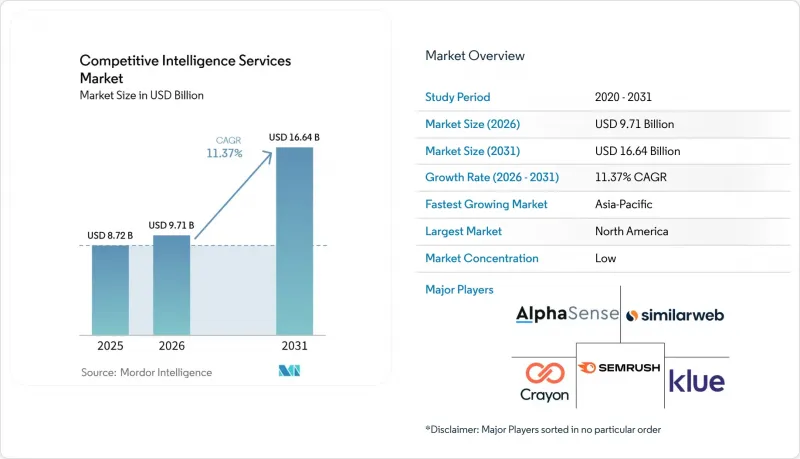
Mordor Intelligence에 의하면, 경쟁 정보 서비스 시장 규모는 2025년 87억 2,000만 달러로 평가되었습니다. 2026년 97억 1,000만 달러에서 2031년까지 166억 4,000만 달러로 확대되어 2026년부터 2031년까지 연평균 성장률(CAGR)은 11.37%를 나타낼 전망입니다.
본 보고서는 서비스 유형(데이터 수집·분석, 시장 모니터링·알림, 보고서 작성·시각화, 전략 수립·자문, 기타), 도입 형태(클라우드 기반, 하이브리드형, On-Premise형), 최종 사용자 산업(은행, 금융서비스 및 보험(BFSI), 소매 및 전자상거래, 미디어 및 엔터테인먼트, 기타), 지역별로 분류되어 있습니다. 시장 예측은 금액(달러)으로 제시되어 있습니다.
세계의 경쟁 정보 서비스 시장 동향 및 인사이트
실시간 경쟁사 모니터링에 대한 수요 증가
기업들은 정기적인 경쟁사 검토에서 제품, 가격 책정, 리더십, 메시징 신호에 대응하는 지속적인 모니터링으로 전환하고 있습니다. 공식적인 경쟁 정보 프로그램을 도입함으로써, 조사 활동을 매출 실적, 경영진의 우선순위 및 각 팀에 요구되는 대응 조치와 더욱 밀접하게 연계할 수 있게 됩니다. 이를 통해 팀은 경쟁사의 변화를 거래, 고객 계정, 제품 결정 또는 고객과의 대화에 연결할 수 있으므로 비즈니스 사례의 실용성이 높아집니다. 경쟁 정보 서비스 시장은 알림이 고객 관계 관리(CRM) 시스템이나 영업 팀이 업무 중에 사용하는 기타 도구로 전달됨으로써 이점을 얻습니다. 이러한 전달 모델은 시장에서의 사건과 고객 및 제품 의사 결정을 담당하는 직원의 대응 사이의 지연을 단축할 수도 있습니다. Crayon사의 2026년 보고서에 따르면, 체계화된 프로그램의 성숙도와 경영진의 지원은 더 강력한 경쟁 성과와 연관되어 있으며, 이는 재현 가능한 모니터링 프로세스의 유효성을 뒷받침합니다.
AI를 활용한 인텔리전스 워크플로우의 확대
생성형 AI와 자율형 에이전트의 설계로 인해, 서비스가 다양한 정보원에서 대량의 정보를 수집, 검토, 분류, 요약하는 방식이 변화하고 있습니다. 경쟁 정보 서비스 시장은 다단계 조사를 완료하고, 조사 결과를 비교하며, 새로운 사건이 발생했을 때 출력을 업데이트할 수 있는 시스템으로 전환되고 있습니다. AlphaSense는 지속적인 조사 워크플로우를 실현하는 ‘SuperAnalyst’의 출시와 함께, 2026년 6월 연간 경상 수익(ARR)이 6억 달러를 돌파했다고 보고했습니다. 또한 이 회사는 기업용 조사 도구에 대한 지속적인 투자를 보여주기 위해, 기업 가치 75억 달러 규모로 3억 5,000만 달러의 자금 조달 라운드를 완료했다고 발표했습니다. 액센츄어는 2026년 6월, 기업에 에이전트형 인텔리전스 워크플로우를 제공하기 위해 AlphaSense에 대한 전략적 투자 및 제휴를 발표했습니다. 기본적인 모니터링 기능은 신뢰할 수 있는 정보 출처의 포괄성보다 쉽게 모방될 가능성이 있기 때문에 제공업체에게는 여전히 설득력 있는 콘텐츠 라이브러리, 신중한 정보 출처 선정, 그리고 견고한 데이터 관리가 요구됩니다.
데이터 개인정보 보호, 동의 및 윤리적 검증
웹 스크레이핑은 여전히 중요한 데이터 수집 기법이지만, 개인정보보호법이 적용되는 주요 지역의 규제 당국으로부터 더욱 엄격한 감시의 대상이 되고 있습니다. 2026년에 유럽 데이터 보호 위원회가 발표한 최종 지침에서는 생성형 AI를 위한 자동 스크래핑을 언급하며, 개인 데이터가 관련된 경우 적용되는 GDPR(EU 개인정보보호규정)의 조건을 개괄하고 있습니다. 제공업체는 수집 과정에서 법적 근거, 데이터 최소화, 투명성 및 민감한 데이터 처리에 대해 고려해야 합니다. 이러한 요구 사항은 특히 대규모 규정 준수 팀이나 공식적인 데이터 거버넌스 기능을 갖추지 못한 중소기업의 경우, 법적, 운영적, 기술적 부담을 가중시킵니다. 경쟁 정보 서비스 시장에서는 그 영향에 차이가 나타납니다. 이는 대규모 플랫폼일수록 이러한 고정 비용을 더 많이 흡수할 수 있고, 프로세스를 보다 일관되게 문서화할 수 있기 때문입니다. 문서화된 정보원 확보 관행을 유지할 수 있는 능력은 신뢰할 수 있는 데이터 관리를 필요로 하는 기업 고객에 대한 입지를 강화하는 데 기여합니다.
부문별 분석
2025년, 경쟁 정보 서비스 시장에서 ‘데이터 수집 및 분석’은 32.35%를 차지했습니다. 이는 후속 모니터링, 시각화, 자문 및 규정 준수 업무에 사용되는 정보를 제공하기 위함입니다. 이는 시장 신호를 수집하여 의사 결정권자에게 제공하는 서비스의 기반으로 계속 자리 잡고 있습니다. ‘시장 모니터링 및 알림’은 사용자가 비정기적인 보고서보다 시의적절한 업데이트를 점점 더 기대하게 되면서 확고한 카테고리로 자리 잡았습니다. ‘보고서 작성 및 시각화’ 역시 팀이 사내 커뮤니케이션을 지원하는 형식으로 조사 결과를 요구하기 때문에 여전히 중요합니다. 기업이 영업, 제품, 전략 활동 전반에 걸쳐 경쟁사에 대한 일관된 관점을 추구하는 가운데, 이러한 핵심 기능은 안정적인 수요를 뒷받침하고 있습니다.
‘리스크 및 컴플라이언스 인텔리전스’는 2026년부터 2031년까지 연평균 성장률(CAGR) 14.16%를 나타낼 것으로 예측되며, 언급된 서비스 유형 중 가장 높은 성장률을 보일 것으로 전망됩니다. 제약, 금융 서비스, 에너지 업계의 조직들은 인텔리전스 업무를 비정기적인 조사에서 정기적인 리스크 모니터링으로 전환하고 있습니다. 또한, ‘영업 지원 및 계약 성사·실패 인텔리전스’도 플랫폼이 경쟁사 정보를 고객 관계 관리(CRM)의 거래 단계, 배틀 카드, 거래 후 검토와 연동함으로써 발전하고 있습니다. ‘전략 수립 및 자문’은 자동화 서비스의 성장이 가속화되고 있는 분야임에도 불구하고, 대기업 및 경영 컨설팅 지원 분야에서 여전히 중요한 역할을 수행하고 있습니다. 디지털 트래픽 및 검색 엔진 최적화(SEO) 인텔리전스, 기업 및 거래 인텔리전스, 통합 모니터링 플랫폼과 같은 기타 서비스들은 이전에는 별도로 수행되던 인텔리전스 활동을 공유 시스템으로 통합하는 추세를 반영하고 있습니다.
지역별 분석
2025년, 북미는 경쟁 정보 서비스 시장의 36.38%를 차지하며 계속해서 가장 규모가 큰 지역 기여자로 자리매김했습니다. 이 지역에는 성숙한 상업 활동을 펼치는 기술, 금융 서비스, SaaS(Software-as-a-Service) 기업이 집중되어 있습니다. 이 부문의 많은 조직에서는 경쟁 정보를 독립적인 조사 활동이 아닌, 수익 창출 활동, 제품 계획 및 거래 주기를 위한 입력 자료로 취급하고 있습니다. 이로 인해 시장의 신호를 영업 및 제품 의사 결정에 연결하고, 사용자가 경쟁사의 동향을 보다 명확하게 파악할 수 있도록 지원하는 플랫폼에 대한 투자가 촉진되고 있습니다. 또한, 이 지역에는 기존의 고객 관계 관리(CRM) 시스템 및 협업 시스템과의 통합을 지원할 수 있는 대규모 기업 고객 기반이 존재합니다.
유럽은 독일, 영국, 프랑스를 필두로 지역별 시장에서 2위의 규모를 차지했습니다. GDPR(EU 개인정보보호규정)(일반 데이터 보호 규정) 및 EU AI법에 따라 규제 당국의 심사를 견딜 수 있는 데이터 수집 방법, 투명한 관리 체제, 그리고 감사 추적이 필요해지고 있습니다. 이는 특히 기밀 데이터를 보유하고 공식적인 규정 준수 의무를 지고 있는 조직에서 보다 강력한 거버넌스 기능을 갖춘 전용 서비스의 도입을 촉진할 가능성이 있습니다. 또한, 유럽의 조직들은 전략적 계획 수립 과정에서도 인텔리전스를 활용하고 있으며, 이는 지속적인 조사 수요를 뒷받침하는 요인이 됩니다. 아시아태평양은 2026년부터 2031년까지 연평균 성장률(CAGR) 13.81%를 나타낼 것으로 예측되며, 이는 경쟁 정보 서비스 시장에서 가장 높은 지역 성장률입니다. 2025년에도 중국은 아시아태평양에서 여전히 최대 시장으로 자리매김했으나, 인도와 동남아시아에서는 중견 기업들이 처음으로 SaaS(Software-as-a-Service) 도구를 도입함에 따라 수요가 증가하고 있습니다.
남미는 지역 차원의 성장 기회를 확대하고 있으며, 브라질과 아르헨티나가 금융 서비스 및 소매 업계에서 도입의 주요 거점이 되고 있습니다. 핀테크 분야의 경쟁이 심화되고 기업들이 시의적절한 외부 정보를 필요로 하는 가운데, 클라우드 도구 이용 확대가 경쟁 정보 서비스 시장의 성장을 뒷받침하고 있습니다. 중동 및 아프리카는 여전히 시장 규모는 작지만, 기업의 디지털화, 해외 투자, 다국적 기업의 사업 확장 및 국내 핀테크 활동을 통해 발전을 이루고 있습니다. 아랍에미리트(UAE)와 사우디아라비아는 디지털 전환과 기술·금융 서비스의 성장을 통해 중동 수요를 뒷받침하고 있습니다. 남아프리카, 이집트, 나이지리아는 경쟁 구도 모니터링이 지속적으로 성장하는 현지 기업 및 다국적 기업에게 점점 더 중요해짐에 따라 아프리카의 발전을 주도하고 있습니다.
기타 혜택 :
- 엑셀 형식 시장 전망(ME) 시트
- 3개월간의 애널리스트 지원
자주 묻는 질문
목차
제1장 서론
제2장 조사 방법
제3장 개요
제4장 시장 구도
제5장 시장 규모 및 성장 예측
제6장 경쟁 구도
제7장 시장 기회 및 향후 전망
KTH 26.09.02According to Mordor Intelligence, the competitive intelligence services market size is projected to expand from USD 8.72 billion in 2025 and USD 9.71 billion in 2026 to USD 16.64 billion by 2031, registering a CAGR of 11.37% between 2026 and 2031.
This report is Segmented by Service Type (Data Collection and Analysis, Market Monitoring and Alerts, Reporting and Visualization, Strategy Development and Advisory, and More), Deployment Mode (Cloud-Based, Hybrid, and On-Premises), End User Industry (BFSI, Retail and E-Commerce, Media and Entertainment, and More), and Geography. The Market Forecasts are Provided in Terms of Value (USD).
Global Competitive Intelligence Services Market Trends and Insights
Rising Demand for Real-Time Competitor Monitoring
Organizations have moved from periodic competitor reviews toward continuous monitoring that responds to product, pricing, leadership, and messaging signals. Formal competitive intelligence programs can tie research activity more closely to sales outcomes, executive priorities, and the responses required from specific teams. This makes the business case more practical by enabling teams to connect a competitor change to a deal, account, product decision, or customer conversation. The Competitive Intelligence Services Market benefits when alerts are delivered in customer relationship management systems and other tools used by sales teams during active work. This delivery model can also reduce the delay between a market event and a response from the employee responsible for a customer or product decision. Crayon's 2026 report linked structured program maturity and executive sponsorship with stronger competitive outcomes, supporting the case for repeatable monitoring processes.
Expansion of AI-Powered Intelligence Workflows
Generative AI and autonomous agent designs are changing how services collect, review, classify, and summarize large volumes of information from different sources. The Competitive Intelligence Services Market is moving toward systems that can complete multi-step research, compare findings, and update outputs as new events occur. AlphaSense reported surpassing USD 600 million in annual recurring revenue in June 2026, following the launch of SuperAnalyst for continuous research workflows. The company also reported a USD 350 million funding round at a USD 7.5 billion valuation, indicating continued investment in enterprise research tools. Accenture announced a strategic investment and partnership with AlphaSense in June 2026 to bring agentic intelligence workflows to enterprises. Providers still need defensible content libraries, careful source selection, and strong data controls because basic monitoring functions can be copied more easily than trusted source coverage.
Data Privacy, Consent, and Ethical Scrutiny
Web scraping remains an important data collection method, but it is under closer scrutiny from regulators in major regions where personal data protection laws apply. The final 2026 European Data Protection Board guidelines address automated scraping for generative AI and outline the GDPR conditions that apply when personal data is involved. Providers must consider lawful basis, data minimization, transparency, and the treatment of sensitive data in their collection processes. These requirements add legal, operational, and engineering work, especially for smaller companies without large compliance teams or formal data governance functions. The Competitive Intelligence Services Market faces uneven effects because larger platforms can absorb more of these fixed costs and document their processes more consistently. Their ability to maintain documented sourcing practices can strengthen their position with enterprise buyers that need reliable data controls.
Other drivers and restraints analyzed in the detailed report include:
- Cross-Functional Adoption Across Sales, Product, and Strategy Teams
- Rising Need for Regulated-Industry and Risk-Linked Intelligence
- High Total Cost of Ownership and Shelfware Risk
For complete list of drivers and restraints, kindly check the Table Of Contents.
Segment Analysis
Data Collection and Analysis accounted for 32.35% of the Competitive Intelligence Services Market in 2025, as it provides the information used for subsequent monitoring, visualization, advisory, and compliance work. It remains the foundation for services that collect market signals and make them available to decision makers. Market Monitoring and Alerts is an established category because users increasingly expect timely updates rather than occasional reports. Reporting and Visualization also remain important because teams need findings in formats that support internal communication. These core functions support steady demand as enterprises seek a consistent view of competitors across sales, product, and strategy activities.
Risk and Compliance Intelligence is projected to record a 14.16% CAGR from 2026 to 2031, the fastest growth among the listed service types. Pharmaceutical, financial services, and energy organizations are moving more intelligence work from discretionary research to recurring risk monitoring. Sales Enablement and Win-Loss Intelligence is also developing as platforms connect competitor information to customer relationship management deal stages, battlecards, and post-deal reviews. Strategy Development and Advisory remains relevant for large enterprises and management consulting support, even where automated services grow faster. Other services, including digital traffic and search engine optimization intelligence, company and deal intelligence, and unified monitoring platforms, reflect the combination of formerly separate intelligence activities into shared systems.
Complete Report Scope:
- By Service Type
- Data Collection and Analysis
- Market Monitoring and Alerts
- Reporting and Visualization
- Strategy Development and Advisory
- Risk and Compliance Intelligence
- Sales Enablement and Win-Loss Intelligence
- Other Service Types (Competitive and Market Monitoring Platforms, Digital, Traffic, SEO, and Marketing Competitive Intelligence, Media, Social, Consumer, and Brand Intelligence, and Company, Financial, Private Market, and Deal Intelligence)
- By Deployment Mode
- Cloud-Based
- Hybrid
- On-Premises
- By End User Industry
- BFSI
- Retail and E-commerce
- Media and Entertainment
- Healthcare and Life Sciences
- Travel and Hospitality
- Consumer Goods
- Other End User Industries (Education, Automotive, and IT and Telecom amongst Others)
- By Geography
- North America
- United States
- Canada
- Mexico
- South America
- Brazil
- Argentina
- Chile
- Rest of South America
- Europe
- Germany
- United Kingdom
- France
- Italy
- Spain
- Rest of Europe
- Asia-Pacific
- China
- Japan
- India
- South Korea
- Australia
- Rest of Asia-Pacific
- Middle East
- United Arab Emirates
- Saudi Arabia
- Qatar
- Rest of Middle East
- Africa
- South Africa
- Egypt
- Nigeria
- Rest of Africa
- North America
Geography Analysis
North America accounted for 36.38% of the Competitive Intelligence Services Market in 2025 and remained the largest regional contributor. The region has a high concentration of technology, financial services, and software-as-a-service companies with mature commercial operations. Many organizations in these sectors treat competitive intelligence as an input to revenue operations, product planning, and deal cycles rather than as a separate research exercise. This supports spending on platforms that can link market signals to sales and product decisions, while giving users a clearer view of competitor actions. The region also has a large base of enterprise buyers that can support integration with established customer relationship management and collaboration systems.
Europe was the second-largest regional market, led by Germany, the United Kingdom, and France. The GDPR and EU AI Act have increased the need for data sourcing practices, transparent controls, and audit trails that can withstand regulatory review. This can support the adoption of purpose-built services with stronger governance features, particularly for organizations with sensitive data and formal compliance obligations. European organizations also use intelligence in connection with strategic planning processes, which can support recurring research requirements. Asia-Pacific is projected to grow at a 13.81% CAGR from 2026 to 2031, the fastest regional rate in the Competitive Intelligence Services Market. China remained the largest Asia-Pacific country market in 2025, while India and Southeast Asia are gaining demand as mid-market organizations adopt software-as-a-service tools for the first time.
South America is developing as a regional opportunity, with Brazil and Argentina serving as major centers for financial services and retail adoption. The Competitive Intelligence Services Market is supported by the broader use of cloud tools as fintech competition increases and businesses need timely external information. The Middle East and Africa remain smaller contributors but are developing through enterprise digitization, foreign investment, multinational expansion, and domestic fintech activity. The UAE and Saudi Arabia support Middle East demand through digital transformation and the growth of technological and financial services. South Africa, Egypt, and Nigeria lead African development as competitive monitoring becomes more relevant to expanding local and multinational businesses.
- AlphaSense, Inc.
- Similarweb Ltd.
- Crayon AS
- Klue Labs Inc.
- Contify
- Comintelli AB
- Cision Ltd.
- Meltwater N.V.
- Semrush Holdings, Inc.
- Sprout Social, Inc.
- Cipher / Knowledge360
- Quid
- Fuld + Company, LLC
- Proactive Worldwide, LLC
- Evalueserve Ltd.
- CB Insights, Inc.
- Crunchbase, Inc.
- Valona Intelligence
- ZoomInfo Technologies LLC
- S&P Global Inc.
Additional Benefits:
- The market estimate (ME) sheet in Excel format
- 3 months of analyst support
TABLE OF CONTENTS
1 INTRODUCTION
- 1.1 Study Assumptions and Market Definition
- 1.2 Scope of the Study
2 RESEARCH METHODOLOGY
3 EXECUTIVE SUMMARY
4 MARKET LANDSCAPE
- 4.1 Market Overview
- 4.2 Market Drivers
- 4.2.1 Rising Demand for Real-Time Competitor Monitoring
- 4.2.2 Expansion of AI-Powered Intelligence Workflows
- 4.2.3 Cross-Functional Adoption Across Sales, Product, and Strategy Teams
- 4.2.4 Rising Need for Regulated-Industry and Risk-Linked Intelligence
- 4.2.5 Growth of Hybrid Continuous Intelligence Models
- 4.2.6 Dark Data and Internal Knowledge Graph Utilization
- 4.3 Market Restraints
- 4.3.1 Data Privacy, Consent, and Ethical Scrutiny
- 4.3.2 High Total Cost of Ownership and Shelfware Risk
- 4.3.3 Hallucination and Verification Burden in Generative AI Workflows
- 4.3.4 Fragmented Buying Centers and Weak Intelligence Governance
- 4.4 Impact of Macroeconomic Factors on the Market
- 4.5 Industry Value-Chain Analysis
- 4.6 Technology Outlook
- 4.7 Regulatory Landscape
- 4.8 Porter's Five Forces Analysis
- 4.8.1 Threat of New Entrants
- 4.8.2 Bargaining Power of Suppliers
- 4.8.3 Bargaining Power of Buyers
- 4.8.4 Threat of Substitutes
- 4.8.5 Intensity of Competitive Rivalry
5 MARKET SIZE AND GROWTH FORECASTS (VALUE)
- 5.1 By Service Type
- 5.1.1 Data Collection and Analysis
- 5.1.2 Market Monitoring and Alerts
- 5.1.3 Reporting and Visualization
- 5.1.4 Strategy Development and Advisory
- 5.1.5 Risk and Compliance Intelligence
- 5.1.6 Sales Enablement and Win-Loss Intelligence
- 5.1.7 Other Service Types (Competitive and Market Monitoring Platforms, Digital, Traffic, SEO, and Marketing Competitive Intelligence, Media, Social, Consumer, and Brand Intelligence, and Company, Financial, Private Market, and Deal Intelligence)
- 5.2 By Deployment Mode
- 5.2.1 Cloud-Based
- 5.2.2 Hybrid
- 5.2.3 On-Premises
- 5.3 By End User Industry
- 5.3.1 BFSI
- 5.3.2 Retail and E-commerce
- 5.3.3 Media and Entertainment
- 5.3.4 Healthcare and Life Sciences
- 5.3.5 Travel and Hospitality
- 5.3.6 Consumer Goods
- 5.3.7 Other End User Industries (Education, Automotive, and IT and Telecom amongst Others)
- 5.4 By Geography
- 5.4.1 North America
- 5.4.1.1 United States
- 5.4.1.2 Canada
- 5.4.1.3 Mexico
- 5.4.2 South America
- 5.4.2.1 Brazil
- 5.4.2.2 Argentina
- 5.4.2.3 Chile
- 5.4.2.4 Rest of South America
- 5.4.3 Europe
- 5.4.3.1 Germany
- 5.4.3.2 United Kingdom
- 5.4.3.3 France
- 5.4.3.4 Italy
- 5.4.3.5 Spain
- 5.4.3.6 Rest of Europe
- 5.4.4 Asia-Pacific
- 5.4.4.1 China
- 5.4.4.2 Japan
- 5.4.4.3 India
- 5.4.4.4 South Korea
- 5.4.4.5 Australia
- 5.4.4.6 Rest of Asia-Pacific
- 5.4.5 Middle East
- 5.4.5.1 United Arab Emirates
- 5.4.5.2 Saudi Arabia
- 5.4.5.3 Qatar
- 5.4.5.4 Rest of Middle East
- 5.4.6 Africa
- 5.4.6.1 South Africa
- 5.4.6.2 Egypt
- 5.4.6.3 Nigeria
- 5.4.6.4 Rest of Africa
- 5.4.1 North America
6 COMPETITIVE LANDSCAPE
- 6.1 Market Concentration
- 6.2 Strategic Moves
- 6.3 Market Share Analysis
- 6.4 Company Profiles (includes Global Level Overview, Market Level Overview, Core Segments, Financials as available, Strategic Information, Market Rank/Share, Products and Services, Recent Developments)
- 6.4.1 AlphaSense, Inc.
- 6.4.2 Similarweb Ltd.
- 6.4.3 Crayon AS
- 6.4.4 Klue Labs Inc.
- 6.4.5 Contify
- 6.4.6 Comintelli AB
- 6.4.7 Cision Ltd.
- 6.4.8 Meltwater N.V.
- 6.4.9 Semrush Holdings, Inc.
- 6.4.10 Sprout Social, Inc.
- 6.4.11 Cipher / Knowledge360
- 6.4.12 Quid
- 6.4.13 Fuld + Company, LLC
- 6.4.14 Proactive Worldwide, LLC
- 6.4.15 Evalueserve Ltd.
- 6.4.16 CB Insights, Inc.
- 6.4.17 Crunchbase, Inc.
- 6.4.18 Valona Intelligence
- 6.4.19 ZoomInfo Technologies LLC
- 6.4.20 S&P Global Inc.
7 MARKET OPPORTUNITIES AND FUTURE OUTLOOK
- 7.1 White-Space and Unmet-Need Assessment


