

|
시장보고서
상품코드
2124455
영국의 비즈니스 인텔리전스(BI) : 시장 점유율 분석, 업계 동향과 통계, 성장 예측(2026-2031년)United Kingdom Business Intelligence - Market Share Analysis, Industry Trends & Statistics, Growth Forecasts (2026 - 2031) |
||||||
 Mordor Intelligence
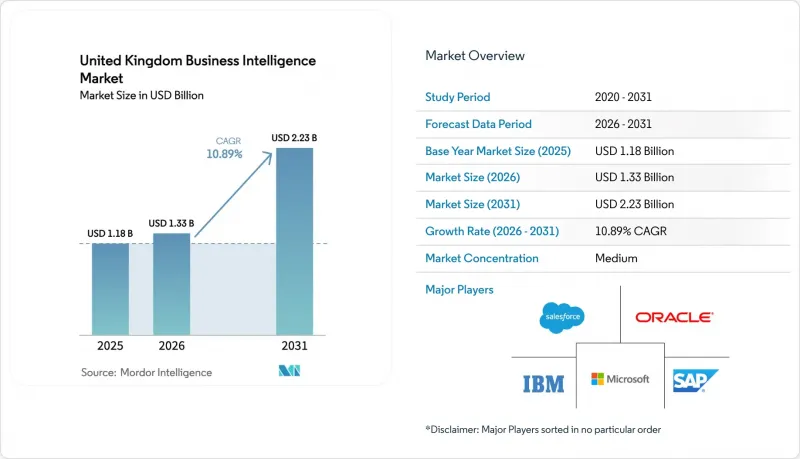
Mordor Intelligence에 의하면, 영국의 비즈니스 인텔리전스(BI) 시장 규모는 2025년 11억 8,000만 달러에서 2026년에는 13억 3,000만 달러에 이르고, 2026-2031년 CAGR 10.89%로 성장을 지속하여 2031년에는 22억 3,000만 달러에 달할 것으로 예측됩니다.
본 보고서는 구성 요소(소프트웨어 및 서비스), 도입 형태(On-Premise, 클라우드, 하이브리드), 조직 규모(중소기업 및 대기업), 기능(보고서 작성, 데이터 마이닝, 성과 관리, 대시보드), 최종 사용자 업종(은행, 금융서비스 및 보험(BFSI), IT 및 통신, 소매, 제조 등) 및 지역별로 분류되어 있습니다. 시장 전망은 금액(달러) 기준으로 제시되어 있습니다.
영국의 비즈니스 인텔리전스(BI) 시장 동향 및 인사이트
영국 중소기업의 ‘클라우드 퍼스트’ 정책
영국 기업의 99.9%를 차지하는 중소기업은 초기 설비 투자를 피할 수 있는 SaaS(Software-as-a-Service)형 분석 솔루션으로 전환하고 있습니다. 영국 국세청(HM Revenue and Customs)에 따르면, 2024년부터 2025년에 걸쳐 이들 기업의 도입률은 34% 증가할 것으로 예상되며, 영국 비즈니스 인텔리전스(BI)의 인기는 이메일 및 회계 업무에 이어 두 번째로 높은 수준입니다. 사용량 기반 과금제를 통해 운영 비용이 수익 주기와 연동되는 한편, 정부의 보조금으로 인해 진입 장벽이 낮아지고 있습니다. 각 벤더사는 현재 도입 기간을 수개월에서 수주로 단축하는 산업별 템플릿을 제공합니다. 이러한 성장세에도 불구하고, 중소기업의 42%는 여전히 데이터 주권과 벤더 종속을 장벽으로 꼽고 있으며, 기밀성이 높은 장부를 On-Premise로 관리하는 하이브리드 아키텍처 도입이 확대되고 있습니다.
생성형 AI를 활용한 분석 플랫폼
대규모 언어 모델을 활용한 자연어 인터페이스를 통해 분석에 대한 접근성이 널리 확산되고 있습니다. 마이크로소프트의 ‘Copilot for Power BI’와 세일즈포스의 ‘Einstein GPT for Tableau’는 모두 2025년에 출시되어, 재무 및 마케팅 팀이 쉬운 영어 프롬프트를 통해 대시보드를 생성할 수 있게 했습니다. 초기 시범 도입에서는 대시보드 작성 시간이 60% 단축되었으나, 잘못된 인사이트가 제시되는 사례가 발생하면서 거버넌스상의 문제도 대두되었습니다. 정보위원회 사무국은 2025년 9월 지침을 발표하며, 설명 책임은 데이터 관리자에게 귀속된다는 점을 기업에 재차 주의를 환기시켰고, 이에 따라 설명 가능성 기능과 감사 추적에 대한 수요가 높아졌습니다.
고급 분석 인력 부족
Tech Nation의 집계에 따르면, 2025년에는 17만 8,000명의 기술 전문가가 부족할 것으로 예상되며, 이러한 격차가 영국 비즈니스 인텔리전스(BI) 도입을 직접적으로 제약하고 있습니다. 대기업은 종종 컨설팅 회사에 의뢰하여 인력을 보충하고 있지만, 중견 기업은 이에 상응하는 예산이 없습니다. 대학에서는 데이터 사이언스 전공 학생 수를 늘리고 있지만, 졸업생들은 고소득 기술직으로 흘러가거나 해외로 이주하는 경우가 많습니다. ‘견습세(Apprenticeship Levy)’에 따라 대기업의 총 급여액의 0.5%가 교육에 할당되고 있지만, 고용주 측은 6개월간의 부트캠프로는 비즈니스 과제를 정의할 수 있는 전략가가 아닌 중급 수준의 기술자만 양성할 수 있다고 주장하고 있습니다.
부문 분석
2025년 영국의 비즈니스 인텔리전스(BI) 시장에서 소프트웨어 지출은 72.00%의 점유율을 차지하며, Power BI, SAP Analytics Cloud, Tableau와 같은 플랫폼의 확고한 입지를 뒷받침하고 있습니다. 그러나 기업들이 노후화된 보고서 제품군을 클라우드로 마이그레이션하고 대시보드에 AI 모델을 통합함에 따라 도입 프로젝트는 점점 더 복잡해지고 있습니다. 시스템 통합사업자들은 현재 데이터 품질 개선, 사용자 수용 테스트, 멀티 클라우드 거버넌스를 총괄하고 있으며, 그 기간은 18개월에 달하고 비용은 500만 파운드(630만 달러)를 초과하기도 합니다.
그 결과, 서비스 수익은 연평균 15.20%의 속도로 증가하고 있습니다. 각 벤더는 미리 설정된 대시보드, 교육, 관리형 데이터 파이프라인을 라이선스에 묶음 제공함으로써 중소기업(SME)의 도입 주기를 단축하고 있습니다. 컨설팅 회사들도 데이터 사이언스자나 DevOps 엔지니어의 서비스를 부분적으로 이용할 수 있는 ‘분석 서비스형(Analytics-as-a-Service)’ 구독 서비스를 제공합니다. 그 결과, 선순환이 만들어지고 있습니다. 기술적 복잡성이 높아짐에 따라 전문 지식에 대한 수요가 촉발되고, 이러한 전문 지식이 소프트웨어 투자에서 얻는 가치를 증폭시킴으로써 영국의 비즈니스 인텔리전스(BI) 시장(UK BI 시장)의 총수익을 확대시키고 있습니다.
2025년에는 클라우드 도입이 영국의 비즈니스 인텔리전스(BI) 시장 점유율의 64.00%를 차지하며, 공공기관에 호스팅형 솔루션을 우선적으로 채택하도록 요구하는 정부의 ‘클라우드 퍼스트’ 정책의 유효성이 입증되었습니다. 그 매력은 분명합니다. 자동 업그레이드, 사용량 기반 과금, 그리고 하이브리드 인력에 대한 전 세계적인 접근성이 그 예입니다. 리스크 회피 성향이 강한 은행조차도 기밀성이 높은 원장 데이터를 On-Premise에 보관하면서도, 개발 및 테스트 워크로드에는 클라우드 샌드박스를 채택하고 있습니다.
영국의 비즈니스 인텔리전스(BI) 시장에서 클라우드에 기인한 시장 규모는 영국 법적 관할권 하에서 하이퍼스케일러가 운영하는 소버린 클라우드 지역에 힘입어 연평균 성장률(CAGR) 17.80%로 확대될 것으로 예측됩니다. 제조업 및 의료 시스템 분야에서는 지연 시간에 민감한 데이터를 로컬에 보관하면서, 분석 워크로드를 퍼블릭 클라우드로 분산시켜 확장성을 확보하는 하이브리드 모델이 점점 더 많이 채택되고 있습니다. 영국의 비즈니스 인텔리전스(BI)(BI) 시장에서 On-Premise 구축은 엄격한 데이터 상주 요건이나 에어갭 요건이 적용되는 일부 영역에서는 계속 이루어지겠지만, 관리성과 확장성을 모두 갖춘 하이브리드 아키텍처가 표준으로 자리 잡고 있습니다.
기타 혜택:
- 엑셀 형식 시장 예측(ME) 시트
- 3개월간의 애널리스트 지원
자주 묻는 질문
목차
제1장 서론
제2장 조사 방법
제3장 주요 요약
제4장 시장 구도
제5장 시장 규모 및 성장 예측(금액 기준, 2025년 기준)
제6장 경쟁 구도
제7장 시장 기회와 향후 전망
LSH 26.09.14According to Mordor Intelligence, the United Kingdom business intelligence market size is expected to grow from USD 1.18 billion in 2025 to USD 1.33 billion in 2026 and is forecast to reach USD 2.23 billion by 2031 at 10.89% CAGR over 2026-2031.
This report is Segmented by Component (Software, and Services), Deployment Mode (On-Premise, Cloud, and Hybrid), Organization Size (SMEs, and Large Enterprises), Functionality (Reporting, Data Mining, Performance Management, and Dashboard), End-User Vertical (BFSI, IT and Telecom, Retail, Manufacturing, and More), and Geography. The Market Forecasts are in Provided in Terms of Value (USD).
United Kingdom Business Intelligence Market Trends and Insights
Cloud-first Policy Among UK SMEs
Small and medium enterprises comprise 99.9% of UK businesses and are pivoting to software-as-a-service analytics that avoid upfront capital expenditure. Adoption among these firms rose 34% between 2024 and 2025 according to HM Revenue and Customs, placing business intelligence behind only email and accounting workloads in popularity. Consumption-based pricing aligns operating costs with revenue cycles, while government grants lower entry barriers. Vendors are now shipping industry templates that cut implementation times from months to weeks. Despite the momentum, 42% of SMEs still flag data-sovereignty and vendor lock-in as obstacles, prompting hybrid architectures that keep sensitive ledgers on-premises.
Generative-AI-Augmented Analytics Platforms
Natural-language interfaces powered by large language models are democratizing analytics access. Microsoft Copilot for Power BI and Salesforce Einstein GPT for Tableau both debuted in 2025, letting finance or marketing teams generate dashboards through plain-English prompts. Early pilots reduced dashboard-creation time by 60% yet raised governance challenges when hallucinated insights surfaced. The Information Commissioner's Office issued guidance in September 2025 reminding enterprises that accountability remains with data controllers, spurring demand for explainability features and audit trails.
Shortage of Advanced Analytics Talent
Tech Nation tallied a deficit of 178,000 technology professionals in 2025, a gap that directly constrains business intelligence rollouts. Large firms often backfill with consultancies, but mid-market companies lack comparable budgets. While universities expand data-science cohorts, graduates frequently gravitate to higher-paying technology roles or emigrate. The Apprenticeship Levy redirects 0.5% of large-company payrolls into training, yet employers argue that six-month boot camps create mid-level technicians rather than strategists capable of framing business questions.
Other drivers and restraints analyzed in the detailed report include:
- Proliferation of IoT-enabled Data Streams
- Need for Real-time Decision Intelligence in Finance
- Data-Residency and Sovereignty Concerns Post-Brexit
For complete list of drivers and restraints, kindly check the Table Of Contents.
Segment Analysis
Spending on software commanded a 72.00% share of the United Kingdom business intelligence market in 2025, underscoring the entrenched position of platforms such as Power BI, SAP Analytics Cloud, and Tableau. Implementation projects, however, are growing more intricate as enterprises migrate aging reporting suites to the cloud and embed AI models into dashboards. System integrators now oversee data-quality remediation, user-acceptance testing, and multi-cloud governance that can span 18 months and exceed GBP 5 million (USD 6.3 million).
Service revenue is consequently rising at a 15.20% annual clip. Vendors package licenses with pre-configured dashboards, training, and managed data pipelines, compressing deployment cycles for SMEs. Consulting firms also market analytics-as-a-service subscriptions that give clients fractional access to data scientists and DevOps engineers. The result is a virtuous loop: rising technical complexity fuels demand for expertise, and that expertise amplifies the value derived from software investments, thereby enlarging overall United Kingdom business intelligence market / UK BI market revenue.
Cloud deployments captured 64.00% of the United Kingdom business intelligence market share in 2025, validating the government's Cloud First policy that requires public bodies to favor hosted solutions. The appeal is clear: automatic upgrades, usage-based billing, and global access for hybrid workforces. Even risk-averse banks are adopting cloud sandboxes for development and test workloads while keeping sensitive ledgers on-premises.
The United Kingdom business intelligence market size attributable to cloud is projected to expand at a 17.80% CAGR, aided by sovereign-cloud regions operated by hyperscalers under British legal jurisdiction. Manufacturers and healthcare systems increasingly adopt hybrid patterns, retaining latency-sensitive data locally and bursting analytical workloads to the public cloud for scale. On-premises deployments in the UK business intelligence (BI) market will persist in pockets with extreme residency or air-gap mandates, yet hybrid architectures that balance control and elasticity are becoming the default.
Complete Report Scope:
- By Component
- Software
- Services
- By Deployment Mode
- On-premises
- Cloud
- Hybrid
- By Organization Size
- Small and Medium Enterprises
- Large Enterprises
- By End-user Vertical
- Banking, Financial Services and Insurance
- Information Technology and Telecom
- Retail and Consumer Goods
- Manufacturing and Logistics
- Healthcare and Life Sciences
- Other End-user Verticals
List of Companies Covered in this Report:
- Microsoft Corporation
- SAP SE
- Salesforce Inc. (Tableau)
- IBM Corporation
- SAS Institute Inc.
- Oracle Corporation
- Tibco Software Inc.
- QlikTech International AB
- MicroStrategy Incorporated
- Google LLC (Looker)
- Zoho Corporation Pvt. Ltd.
- Sisense Inc.
- Domo Inc.
- Board International SA
- Yellowfin International Pty Ltd
- ThoughtSpot Inc.
- Pyramid Analytics BV
- Infor Inc.
- Information Builders Inc.
Additional Benefits:
- The market estimate (ME) sheet in Excel format
- 3 months of analyst support
TABLE OF CONTENTS
1 INTRODUCTION
- 1.1 Study Assumptions and Market Definition
- 1.2 Scope of the Study
2 RESEARCH METHODOLOGY
3 EXECUTIVE SUMMARY
4 MARKET LANDSCAPE
- 4.1 Market Overview
- 4.2 Market Drivers
- 4.2.1 Proliferation of IoT-enabled Data Streams
- 4.2.2 Cloud-first Policy Among UK SMEs
- 4.2.3 Need for Real-time Decision Intelligence in Finance
- 4.2.4 Government Smart-City Initiatives Driving BI Demand
- 4.2.5 Rise of Embedded BI in Operational Apps
- 4.2.6 Generative-AI Augmented Analytics Platforms
- 4.3 Market Restraints
- 4.3.1 Shortage of Advanced Analytics Talent
- 4.3.2 Data-Residency and Sovereignty Concerns Post-Brexit
- 4.3.3 High Cost of Modern Data Platforms for SMEs
- 4.3.4 Legacy IT Integration Complexities
- 4.4 Industry Value Chain Analysis
- 4.5 Regulatory Landscape
- 4.6 Technological Outlook
- 4.7 Porter's Five Forces Analysis
- 4.7.1 Bargaining Power of Suppliers
- 4.7.2 Bargaining Power of Buyers
- 4.7.3 Threat of New Entrants
- 4.7.4 Threat of Substitutes
- 4.7.5 Intensity of Competitive Rivalry
5 MARKET SIZE AND GROWTH FORECASTS (VALUE, 2025 BASE YEAR)
- 5.1 By Component
- 5.1.1 Software
- 5.1.2 Services
- 5.2 By Deployment Mode
- 5.2.1 On-premises
- 5.2.2 Cloud
- 5.2.3 Hybrid
- 5.3 By Organization Size
- 5.3.1 Small and Medium Enterprises
- 5.3.2 Large Enterprises
- 5.4 By End-user Vertical
- 5.4.1 Banking, Financial Services and Insurance
- 5.4.2 Information Technology and Telecom
- 5.4.3 Retail and Consumer Goods
- 5.4.4 Manufacturing and Logistics
- 5.4.5 Healthcare and Life Sciences
- 5.4.6 Other End-user Verticals
6 COMPETITIVE LANDSCAPE
- 6.1 Market Concentration
- 6.2 Strategic Moves
- 6.3 Market Share Analysis
- 6.4 Company Profiles (includes Global Level Overview, Market Level Overview, Core Segments, Financials as available, Strategic Information, Market Rank/Share, Products and Services, Recent Developments)
- 6.4.1 Microsoft Corporation
- 6.4.2 SAP SE
- 6.4.3 Salesforce Inc. (Tableau)
- 6.4.4 IBM Corporation
- 6.4.5 SAS Institute Inc.
- 6.4.6 Oracle Corporation
- 6.4.7 Tibco Software Inc.
- 6.4.8 QlikTech International AB
- 6.4.9 MicroStrategy Incorporated
- 6.4.10 Google LLC (Looker)
- 6.4.11 Zoho Corporation Pvt. Ltd.
- 6.4.12 Sisense Inc.
- 6.4.13 Domo Inc.
- 6.4.14 Board International SA
- 6.4.15 Yellowfin International Pty Ltd
- 6.4.16 ThoughtSpot Inc.
- 6.4.17 Pyramid Analytics BV
- 6.4.18 Infor Inc.
- 6.4.19 Information Builders Inc.
7 MARKET OPPORTUNITIES AND FUTURE OUTLOOK
- 7.1 White-Space and Unmet-Need Assessment


