
|
시장보고서
상품코드
2122504
모바일 비즈니스 인텔리전스 : 시장 점유율 분석, 업계 동향 및 통계, 성장 예측(2026-2031년)Mobile Business Intelligence - Market Share Analysis, Industry Trends & Statistics, Growth Forecasts (2026 - 2031) |
||||||
 Mordor Intelligence
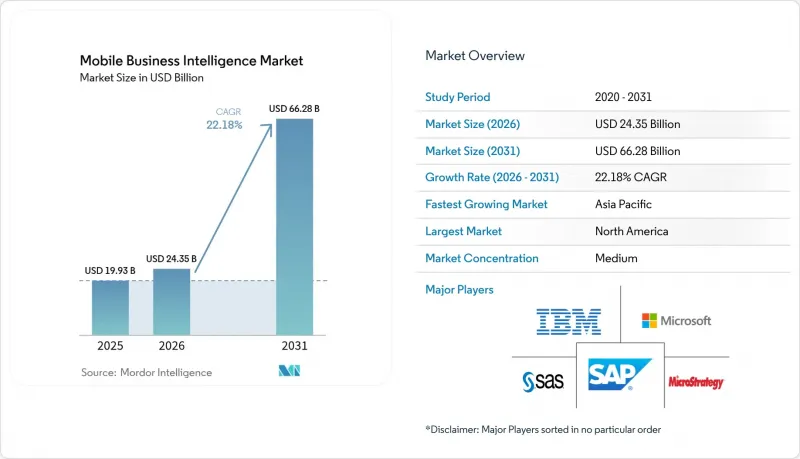
Mordor Intelligence에 의하면, 2026년 모바일 비즈니스 인텔리전스 시장 규모는 243억 5,000만 달러로 추정되고 2025년 199억 3,000만 달러에서 성장하여 2031년에는 662억 8,000만 달러에 이를 것으로 예측됩니다.
2026년부터 2031년까지 연평균 성장률(CAGR) 22.18%로 성장할 것으로 전망됩니다.

본 보고서는 솔루션(소프트웨어 및 서비스), 조직 규모(대기업 및 중소기업(SME)), 용도(영업·마케팅 분석, 재무·리스크 분석 등), 최종 사용자 산업(은행, 금융서비스 및 보험(BFSI), IT 및 통신, 헬스케어 및 생명과학 등), 그리고 지역별로 분류되어 있습니다. 시장 전망은 금액(달러) 기준으로 제시되어 있습니다.
세계의 모바일 비즈니스 인텔리전스 시장 동향 및 인사이트
대기업에서의 클라우드 퍼스트형 모바일 BI 도입
대기업은 On-Premise 시스템에서 클라우드 네이티브 모바일 BI로 전환하고 있으며, 이를 통해 전 세계 직원들이 VPN의 번거로움 없이 대시보드에 액세스할 수 있게 되었습니다. 5만 2,000개 이상의 기업이 Microsoft Power BI를 적극적으로 활용하여 Microsoft 365 워크스트림에 분석 기능을 통합하고 있습니다. 이러한 전환을 통해 서버 유지 관리가 불필요해지고, 이용량이 급증할 때 리소스가 탄력적으로 확장되므로 총 소유 비용(TCO)이 절감됩니다. SAP Analytics Cloud 역시 엄격한 ID 관리를 유지하면서 실시간 트랜잭션 데이터와 모바일 시각화 기능을 연동하고 있습니다. 이 모델이 보급됨에 따라, 과거 클라우드 전환에 소극적이었던 규제 대상 산업에서도 모바일 비즈니스 인텔리전스 시장의 침투가 깊어지고 있습니다.
실시간 분석을 가능하게 하는 5G/엣지 도입의 급증
현재 아시아태평양 7개국에서 독립적인 5G 네트워크가 가동 중이며, 응답성이 높은 분석을 중시하는 8,800억 달러 규모의 지역 모바일 경제를 뒷받침하고 있습니다. 엣지 컴퓨팅은 처리를 로컬 게이트웨이로 이전하기 때문에 모바일 대시보드는 밀리초 단위로 업데이트됩니다. 이는 공장의 예측 유지보수 알림이나 소매업의 재고 조사 결정에 필수적인 기능입니다. 도쿄의 금융 거래 데스크에서는 이미 밀리초 미만의 피드를 활용하여 핸드헬드 단말기에서 파생상품 가격 산정을 수행하고 있습니다. 이러한 사례들은 5G와 엣지가 결합되어 모바일 비즈니스 인텔리전스 시장의 활용도를 얼마나 높이고 있는지를 보여줍니다.
개인용 기기에서 뿌리 깊은 보안 및 개인정보 보호에 대한 우려
기업의 60%는 매출 실적 향상이 분명함에도 불구하고, 모바일 보안을 BI의 광범위한 도입에 있어 주요 장벽으로 꼽고 있습니다. BYOD(개인 기기의 업무용 사용) 정책으로 인해 소비자용 앱과 기업용 앱이 혼재되어 정보 유출 위험이 높아지고 있지만, 애플의 새로운 개인정보 보호 대책은 이를 부분적으로만 완화하고 있습니다. 은행이나 병원에서는 모바일 BI 사용을 회사에서 지급한 기기로 제한하는 경우가 많으며, 암호화나 생체 인증을 통한 로그인 기능이 향상되었음에도 불구하고, 고부가가치 산업에서의 보급 속도는 둔화되고 있습니다.
부문별 분석
소프트웨어는 여전히 수익의 기반이며, 시각화 도구, 쿼리 엔진, 거버넌스 계층을 제공하여 2025년에는 65.92%의 점유율을 차지했습니다. 이러한 제품은 대부분의 기업용 애널리틱스 스택의 기반이 되며, ID 관리 제품군, 데이터 웨어하우스, 로우코드 플랫폼과 통합되어 있습니다. 그럼에도 불구하고, 도입, 맞춤화, 관리형 운영에 대한 수요가 급증함에 따라 서비스 제공업체들은 라이선스 공급업체보다 더 빠르게 계약을 확보하고 있습니다. 많은 고객은 현재 사내 팀의 자원이 부족하여 대규모 언어 모델, 엣지 배포 스크립트, 제로 트러스트 제어의 미세 조정을 외부에 위탁하고 있습니다. 조직이 순수한 소프트웨어 지출에서 성과 기반 계약으로 전환함에 따라, 모바일 비즈니스 인텔리전스 시장의 서비스 규모는 2031년까지 높은 두 자릿수 CAGR로 성장할 것으로 예측됩니다.
컨설팅 기업들은 데이터 엔지니어링, 사용자 교육 및 운영 개시 후 최적화를 패키지로 제공하여, 고객이 운영을 시작한 직후부터 가치를 창출할 수 있도록 지원하고 있습니다. 매니지드 서비스 파트너들은 모바일 앱 패치 적용, 사용 현황 모니터링 및 시맨틱 레이어 개선을 위해 다년 계약을 체결하고 있으며, 이를 통해 사업 부서는 플랫폼 유지 관리 대신 인사이트 활용에 집중할 수 있게 됩니다. MicroStrategy의 Google Cloud 마켓플레이스 등재는 이러한 추세를 여실히 보여줍니다. 자동화된 프로비저닝을 통해 도입 기간이 단축되는 한편, 인증 파트너가 지속적인 거버넌스를 담당합니다. 이러한 동향은 셀프 서비스형 도구의 기능이 향상되는 가운데서도 서비스 주도형 성장 궤도가 지속될 것임을 뒷받침합니다.
2025년에는 대기업이 매출의 74.35%를 차지했습니다. 이는 대기업이 세계 사업 전개, 풍부한 IT 인력, 그리고 견고한 모바일 BI 제품군 도입을 뒷받침하는 규정 준수 의무를 지고 있기 때문입니다. 대기업은 ERP 및 CRM 워크플로우에 분석 차트를 통합하여 수천 명의 직원이 현장에서 KPI를 추적할 수 있도록 하고 있습니다. 다중 테넌트 거버넌스, 싱글 사인온(SSO), 세밀한 역할 제어는 금융, 의료, 공공 부문의 감사 담당자들을 만족시키고 있습니다. 이러한 대기업의 우위에도 불구하고, 턴키 방식의 SaaS로 인해 진입 장벽이 낮아지면서 현재는 중소기업 부문이 가장 빠른 성장세를 보이고 있습니다.
중소기업은 종량제 구독, 자동 확장, 그리고 익숙한 생산성 제품군 내에 표시되는 마법사 기반 보고서 작성 도구를 높이 평가했습니다. 창업자들이 고가의 On-Premise형 데이터베이스를 구축하지 않고도 현금 흐름, 재고, 고객 감정을 즉시 파악하고자 하는 가운데, 중소기업용 모바일 비즈니스 인텔리전스 시장 규모는 급격히 확대될 것으로 예측됩니다. 크로아티아의 조사 데이터에 따르면, 도입의 성공은 경영진의 지원 및 명확한 실적 목표와 상관관계가 있는 것으로 나타났습니다. 앱 스토어에는 Shopify, QuickBooks, Stripe용 기성 커넥터가 넘쳐나며, 중소기업은 데이터 사이언스자를 고용하지 않고도 데이터 중심 문화를 도입할 수 있습니다. 이는 이 계층이 모바일 비즈니스 인텔리전스 업계 전체를 상회하는 성장을 지속할 수 있는 이유를 여실히 보여줍니다.
지역별 분석
2025년, 북미는 전 세계 매출의 36.25%를 차지했습니다. 그 배경에는 LTE-Advanced의 광범위한 보급, 5G의 신속한 전개, 그리고 모바일 보안 프레임워크에 대한 기업의 숙련도가 있습니다. 실리콘밸리의 벤더들은 음성 쿼리나 카메라를 통한 데이터 수집과 같은 새로운 기능을 전 세계 출시보다 앞서 국내에서 시범 도입하고 있으며, 이는 이 지역에 조기 생산성 향상을 가져오고 있습니다. Microsoft Entra ID 및 Okta와의 긴밀한 연동을 통해 데스크톱에서 스마트폰으로의 ID 연동이 간소화되어 활성 사용자 수가 증가하고 있습니다. 또한 인건비 급등은 기업이 분석 주도형 효율화를 추구하게 하는 동기가 되어, 모바일 비즈니스 인텔리전스 시장의 업그레이드에 대한 지속적인 예산 배정을 보장하고 있습니다.
아시아태평양은 각국 정부가 5G 주파수 대역에 대한 보조금을 지급하고, 국경 내 클라우드 지역을 우선시하는 데이터 현지화를 의무화하고 있기 때문에 2031년까지 연평균 성장률(CAGR)이 22.85%를 나타낼 것으로 예측되며, 두드러진 성장세를 보이고 있습니다. 중국의 대형 전자상거래 기업들은 페타바이트 규모의 텔레메트리 데이터를 실시간 대시보드에 반영하여, 몇 분 단위로 플래시 세일을 최적화하고 있습니다. 인도의 ‘통합 결제 인터페이스(UPI)’는 하루 수십억 건의 거래 데이터를 분석용 클라우드로 전송하여, 은행이 지방 대리점이 소지한 스마트폰에서 부정 감지 모델을 정교화할 수 있도록 하고 있습니다. 많은 아세안(ASEAN) 국가의 제조업체들은 기존의 MES 시스템을 건너뛰고 모바일 대시보드를 가장 먼저 도입하고 있으며, 이러한 ‘도약적 효과’로 인해 모바일 비즈니스 인텔리전스 시장 규모는 다른 어느 지역보다 빠르게 확대되고 있습니다.
유럽에서는 GDPR(EU 개인정보보호규정), 지속가능성 목표, 그리고 인더스트리 5.0 전략의 영향으로 꾸준한 성장이 나타나고 있습니다. 유틸리티자는 모바일 BI를 활용해 재생에너지의 발전 상황을 모니터링하고, 자동차 제조업체는 휴대용 분석 도구를 이용해 ‘저스트-인-시퀀싱(Just-in-Sequence)’ 배송을 조정하고 있습니다. 엄격한 개인정보 보호 규제로 인해 가명화 및 기기 내 암호화가 촉진되고 있어 개발의 복잡성은 증가하고 있지만, 이는 규정 준수 감사를 통과한 벤더의 차별화 요소로도 작용하고 있습니다. 한편, 라틴아메리카 및 중동 및 아프리카에서는 새로운 시장이 개척되고 있습니다. 브라질의 실시간 결제 네트워크 ‘PIX’는 모바일 인사이트를 갈망하는 핀테크 기업에 행동 데이터를 제공합니다. 걸프 지역의 통신 사업자들은 분석 대시보드를 기업용 데이터 요금제에 묶어, 유전 운영사, 병원, 스마트 시티 관리자들에게 모빌리티와 인텔리전스를 통합한 원스톱 솔루션을 판매하고 있습니다.
기타 혜택 :
- 엑셀 형식 시장 예측(ME) 시트
- 3개월간의 애널리스트 지원
자주 묻는 질문
목차
제1장 서론
제2장 조사 방법
제3장 주요 요약
제4장 시장 구도
제5장 시장 규모 및 성장 예측
제6장 경쟁 구도
제7장 시장 기회 및 향후 전망
KTH 26.09.08According to Mordor Intelligence, mobile business intelligence market size in 2026 is estimated at USD 24.35 billion, growing from 2025 value of USD 19.93 billion with 2031 projections showing USD 66.28 billion, growing at 22.18% CAGR over 2026-2031.
This report is Segmented by Solution (Software and Services), Organization Size (Large Enterprises and Small and Medium Enterprises (SMEs)), Application (Sales and Marketing Analytics, Finance and Risk Analytics, and More), End-User Vertical (BFSI, IT and Telecommunications, Healthcare and Life Sciences, and More), and Geography. The Market Forecasts are Provided in Terms of Value (USD).
Global Mobile Business Intelligence Market Trends and Insights
Cloud-first Mobile BI Adoption Among Large Enterprises
Large corporations are swapping on-premises stacks for cloud-native mobile BI so global staff can reach dashboards without VPN friction. More than 52,000 companies actively use Microsoft Power BI, embedding analytics into Microsoft 365 work streams. The shift lowers total cost of ownership because server upkeep disappears and elastic resources scale during peak usage. SAP Analytics Cloud similarly links live transactional data with mobile visualizations while preserving strict identity controls. As this model proliferates, mobile business intelligence market penetration deepens across regulated sectors that once resisted cloud migration.
Surge in 5G/Edge Deployments Enabling Real-time Analytics
Standalone 5G networks now run in seven Asia-Pacific countries, undergirding a USD 880 billion regional mobile economy that prizes responsive analytics. Edge computing moves processing to local gateways so mobile dashboards refresh in milliseconds, a necessity for factory predictive-maintenance alerts and retail shelf-stocking decisions. Financial-trading desks in Tokyo already exploit sub-millisecond feeds to price derivatives on handheld devices. These examples illustrate how 5G plus edge collectively raise usage intensity inside the mobile business intelligence market.
Persistent Security and Privacy Concerns on Personal Devices
Sixty percent of enterprises cite mobile security as the main barrier to broader BI rollout despite clear sales-performance gains. BYOD policies mingle consumer and corporate apps, raising leakage risks that new Apple privacy manifests only partly mitigate. Banks and hospitals often restrict mobile BI to company-issued phones, slowing penetration in high-value verticals even as encryption and biometric log-ins improve.
Other drivers and restraints analyzed in the detailed report include:
- BYOD Expansion and MDM Integration in SMEs
- Embedded Analytics Within SaaS Apps and Mobile Workflows
- Limited Mobile Dashboard Usability for Complex Analysis
For complete list of drivers and restraints, kindly check the Table Of Contents.
Segment Analysis
Software remains the revenue cornerstone, supplying visualization tools, query engines and governance layers that earned a 65.92% share in 2025. These offerings anchor most enterprise analytics stacks and integrate with identity suites, data warehouses and low-code platforms. Still, surging demand for implementation, customization and managed operations means service providers are booking faster contracts than license vendors. Many clients now outsource fine-tuning of large language models, edge-deployment scripts and zero-trust controls because internal teams lack bandwidth. The mobile business intelligence market size for services is projected to expand at high double-digit CAGR through 2031 as organizations shift from pure software spend toward outcome-based engagements.
Consulting firms bundle data engineering, user-training and day-two optimization so clients can unlock value soon after go-live. Managed-services partners sign multiyear agreements to keep mobile apps patched, monitor usage and refine semantic layers, freeing business units to focus on insight consumption instead of platform care. MicroStrategy's listing on Google Cloud Marketplace illustrates the trend: automated provisioning trims deployment timelines, while certified partners step in for ongoing governance. These patterns reinforce a service-rich growth arc likely to continue even as self-service tooling improves.
Large enterprises controlled 74.35% revenue in 2025 because they possess global operations, ample IT staff, and compliance obligations that favor robust mobile BI suites. They embed analytic graphs into ERP and CRM workflows so thousands of employees can track KPIs in the field. Multi-tenant governance, single sign-on, and fine-grained role controls satisfy auditors in finance, healthcare, and public-sector domains. Despite this dominance, the small-business segment now logs the briskest expansion as turnkey SaaS lowers entry barriers.
SMEs appreciate pay-as-you-go subscriptions, automated scaling, and wizard-based report builders that appear within familiar productivity suites. The mobile business intelligence market size for SMEs is forecast to climb steeply as founders seek instant visibility into cash flow, inventory, and customer sentiment without spinning up expensive on-prem databases. Croatian survey data shows that adoption success correlates with top-management sponsorship and clear performance targets. As app stores flood with pre-built connectors to Shopify, QuickBooks, and Stripe, smaller firms can join data-driven cultures without hiring data scientists, underscoring why this cohort will keep outpacing the overall mobile business intelligence industry.
Complete Report Scope:
- By Solution
- Software
- Mobile BI Platforms
- Data Visualization Tools
- Dashboard and Reporting Apps
- Services
- Professional Services
- Managed Services
- Software
- By Organization Size
- Large Enterprises
- Small and Medium Enterprises (SMEs)
- By Application
- Sales and Marketing Analytics
- Finance and Risk Analytics
- Operations and Supply-chain Analytics
- HR and Workforce Analytics
- Customer Experience Analytics
- By End-user Vertical
- BFSI
- IT and Telecommunications
- Healthcare and Life Sciences
- Retail and E-commerce
- Government and Public Sector
- Other End-user Verticals
- By Geography
- North America
- United States
- Canada
- Mexico
- Europe
- Germany
- United Kingdom
- France
- Italy
- Spain
- Rest of Europe
- Asia-Pacific
- China
- Japan
- India
- South Korea
- Australia
- Rest of Asia-Pacific
- South America
- Brazil
- Argentina
- Rest of South America
- Middle East and Africa
- Middle East
- Saudi Arabia
- United Arab Emirates
- Turkey
- Rest of Middle East
- Africa
- South Africa
- Egypt
- Nigeria
- Rest of Africa
- Middle East
- North America
Geography Analysis
North America kept 36.25% of global revenue in 2025, anchored by ubiquitous LTE-Advanced coverage, swift 5G roll-outs, and enterprise familiarity with mobile security frameworks. Silicon Valley vendors pilot novel features-voice query, camera-based data capture-domestically before global releases, giving the region early productivity gains. Tight integrations with Microsoft Entra ID and Okta simplify identity propagation from desktop to phone, boosting active-user counts. High labor costs also motivate firms to chase analytics-driven efficiency, ensuring continued budget allocation for upgrades in the mobile business intelligence market.
Asia-Pacific stands out with a projected 22.85% CAGR through 2031 as governments subsidize 5G spectrum and mandate data-localization that favors cloud regions inside national borders. China's e-commerce giants stream petabyte-scale telemetry into real-time dashboards that optimize flash sales in minutes. India's Unified Payments Interface pushes billions of daily transactions into analytics clouds, letting banks refine fraud models on smartphones carried by rural agents. Many ASEAN manufacturers skip legacy MES systems and adopt mobile dashboards first, illustrating a leapfrog effect that expands the mobile business intelligence market size faster than any other region.
Europe posts steady expansion under the weight of GDPR, sustainability targets, and Industry 5.0 strategies. Utilities use mobile BI to monitor renewable generation, while carmakers rely on handheld analytics to coordinate just-in-sequence deliveries. Strict privacy rules encourage pseudonymization and on-device encryption, raising development complexity but also differentiating vendors that pass compliance audits. Meanwhile, Latin America and the Middle East and Africa open fresh territory. Brazil's PIX instant-payment network feeds behavioral data to fintechs hungry for mobile insights. Gulf telcos bundle analytics dashboards with enterprise data plans, selling one-stop mobility plus intelligence to oil-field operators, hospitals, and smart-city managers.
- Microsoft Corporation
- SAP SE
- IBM Corporation
- Salesforce Inc. (Tableau)
- Oracle Corporation
- QlikTech International AB
- SAS Institute
- MicroStrategy Inc.
- TIBCO Software
- Sisense Inc.
- ThoughtSpot Inc.
- Google LLC (Looker)
- Domo Inc.
- Yellowfin International
- Phocas Software
- Zoho Corporation
- Board International
- Dundas Data Visualization
- TARGIT A/S
- e-Zest Solutions Ltd.
- Information Builders Inc.
Additional Benefits:
- The market estimate (ME) sheet in Excel format
- 3 months of analyst support
TABLE OF CONTENTS
1 INTRODUCTION
- 1.1 Study Assumptions and Market Definition
- 1.2 Scope of the Study
2 RESEARCH METHODOLOGY
3 EXECUTIVE SUMMARY
4 MARKET LANDSCAPE
- 4.1 Market Overview
- 4.2 Market Drivers
- 4.2.1 Cloud-first mobile BI adoption among large enterprises
- 4.2.2 Surge in 5G/edge deployments enabling real-time analytics
- 4.2.3 BYOD expansion and MDM integration in SMEs
- 4.2.4 Embedded analytics within SaaS apps and mobile workflows
- 4.2.5 Generative-AI-powered natural language query interfaces
- 4.2.6 Telco-led "network analytics-as-a-service" offerings
- 4.3 Market Restraints
- 4.3.1 Persistent security and privacy concerns on personal devices
- 4.3.2 Limited mobile dashboard usability for complex analysis
- 4.3.3 Data-governance fragmentation across multi-cloud estates
- 4.3.4 App-store policy changes throttling SDK data capture
- 4.4 Value Chain Analysis
- 4.5 Regulatory Landscape
- 4.6 Technological Outlook
- 4.7 Porter's Five Forces Analysis
- 4.7.1 Bargaining Power of Suppliers
- 4.7.2 Bargaining Power of Consumers
- 4.7.3 Threat of New Entrants
- 4.7.4 Threat of Substitutes
- 4.7.5 Intensity of Competitive Rivalry
- 4.8 Assessment of the Impact of Macroeconomic Trends on the Market
5 MARKET SIZE AND GROWTH FORECASTS (VALUE)
- 5.1 By Solution
- 5.1.1 Software
- 5.1.1.1 Mobile BI Platforms
- 5.1.1.2 Data Visualization Tools
- 5.1.1.3 Dashboard and Reporting Apps
- 5.1.2 Services
- 5.1.2.1 Professional Services
- 5.1.2.2 Managed Services
- 5.1.1 Software
- 5.2 By Organization Size
- 5.2.1 Large Enterprises
- 5.2.2 Small and Medium Enterprises (SMEs)
- 5.3 By Application
- 5.3.1 Sales and Marketing Analytics
- 5.3.2 Finance and Risk Analytics
- 5.3.3 Operations and Supply-chain Analytics
- 5.3.4 HR and Workforce Analytics
- 5.3.5 Customer Experience Analytics
- 5.4 By End-user Vertical
- 5.4.1 BFSI
- 5.4.2 IT and Telecommunications
- 5.4.3 Healthcare and Life Sciences
- 5.4.4 Retail and E-commerce
- 5.4.5 Government and Public Sector
- 5.4.6 Other End-user Verticals
- 5.5 By Geography
- 5.5.1 North America
- 5.5.1.1 United States
- 5.5.1.2 Canada
- 5.5.1.3 Mexico
- 5.5.2 Europe
- 5.5.2.1 Germany
- 5.5.2.2 United Kingdom
- 5.5.2.3 France
- 5.5.2.4 Italy
- 5.5.2.5 Spain
- 5.5.2.6 Rest of Europe
- 5.5.3 Asia-Pacific
- 5.5.3.1 China
- 5.5.3.2 Japan
- 5.5.3.3 India
- 5.5.3.4 South Korea
- 5.5.3.5 Australia
- 5.5.3.6 Rest of Asia-Pacific
- 5.5.4 South America
- 5.5.4.1 Brazil
- 5.5.4.2 Argentina
- 5.5.4.3 Rest of South America
- 5.5.5 Middle East and Africa
- 5.5.5.1 Middle East
- 5.5.5.1.1 Saudi Arabia
- 5.5.5.1.2 United Arab Emirates
- 5.5.5.1.3 Turkey
- 5.5.5.1.4 Rest of Middle East
- 5.5.5.2 Africa
- 5.5.5.2.1 South Africa
- 5.5.5.2.2 Egypt
- 5.5.5.2.3 Nigeria
- 5.5.5.2.4 Rest of Africa
- 5.5.5.1 Middle East
- 5.5.1 North America
6 COMPETITIVE LANDSCAPE
- 6.1 Market Concentration
- 6.2 Strategic Moves
- 6.3 Market Share Analysis
- 6.4 Company Profiles (includes Global level Overview, Market level overview, Core Segments, Financials as available, Strategic Information, Market Rank/Share, Products and Services, Recent Developments)
- 6.4.1 Microsoft Corporation
- 6.4.2 SAP SE
- 6.4.3 IBM Corporation
- 6.4.4 Salesforce Inc. (Tableau)
- 6.4.5 Oracle Corporation
- 6.4.6 QlikTech International AB
- 6.4.7 SAS Institute
- 6.4.8 MicroStrategy Inc.
- 6.4.9 TIBCO Software
- 6.4.10 Sisense Inc.
- 6.4.11 ThoughtSpot Inc.
- 6.4.12 Google LLC (Looker)
- 6.4.13 Domo Inc.
- 6.4.14 Yellowfin International
- 6.4.15 Phocas Software
- 6.4.16 Zoho Corporation
- 6.4.17 Board International
- 6.4.18 Dundas Data Visualization
- 6.4.19 TARGIT A/S
- 6.4.20 e-Zest Solutions Ltd.
- 6.4.21 Information Builders Inc.
7 MARKET OPPORTUNITIES AND FUTURE OUTLOOK
- 7.1 White-space and Unmet-need Assessment