
|
시장보고서
상품코드
2119062
중동의 와이어 및 케이블 : 시장 점유율 분석, 산업 동향 및 통계 데이터, 성장 예측(2026-2031년)Middle East Wire and Cable - Market Share Analysis, Industry Trends & Statistics, Growth Forecasts (2026 - 2031) |
||||||
 Mordor Intelligence
Mordor Intelligence에 의하면, 중동의 와이어 및 케이블 시장 규모는 2025년에 46억 7,000만 달러로 평가되었습니다. 2026년 48억 1,000만 달러에서 2031년까지 57억 8,000만 달러에 이를 것으로 추정되고 예측 기간(2026-2031년) CAGR은 3.74%를 나타낼 전망입니다.
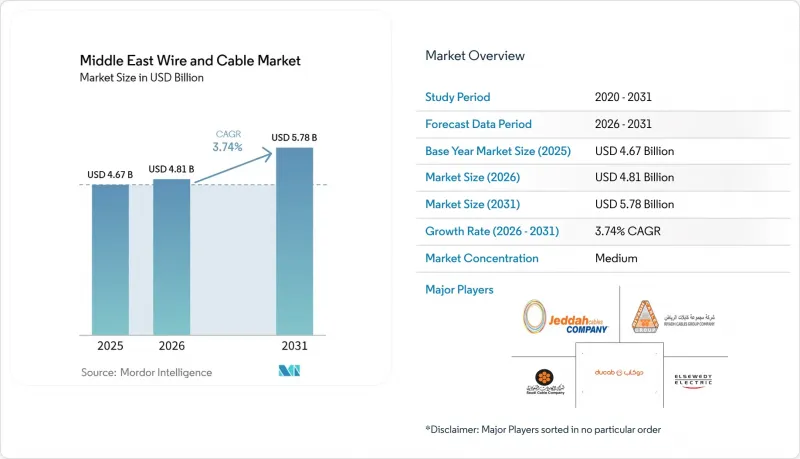
본 보고서는 전압(저전압, 중전압, 초고전압), 케이블 유형(전력 케이블, 광섬유 케이블 등), 도체(구리 등), 매설 방식(가공, 지하, 해저),최종 사용자(건설(주택) 등), 단열(단열재 포함·단열재 미포함), 지역(사우디아라비아, 카타르 등)별로 분류되어 있습니다. 시장 전망은 금액(달러) 기준으로 제시되어 있습니다.
중동의 와이어 및 케이블 시장 동향 및 인사이트
각국의 전력망 확장 및 현대화
각국의 송전망 현대화는 중동의 와이어 및 케이블 시장에서 여전히 가장 강력한 수요 견인 요인으로 작용하고 있습니다. 사우디아라비아 전력공사(SEC)의 조달 활동은 새로운 부하 센터 및 주거지 확장을 위한 중·고전압 시스템 조달을 뒷받침하고 있습니다. 기가 프로젝트의 건설로 인해 송전 연결 및 전력 설비에 대한 수요가 증가하고 있습니다. HVDC(고전압 직류) 프로젝트에서는 주요 송전 시스템 외에도 관련 피더 케이블 및 변전소용 케이블이 필요합니다. 이러한 조합으로 인해 단일 조달 프로젝트가 나타내는 것보다 더 광범위한 케이블 범주에 걸친 수요가 뒷받침되고 있습니다. 입증된 시험 실적을 보유한 공급업체는 이러한 요구 사항을 충족하는 데 유리한 입장에 있습니다.
유틸리티 규모의 재생에너지 및 계통 연계 프로젝트
재생에너지 프로젝트는 태양광 발전용 직류 케이블, 컬렉터 케이블 및 장거리 송전용 도체에 대한 수요를 창출하고 있습니다. 사우디아라비아는 2030년까지 58.7 GW의 재생에너지 발전 용량 목표를 제시하고 있으며, 이는 신규 발전 설비 및 계통 연계에 필요한 향후 몇 년간의 케이블 수요를 뒷받침할 것입니다. 외딴 지역의 태양광 및 풍력 발전소에서는 열과 자외선을 견딜 수 있는 단열재가 필요합니다. 이러한 요건으로 인해 대규모 전력 사업 프로젝트에 참여하는 공급업체에게는 사양 준수가 중요해집니다. 또한 중동의 와이어 및 케이블 시장은 해상 에너지 시스템이 본토의 송전망에 연결될 때에도 혜택을 받게 됩니다. 이 작업에는 전용 해저 케이블, 육상 연결 설비, 그리고 광역 송전망과의 연결이 필요합니다.
구리, 알루미늄, 폴리머의 가격 변동
원자재 가격 변동은 지역 케이블 제조업체에게 가장 시급한 이익률 위험 요소입니다. 2026년 5월 톤당 1만 3,500달러 가까이 치솟은 구리 가격은 구리를 많이 사용하는 제품의 원가를 상승시켰습니다. 고정 가격 인프라 계약의 경우, 계약 체결 후 금속 가격이 변동하면 공급업체는 위험에 노출됩니다. 생산자들은 금속 가격에 연동된 조정 조항을 도입하거나 가격 재검토 빈도를 높임으로써 이에 대응하고 있습니다. 구리 비용 상승은 기술 기준이 허용하는 범위 내에서 엔지니어가 알루미늄이나 복합 도체의 채택을 검토하는 계기가 될 수도 있습니다. 주요 공급업체는 업스트림 원자재를 확보할 수 있거나 단기적인 비용 변동을 흡수할 수 있는 경우 우위를 점할 가능성이 있습니다.
부문별 분석
2025년에는 저전압 케이블이 매출의 50.94%를 차지하며, 중동의 와이어 및 케이블 시장에서 가장 큰 전압 카테고리가 되었습니다. 이 수요의 대부분은 주택 및 상업 건축에서 비롯된 것입니다. NEOM, 딜리야 게이트, ROSHN에서는 단계적인 건설 프로그램을 통해 대량의 건축용 전선이 필요로 되고 있습니다. 저전압 제품은 상업시설 및 공공 건축물 내부의 내부 배전도 지원하고 있습니다. 이러한 수요는 건설 일정, 건축 허가 및 시공사 조달 주기에 따라 달라집니다. 초고압·고압 케이블은 2031년까지 연평균 성장률(CAGR) 3.85%를 나타낼 것으로 예측됩니다. 이는 HVDC(고압 직류 송전) 및 초고압 교류 송전 회랑에 대한 투자를 반영한 것입니다. 이러한 시스템은 새로운 부하 센터를 국가 송전망 및 원격지의 발전 설비와 연결합니다. 중전압 케이블은 도시 지역의 배전, 지하철 연장, 변전소 및 산업 단지에서 여전히 필수적인 역할을 수행하고 있습니다.
리야드 케이블스 그룹은 2026년 5월, TAQA사가 제조한 1×2500 mm² 400 kV 초고압(EHV) 케이블 시스템의 형식 시험을 완료했습니다. 시험은 해당사의 ISO 17025 인증 시험소에서 진행되었습니다. 이번 성과는 그동안 주로 해외 제조업체에 의해 공급되던 전압 등급에 대해 국내에서 제조 능력을 보유하고 있음을 보여줍니다. 기술적 자격을 취득함으로써 우수한 유틸리티 입찰에 참여할 기회가 확대됩니다. EHV 조달 요건에서 IEC 60840 및 IEC 62067의 중요성은 점점 더 커지고 있습니다. 이러한 규격으로 인해 문서화된 시험 실적이 없는 공급업체에 대한 진입 장벽이 높아지고 있습니다. 사전 승인을 받은 공급업체는 이 제한된 인증 기준의 혜택을 누릴 수 있습니다. 신규 진입 공급업체는 시험, 설계 검증 및 프로젝트 실적에 대한 투자가 필요합니다. 중동의 와이어 및 케이블 시장에서는 건설 및 송전망 정비 계획이 병행되어 진행되고 있어, 모든 전압 등급에 걸쳐 폭넓은 수요가 유지되고 있습니다. 이에 따라 건축, 배전, 송전 각 용도에서 균형 잡힌 비즈니스 기회가 창출되고 있습니다.
2025년에는 전력 케이블이 매출의 61.86%를 차지하며 여전히 가장 큰 케이블 유형으로 자리매김했습니다. 에너지 인프라는 여전히 해당 지역의 설비 투자에서 상당한 비중을 차지하고 있습니다. 모든 신규 재생에너지 프로젝트에는 발전, 배전, 송전 시스템이 필요합니다. 사우디아라비아의 재생에너지 계획은 예측 기간 동안 지속적인 전력 케이블 조달을 뒷받침하고 있습니다. 신호 및 제어 제품은 플랜트, 산업 시설, 에너지 시설의 계측에 활용되고 있습니다. 동축 케이블 및 데이터 케이블은 모니터링 및 통신 기능을 뒷받침하고 있습니다. 이러한 용도는 다양한 제품 포트폴리오를 보유한 제조업체에게 지속적인 수요를 창출하고 있습니다. 전력 케이블 수요는 도시 지역의 송전망 업그레이드와 새로운 변전소 건설로부터도 혜택을 받고 있습니다. 전력 시스템이 해당 지역의 대부분의 프로젝트 기반을 이루고 있기 때문에 이 부문은 중동의 와이어 및 케이블 시장에서 여전히 중심적인 위치를 차지하고 있습니다. 그 규모는 신뢰할 수 있는 전력 인프라가 계속해서 우선시되고 있음을 반영합니다.
광섬유 케이블은 2031년까지 연평균 성장률(CAGR) 3.98%를 나타낼 것으로 예측됩니다. 육상 FTTH 네트워크, 5G 백홀 및 해저 시스템이 이러한 성장을 뒷받침하고 있습니다. 해저 프로젝트의 경우, 상륙국이나 내륙 데이터센터로 이어지는 경로를 따라 육상 케이블이 필요합니다. 이로 인해 해저 케이블 분야 그 자체를 넘어선 수요가 발생하고 있습니다. Ooredoo사의 FIG 프로젝트는 계획 중인 지역 간 연결 인프라에 대한 투자 규모를 여실히 보여주고 있습니다. 광섬유 제품은 데이터센터 간 상호 연결 및 구조화된 배선에도 활용되고 있습니다. 하이브리드 케이블 설계를 통해 고전압 송전과 광 센싱을 결합할 수 있습니다. 이러한 제품은 유틸리티 사업자가 공유 경로상의 온도나 변형을 모니터링하는 데 도움이 됩니다. 따라서 전력 케이블이 여전히 주요 카테고리인 반면, 디지털 인프라로 인해 케이블의 유형은 다양해지고 있습니다. 이로 인해 부가가치가 높은 특수 제품으로의 점진적인 전환이 촉진되고 있습니다.
기타 혜택 :
- 엑셀 형식 시장 예측(ME) 시트
- 3개월간의 애널리스트 지원
자주 묻는 질문
목차
제1장 서론
제2장 분석 방법
제3장 주요 요약
제4장 시장 구도
제5장 시장 규모 및 성장 예측
제6장 경쟁 구도
제7장 시장 기회 및 향후 전망
KTH 26.09.04According to Mordor Intelligence, the Middle East wire and cable market size was valued at USD 4.67 billion in 2025 and estimated to grow from USD 4.81 billion in 2026 to reach USD 5.78 billion by 2031, at a CAGR of 3.74% during the forecast period (2026-2031).
This report is Segmented by Voltage (Low, Medium, and Extra- and High-Voltage), Cable Type (Power, Fiber-Optic, and More), Conductor (Copper, and More), Installation (Overhead, Underground, and Submarine), End-User (Construction - Residential, and More), Insulation (Insulated and Non-Insulated) and Geography (Saudi Arabia, Qatar, and More). The Market Forecasts are Provided in Terms of Value (USD).
Middle East Wire and Cable Market Trends and Insights
Expansion and Modernization of National Electricity Grids
National grid modernization remains the strongest demand driver for the Middle East wire and cable market. Saudi Electricity Company procurement supports the procurement of medium- and high-voltage systems for new load centers and residential expansion. Giga-project construction adds to the need for transmission connections and utility equipment. HVDC projects require associated feeder and substation cables in addition to their main transmission systems. This combination supports demand across more cable categories than a single procurement award may show. Suppliers with established testing credentials are well placed to respond to these requirements.
Utility-Scale Renewable Energy and Grid-Integration Projects
Renewable projects create demand for solar DC cables, collector cables, and long-distance transmission conductors. Saudi Arabia has a 58.7 GW renewable capacity target for 2030, which supports multi-year cable needs for new generation and grid connections. Remote solar and wind sites require insulation that can tolerate heat and ultraviolet exposure. These requirements make compliance with specifications important for suppliers serving premium utility projects. The Middle East wire and cable market also benefits when offshore energy systems connect to mainland grids. This work requires specialized marine cables, landfall equipment, and links to the wider grid.
Copper, Aluminum, and Polymer Price Volatility
Raw-material volatility is the most immediate margin risk for regional cable manufacturers. Copper prices near USD 13,500 per tonne in May 2026 raised costs for products that use copper intensively. Fixed-price infrastructure contracts expose suppliers when metal prices change after contract award. Producers are responding through metal-linked adjustment clauses and more frequent price resets. Higher copper costs can also encourage engineers to consider aluminum or composite conductors where technical rules allow. Larger suppliers may gain an advantage when they can secure upstream materials or absorb short-term cost movements.
Other drivers and restraints analyzed in the detailed report include:
- Mega-Project, Transport Network, and Smart-City Construction
- Data Center, 5G, FTTH, and Submarine Connectivity Expansion
- Fragmented National Standards, Testing, and Certification Requirements
For complete list of drivers and restraints, kindly check the Table Of Contents.
Segment Analysis
Low-voltage cables accounted for 50.94% of revenue in 2025, making them the largest voltage category in the Middle East wire and cable market. Residential and commercial construction account for much of this demand. NEOM, Diriyah Gate, and ROSHN require large volumes of building wire through phased construction programs. Low-voltage products also support internal distribution within commercial sites and public buildings. Their demand depends on construction schedules, building approvals, and contractor purchasing cycles. Extra- and high-voltage cables are forecast to grow at a 3.85% CAGR through 2031. This reflects investment in HVDC and extra-high-voltage alternating-current corridors. These systems link new load centers with national grids and remote generation assets. Medium-voltage cables remain essential for urban distribution, metro extensions, substations, and industrial parks.
Riyadh Cables Group completed type testing for a TAQA 1X2500 mm2 400 kV EHV cable system in May 2026. The testing took place at the company's ISO 17025-accredited laboratory. The event indicates a domestic capability for a voltage class previously supplied mainly by foreign producers. Technical qualification can improve access to premium utility tenders. IEC 60840 and IEC 62067 are increasingly important in EHV procurement requirements. These standards raise the entry threshold for suppliers without documented testing credentials. Pre-approved suppliers can benefit from this restricted qualification base. New suppliers must invest in testing, design validation, and project references. The Middle East wire and cable market retains a broad need for all voltage classes because construction and grid programs advance together. This creates a balanced opportunity across building, distribution, and transmission applications.
Power cables commanded 61.86% of revenue in 2025 and remained the largest cable type. Energy infrastructure continues to receive a significant share of regional capital spending. Every new renewable project needs collection, distribution, and transmission systems. Saudi Arabia's renewable energy program supports sustained power cable procurement over the forecast period. Signal and control products serve instrumentation in plants, industrial facilities, and energy sites. Coaxial and data cables support monitoring and communications functions. These applications provide recurring demand for producers with varied product portfolios. Power cable demand also benefits from urban grid upgrades and new substations. The category remains central to the Middle East wire and cable market because electricity systems underpin most regional projects. Its scale reflects the continuing priority placed on reliable power infrastructure.
Fiber-optic cable is expected to grow at a 3.98% CAGR through 2031. Terrestrial FTTH networks, 5G backhaul, and submarine systems support that expansion. Submarine projects require land-based cables at landing stations and along routes to inland data centers. This creates demand beyond the marine cable section itself. Ooredoo's FIG project shows the scale of planned regional connectivity investment. Fiber products are also used in data-center interconnects and structured cabling. Hybrid cable designs can combine high-voltage transmission with optical sensing. Such products can help utilities monitor temperature and strain on a shared route. Digital infrastructure therefore broadens the cable type mix while power cable remains the dominant category. This supports a gradual shift toward higher-value specialty products.
Complete Report Scope:
- By Voltage
- Extra- and High-Voltage (Greater Than 35 kV)
- Medium-Voltage (1-35 kV)
- Low-Voltage (Less Than 1 kV)
- By Cable Type
- Power Cable
- Fiber-Optic Cable
- Signal and Control Cable
- Coaxial and Data Cable
- By Conductor Material
- Copper
- Aluminum
- Optical Glass/Polymer
- By Installation
- Overhead
- Underground
- Submarine
- By End-User Vertical
- Construction - Residential
- Construction - Commercial
- Power Infrastructure (Utilities and Renewables)
- Telecommunications and Data Centers
- Oil and Gas and Petrochemicals
- Automotive and Mobility
- Industrial Manufacturing
- By Insulation
- Insulated
- Non-Insulated
- By Country
- Saudi Arabia
- United Arab Emirates
- Qatar
- Israel
- Turkey
- Kuwait
- Oman
- Bahrain
- Rest of Middle East
List of Companies Covered in this Report:
- Riyadh Cables Group
- Jeddah Cables Company
- Ducab Group
- Elsewedy Electric
- Saudi Cable Company
- Bahra Advanced Cable Manufacture Co.
- Oman Cables Industry SAOG
- National Cable Industry
- Arabian Cables Company
- Doha Cables
- Qatar International Cables Company
- Prysmian S.p.A.
- Nexans S.A.
- NKT A/S
- LS Cable and System Ltd.
- Sumitomo Electric Industries, Ltd.
- Furukawa Electric Co., Ltd.
- Fujikura Ltd.
- ABB Ltd.
- Hitachi Energy Ltd.
Additional Benefits:
- The market estimate (ME) sheet in Excel format
- 3 months of analyst support
TABLE OF CONTENTS
1 INTRODUCTION
- 1.1 Study Assumptions and Market Definition
- 1.2 Scope of the Study
2 RESEARCH METHODOLOGY
3 EXECUTIVE SUMMARY
4 MARKET LANDSCAPE
- 4.1 Market Overview
- 4.2 Market Drivers
- 4.2.1 Expansion and Modernization of National Electricity Grids
- 4.2.2 Utility-Scale Renewable Energy and Grid-Integration Projects
- 4.2.3 Construction of Mega-Projects, Transport Networks, and Smart Cities
- 4.2.4 Data Center, 5G, Fiber-to-the-Home, and Submarine Connectivity Expansion
- 4.2.5 Energy Diversification and Industrial Localization Under National Vision Programs
- 4.2.6 Climate-Resilient Cable Specifications for Desert and Coastal Infrastructure
- 4.3 Market Restraints
- 4.3.1 Copper, Aluminum, and Polymer Price Volatility
- 4.3.2 Fragmented National Standards, Testing, and Certification Requirements
- 4.3.3 Extreme Heat, Ultraviolet Exposure, Sandstorms, and Coastal Corrosion
- 4.3.4 Counterfeit, Substandard, and Non-Compliant Cable Imports
- 4.4 Industry Supply Chain Analysis
- 4.5 Regulatory Landscape
- 4.6 Technological Outlook
- 4.7 Impact of Macroeconomic Factors on the Market
- 4.8 Investment Analysis
- 4.9 Porter's Five Forces Analysis
- 4.9.1 Bargaining Power of Suppliers
- 4.9.2 Bargaining Power of Buyers
- 4.9.3 Threat of New Entrants
- 4.9.4 Threat of Substitutes
- 4.9.5 Intensity of Competitive Rivalry
5 MARKET SIZE AND GROWTH FORECASTS (VALUE)
- 5.1 By Voltage
- 5.1.1 Extra- and High-Voltage (Greater Than 35 kV)
- 5.1.2 Medium-Voltage (1-35 kV)
- 5.1.3 Low-Voltage (Less Than 1 kV)
- 5.2 By Cable Type
- 5.2.1 Power Cable
- 5.2.2 Fiber-Optic Cable
- 5.2.3 Signal and Control Cable
- 5.2.4 Coaxial and Data Cable
- 5.3 By Conductor Material
- 5.3.1 Copper
- 5.3.2 Aluminum
- 5.3.3 Optical Glass/Polymer
- 5.4 By Installation
- 5.4.1 Overhead
- 5.4.2 Underground
- 5.4.3 Submarine
- 5.5 By End-User Vertical
- 5.5.1 Construction - Residential
- 5.5.2 Construction - Commercial
- 5.5.3 Power Infrastructure (Utilities and Renewables)
- 5.5.4 Telecommunications and Data Centers
- 5.5.5 Oil and Gas and Petrochemicals
- 5.5.6 Automotive and Mobility
- 5.5.7 Industrial Manufacturing
- 5.6 By Insulation
- 5.6.1 Insulated
- 5.6.2 Non-Insulated
- 5.7 By Country
- 5.7.1 Saudi Arabia
- 5.7.2 United Arab Emirates
- 5.7.3 Qatar
- 5.7.4 Israel
- 5.7.5 Turkey
- 5.7.6 Kuwait
- 5.7.7 Oman
- 5.7.8 Bahrain
- 5.7.9 Rest of Middle East
6 COMPETITIVE LANDSCAPE
- 6.1 Market Concentration
- 6.2 Strategic Moves
- 6.3 Vendor Positioning Analysis
- 6.4 Company Profiles (includes Global Level Overview, Market Level Overview, Core Segments, Financials as available, Strategic Information, Market Rank/Share, Products and Services, Recent Developments)
- 6.4.1 Riyadh Cables Group
- 6.4.2 Jeddah Cables Company
- 6.4.3 Ducab Group
- 6.4.4 Elsewedy Electric
- 6.4.5 Saudi Cable Company
- 6.4.6 Bahra Advanced Cable Manufacture Co.
- 6.4.7 Oman Cables Industry SAOG
- 6.4.8 National Cable Industry
- 6.4.9 Arabian Cables Company
- 6.4.10 Doha Cables
- 6.4.11 Qatar International Cables Company
- 6.4.12 Prysmian S.p.A.
- 6.4.13 Nexans S.A.
- 6.4.14 NKT A/S
- 6.4.15 LS Cable and System Ltd.
- 6.4.16 Sumitomo Electric Industries, Ltd.
- 6.4.17 Furukawa Electric Co., Ltd.
- 6.4.18 Fujikura Ltd.
- 6.4.19 ABB Ltd.
- 6.4.20 Hitachi Energy Ltd.
7 MARKET OPPORTUNITIES AND FUTURE OUTLOOK
- 7.1 White-Space and Unmet-Need Assessment