

|
시장보고서
상품코드
2119073
넷 제로 에너지 빌딩 : 시장 점유율 분석, 업계 동향 및 통계, 성장 예측(2026-2031년)Net-Zero Energy Buildings - Market Share Analysis, Industry Trends & Statistics, Growth Forecasts (2026 - 2031) |
||||||
 Mordor Intelligence
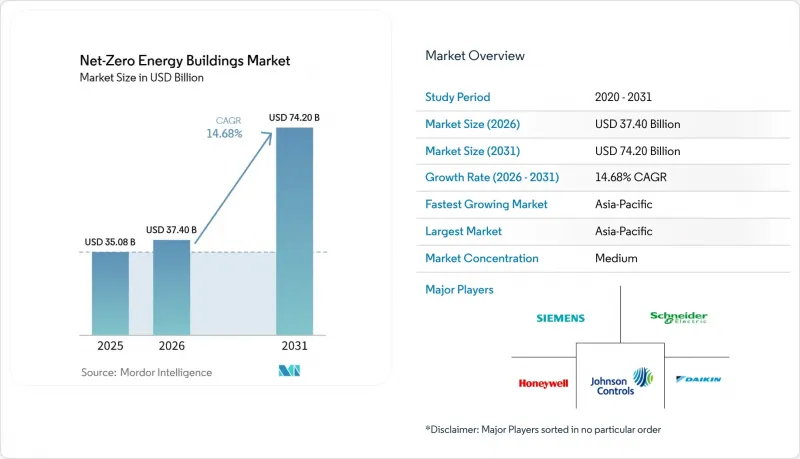
Mordor Intelligence에 의하면, 넷 제로 에너지 빌딩 시장 규모는 2025년에 350억 8,000만 달러로 평가되었습니다. 2026년 374억 달러에서 2031년까지 742억 달러에 이를 것으로 예상되며, 예측 기간(2026-2031년) CAGR은 14.68%를 나타낼 전망입니다.
본 보고서는 건축물 유형(주거, 상업시설, 공공시설, 산업 시설), 제공 내용(솔루션 및 서비스), 건설 유형(신축 및 개보수), 지역(북미, 유럽, 아시아태평양, 남미, 중동 및 아프리카)별로 분류되어 있습니다. 시장 예측은 금액(달러) 기준으로 제시되어 있습니다.
세계의 넷 제로 에너지 빌딩 시장 동향 및 인사이트
규제 요건 및 건축 기준
건축 기준은 단순히 최소 기준을 정하는 데 그치지 않고, 프로젝트 수요를 점점 더 주도하고 있습니다. 2024년 5월부터 시행되고 있는 EU의 ‘건축물의 에너지 성능에 관한 지침(개정판)’에 따르면, 2028년 1월 이후 공공 기관이 소유한 모든 신축 건축물에 대해 제로 배출을 의무화하고 있습니다. 이 요건은 2030년 1월부터는 기타 모든 신축 건축물로도 확대됩니다. 회원국은 2026년 5월 29일까지 이 지침을 국내법에 반영해야 합니다. 또한, 유럽위원회는 27개 회원국 모두가 이 기한을 지키지 못했음을 확인하고, 2026년 7월에 각 회원국에 대해 위반 절차를 개시한 사실도 명시되어 있습니다.
영국의 ‘미래 주택 및 건축 기준(Future Homes and Buildings Standards)’은 2027년 3월 24일에 시행됩니다. 이 기준에 따르면 신축 주택의 경우 부지 내 재생에너지 발전(실질적으로는 옥상 태양광 발전)을 법적으로 의무화할 뿐만 아니라, 저탄소 난방 시스템 도입도 의무화됩니다.
유럽 이외의 지역에서도 규제가 강화되고 있습니다. 캘리포니아주의 ‘2025년 타이틀 24 건축물 에너지 효율 기준’에서는 태양광 발전 및 배터리 저장 장치 설치 요건이 비주거용 건물 및 고층 공동주택으로 확대됩니다. 이러한 기준은 캘리포니아주의 기존 주택용 태양광 발전 의무화를 기반으로 하며, 캘리포니아주가 내세운 ‘2045년까지 넷 제로 달성’이라는 보다 광범위한 목표를 향한 시장의 진전을 뒷받침하는 것입니다.
재생에너지 통합 및 스마트 기술
운영 관리 방식은 건설 후에도 건물이 넷 제로 성능을 유지할 수 있는지 여부를 좌우합니다. Trane Technologies와 Amazon은 BrainBox AI를 활용한 3곳의 풀필먼트 센터에서 진행한 시범 사업을 통해 에너지 사용량을 약 15% 절감했다고 보고했습니다. 양사는 2026년에 30곳 이상의 Amazon Grocery 풀필먼트 센터에 이 시스템을 도입할 것이라고 발표했습니다. 스마트 제어 시스템은 HVAC 설비, 분산형 발전, 에너지 저장 시스템 및 사용 현황을 통합적으로 조정할 수 있습니다. 건축 기준이 실측된 성능을 중시하는 방향으로 전환됨에 따라, 규정 준수를 위한 모니터링과 최적화의 중요성이 커지고 있습니다. 이에 따라 넷 제로 에너지 빌딩 시장에서 디지털 빌딩 관리 도구에 대한 지속적인 수요가 발생하고 있습니다.
높은 초기 투자 비용
넷 제로 에너지 빌딩의 건설 비용은 일반적으로 기존 건물보다 5-15% 더 높습니다. 이러한 비용 증가는 단열 성능 향상, 고성능 창문 및 기밀성이 높은 외피, 효율적인 공조·히트펌프 시스템, 그리고 태양광 발전 등 부지 내 재생에너지 발전에 기인합니다. 일반적인 주택 프로젝트의 경우, 추가 초기 비용은 약 15,000-5만 달러 범위이지만, 상업 프로젝트에서는 규모나 시스템의 복잡성에 따라 그에 비례하여 더 높은 비용이 발생합니다.
에너지 절약 효과로 인해 이러한 비용은 시간이 지남에 따라 상쇄됩니다. 투자 회수 기간은 주거용 건물의 경우 보통 8-15년, 상업용 건물의 경우 10-20년이며, 그 기간 동안 에너지 비용이 제로가 되거나 대폭 절감됩니다. 그러나 초기 투자액과 절감 효과 실현 사이의 격차가 지속적인 경제적 장벽으로 작용하고 있습니다. 이 과제는 건설 중 자금 조달 제약에 직면한 개발업자나 구매자, 혹은 투자 회수를 완전히 누릴 수 있을 만큼 장기간 자산을 보유할 전망이 없는 경우에 특히 심각합니다.
부문별 분석
공공시설은 2031년까지 연평균 성장률(CAGR) 15.6%를 나타낼 것으로 예측되며, 이는 건축물 유형 중 가장 높은 성장률입니다. 병원, 학교, 공공시설은 공공 부문이 정한 배출량 감축 요건에 직면해 있습니다. 영국 국민보건서비스(NHS)는 2028년부터 2032년까지 배출량을 80% 감축하고, 2040년까지 탄소 중립을 달성하는 것을 목표로 하고 있습니다. 2025년 9월, 체스터 백작부인 병원이 잉글랜드 최초로 인증을 받은 NHS 넷 제로 건물로 인정받았습니다. 이러한 공공 부문의 약속으로 인해 공공시설 프로젝트는 재량적 투자 주기에 대한 의존도를 낮추고 있습니다.
2025년, 넷 제로 에너지 시장에서 상업용 건물의 점유율은 43.8%를 차지했습니다. 기업의 보고 요건, 인증된 공간에 대한 임차인 수요, 그리고 측정 가능한 에너지 절감 효과가 이러한 위상을 뒷받침했습니다. 투자자들은 대규모 상업용 자산의 운영 비용 성과를 보다 쉽게 평가할 수 있습니다. 주거 및 산업용 프로젝트의 점유율은 낮았으나, 새로운 건축 기준 요건과 기업의 시설 탈탄소화 프로그램에 힘입어 성장세를 보였습니다. 따라서 넷 제로 에너지 빌딩 업계에는 다양한 건축 용도에 걸친 수요가 존재하지만, 상업용 자산이 여전히 최대의 수익원입니다.
지역별 분석
아시아태평양은 2025년에 넷 제로 에너지 빌딩 시장의 37.1%를 차지했으며, 2031년까지 연평균 성장률(CAGR) 16.8%로 성장할 것으로 전망됩니다. 태양광 발전, 히트 펌프, 단열재 분야에서 중국의 제조 규모가 이 지역의 보급을 뒷받침하고 있습니다. 인도의 지속가능성 프레임워크와 그린 파이낸스 정책은 자본을 상업용 및 공공시설용 자산으로 유도하고 있습니다. 일본은 ‘탑러너(Top Runner)’ 프로그램을 통해 에너지 기준을 지속적으로 강화하고 있습니다. 한국, 싱가포르, 호주 역시 신축 및 공공 부문 리모델링에서 제로 배출 건축 이니셔티브를 추진하고 있습니다.
북미는 지역별 기여도에서 두 번째로 큰 비중을 차지했습니다. 캘리포니아주의 ‘2025년 타이틀 24 제6부 에너지 코드’가 2026년 1월 1일부터 시행됨에 따라, 비주거용 및 고층 공동주택에 대한 태양광 발전 및 배터리 저장 장치 설치 요건이 확대되었습니다. 뉴욕주가 2026년부터 2030년까지 시행하는 54억 달러 규모의 프로그램은 에너지 절약 및 전기화 공사에 대한 막대한 수요를 창출하고 있습니다. 캐나다의 ‘딥 리트로핏 액셀러레이터 이니셔티브’도 상업시설, 공공시설 및 주택의 개보수 활동을 지원하고 있습니다. 이러한 정책들은 넷 제로 에너지 빌딩 시장에서 신축 및 개보수 모두를 촉진하고 있습니다.
다룬 지역 중 유럽은 가장 잘 정비된 규제 체계를 갖추고 있습니다. EU 회원국들은 개정된 ‘건물의 에너지 성능에 관한 지침’을 국내법에 반영해야 하는 기한인 2026년 5월을 맞이했습니다. 이 지침에 따라 지역 전체의 신규 공공 및 민간 건축물에 대한 준수 일정이 통일되었습니다. 남미, 중동 및 아프리카는 여전히 초기 단계에 있으며, 도입은 상업 프로젝트나 정부 소유 프로젝트에 집중되어 있습니다. 이 지역들의 프로젝트 파이프라인은 각국의 평가 프로그램 및 개발 금융 지원에 의존하고 있습니다.
기타 혜택 :
- 엑셀 형식 시장 예측(ME) 시트
- 3개월간의 애널리스트 지원
자주 묻는 질문
목차
제1장 서론
제2장 조사 방법
제3장 개요
제4장 시장 동향 및 분석
제5장 시장 규모 및 성장 예측(2020-2031년)
제6장 경쟁 구도
제7장 시장 기회 및 향후 전망
KTH 26.09.02According to Mordor Intelligence, the Net-Zero energy buildings market size was valued at USD 35.08 billion in 2025 and is estimated to grow from USD 37.40 billion in 2026 to reach USD 74.20 billion by 2031, at a CAGR of 14.68% during the forecast period (2026-2031).
This report is Segmented by Building Type (Residential, Commercial, Institutional, and Industrial), Offerings (Solutions and Services), Construction Type (New Construction and Renovation), and Geography (North America, Europe, Asia-Pacific, South America, and Middle East and Africa). The Market Forecasts are Provided in Terms of Value (USD).
Global Net-Zero Energy Buildings Market Trends and Insights
Regulatory Mandates and Building Standards
Building codes increasingly drive project demand rather than merely set minimum standards. The EU's recast Energy Performance of Buildings Directive, in force since May 2024, requires all new buildings owned by public bodies to be zero-emission from January 2028. The requirement will extend to all other new buildings from January 2030. Member states must transpose the directive into national law by May 29, 2026. The text also notes that the European Commission confirmed that all 27 member states missed this deadline and opened infringement procedures against them in July 2026.
The UK's Future Homes and Buildings Standards will take effect on March 24, 2027. They will introduce a legal requirement for on-site renewable electricity generation, effectively rooftop solar, in new dwellings, along with mandatory low-carbon heating.
Mandates are also tightening outside Europe. California's 2025 Title 24 Building Energy Efficiency Standards will extend photovoltaic and battery storage requirements to nonresidential and high-rise multifamily buildings. These standards build on the state's existing residential solar mandate and support the market's progress toward California's broader net-zero-by-2045 target.
Renewable Integration and Smart Technologies
Operational controls determine whether a building maintains net-zero performance after construction. Trane Technologies and Amazon reported nearly 15% reductions in energy use across 3 fulfillment-center pilots using BrainBox AI. The companies announced deployment across more than 30 Amazon Grocery fulfillment centers in 2026. Smart controls can coordinate HVAC equipment, distributed generation, storage, and occupancy conditions. As codes shift toward measured performance, monitoring and optimization become more important to compliance. This creates recurring demand for digital building-management tools in the net-zero energy buildings market.
High Upfront Capital Requirements
Net-zero energy buildings typically cost 5-15% more to construct than conventional buildings. This premium stems from enhanced insulation, high-performance windows and airtight envelopes, efficient HVAC and heat pump systems, and on-site renewable generation, such as solar PV. For a typical residential project, the additional upfront cost ranges from approximately USD 15,000 to USD 50,000, while commercial projects incur proportionally higher costs depending on size and system complexity.
Energy savings offset these costs over time. Payback periods typically range from 8 to 15 years for residential buildings and 10 to 20 years for commercial buildings, with energy bills eliminated or sharply reduced. However, the gap between upfront capital expenditure and the realization of savings creates a persistent affordability barrier. This challenge is particularly acute for developers and buyers who face capital constraints during construction or do not expect to hold the asset long enough to capture the full payback.
Other drivers and restraints analyzed in the detailed report include:
- Deep Energy Retrofits and Electrification Programs
- Energy Cost Volatility and Building Energy Resilience
- Shortage of Skilled Decarbonization Professionals
For complete list of drivers and restraints, kindly check the Table Of Contents.
Segment Analysis
Institutional buildings are forecast to grow at a 15.6% CAGR through 2031, the highest rate within the building-type category. Hospitals, schools, and public facilities face defined public-sector emissions requirements. The NHS aims to reduce emissions by 80% by 2028 to 2032 and reach net-zero by 2040. The Countess of Chester Hospital was confirmed as England's first verified NHS net-zero building in September 2025. These public commitments make institutional projects less dependent on discretionary investment cycles.
Commercial buildings accounted for 43.8% of the net-zero energy market share in 2025. Corporate reporting requirements, tenant demand for certified space, and measurable energy savings supported this position. Investors can assess operating-cost outcomes more easily in large commercial assets. Residential and industrial projects had smaller shares but were supported by new code requirements and corporate facility-decarbonization programs. The net-zero energy buildings industry, therefore, has demand across several building uses, while commercial assets remain the largest current source of revenue.
Complete Report Scope:
- By Building Type
- Residential
- Commercial
- Institutional
- Industrial
- By Offerings
- Solutions (New Net-Zero Energy Building Development, Net-Zero Building Retrofit, Integrated Design & Delivery and Smart Net-Zero Building Solutions)
- Services (Architectural & Engineering Design, Construction Services, Commissioning & Certification Services and Consulting Services)
- By Construction Type
- New Construction
- Renovation
- By Geography
- North America
- United States
- Canada
- Mexico
- Europe
- United Kingdom
- Germany
- France
- Italy
- Spain
- Russia
- Rest of Europe
- Asia-Pacific
- China
- India
- Japan
- Australia
- South Korea
- SouthEast Asia (Singapore, Malaysia, Thailand, Indonesia, Vietnam, and Philippines)
- Rest of Asia-Pacific
- South America
- Brazil
- Argentina
- Rest of South America
- Middle East and Africa
- Saudi Arabia
- United Arab Emirates
- Turkey
- South Africa
- Nigeria
- Rest of Middle East and Africa
- North America
Geography Analysis
Asia-Pacific held 37.1% of the net-zero energy buildings market share in 2025 and is projected to grow at a 16.8% CAGR through 2031. China's manufacturing scale in solar photovoltaics, heat pumps, and insulation supports regional adoption. India's sustainability frameworks and green-finance measures direct capital toward commercial and institutional assets. Japan continues to tighten energy benchmarks through the Top Runner program. South Korea, Singapore, and Australia are also advancing zero-emission building activity in new construction and public-sector renovation.
North America was the second-largest regional contributor. California's 2025 Title 24 Part 6 Energy Code took effect on January 1, 2026, and expands photovoltaic and battery-storage requirements for nonresidential and high-rise multifamily buildings. New York's USD 5.4 billion program for 2026 through 2030 adds a large pool of demand for efficiency and electrification work. Canada's Deep Retrofit Accelerator Initiative also supports commercial, institutional, and residential retrofit activity. These policies support both new construction and renovation across the net-zero energy buildings market.
Europe has the most developed regulatory architecture among the regions discussed. EU member states reached the May 2026 transposition deadline for the revised Energy Performance of Buildings Directive. The directive aligns compliance timelines for new public and private buildings across the region. South America and the Middle East and Africa remain earlier-stage areas where adoption is concentrated in commercial and sovereign-owned projects. Their pipeline depends on national rating programs and development-finance support.
- Siemens AG
- Schneider Electric SE
- Johnson Controls International plc
- Honeywell International Inc.
- Daikin Industries, Ltd.
- Carrier Global Corporation
- Trane Technologies plc
- ABB Ltd.
- Mitsubishi Electric Corporation
- Panasonic Holdings Corporation
- Saint-Gobain S.A.
- Kingspan Group plc
- ROCKWOOL A/S
- Lutron Electronics Co., Inc.
- Legrand SA
- Emerson Electric Co.
- Canadian Solar Inc.
- Sika AG
- SageGlass
- Integrated Environmental Solutions Limited
- Skanska AB
- Lendlease Group
- Velux Group
- Bouygues Construction
Additional Benefits:
- The market estimate (ME) sheet in Excel format
- 3 months of analyst support
TABLE OF CONTENTS
1 Introduction
- 1.1 Study Assumptions and Market Definition
- 1.2 Scope of the Study
2 Research Methodology
3 Executive Summary
4 Market Insights and Dynamics
- 4.1 Market Overview
- 4.2 Market Drivers
- 4.2.1 Regulatory Mandates and Building Standards
- 4.2.2 Renewable Integration and Smart Technologies
- 4.2.3 Deep Energy Retrofits and Electrification Programs
- 4.2.4 Energy Cost Volatility and Building Energy Resilience
- 4.2.5 Grid-Interactive Building Solutions
- 4.2.6 Performance-Based Delivery
- 4.3 Market Restraints
- 4.3.1 High Upfront Capital Requirements
- 4.3.2 Shortage of Skilled Decarbonization Professionals
- 4.3.3 Complex Building System Integration
- 4.3.4 Interoperability and Cybersecurity Risks
- 4.4 Value and Supply-Chain Analysis
- 4.5 Regulatory Landscape
- 4.6 Technological Outlook
- 4.7 Market Evolution and Adoption Trends
- 4.8 Key Net-Zero Energy Building Projects
- 4.9 Porter's Five Forces Analysis
- 4.9.1 Bargaining Power of Suppliers
- 4.9.2 Bargaining Power of Consumers
- 4.9.3 Threat of New Entrants
- 4.9.4 Threat of Substitutes
- 4.9.5 Intensity of Competitive Rivalry
5 Market Size & Growth Forecasts (Value, USD), 2020-2031
- 5.1 By Building Type
- 5.1.1 Residential
- 5.1.2 Commercial
- 5.1.3 Institutional
- 5.1.4 Industrial
- 5.2 By Offerings
- 5.2.1 Solutions (New Net-Zero Energy Building Development, Net-Zero Building Retrofit, Integrated Design & Delivery and Smart Net-Zero Building Solutions)
- 5.2.2 Services (Architectural & Engineering Design, Construction Services, Commissioning & Certification Services and Consulting Services)
- 5.3 By Construction Type
- 5.3.1 New Construction
- 5.3.2 Renovation
- 5.4 By Geography
- 5.4.1 North America
- 5.4.1.1 United States
- 5.4.1.2 Canada
- 5.4.1.3 Mexico
- 5.4.2 Europe
- 5.4.2.1 United Kingdom
- 5.4.2.2 Germany
- 5.4.2.3 France
- 5.4.2.4 Italy
- 5.4.2.5 Spain
- 5.4.2.6 Russia
- 5.4.2.7 Rest of Europe
- 5.4.3 Asia-Pacific
- 5.4.3.1 China
- 5.4.3.2 India
- 5.4.3.3 Japan
- 5.4.3.4 Australia
- 5.4.3.5 South Korea
- 5.4.3.6 SouthEast Asia (Singapore, Malaysia, Thailand, Indonesia, Vietnam, and Philippines)
- 5.4.3.7 Rest of Asia-Pacific
- 5.4.4 South America
- 5.4.4.1 Brazil
- 5.4.4.2 Argentina
- 5.4.4.3 Rest of South America
- 5.4.5 Middle East and Africa
- 5.4.5.1 Saudi Arabia
- 5.4.5.2 United Arab Emirates
- 5.4.5.3 Turkey
- 5.4.5.4 South Africa
- 5.4.5.5 Nigeria
- 5.4.5.6 Rest of Middle East and Africa
- 5.4.1 North America
6 Competitive Landscape
- 6.1 Market Concentration
- 6.2 Strategic Moves
- 6.3 Market Share Analysis
- 6.4 Company Profiles (Includes Global Level Overview, Market Level Overview, Core Segments, Financials as Available, Strategic Information, Products & Services, and Recent Developments)
- 6.4.1 Siemens AG
- 6.4.2 Schneider Electric SE
- 6.4.3 Johnson Controls International plc
- 6.4.4 Honeywell International Inc.
- 6.4.5 Daikin Industries, Ltd.
- 6.4.6 Carrier Global Corporation
- 6.4.7 Trane Technologies plc
- 6.4.8 ABB Ltd.
- 6.4.9 Mitsubishi Electric Corporation
- 6.4.10 Panasonic Holdings Corporation
- 6.4.11 Saint-Gobain S.A.
- 6.4.12 Kingspan Group plc
- 6.4.13 ROCKWOOL A/S
- 6.4.14 Lutron Electronics Co., Inc.
- 6.4.15 Legrand SA
- 6.4.16 Emerson Electric Co.
- 6.4.17 Canadian Solar Inc.
- 6.4.18 Sika AG
- 6.4.19 SageGlass
- 6.4.20 Integrated Environmental Solutions Limited
- 6.4.21 Skanska AB
- 6.4.22 Lendlease Group
- 6.4.23 Velux Group
- 6.4.24 Bouygues Construction
7 Market Opportunities & Future Outlook
- 7.1 White-Space and Unmet-Need Assessment


