

|
시장보고서
상품코드
2119150
세제용 알코올 : 시장 점유율 분석, 업계 동향 및 통계, 성장 예측(2026-2031년)Detergent Alcohols - Market Share Analysis, Industry Trends & Statistics, Growth Forecasts (2026 - 2031) |
||||||
 Mordor Intelligence
Mordor Intelligence에 의하면, 세제용 알코올 시장은 2025년에 73억 5,000만 달러 규모로 평가되었습니다. 2026년 77억 6,000만 달러에서 2031년까지 103억 2,000만 달러에 이를 것으로 추정되고 예측 기간(2026-2031년) CAGR은 5.87%를 나타낼 전망입니다.
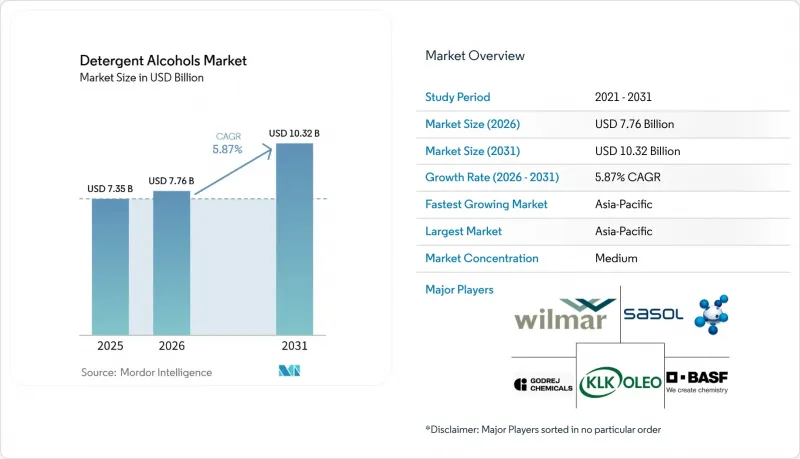
본 보고서는 제형 유형(액체 및 분말), 원료(천연계 세제용 알코올 및 합성계 세제용 알코올), 용도(가정용 세척, 산업·시설용 세척 등), 최종 이용 산업(홈케어, 퍼스널케어, 섬유 가공 등), 지역(아시아태평양, 북미 등)별로 분류되어 있습니다. 시장 예측은 금액(달러) 기준으로 제시되어 있습니다.
세계의 세제용 알코올 시장 동향 및 인사이트
가정용 및 산업용 세정 분야에서 고성능 계면활성제에 대한 수요 증가
C12-C18 알코올에서 유래한 알코올 에톡실레이트 및 알코올 에테르 황산염은 액체 세탁 세제, 식기 세제 및 산업용 세정제의 배합에 널리 사용되고 있습니다. 이러한 화합물은 생분해성이 높고 저온에서도 뛰어난 성능을 발휘하기 때문에 확실한 세정 성능이 요구되는 제품, 특히 소비자가 저온 세탁 사이클에서도 효과를 기대하는 상황에서 사용하기에 적합합니다. 외식 산업, 의료, 호텔·관광 업계의 위생 기준이 엄격해짐에 따라, 산업용 세정 계면활성제에 대한 수요가 지속되고 있어 안정적인 수요 기반을 형성하고 있습니다. 농축 액체 세제는 동등한 분말 제품에 비해 단위 부피당 지방 알코올 함량이 많기 때문에 소비자용 제품 자체의 포장이나 물 사용량이 줄어들더라도 완성된 세제 1단위당 알코올 가치 밀도가 높아집니다. 쿠로다사는 2026년 7월, 자사의 EBC Crosolv 제품이 전처리 스프레이에서 유성 오염 제거 효과를 최대 27% 향상시켰다고 보고하며, 바이오 유래 성분이 배합 성능 향상에도 기여할 수 있음을 보여주었습니다. 세정제 배합 기술이 지속적으로 발전함에 따라, 세제용 알코올 시장에서는 더욱 강력한 기능성을 갖춘 천연 유래 등급이 선호될 것입니다.
퍼스널케어 및 화장품 제형에서 세제용 알코올의 활용 확대
세틸 알코올, 스테아릴 알코올, 세테아릴 알코올은 씻어내는 유형 및 씻어내지 않는 유형의 퍼스널케어 제품에서 유화제, 보습제, 텍스처제로 사용되고 있습니다. 이러한 성분들은 뚜렷한 관능적 특성과 배합 특성을 가지고 있어, 일부 화장품 용도에서는 대체하기 어렵습니다. 지방 알코올계 비이온성 계면활성제는 헤어케어 및 기타 퍼스널케어 제형에도 사용되고 있으며, 구매자들은 식물 유래의 보습제나 일관된 관능적 특성을 원하고 있지만, 이러한 특성은 석유화학 유래 대체품으로는 제형 변경 없이는 재현하기 어려울 수 있습니다. 카오(Kao)는 2025년 3월, Future Origins사와 바이오 발효를 통해 제조된 팜유를 포함하지 않는 C12/C14 지방 알코올 ‘NALO’에 관한 다년 구매 계약을 체결했습니다. 이 계약은 발효 유래 원료공급이 더 광범위한 상업적 규모에 도달할 때까지 기다리지 않고, 구매자가 사전에 조달 전략을 수립하고 있음을 보여줍니다. 퍼스널케어 제품 구매자가 인증받고 차별화된 원료에 대해 높은 비용을 수용하게 되면, 세제용 알코올 시장은 그 혜택을 누리게 될 것입니다.
팜 커널 오일, 코코넛 오일 및 기타 유지 화학 원료 가격 변동
말레이시아의 정제·표백·탈취(RBD) 팜 커널 오일은 기상 조건에 따른 수확량 감소, 수출 규제 및 물류 제약의 영향으로 2025년 9월 FOB 가격 기준 톤당 2,035달러에 도달했습니다. 2025년에는 코코넛 오일 가격도 급등하여, 코코넛 유래 원료에 의존하는 라우릴 알코올 생산자들에게 압박이 가중되었습니다. 이러한 가격 상승으로 인해 장기 원료 공급 계약을 체결하지 않은 생산자들의 이익률은 압박을 받았으며, 일부 라우릴 알코올 생산자들은 팜 커널 오일을 원료로 한 대체 제품으로의 전환을 가속화하게 되었습니다. 2026년 초에는 수급 균형이 회복되기 시작하면서 압박이 완화될 조짐이 보였으나, 재배상의 제약과 가뭄 주기로 인해 팜 커널 오일의 생산량은 여전히 제한적이었습니다. 중견 제조업체들은 이익률이 축소되면 유지보수 비용 지출을 미룰 가능성이 있습니다. 이는 원료 가격이 정상화되기 시작한 후에도 공급 제약을 장기화시킬 우려가 있습니다. 생산의 신뢰성을 회복하고 유지보수 일정을 재개하는 데는 단기적인 상품 가격 조정보다 더 오랜 시간이 걸리기 때문입니다. 퍼스널케어 제품 제조업체는 배합 변경에 막대한 비용이 드는 재등록이 필요할 수 있기 때문에 가정용품 제조업체에 비해 유연성이 떨어집니다.
부문별 분석
2025년, 액상 제형은 세제용 알코올 시장 점유율의 63.22%를 차지했으며, 2031년까지 연평균 성장률(CAGR) 6.22%를 나타낼 것으로 예측됩니다. 이러한 규모 및 성장의 조합은 액상 유형의 세탁 세제, 식기 세척제 및 퍼스널케어 제품이 계속해서 사용되고 있음을 반영합니다. 알코올 에톡실레이트 및 알코올 에테르 황산염은 수성 매트릭스에 효과적으로 용해됩니다. 따라서 이들은 세탁 및 주방 세제를 포함한 선진국 및 신흥 시장에서 사용되는 많은 액상 제제의 핵심 활성 성분이 되고 있습니다. 농축형은 표준 분말 제품보다 단위 부피당 지방 알코올 사용량이 더 많습니다.
분말 제형은 인도 농촌 지역, 사하라 사막 이남의 아프리카, 라틴아메리카 일부 등 가격에 민감한 지역에서 여전히 상업적으로 중요한 위치를 차지하고 있습니다. 이러한 지역에서는 찬물로 세탁하는 습관과 제품 비용이 저렴하다는 점이 분말 세제 수요를 뒷받침하고 있습니다. BASF는 2025년 7월, 액체 세제와의 궁합을 고려하여 생분해성 리파아제 ‘Lavergy L Pace’ 및 셀룰라아제 ‘C Care’를 추가함으로써 액체 효소 제품군을 확충했습니다. 이에 따라 성분 개발은 주류를 이루는 액체 제제의 성능 향상에 중점을 두고 있습니다.
천연 유래 세제용 알코올은 2025년 세제용 알코올 시장 점유율의 68.41%를 차지했으며, 2031년까지 연평균 성장률(CAGR) 6.38%를 나타낼 것으로 예측됩니다. 이러한 위상을 뒷받침하는 요인은 지속가능성 노력, 클린 라벨에 대한 수요, 그리고 인도네시아 내 생산 능력 확충입니다. 팜 커널 오일 유래의 라우릴 알코올 및 미리스틸 알코올은 가정용 세정제 및 산업용 계면활성제에 널리 사용되고 있습니다. 세틸 알코올 및 스테아릴 알코올은 그 사슬 길이 분포가 유화 및 텍스처 형성에 기여하기 때문에 특히 퍼스널케어 제품에서 중요합니다. 특히, 명확한 조달 요건이 정해진 퍼스널케어 제품의 제형에서는 원료의 추적성이 확보된 천연 원료 공급업체가 프리미엄 고객과의 계약에서 우선적으로 선정될 가능성이 있습니다.
지글러법 및 옥소법으로 제조되는 합성 알코올은 북미 및 유럽의 산업용 분야에서 여전히 중요한 위치를 차지하고 있습니다. 홀수 탄소 수나 분지 사슬을 가진 변종은 천연 알코올로는 쉽게 구현할 수 없는 특성을 제공할 수 있습니다. 에코그린 올레오케미칼스는 바탐 자유무역지역에서 최대의 투자 실적을 올린 국내 민간 기업으로서, BP 바탐으로부터 ‘2025년 투자상’을 수상했습니다. 이러한 움직임은 인도네시아의 천연 알코올 인프라에 대한 지속적인 투자를 시사합니다. 또한, RSPO 요건의 개정에 따라 공급망 전반에 걸친 규정 준수 문서화의 중요성도 높아지고 있습니다.
지역별 분석
아시아태평양은 2025년 세제용 알코올 시장 점유율의 45.38%를 차지했으며, 2031년까지 연평균 성장률(CAGR) 6.41%를 나타낼 것으로 예측됩니다. 인도네시아와 말레이시아에는 야자나무 원료와 C12-C18 알코올 생산을 연결하는 통합형 오일케미컬 단지가 위치해 있습니다. 중국과 인도에서는 퍼스널케어 및 홈 케어 수요로 인해 소비가 확대되고 있으며, 이 지역의 생산 거점은 많은 구매자에게 가까운 공급원이 되고 있습니다. 일본에서는 화장품 배합에 사용되는 고순도 알코올 수요가 뒷받침되고 있습니다. 고급 헤어케어 제품이나 미용 제품의 경우, 범용 가정용 세정 제품보다 성분의 순도, 명확한 성능, 그리고 공급망의 문서화가 더욱 중요시되고 있습니다. 에코그린(EcoGreen)사가 2025년에 바탐에서 사업을 전개한 것도 인도네시아에서의 지속적인 자본 투자를 시사합니다.
북미와 유럽은 성숙한 시장으로, 규제와 제품의 부가가치가 더욱 중요시되고 있습니다. 규정(EU) 2026/405는 2029년 9월부터 적용되어, 더욱 엄격한 생분해성 및 추적성 조치가 요구될 것입니다. BASF는 2026년에 RSPO 인증을 받은 팜유 및 팜핵유의 조달 비율이 79.2%에 달했으며, 정유시설 수준까지의 추적 가능성이 98% 달성되었다고 보고했습니다. 북미에서는 사솔(Sasol)과 쉘(Shell)의 합성 알코올 생산 능력에 크게 의존하고 있습니다. 소비재 기업들이 산림 파괴를 수반하지 않는 조달을 추구하고, 보다 견고한 추적성 기록으로 뒷받침된 원자재를 요구함에 따라 바이오 제품의 수입이 중요성을 더할 가능성이 있습니다.
남미, 중동 및 아프리카는 성장 잠재력을 지닌 지역입니다. 브라질에서는 소비재 및 기관을 대상으로 한 청소 활동을 통해 수요가 뒷받침되고 있습니다. 남미에서는 인드라마 벤처스(Indrama Ventures) 산하 옥시테노(Oxitene) 부문의 재생 가능 지방 알코올 가공이 바이오 소재에 대한 하류 수요를 보여주고 있습니다. 중동 및 아프리카에서는 사솔(Sasol)의 남아프리카 합성 알코올 생산과 사우디아라비아의 석유화학 원료가 공급을 뒷받침하고 있습니다. 환율 변동이나 물류 비용이 팜유 유래 오일케미칼 제품의 수입을 제약할 가능성이 있으며, 인구 동향에 기반한 잠재 수요와 실제 구매량 사이에 주기적인 괴리가 발생할 수 있습니다. 이러한 요인들로 인해, 기초가 되는 인구 증가와 도시화의 진전이 세제용 알코올 수요로 어느 정도 이어질 수 있는지가 제한될 가능성이 있습니다.
기타 혜택 :
- 엑셀 형식 시장 예측(ME) 시트
- 3개월간의 애널리스트 지원
자주 묻는 질문
목차
제1장 서론
제2장 조사 방법
제3장 주요 요약
제4장 시장 구도
제5장 시장 규모 및 성장 예측
제6장 경쟁 구도
제7장 시장 기회 및 향후 전망
KTH 26.09.04According to Mordor Intelligence, the detergent alcohols market was valued at USD 7.35 billion in 2025 and is estimated to grow from USD 7.76 billion in 2026 to reach USD 10.32 billion by 2031, at a CAGR of 5.87% during the forecast period (2026-2031).
This report is Segmented by Formulation Type (Liquid and Powder), Source (Natural Detergent Alcohols and Synthetic Detergent Alcohols), Application (Household Cleaning, Industrial and Institutional Cleaning, and More), End-Use Industry (Home Care, Personal Care, Textile Processing, and More), Geography (Asia-Pacific, North America, and More). The Market Forecasts are Provided in Terms of Value (USD).
Global Detergent Alcohols Market Trends and Insights
Rising Demand for High-Performance Surfactants in Household and Industrial Cleaning
Alcohol ethoxylates and alcohol ether sulfates derived from C12 to C18 alcohols are widely used in liquid laundry, dishwashing, and institutional cleaning formulations. Their biodegradability and cold-temperature performance support their use in products that need dependable cleaning performance, especially where consumers expect results in lower-temperature wash cycles. Higher hygiene requirements in food service, health care, and hospitality have sustained demand for industrial cleaning surfactants, adding a durable layer of demand. Concentrated liquid detergents require greater fatty alcohol loading per unit volume than comparable powder products, raising alcohol value density for each unit of finished detergent even when the consumer product itself uses less packaging and water. Croda reported in July 2026 that its EBC Crosolv products delivered up to 27% better greasy stain removal in pre-treatment sprays, showing how bio-based ingredients can also address formulation performance. The detergent alcohols market is likely to favor natural grades with stronger functional properties as cleaning formulations continue to develop.
Expanding Use of Detergent Alcohols in Personal Care and Cosmetics Formulations
Cetyl, stearyl, and cetearyl alcohols are used as emulsifiers, emollients, and texture agents in rinse-off and leave-on personal care products. Their defined sensory and formulation properties make substitution difficult in some cosmetic applications. Fatty alcohol-based non-ionic surfactants are also used in hair care and other personal care formulations, where buyers seek plant-derived emollients and consistent sensory properties that petrochemical alternatives may not reproduce without formulation changes. Kao entered a multiyear purchase agreement with Future Origins in March 2025 for NALO, a palm-free C12/C14 fatty alcohol made through biofermentation. This agreement shows that buyers are preparing their sourcing strategies before fermentation-derived supply reaches broader commercial volumes, rather than waiting for large-scale production to become available. The detergent alcohols market benefits when personal care buyers accept higher costs for certified and differentiated materials.
Volatility in Prices of Palm Kernel Oil, Coconut Oil, and Other Oleochemical Feedstocks
Refined, Bleached, and Deodorized (RBD) palm kernel oil in Malaysia reached USD 2,035 per metric ton FOB in September 2025, following weather-related yield disruption, export restrictions, and logistics constraints. Coconut oil prices also rose sharply in 2025, increasing pressure on lauryl alcohol producers that rely on coconut-derived feedstock. These increases reduced margins for producers without long-term feedstock agreements and encouraged some lauryl alcohol producers to accelerate palm-kernel-oil-based substitution. Early 2026 conditions indicated easing pressure as supply and demand started to rebalance, although planting constraints and drought cycles continued to limit palm kernel oil output. Mid-tier producers may defer maintenance spending when margins narrow, which can prolong supply constraints even after feedstock prices begin to correct, because restoring production reliability and maintenance schedules takes longer than a short-term commodity price adjustment. Personal care producers have less flexibility than household product makers because formulation changes can require costly re-registration.
Other drivers and restraints analyzed in the detailed report include:
- Growing Adoption of Bio-Based and Renewable Oleochemical Feedstocks
- Favorable Regulatory Shift Toward Biodegradable and Environmentally Friendly Surfactant Ingredients
- Sustainability and Environmental Concerns Related to Palm Oil-Based Supply Chains
For complete list of drivers and restraints, kindly check the Table Of Contents.
Segment Analysis
Liquid formulation held 63.22% of the detergent alcohols market share in 2025 and is projected to grow at a 6.22% CAGR through 2031. This combined scale and growth position reflects continued use of liquid laundry, dishwashing, and personal care products. Alcohol ethoxylates and alcohol ether sulfates dissolve effectively in water-based matrices. They are therefore core active ingredients in many liquid formulations used in developed and emerging markets, including laundry and dishwashing products. Concentrated formats use more fatty alcohol per unit volume than standard powder products.
Powder formulation remains commercially important in price-sensitive areas, including rural India, Sub-Saharan Africa, and parts of Latin America. Cold-water washing habits and lower product costs support powder demand in these locations. BASF expanded its liquid enzyme portfolio in July 2025 with biodegradable Lavergy L Pace lipase and C Care cellulase for liquid detergent compatibility. Ingredient development is therefore concentrating on performance within the leading liquid format.
Natural detergent alcohols held 68.41% of the detergent alcohols market share in 2025 and are projected to grow at a 6.38% CAGR through 2031. Sustainability commitments, clean-label demand, and Indonesian capacity additions support this position. Lauryl and myristyl alcohols from palm kernel oil streams are widely used in household cleaning and industrial surfactants. Cetyl and stearyl alcohols are especially relevant to personal care products because their chain distribution supports emulsification and texture. Natural suppliers with traceable feedstock documentation can be preferred in premium customer agreements, particularly for personal care formulations with defined sourcing requirements.
Synthetic alcohols made through Ziegler and oxo processes remain relevant in North American and European industrial applications. Odd-carbon and branched-chain variants can provide properties that natural alcohols cannot readily match. Ecogreen Oleochemicals received BP Batam's 2025 Investment Award as the domestic private national company with the largest investment realization in the Batam Free Trade Zone. This development points to continued investment in Indonesia's natural alcohol infrastructure. Updated RSPO requirements also raise the importance of documented compliance across the supply chain.
Complete Report Scope:
- By Formulation Type
- Liquid
- Powder
- By Source
- Natural Detergent Alcohols
- Lauryl Alcohol (Dodecanol)
- Myristyl Alcohol (Tetradecanol)
- Cetyl Alcohol (Hexadecanol)
- Stearyl Alcohol (Octadecanol)
- Oleyl Alcohol (Octadecenol)
- Cetyl-Stearyl Alcohol Blends
- Other Natural Detergent Alcohols
- Synthetic Detergent Alcohols
- Linear Synthetic Alcohols
- Branched Synthetic Alcohols
- Other Synthetic Detergent Alcohols
- Natural Detergent Alcohols
- By Application
- Household Cleaning
- Industrial and Institutional Cleaning
- Personal Care and Cosmetics
- Textile Processing
- Lubricants and Chemical Intermediates
- Other Applications
- By End-Use Industry
- Home Care
- Personal Care
- Industrial and Institutional
- Chemical
- By Geography
- Asia-Pacific
- China
- India
- Japan
- South Korea
- Rest of Asia-Pacific
- North America
- United States
- Canada
- Mexico
- Europe
- Germany
- United Kingdom
- France
- Italy
- Russia
- Rest of Europe
- South America
- Brazil
- Argentina
- Rest of South America
- Middle-East and Africa
- Saudi Arabia
- South Africa
- Rest of Middle-East and Africa
- Asia-Pacific
Geography Analysis
Asia-Pacific held 45.38% of the detergent alcohols market share in 2025 and is forecast to grow at a 6.41% CAGR through 2031. Indonesia and Malaysia host integrated oleochemical complexes that connect oil palm feedstock with C12 to C18 alcohol production. China and India add consumption growth through personal care and home care demand, while the regional production base provides a close supply source for many buyers. Japan supports demand for high-purity alcohols used in cosmetic formulations, where premium hair care and beauty products place greater weight on ingredient purity, defined performance, and supply-chain documentation than commodity household cleaning products. Ecogreen's 2025 recognition in Batam also indicates continued capital deployment in Indonesia.
North America and Europe are mature regions where regulation and product value are more important. Regulation (EU) 2026/405 will apply from September 2029 and will require stronger biodegradability and traceability practices. BASF reported 79.2% RSPO-certified palm and palm kernel oil sourcing and 98% traceability to the oil mill level in 2026. North America relies substantially on synthetic alcohol capacity from Sasol and Shell. Bio-based imports can gain relevance as consumer goods companies pursue deforestation-free sourcing and seek materials supported by stronger traceability records.
South America, and the Middle-East and Africa are regions with growth potential. Brazil supports demand through consumer goods and institutional cleaning activity. In South America, renewable fatty alcohol processing by Indorama Ventures' Oxiteno division shows downstream demand for bio-based materials. The Middle-East and Africa have supply support from Sasol's South African synthetic alcohol production and Saudi petrochemical feedstock. Currency volatility and logistics costs can constrain imports of palm-derived oleochemicals, creating periodic gaps between demographic demand potential and realized purchasing. These factors can limit the extent to which the underlying population and urbanization growth convert into detergent alcohol demand.
- BASF
- Cargill, Incorporated
- Croda International Plc
- Ecogreen Oleochemicals
- Emery Oleochemicals
- Godrej Chemicals
- Kao Corporation
- KLK OLEO
- Musim Mas Group
- OLEOCHEMICAL INDUSTRIES BERHAD
- Procter & Gamble
- Sasol Limited
- Shell
- VVF Ltd.
- Wilmar International Ltd
Additional Benefits:
- The market estimate (ME) sheet in Excel format
- 3 months of analyst support
TABLE OF CONTENTS
1 Introduction
- 1.1 Study Assumptions and Market Definition
- 1.2 Scope of the Study
2 Research Methodology
3 Executive Summary
4 Market Landscape
- 4.1 Market Overview
- 4.2 Market Drivers
- 4.2.1 Rising Demand for High-Performance Surfactants in Household and Industrial Cleaning
- 4.2.2 Expanding Use of Detergent Alcohols in Personal Care and Cosmetics Formulations
- 4.2.3 Growing Adoption of Bio-Based and Renewable Oleochemical Feedstocks
- 4.2.4 Increasing Demand for Cost-Effective Detergent Raw Materials in Emerging Economies
- 4.2.5 Favorable Regulatory Shift Toward Biodegradable and Environmentally Friendly Surfactant Ingredients
- 4.3 Market Restraints
- 4.3.1 Volatility in Prices of Palm Kernel Oil, Coconut Oil, and Other Oleochemical Feedstocks
- 4.3.2 Sustainability and Environmental Concerns Related to Palm Oil-Based Supply Chains
- 4.3.3 High Capital Investment Requirements for Production and Refining Facilities
- 4.4 Value Chain Analysis
- 4.5 Porter's Five Forces Analysis
- 4.5.1 Threat of New Entrants
- 4.5.2 Bargaining Power of Suppliers
- 4.5.3 Bargaining Power of Buyers
- 4.5.4 Threat of Substitutes
- 4.5.5 Competitive Rivalry
5 Market Size and Growth Forecasts (Value)
- 5.1 By Formulation Type
- 5.1.1 Liquid
- 5.1.2 Powder
- 5.2 By Source
- 5.2.1 Natural Detergent Alcohols
- 5.2.1.1 Lauryl Alcohol (Dodecanol)
- 5.2.1.2 Myristyl Alcohol (Tetradecanol)
- 5.2.1.3 Cetyl Alcohol (Hexadecanol)
- 5.2.1.4 Stearyl Alcohol (Octadecanol)
- 5.2.1.5 Oleyl Alcohol (Octadecenol)
- 5.2.1.6 Cetyl-Stearyl Alcohol Blends
- 5.2.1.7 Other Natural Detergent Alcohols
- 5.2.2 Synthetic Detergent Alcohols
- 5.2.2.1 Linear Synthetic Alcohols
- 5.2.2.2 Branched Synthetic Alcohols
- 5.2.2.3 Other Synthetic Detergent Alcohols
- 5.2.1 Natural Detergent Alcohols
- 5.3 By Application
- 5.3.1 Household Cleaning
- 5.3.2 Industrial and Institutional Cleaning
- 5.3.3 Personal Care and Cosmetics
- 5.3.4 Textile Processing
- 5.3.5 Lubricants and Chemical Intermediates
- 5.3.6 Other Applications
- 5.4 By End-Use Industry
- 5.4.1 Home Care
- 5.4.2 Personal Care
- 5.4.3 Industrial and Institutional
- 5.4.4 Chemical
- 5.5 By Geography
- 5.5.1 Asia-Pacific
- 5.5.1.1 China
- 5.5.1.2 India
- 5.5.1.3 Japan
- 5.5.1.4 South Korea
- 5.5.1.5 Rest of Asia-Pacific
- 5.5.2 North America
- 5.5.2.1 United States
- 5.5.2.2 Canada
- 5.5.2.3 Mexico
- 5.5.3 Europe
- 5.5.3.1 Germany
- 5.5.3.2 United Kingdom
- 5.5.3.3 France
- 5.5.3.4 Italy
- 5.5.3.5 Russia
- 5.5.3.6 Rest of Europe
- 5.5.4 South America
- 5.5.4.1 Brazil
- 5.5.4.2 Argentina
- 5.5.4.3 Rest of South America
- 5.5.5 Middle-East and Africa
- 5.5.5.1 Saudi Arabia
- 5.5.5.2 South Africa
- 5.5.5.3 Rest of Middle-East and Africa
- 5.5.1 Asia-Pacific
6 Competitive Landscape
- 6.1 Market Concentration
- 6.2 Strategic Moves
- 6.3 Market Share (%)/Ranking Analysis
- 6.4 Company Profiles (includes Global Overview, Market Overview, Core Segments, Financials as available, Strategic Information, Products and Services, and Recent Developments)
- 6.4.1 BASF
- 6.4.2 Cargill, Incorporated
- 6.4.3 Croda International Plc
- 6.4.4 Ecogreen Oleochemicals
- 6.4.5 Emery Oleochemicals
- 6.4.6 Godrej Chemicals
- 6.4.7 Kao Corporation
- 6.4.8 KLK OLEO
- 6.4.9 Musim Mas Group
- 6.4.10 OLEOCHEMICAL INDUSTRIES BERHAD
- 6.4.11 Procter & Gamble
- 6.4.12 Sasol Limited
- 6.4.13 Shell
- 6.4.14 VVF Ltd.
- 6.4.15 Wilmar International Ltd
7 Market Opportunities and Future Outlook
- 7.1 White-Space and Unmet-Need Assessment


