|
시장보고서
상품코드
2119169
자작나무 알레르기 시장 : 시장 점유율 분석, 업계 동향 및 통계, 성장 예측(2026-2031년)Birch Allergy - Market Share Analysis, Industry Trends & Statistics, Growth Forecasts (2026 - 2031) |
||||||
 Mordor Intelligence
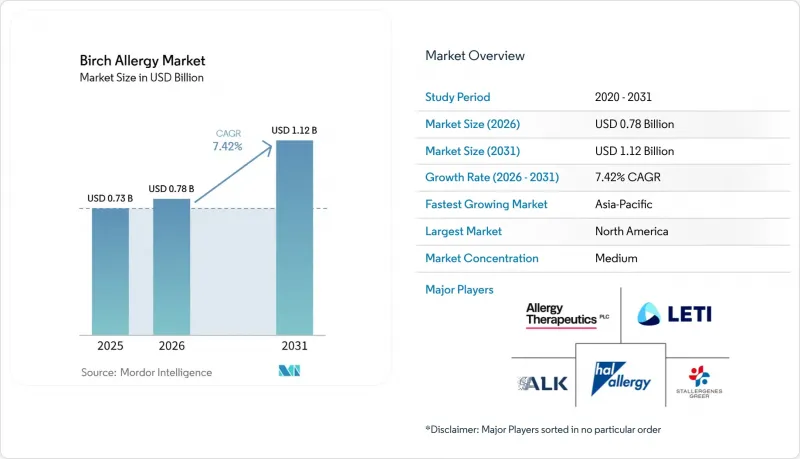
Mordor Intelligence에 의하면, 자작나무 알레르기 시장 규모는 2025년 7억 3,000만 달러로 평가되었고, 2026년에는 7억 8,000만 달러로 추정되고, 2026-2031년 CAGR 7.42%로 성장을 지속할 전망이며, 2031년까지 11억 2,000만 달러에 이를 것으로 예측됩니다.
본 보고서는 제품별(치료법(항히스타민제 등), 진단(스킨프릭 검사 및 피내 검사 등)), 유통 채널별(소매 약국, 병원 약국, 기타), 최종 사용자별(병원, 알레르기·면역학 클리닉, 재택 간호 환경, 기타 최종 사용자), 지역별(북미, 유럽, 아시아태평양, 기타)로 분류되어 있습니다. 시장 예측은 금액(달러) 기준으로 제시되어 있습니다.
세계의 자작나무 알레르기 시장 동향 및 인사이트
자작나무 꽃가루에 대한 감작 증가와 알레르기성 비염의 부담
자작나무에 대한 감작은 처방량만으로는 추정되는 것보다 더 널리 관찰됩니다. Bet v 1에 대한 감작률은 스칸디나비아 및 중부 유럽 하위 지역에서 25%에 달하며, 유럽 전체의 유병률은 8%에서 16% 사이입니다. 2026년 홋카이도에서 실시된 연구에 따르면, 자작나무 꽃가루 알레르기와 구강 알레르기 증후군이 삶의 질(QOL)에 큰 부담을 주는 것으로 보고되었으며, 감작률은 1972년 이후 상승 추세를 보이고 있습니다. 자작나무에 감작된 환자의 약 70%는 Bet v 1 관련 단백질을 매개로 사과, 헤이즐넛, 대두에 대해 반응을 보일 가능성이 있습니다. 이러한 반응으로 인해 환자들은 비증상보다 먼저 구강 증상을 호소하며 진료를 받게 되고, 그 결과 전문의에게 의뢰되는 시기가 늦어지는 반면, 일반의약품에 대한 수요는 지속될 것입니다. 16년에 걸친 BAMSE 코호트 연구에 따르면, 꽃가루 알레르기성 비염을 앓고 있는 청소년의 50% 이상이 약물을 복용하고 있음에도 불구하고 증상을 조절하지 못하고 있는 것으로 밝혀졌습니다.
설하 알레르겐 면역요법의 보급 확대
자작나무 알레르기 시장은 일반적으로 SLIT라고 불리는 설하 알레르겐 면역요법에 대한 접근성 확대에 힘입어 성장하고 있습니다. ALK-Abello는 2025년 4월, 유럽 17개국에서 5세부터 17세까지의 소아 및 청소년 환자를 대상으로 한 ‘ITULAZAX’의 승인을 획득했습니다. NICE는 2025년 7월, 잉글랜드에서 중증 자작나무 꽃가루 알레르기에 대한 ‘ITULAZAX’를 권장했으며, 최대 2만 7,000명의 환자가 이를 이용할 수 있게 될 전망입니다. Stallergenes Greer는 2025년 10월, 소아를 대상으로 한 제IIIb상 YOBI 임상시험에서 위약에 비해 ARC 종합 점수가 41% 개선되었다고 보고했습니다. 4만 4,000명 이상의 환자를 대상으로 한 독일 연구에서는 3종 나무 SLIT 용액이 대조군(대증요법군)에 비해 천식 발병 위험을 41% 감소시키는 것으로 밝혀졌습니다. 이러한 진전은 계절성 증상 완화에 그치지 않는 치료의 임상적·경제적 근거를 더욱 공고히 하고 있습니다.
비용, 치료 기간, 접근성 제약
알레르겐 면역 요법은 일반적으로 3-5년간의 지속적인 치료가 필요하기 때문에 보험 미가입자나 저소득 가정의 치료 보급을 저해할 가능성이 있습니다. 피하 투여 요법의 경우, 치료 기간 동안 30-80회의 내원이나 주사 후 경과 관찰이 필요할 수 있습니다. SLIT(설하 면역 요법)는 내원 횟수를 줄일 수 있지만, 보험 급여가 일부만 적용되거나 전혀 적용되지 않는 가정에서는 비용 부담이 가정에 전가될 가능성이 있습니다. 독일에서는 알레르겐 면역 요법에 대한 공적 보험 적용이 ‘Therapieallergene-Verordnung(알레르겐 요법 규정)’의 틀에 따라 승인된 제제에 한정되어 있습니다. 이러한 요건으로 인해 표준화되지 않은 제제에 대한 접근이 제한되어, 항히스타민제나 코르티코스테로이드에 대한 의존이 지속될 가능성이 있습니다. 전문의 부족이나 진료 예약까지의 긴 대기 시간은 특히 지방이나 알레르기 의료 체계가 충분히 갖춰지지 않은 국가에서 추가적인 장벽이 되고 있습니다.
부문 분석
2025년, 자작나무 알레르기 시장의 매출액 중 85.31%를 치료법이 차지했으며, 이는 소매, 병원, 재택 치료 각 분야에서 제네릭 항히스타민제와 비강 내 코르티코스테로이드에 의해 뒷받침되고 있습니다. 류코트리엔 수용체 길항제, 충혈 완화제, 비만세포 안정제는 여러 증상이나 천식과 관련된 증상을 가진 환자에게 여전히 중요한 역할을 하고 있습니다. 면역요법은 치료를 받은 환자 1인당 연간 매출액이 높으며, 소아용 SLIT의 승인으로 인해 유럽과 캐나다에서 적응증이 확대되고 있습니다. 4만 4,000명 이상의 환자를 대상으로 한 독일의 연구에 따르면, 3종 수목 SLIT 액제제가 대증 요법과 비교하여 알레르기성 비염의 위험 감소 및 천식 진행 억제와 관련이 있는 것으로 나타났습니다. 이러한 증거는 계절성 항히스타민제만으로는 제공할 수 없는 장기적인 비용 측면의 근거를 보험사에 제시하는 것입니다.
진단 부문은 가장 빠르게 성장하는 제품 카테고리이며, 2031년 연평균 성장률(CAGR)은 9.58%로 예측됩니다. 이는 멀티플렉스 플랫폼을 통해 한 번의 검사로 다수의 분자 알레르겐을 평가할 수 있기 때문입니다. 자작나무 알레르기 시장에서 진단 부문 시장 규모는 검사 건수가 많은 병원 검사실에서 단일 성분 피부 단자 검사를 대체할 수 있는 능력에 힘입어, 보다 광범위한 임상 정보를 제공하고 건당 청구 금액을 높이고 있습니다. 성분 분해형 진단을 통해, 그렇지 않으면 치료 경로에서 제외될 가능성이 있는 면역요법 적격 후보자를 식별할 수 있습니다. 이러한 진단에서 치료로의 연계는 단순한 검사 수익에 그치지 않고 치료 이용 확대로 이어집니다. 성분 정보를 바탕으로 한 적응증 후보자 선정을 지지하는 유럽의 임상 지침이 이러한 추세를 뒷받침하고 있습니다.
2025년, 자작나무 알레르기 시장에서 알레르기성 비염이 차지하는 비중은 66.31%였습니다. 이는 코나 눈의 증상이 여전히 진단 및 약물 사용의 일반적인 진입점 역할을 하고 있기 때문입니다. 알레르기성 결막염은 비염과 동반되는 경우가 많으며, 이는 ‘비결막염’이라는 단일 치료 경로를 통해 항히스타민제나 비강 내 코르티코스테로이드의 지속적인 사용을 뒷받침하고 있습니다. 알레르기성 천식, 아토피 피부염, 접촉성 두드러기는 각각 서로 다른 치료 경로를 가지고 있으며, 나머지 증상을 차지하고 있습니다. 2026년 영국에서 수행된 사례 시계열 연구에 따르면, 중등도의 자작나무 꽃가루 노출과 0-4세 소아의 천식 관련 입원 상대 위험도 1.131 간의 연관성이 밝혀졌습니다. 이는 규모가 작은 천식 범주라 할지라도, 노출이 정점에 달할 때에는 여전히 심각한 의료 부담을 초래할 수 있는 이유를 보여줍니다.
구강 알레르기 증후군과 꽃가루·식품 증후군은 인식 및 코딩의 개선에 따라 2031년 연평균 성장률(CAGR)이 9.58%로 가장 빠르게 증가하는 증상입니다. 자작나무 꽃가루 알레르기 환자의 약 70%는 교차 반응성이 있는 식품 과민증을 경험할 가능성이 있습니다. 2024년 국제 델파이법을 통한 합의에서 꽃가루·식품 알레르기 증후군에 대한 교육, 식이 회피, 에피네프린 자동 주사기 처방에 관한 지침이 확립되었습니다. 따라서 이 동반 질환이 있는 환자의 경우, 꽃가루 알레르기 관리에 더해 항히스타민제가 필요할 수 있으며, 고위험 사례에서는 에피네프린 자동 주사기가 필요할 수 있습니다.
지역별 분석
2025년, 북미는 자작나무 알레르기 시장의 39.61% 점유율을 차지했습니다. 미국에서는 일반의약품 항히스타민제가 널리 사용되고 있을 뿐만 아니라, 의료 기관에서의 피하 면역 요법(SCIT) 수요를 뒷받침하는 확고한 전문의 기반이 마련되어 있습니다. 캐나다에서는 2025년 5-17세 환자를 대상으로 한 ITULATEK의 승인을 받아 소아용 설하 면역 요법(SLIT)에 대한 접근성이 확대되었습니다. 멕시코에서는 주요 대도시권 이외의 지역에서도 알레르기 전문의의 활동이 활발해지고 있습니다. 디지털 처방 모니터링 시스템을 활용함으로써 약국은 꽃가루 관련 수요를 예측하고, 지역 상황에 맞추어 재고를 조정할 수 있습니다.
유럽은 계속해서 자작나무 꽃가루 알레르기의 임상 및 상업적 중심지 역할을 하고 있습니다. 스칸디나비아와 중부 유럽의 하위 지역에서는 Bet v 1에 대한 감작률이 25%에 달할 전망입니다. 독일은 승인된 알레르겐 면역요법 제제가 TAV 체계 하에서 법정 보험 적용 대상이 되기 때문에 규제 측면에서 핵심적인 역할을 하고 있습니다. NICE는 2025년 7월, 잉글랜드에서 ITULAZAX를 권장했습니다. 이로 인해 역사적으로 다른 유럽 국가들에 비해 알레르겐 면역요법 이용률이 낮았던 독일 의료 시스템에서 접근성이 개선될 가능성이 있습니다. 폴란드, 헝가리, 체코 공화국에서는 꽃가루 시즌의 변화와 전문의에 대한 접근성 확대에 따라 시장이 성장할 가능성이 있습니다.
아시아태평양은 2031년 연평균 성장률(CAGR)이 8.25%로 가장 빠르게 성장하고 있는 지역입니다. 일본에서는 유럽 이외의 지역에서도 상당한 환자 수가 예상되며, 2026년 홋카이도에서 실시된 연구에서는 자작나무 꽃가루 알레르기와 구강 알레르기 증후군이 건강에 미치는 영향이 확인되었습니다. 한국에서는 자작나무에 대한 감작률이 10.2%로 성장을 지속하고, 있어, 진단 플랫폼 및 설하 면역 요법(SLIT)에 대한 수요를 뒷받침하고 있습니다. ALK-Abello와 GenSci는 2025년 중국에서 제휴를 맺었으며, 이는 알레르겐 면역 요법을 위한 중국의 장기적인 인프라 구축의 조짐을 보여줍니다. 중동 및 아프리카, 남미는 자작나무의 분포와 전문의 네트워크가 제한적이어서 여전히 초기 단계에 있는 지역이지만, 진단법의 보급이 향후 치료법 도입을 촉진할 가능성이 있습니다.
기타 혜택
- 엑셀 형식 시장 예측(ME) 시트
- 3개월 간의 애널리스트 지원
자주 묻는 질문
목차
제1장 서론
제2장 조사 방법
제3장 주요 요약
제4장 시장 구도
제5장 시장 규모 및 성장 예측
제6장 경쟁 구도
제7장 시장 기회 및 향후 전망
AJY 26.09.03According to Mordor Intelligence, the birch allergy market size is expected to grow from USD 0.73 billion in 2025 to USD 0.78 billion in 2026 and is forecast to reach USD 1.12 billion by 2031 at 7.42% CAGR over 2026-2031.
This report is Segmented by Product (Therapies [Antihistamines and More], Diagnostics [Skin Prick and Intradermal Tests and More]), Distribution Channel (Retail Pharmacy, Hospital Pharmacy, and More), End User (Hospitals, Allergy and Immunology Clinics, Homecare Settings, Other End Users), and Geography (North America, Europe, Asia-Pacific, and More). The Market Forecasts are Provided in Terms of Value (USD).
Global Birch Allergy Market Trends and Insights
Rising Birch Pollen Sensitization and Allergic Rhinitis Burden
Birch sensitization is more widespread than prescription volumes alone suggest. Sensitization to Bet v 1 reaches 25% in Scandinavian and Central European subregions, while European prevalence ranges from 8% to 16%. A 2026 Hokkaido study reported a substantial quality-of-life burden from birch pollinosis and oral allergy syndrome, with sensitization rising since 1972. Around 70% of birch-sensitized patients can develop reactions to apples, hazelnuts, and soy through Bet v 1-related proteins. These reactions may bring patients to care for oral symptoms before nasal symptoms, which can delay referral but sustain demand for over-the-counter medicines. The 16-year BAMSE cohort found that more than 50% of adolescents with pollen allergic rhinitis had uncontrolled symptoms despite using medication.
Wider Adoption of Sublingual Allergen Immunotherapy
The birch allergy market is gaining support from broader access to sublingual allergen immunotherapy, commonly called SLIT. ALK-Abello received approval for ITULAZAX for children and adolescents aged 5-17 across 17 European countries in April 2025. NICE recommended ITULAZAX for severe birch tree pollen allergy in England in July 2025, with access intended for up to 27,000 patients. Stallergenes Greer reported a 41% improvement in the ARC total combined score versus placebo in its Phase IIIb pediatric YOBI study in October 2025. A German study of more than 44,000 patients found that 3-tree SLIT-liquid reduced asthma onset risk by 41% versus symptomatic controls. These developments strengthen the clinical and economic case for treatment that goes beyond seasonal symptom relief.
Cost, Treatment Duration, and Access Constraints
Allergen immunotherapy usually requires 3-5 years of sustained treatment, which can restrict uptake among uninsured and lower-income households. Subcutaneous regimens can require 30-80 clinic visits and post-injection observation during a treatment course. SLIT reduces clinic visits, but it can shift costs to households where reimbursement remains partial or unavailable. In Germany, statutory reimbursement for allergen immunotherapy is conditioned on approved preparations under the Therapieallergene-Verordnung framework. These requirements can restrict access for non-standardized formulations and preserve reliance on antihistamines and corticosteroids. Specialist shortages and long appointment waits create a further barrier, especially in rural areas and countries without mature allergy services.
Other drivers and restraints analyzed in the detailed report include:
- Component-Resolved Diagnostics and Digital Pollen Tools
- Earlier Pollen Seasons and Cross-Reactive Exposure
- Adverse Reactions and Product Standardization Limits
For complete list of drivers and restraints, kindly check the Table Of Contents.
Segment Analysis
Therapies accounted for 85.31% of Birch Allergy Market revenue in 2025, supported by generic antihistamines and intranasal corticosteroids across retail, hospital, and homecare settings. Leukotriene receptor antagonists, decongestants, and mast cell stabilizers remain relevant for patients with multiple symptoms or asthma-related presentations. Immunotherapy has higher annual revenue per treated patient, and pediatric SLIT approvals are expanding eligibility in Europe and Canada. A German study covering more than 44,000 patients associated 3-tree SLIT-liquid with reduced allergic rhinitis risk and asthma progression versus symptomatic care. This evidence gives payers a long-term cost argument that seasonal antihistamines alone cannot provide.
Diagnostics is the fastest-growing product category, with a 9.58% CAGR through 2031, as multiplex platforms evaluate many molecular allergens in one run. The Birch Allergy Market size for diagnostics is supported by their ability to replace single-component skin prick testing in high-volume hospital laboratories, generating wider clinical information and higher billing value per episode. Component-resolved testing can identify immunotherapy candidates who would otherwise remain outside the treatment pathway. This diagnostic-to-therapy linkage can increase therapy use rather than only testing revenues. European clinical guidance supporting component-informed candidate selection reinforces this development.
Allergic rhinitis held 66.31% of Birch Allergy Market share in 2025, because nasal and ocular symptoms remain the usual route into diagnosis and medicine use. Allergic conjunctivitis frequently occurs with rhinitis, which supports recurring use of antihistamines and intranasal corticosteroids through one rhinoconjunctivitis pathway. Allergic asthma, atopic dermatitis, and contact urticaria have different care pathways and account for the remaining manifestations. A 2026 English case-time series study associated medium birch pollen exposure with a relative risk of 1.131 for asthma-related admissions among children aged 0-4. This shows why the smaller asthma category can still create a material healthcare burden during peak exposure.
Oral allergy syndrome and pollen-food syndrome is the fastest-growing manifestation, at a 9.58% CAGR through 2031, as recognition and coding improve. Around 70% of birch-pollen allergic patients can experience cross-reactive food hypersensitivity. A 2024 international Delphi consensus established guidance for education, dietary avoidance, and epinephrine autoinjector prescribing in pollen-food allergy syndrome. Patients with this comorbidity may therefore require antihistamines and, in higher-risk cases, epinephrine autoinjectors alongside management of their pollen allergy.
Complete Report Scope:
- By Product
- Therapies
- Antihistamines
- Intranasal Corticosteroids
- Leukotriene Receptor Antagonists
- Decongestants
- Mast Cell Stabilizers
- Immunotherapy
- Other Therapies
- Diagnostics
- Skin Prick and Intradermal Tests
- Serum Specific IgE Tests
- Component-Resolved Diagnostics
- Therapies
- By Allergy Manifestation
- Allergic Rhinitis
- Allergic Rhinoconjunctivitis
- Allergic Asthma Exacerbation
- Oral Allergy Syndrome and Pollen-Food Syndrome
- By Distribution Channel
- Retail Pharmacy
- Hospital Pharmacy
- Online Pharmacy
- Other Distribution Channels
- By End User
- Hospitals
- Allergy and Immunology Clinics
- Homecare Settings
- Other End Users
- By Geography
- North America
- United States
- Canada
- Mexico
- Europe
- Germany
- United Kingdom
- France
- Italy
- Spain
- Rest of Europe
- Asia-Pacific
- China
- Japan
- India
- Australia
- South Korea
- Rest of Asia-Pacific
- Middle East and Africa
- GCC
- South Africa
- Rest of Middle East and Africa
- South America
- Brazil
- Argentina
- Rest of South America
- North America
Geography Analysis
North America held 39.61% of Birch Allergy Market share in 2025. The United States combines broad over-the-counter antihistamine use with an established specialist base that supports institutional SCIT demand. Canada expanded pediatric SLIT access after the 2025 authorization of ITULATEK for patients aged 5-17. Mexico is showing greater allergy specialist activity beyond major metropolitan areas. Digital prescription surveillance can help pharmacies anticipate pollen-linked demand and align inventory with local conditions.
Europe remains the core clinical and commercial base for birch pollen allergy. Bet v 1 sensitization reaches 25% in Scandinavian and Central European subregions. Germany is a regulatory anchor because approved allergen immunotherapy preparations can receive statutory reimbursement under the TAV framework. NICE recommended ITULAZAX in England in July 2025, which can improve access in a system that historically used less allergen immunotherapy than some European peers. Poland, Hungary, and the Czech Republic offer expansion potential as pollen seasons change and specialist access develops.
Asia-Pacific is the fastest-growing regional area, at an 8.25% CAGR through 2031. Japan has a meaningful non-European burden, and the 2026 Hokkaido study confirmed the health impact of birch pollinosis and oral allergy syndrome. South Korea recorded a 10.2% birch sensitization rate, supporting demand for diagnostic platforms and SLIT options. ALK and GenSci formed a 2025 China partnership that signals long-term in-country infrastructure development for allergen immunotherapy. The Middle East, Africa, and South America remain early-stage areas because birch distribution and specialist networks are limited, although diagnostic adoption can support later therapeutic entry.
- ALK-Abello
- Allergy Therapeutics Plc
- Anergis SA
- Bayer
- Bencard Allergie GmbH
- Biomay
- Danaher
- Desentum Oy
- HAL Allergy Group
- Haleon plc
- Kenvue Inc.
- Laboratorios LETI, S.L.
- Merck
- Novartis
- Regeneron Pharmaceuticals
- Roxall Medizin GmbH
- Sanofi
- Siemens Healthineers
- Stallergenes Greer plc
- Thermo Fisher Scientific
- Viatris
Additional Benefits:
- The market estimate (ME) sheet in Excel format
- 3 months of analyst support
TABLE OF CONTENTS
1 Introduction
- 1.1 Study Assumptions and Market Definition
- 1.2 Scope of the Study
2 Research Methodology
3 Executive Summary
4 Market Landscape
- 4.1 Market Overview
- 4.2 Market Drivers
- 4.2.1 Rising Birch Pollen Sensitization and Allergic Rhinitis Burden
- 4.2.2 Wider Adoption of Sublingual Allergen Immunotherapy
- 4.2.3 Expansion of Component-Resolved Allergy Diagnostics
- 4.2.4 Climate-Driven Earlier and More Intense Birch Pollen Seasons
- 4.2.5 Cross-Reactive Birch Homolog Exposure Extending the Treatment Window
- 4.2.6 Digitized Pollen Forecasting and Season-Linked Medication Demand
- 4.3 Market Restraints
- 4.3.1 High Cost and Long Duration of Disease-Modifying Immunotherapy
- 4.3.2 Local and Systemic Adverse Reactions to Allergen Immunotherapy
- 4.3.3 Low Specialist Capacity and Uneven Reimbursement
- 4.3.4 Variability in Birch Pollen Composition Weakening Extract Standardization
- 4.4 Regulatory Landscape
- 4.5 Technological Outlook
- 4.6 Porter's Five Forces Analysis
- 4.6.1 Threat of New Entrants
- 4.6.2 Bargaining Power of Suppliers
- 4.6.3 Bargaining Power of Buyers
- 4.6.4 Threat of Substitutes
- 4.6.5 Rivalry Among Existing Competitors
5 Market Size & Growth Forecasts (Value, USD)
- 5.1 By Product
- 5.1.1 Therapies
- 5.1.1.1 Antihistamines
- 5.1.1.2 Intranasal Corticosteroids
- 5.1.1.3 Leukotriene Receptor Antagonists
- 5.1.1.4 Decongestants
- 5.1.1.5 Mast Cell Stabilizers
- 5.1.1.6 Immunotherapy
- 5.1.1.7 Other Therapies
- 5.1.2 Diagnostics
- 5.1.2.1 Skin Prick and Intradermal Tests
- 5.1.2.2 Serum Specific IgE Tests
- 5.1.2.3 Component-Resolved Diagnostics
- 5.1.1 Therapies
- 5.2 By Allergy Manifestation
- 5.2.1 Allergic Rhinitis
- 5.2.2 Allergic Rhinoconjunctivitis
- 5.2.3 Allergic Asthma Exacerbation
- 5.2.4 Oral Allergy Syndrome and Pollen-Food Syndrome
- 5.3 By Distribution Channel
- 5.3.1 Retail Pharmacy
- 5.3.2 Hospital Pharmacy
- 5.3.3 Online Pharmacy
- 5.3.4 Other Distribution Channels
- 5.4 By End User
- 5.4.1 Hospitals
- 5.4.2 Allergy and Immunology Clinics
- 5.4.3 Homecare Settings
- 5.4.4 Other End Users
- 5.5 By Geography
- 5.5.1 North America
- 5.5.1.1 United States
- 5.5.1.2 Canada
- 5.5.1.3 Mexico
- 5.5.2 Europe
- 5.5.2.1 Germany
- 5.5.2.2 United Kingdom
- 5.5.2.3 France
- 5.5.2.4 Italy
- 5.5.2.5 Spain
- 5.5.2.6 Rest of Europe
- 5.5.3 Asia-Pacific
- 5.5.3.1 China
- 5.5.3.2 Japan
- 5.5.3.3 India
- 5.5.3.4 Australia
- 5.5.3.5 South Korea
- 5.5.3.6 Rest of Asia-Pacific
- 5.5.4 Middle East and Africa
- 5.5.4.1 GCC
- 5.5.4.2 South Africa
- 5.5.4.3 Rest of Middle East and Africa
- 5.5.5 South America
- 5.5.5.1 Brazil
- 5.5.5.2 Argentina
- 5.5.5.3 Rest of South America
- 5.5.1 North America
6 Competitive Landscape
- 6.1 Market Concentration
- 6.2 Market Share Analysis
- 6.3 Company Profiles (includes Global Level Overview, Market Level Overview, Core Segments, Financials as available, Strategic Information, Market Rank/Share, Products and Services, Recent Developments)
- 6.3.1 ALK-Abello A/S
- 6.3.2 Allergy Therapeutics Plc
- 6.3.3 Anergis SA
- 6.3.4 Bayer AG
- 6.3.5 Bencard Allergie GmbH
- 6.3.6 Biomay AG
- 6.3.7 Danaher Corporation
- 6.3.8 Desentum Oy
- 6.3.9 HAL Allergy Group
- 6.3.10 Haleon plc
- 6.3.11 Kenvue Inc.
- 6.3.12 Laboratorios LETI, S.L.
- 6.3.13 Merck KGaA
- 6.3.14 Novartis AG
- 6.3.15 Regeneron Pharmaceuticals, Inc.
- 6.3.16 Roxall Medizin GmbH
- 6.3.17 Sanofi
- 6.3.18 Siemens Healthineers AG
- 6.3.19 Stallergenes Greer plc
- 6.3.20 Thermo Fisher Scientific Inc.
- 6.3.21 Viatris Inc.
7 Market Opportunities and Future Outlook
- 7.1 White-Space and Unmet-Need Assessment