|
시장보고서
상품코드
2119231
AI크리에이티브 최적화 서비스 : 시장 점유율 분석, 업계 동향 및 통계, 성장 예측(2026-2031년)AI Creative Optimization Services - Market Share Analysis, Industry Trends & Statistics, Growth Forecasts (2026 - 2031) |
||||||
 Mordor Intelligence
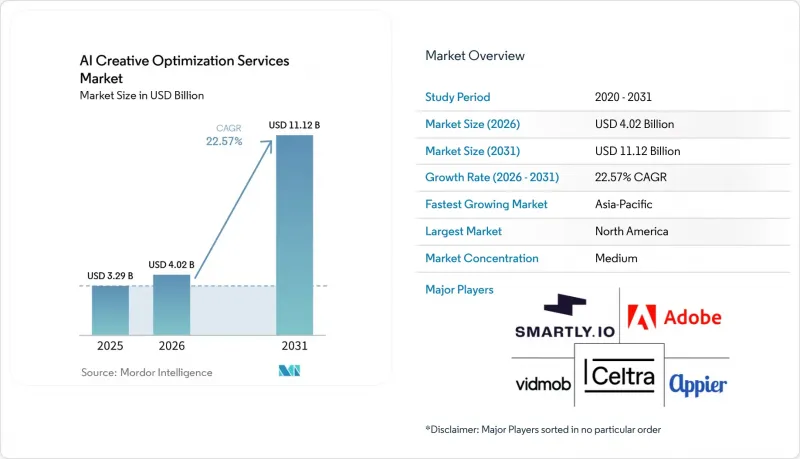
Mordor Intelligence에 의하면, AI크리에이티브 최적화 서비스 시장 규모는 2025년에 32억 9,000만 달러로 평가되었습니다. 2026년 40억 2,000만 달러에서 2031년까지 111억 2,000만 달러에 이를 것으로 예상되며, 예측 기간(2026-2031년) CAGR은 22.57%를 나타낼 전망입니다.
본 보고서는 서비스 유형(크리에이티브 전략 및 최적화 컨설팅 서비스, 매니지드 다이내믹 크리에이티브 최적화(DCO) 서비스,생성형 크리에이티브 변형 개발 서비스, 크리에이티브 성과 분석 및 인사이트 서비스 등), 최종 사용자 산업(소매 및 전자상거래 등), 지역별로 분류되어 있습니다. 시장 예측은 금액(미 달러) 기준으로 제시되어 있습니다.
세계의 AI 크리에이티브 최적화 서비스 시장 동향 및 인사이트
생성형 AI를 통한 변형 제작 시간 및 비용 절감
AI 크리에이티브 최적화 서비스 시장에서는 팀이 수작업 기반 개발에서 AI를 활용한 자산 제작으로 전환함에 따라 제작 워크플로우가 혁신을 이루고 있습니다. 예전에는 캠페인 하나당 5-10가지 유형의 변형만 제작할 수 있었던 브랜드도, 현재는 서로 다른 게재 위치, 타겟층, 상품, 시각적 표현에 걸쳐 채널에 최적화된 버전을 수백 가지 동시에 전개할 수 있게 되었습니다. 이러한 능력을 통해 주요 캠페인 시작 시점에 업데이트를 한정하지 않고, 유료 미디어 전반에 걸쳐 더 빈번한 테스트와 업데이트 주기를 가능하게 합니다. IAB 보고서에 따르면, AI를 활용한 제작을 통해 크리에이티브 개발 주기를 80-90% 단축할 수 있으므로, 광고주에게 지속적인 업데이트 프로그램의 실행이 더욱 현실화되고 있습니다. 변형 옵션이 늘어남에 따라, 광고 게재 시스템은 노출을 할당할 때 평가할 수 있는 크리에이티브 신호를 더 많이 확보하게 됩니다. Google Performance Max와 Meta Advantage+는 광고 게재 과정에서 제출된 자산의 품질과 다양성을 활용하고 있으며, 이를 통해 크리에이티브 인프라와 미디어 효율성, 캠페인 실행이 더욱 밀접하게 연계되고 있습니다. AI를 활용한 크리에이티브 최적화 서비스 시장에서 이러한 변화는 크리에이티브 팀의 역할을 변화시키고 있습니다. 크리에이티브 팀은 자산의 양, 성과 피드백, 브랜드 규칙, 그리고 각 채널에서의 광고 게재 준비 상태를 상호 연관된 활동으로 관리해야 합니다. 그 결과, 제작 속도가 크리에이티브 업데이트와 캠페인 시작 후 수행되는 지속적인 최적화 작업 모두를 지원하는 워크플로가 실현됩니다.
유료 소셜, 디스플레이, 커넥티드 TV에서의 개인화 광고 수요
AI 크리에이티브 최적화 서비스 시장은 유료 소셜, 디스플레이, 커넥티드 TV에서의 맞춤형 광고 수요에 힘입어 성장하고 있습니다. 맞춤형 크리에이티브는 단순한 문구 변경에 그치지 않고, 서로 다른 오디언스와 게재 조건에 따라 맥락을 인식한 뒤 여러 시각적 요소와 메시지 요소를 조합해 나가는 단계로 진화하고 있습니다. 2025년 IAB 조사에 따르면, 광고주들은 생성형 AI를 활용하여 오디언스별로 최적화된 버전을 제작하거나, 시각적 스타일을 변경하거나, 문맥과의 관련성을 높이는 등 다양한 방식으로 활용하고 있었습니다. Innovid의 보고서에 따르면, 헬스케어 분야 마케터들의 커넥티드 TV에 대한 예산 배분이 60% 증가했으며, 과거에는 주로 방송 형식의 배포에 사용되던 포맷에서도 개인화 요구 사항이 점차 대두되고 있는 것으로 나타났습니다. 헬스케어 및 금융 서비스 광고주는 규제가 엄격한 환경에서 개인화된 크리에이티브를 적용할 때 버전별 심사 절차가 필요합니다. 매니지드 서비스는 승인된 메시지와 자산을 언제든지 활용할 수 있도록 하면서, 더 많은 버전에 대해 의료·법률·규제 관련 검증을 적용함으로써 이러한 요건을 충족할 수 있습니다. 따라서 AI 크리에이티브 최적화 서비스 시장에서는 제공업체가 개인화를 단순히 캠페인 시작 시 선택되는 크리에이티브 옵션이 아닌, 운영 프로세스로 다루어야 할 필요가 있습니다. 또한, 승인된 주장을 변경하지 않고 다수의 버전을 제작해야 하는 경우, 재사용 가능한 승인 규칙과 체계적인 자산 기록이 유용합니다.
데이터 개인정보 보호 및 신호 손실로 인한 개인화 입력 정보의 제한
AI 크리에이티브 최적화 서비스 시장은 개인화에 사용되는 행동 신호의 지속적인 상실로 인해 제약에 직면해 있습니다. Safari 및 Firefox의 보호 기능, 사용자 수준의 광고 차단기, 동의 선택, 모바일 추적 제한으로 인해 크리에이티브 시스템이 활용할 수 있는 관측 가능한 오디언스 데이터는 감소하고 있습니다. 구글은 크롬에서 써드파티 쿠키를 완전히 제거하겠다는 계획을 변경했지만, 전체 광고 환경에서 크로스사이트 추적의 품질은 여전히 제약을 받고 있습니다. IAB Tech Lab은 보다 책임감 있는 타겟팅과 데이터 활용을 지원하기 위한 ‘인증된 오디언스(Certified Audience)’ 기준을 마련하고 있습니다. 광고주는 Google Ads Data Hub나 Amazon Marketing Cloud와 같은 클린룸 환경을 활용하여 일부 자사 데이터를 처리할 수 있습니다. 이러한 접근 방식은 기존의 픽셀 기반 워크플로우보다 더 높은 수준의 통합과 거버넌스를 요구하기 때문에 개인화된 크리에이티브 전달의 운영 부담이 증가하고 캠페인 계획에서의 데이터 활용이 지연되는 한편, 개인정보를 보호하는 프로세스 내에서 활용 가능한 자산의 품질과 다양성에 대한 관심이 높아지고 있습니다.
부문별 분석
2025년, 매니지드 다이내믹 크리에이티브 최적화 서비스는 AI 크리에이티브 최적화 서비스 시장 규모의 27.38%를 차지했습니다. 기업 광고주는 이러한 서비스를 활용하여 프로그래매틱, 소셜, 커넥티드 TV의 각 인벤토리에 걸친 개인화를 동시에 조정하고 있습니다. 운영 모델에는 지속적인 데이터 수집, 크리에이티브 구성, A/B 테스트 및 성과 보고서가 포함됩니다. 이는 인벤토리, 타겟 고객, 캠페인 결과가 변화하더라도 서비스가 지속적으로 운영되므로 일회성 크리에이티브 배포와는 다릅니다. 이러한 업무의 지속적 특성이 매니지드 서비스의 수익을 뒷받침하며, 캠페인 시작 후에도 제공업체가 지속적으로 관여할 수 있게 합니다.
생성형 크리에이티브 변형 개발 서비스는 2026년부터 2031년까지 연평균 성장률(CAGR) 23.17%로 확대될 것으로 예측됩니다. 각 브랜드가 하나의 브리프에서 수백 개에 달하는 각 채널별 자산을 생성할 수 있는 파이프라인을 구축함에 따라, 이 서비스 유형 내의 AI 크리에이티브 최적화 서비스 시장은 확대되고 있습니다. 팀은 이 프로세스를 활용함으로써 모든 자산을 처음부터 다시 제작하지 않고도 게재처, 타겟 고객,언어, 제품, 형식의 요구 사항에 맞춘 버전을 제작할 수 있습니다. VidMob은 2025년 2월, Adobe Premiere Pro 및 Adobe Illustrator용 생성형 AI 플러그인을 발표하며, 크리에이티브 도구와 성과 중심의 제작 워크플로우 간의 연동을 보여주었습니다. 또한, ‘크리에이티브 성과 분석 및 인사이트 서비스’ 역시 크리에이티브 데이터와 마케팅 인텔리전스 시스템 간의 연동을 강화하고 있으며, 광고주가 게재 성과와 반응 성과를 뒷받침하는 자산의 특징을 평가할 수 있도록 지원하고 있습니다.
지역별 분석
2025년, 북미는 41.63%의 점유율을 차지했습니다. 이 지역에는 성숙한 프로그래매틱 광고 인프라, 경험이 풍부한 기업 광고주, 그리고 미국에 집중된 주요 플랫폼 및 서비스 제공업체가 존재합니다. 이러한 조건 덕분에 소셜, 디스플레이, 커넥티드 TV, 커머스 미디어에 걸친 매니지드 크리에이티브 시스템의 활용이 뒷받침되고 있으며, 팀은 자산의 제작과 활용, 측정을 연계할 수 있습니다. 또한 이 지역에는 매니지드 구현 모델을 뒷받침하는 데이터 연동, 크리에이티브 테스트, 측정 도구에 투자할 수 있는 광고주가 다수 존재합니다. 남미는 신흥 지역으로, 소셜 동영상 및 이커머스 광고가 지속적으로 발전하는 가운데 브라질이 주요 성장 동력으로 작용하고 있습니다.
유럽은 독일, 영국, 프랑스에서의 도입에 힘입어 지역별 규모에서 2위를 차지하고 있습니다. 이 지역의 AI 크리에이티브 최적화 서비스 시장은 첨단 프로그래매틱 시스템과, 보다 엄격한 동의 관리 하에서 운영 가능한 퍼스트파티 데이터 주도형 크리에이티브 기법에 대한 수요에 의해 형성되고 있습니다. GDPR(EU 개인정보보호규정)의 동의 및 데이터 최소화 관련 규정에 따라 행동 타겟팅이 제한되는 상황에서 광고주는 크리에이티브의 품질 신호를 더욱 중시하도록 유도받고 있으며, 그 결과 자산의 관련성과 통제된 테스트의 유용성이 높아지고 있습니다. EU AI법은 콘텐츠 거버넌스 요건을 추가하고 있으며, 해당 규정은 2027년까지 단계적으로 시행될 전망입니다. 이에 따라 AI를 활용한 광고 콘텐츠의 심사 및 문서화를 위한 체계적인 워크플로가 촉진되고 있습니다.
아시아태평양은 2026년부터 2031년까지 연평균 성장률(CAGR) 23.94%를 나타낼 것으로 예측됩니다. 인도와 중국이 주요 성장 동력이 되고 있으며, 리테일 미디어, 숏폼 동영상, 그리고 빈번하고 지역에 맞춘 광고 소재 조정이 필요한 대규모 디지털 광고 생태계가 이를 뒷받침하고 있습니다. 텐센트, 바이트댄스, 바이두, 알리바바, 그리고 Douyin/TikTok은 AI 크리에이티브 도구를 자사의 광고 스택에 통합하고 있으며, 이로 인해 광고주는 데이터 및 형식 요건이 서로 다른 여러 플랫폼에 걸친 활동을 관리해야 할 필요성이 커지고 있습니다. Appier는 2026년 태국과 베트남에서 ‘AdCreative.ai’를 출시하며 생성형 크리에이티브 기능을 동남아시아 시장으로 확대했습니다. 광고주들이 다국어, 다중 플랫폼, 크리에이티브 인프라 수준, 그리고 현지화된 실행이 필요한 모바일 우선 미디어 환경에 대응해 나감에 따라, 이 지역의 AI 크리에이티브 최적화 서비스 시장은 발전할 가능성이 있습니다. 한편, 중동에서는 아랍에미리트와 사우디아라비아가 도입을 주도하고 있으며, 아프리카에서는 이집트, 나이지리아, 남아프리카공화국이 모바일 우선 수요를 뒷받침하고 있습니다.
기타 혜택 :
- 엑셀 형식 시장 예측(ME) 시트
- 3개월간의 애널리스트 지원
자주 묻는 질문
목차
제1장 서론
제2장 조사 방법
제3장 개요
제4장 시장 구도
제5장 시장 규모 및 성장 예측
제6장 경쟁 구도
제7장 시장 기회 및 향후 전망
KTH 26.09.02According to Mordor Intelligence, the AI creative optimization services market size was valued at USD 3.29 billion in 2025 and estimated to grow from USD 4.02 billion in 2026 to reach USD 11.12 billion by 2031, at a CAGR of 22.57% during the forecast period (2026-2031).
This report is Segmented by Service Type (Creative Strategy and Optimization Consulting Services, Managed Dynamic Creative Optimization (DCO) Services, Generative Creative Variant Development Services, Creative Performance Analytics and Insight Services, and More), End-User Industry (Retail and E-Commerce, and More), and Geography. The Market Forecasts are Provided in Terms of Value (USD).
Global AI Creative Optimization Services Market Trends and Insights
Generative AI Compression of Variant Production Time and Cost
The AI creative optimization services market is transforming production workflows as teams shift from manual development to AI-assisted asset creation. Brands that once produced 5-10 variants for a campaign can now deploy hundreds of channel-ready versions simultaneously, across different placements, audiences, products, and visual treatments. This capacity supports more frequent testing and refresh cycles across paid media, rather than limiting updates to major campaign launches. The IAB reported that AI-assisted production can reduce creative development cycle times by 80-90%, making continuous refresh programs more feasible for advertisers. Greater variation also gives delivery systems more creative signals to assess when allocating impressions. Google Performance Max and Meta Advantage+ use the quality and diversity of submitted assets in their delivery processes, making creative infrastructure more closely connected to media efficiency and campaign execution. Within the AI creative optimization services market, this changes the role of creative teams, who must manage asset volume, performance feedback, brand rules, and channel readiness as interconnected activities. The result is a workflow in which production speed supports both creative refresh and ongoing optimization work performed after a campaign is live.
Demand for Personalized Ads Across Paid Social, Display, and Connected TV
The AI creative optimization services market is supported by demand for personalized advertising across paid social, display, and connected TV. Personalized creative has moved beyond simple copy changes to the context-aware assembly of multiple visual and messaging elements for different audiences and placement conditions. In 2025, the IAB found that advertisers used generative AI to create audience-specific versions, change visual styles, and improve contextual relevance. Innovid reported a 60% increase in healthcare marketer allocation to connected TV, showing that personalization requirements are reaching formats once used mainly for broadcast-style delivery. Healthcare and financial services advertisers need version-level review processes as they apply personalized creative in regulated environments. Managed services can address this requirement by applying medical, legal, and regulatory checks to a larger set of versions while keeping approved messages and assets available for activation. The AI creative optimization services market, therefore, requires providers to treat personalization as an operational process rather than merely a creative option selected at the start of a campaign. This also makes reusable approval rules and orderly asset records useful when teams must produce many versions without changing approved claims.
Data Privacy and Signal Loss Limiting Personalization Inputs
The AI creative optimization services market faces limits due to the continued loss of behavioral signals used for personalization. Safari and Firefox protections, user-level ad blockers, consent choices, and mobile tracking limits reduce the observable audience data available to creative systems. Google changed its plan to fully remove third-party cookies from Chrome, but the quality of cross-site tracking remains constrained across the broader advertising environment. The IAB Tech Lab describes authenticated audience standards that seek to support more responsible addressability and data use. Advertisers can use clean-room environments such as Google Ads Data Hub and Amazon Marketing Cloud to work with some first-party data. These approaches require more integration and governance than older pixel-based workflows, raising the operating burden for personalized creative delivery, slowing the use of data in campaign planning, and shifting attention toward the quality and variety of assets that remain available within privacy-safe processes.
Other drivers and restraints analyzed in the detailed report include:
- Expansion of Performance Marketing Budgets Toward Creative-Led Optimization
- Retail Media Format Proliferation Raising Demand for Creative Orchestration
- Integration Complexity Across MarTech, AdTech, and Measurement Stacks
For complete list of drivers and restraints, kindly check the Table Of Contents.
Segment Analysis
Managed Dynamic Creative Optimization Services captured 27.38% of the AI creative optimization services market size in 2025. Enterprise advertisers use these services to coordinate personalization across programmatic, social, and connected TV inventory simultaneously. The operating model covers recurring data ingestion, creative assembly, A/B testing, and performance reporting. This differs from a one-time creative deployment because the service remains active as inventory, audiences, and campaign results change. The recurring nature of this work supports managed-service revenue and keeps providers involved after a campaign launches.
Generative Creative Variant Development Services is projected to expand at a 23.17% CAGR between 2026 and 2031. The AI creative optimization services market for this service type is advancing as brands build pipelines that can turn 1 brief into hundreds of channel-ready assets. Teams can use the process to create versions for placement, audience, language, product, and format needs without rebuilding every asset from the start. VidMob introduced a generative AI plugin for Adobe Premiere Pro and Adobe Illustrator in February 2025, illustrating the connection between creative tools and performance-oriented production workflows. Creative Performance Analytics and Insight Services also increasingly connect creative data with marketing intelligence systems, helping advertisers assess the asset features that support delivery and response outcomes.
Complete Report Scope:
- By Service Type
- Creative Strategy and Optimization Consulting Services
- Managed Dynamic Creative Optimization (DCO) Services
- Generative Creative Variant Development Services
- Creative Analytics and Insights
- Other Service Types
- By End-user Industry
- Retail and E-commerce
- Media and Entertainment
- IT and Telecom
- BFSI
- Healthcare and Life Sciences
- Automotive
- Other End-user Industries
- By Geography
- North America
- United States
- Canada
- Mexico
- South America
- Brazil
- Argentina
- Chile
- Rest of South America
- Europe
- Germany
- United Kingdom
- France
- Italy
- Spain
- Rest of Europe
- Asia-Pacific
- China
- Japan
- India
- South Korea
- Australia
- Rest of Asia-Pacific
- Middle East
- Saudi Arabia
- United Arab Emirates
- Qatar
- Rest of Middle East
- Africa
- South Africa
- Egypt
- Nigeria
- Rest of Africa
- North America
Geography Analysis
North America held 41.63% in 2025. The region has mature programmatic advertising infrastructure, experienced enterprise advertisers, and a concentration of major platform and service providers in the United States. These conditions support the use of managed creative systems across social, display, connected TV, and commerce media, where teams can connect asset production with activation and measurement. The region also has a large base of advertisers who can invest in data connections, creative testing, and measurement tools that support managed implementation models. South America is an emerging region, with Brazil serving as the main growth anchor as social video and e-commerce advertising continue to develop.
Europe held the second-largest regional position, supported by adoption in Germany, the United Kingdom, and France. The AI creative optimization services market in the region is shaped by advanced programmatic systems and demand for first-party data-led creative methods that can operate with stronger consent controls. GDPR consent and data minimization rules encourage advertisers to rely more on creative quality signals when behavioral targeting is limited, which makes asset relevance and controlled testing more useful. The EU AI Act is adding content governance requirements, with provisions expected to take effect progressively through 2027, and this is encouraging structured workflows for the review and documentation of AI-supported advertising content.
Asia-Pacific is projected to grow at a 23.94% CAGR between 2026 and 2031. India and China are the main growth engines, supported by retail media, short-form video, and large digital advertising ecosystems that require frequent and localized asset adaptation. Tencent, ByteDance, Baidu, Alibaba, and Douyin/TikTok integrate AI creative tools into their advertising stacks, which increases the need for advertisers to manage activity across several platforms with different data and format requirements. Appier launched AdCreative.ai in Thailand and Vietnam during 2026, extending generative creative capabilities to Southeast Asian markets. The AI creative optimization services market can develop in the region as advertisers navigate multiple languages, platforms, levels of creative infrastructure, and mobile-first media environments that require localized execution, while the United Arab Emirates and Saudi Arabia lead adoption in the Middle East and Egypt, Nigeria, and South Africa support mobile-first demand in Africa.
- Adobe Inc.
- Smartly.io Solutions Oy
- Celtra, Inc.
- VidMob, Inc.
- Appier Group Inc.
- Bannerflow AB
- Jivox Corporation
- Persado, Inc.
- Mediaocean LLC
- Adform A/S
- Criteo S.A.
- Quantcast Corporation
- Innovid Corp.
- Hunch Ads d.o.o.
- Marpipe, Inc.
- Creatopy Inc.
- CreativeX, Inc.
- Shuttlerock Limited
Additional Benefits:
- The market estimate (ME) sheet in Excel format
- 3 months of analyst support
TABLE OF CONTENTS
1 INTRODUCTION
- 1.1 Study Assumptions and Market Definition
- 1.2 Scope of the Study
2 RESEARCH METHODOLOGY
3 EXECUTIVE SUMMARY
4 MARKET LANDSCAPE
- 4.1 Market Overview
- 4.2 Market Drivers
- 4.2.1 Expansion of Performance Marketing Budgets Toward Creative-Led Optimization
- 4.2.2 Demand for Personalized Ads Across Paid Social, Display, and CTV
- 4.2.3 Generative AI Compression of Variant Production Time and Cost
- 4.2.4 Rising Creative Fatigue and Always-On Refresh Requirements
- 4.2.5 First-Party Creative Data and Predictive Scoring Becoming Media Inputs
- 4.2.6 Retail Media Format Proliferation Raising Demand for Creative Orchestration
- 4.3 Market Restraints
- 4.3.1 Data Privacy and Signal Loss Limiting Personalization Inputs
- 4.3.2 Integration Complexity Across MarTech, AdTech, and Measurement Stacks
- 4.3.3 AI Content Disclosure and Synthetic Performer Compliance Burdens
- 4.3.4 Native Platform Automation Compressing Standalone Vendor Differentiation
- 4.4 Industry Value Chain Analysis
- 4.5 Impact of Macroeconomic Factors on the Market
- 4.6 Regulatory Landscape
- 4.7 Technological Outlook
- 4.8 Porter's Five Forces Analysis
- 4.8.1 Threat of New Entrants
- 4.8.2 Bargaining Power of Buyers
- 4.8.3 Bargaining Power of Suppliers
- 4.8.4 Threat of Substitutes
- 4.8.5 Industry Rivalry
5 MARKET SIZE AND GROWTH FORECASTS (VALUE)
- 5.1 By Service Type
- 5.1.1 Creative Strategy and Optimization Consulting Services
- 5.1.2 Managed Dynamic Creative Optimization (DCO) Services
- 5.1.3 Generative Creative Variant Development Services
- 5.1.4 Creative Analytics and Insights
- 5.1.5 Other Service Types
- 5.2 By End-user Industry
- 5.2.1 Retail and E-commerce
- 5.2.2 Media and Entertainment
- 5.2.3 IT and Telecom
- 5.2.4 BFSI
- 5.2.5 Healthcare and Life Sciences
- 5.2.6 Automotive
- 5.2.7 Other End-user Industries
- 5.3 By Geography
- 5.3.1 North America
- 5.3.1.1 United States
- 5.3.1.2 Canada
- 5.3.1.3 Mexico
- 5.3.2 South America
- 5.3.2.1 Brazil
- 5.3.2.2 Argentina
- 5.3.2.3 Chile
- 5.3.2.4 Rest of South America
- 5.3.3 Europe
- 5.3.3.1 Germany
- 5.3.3.2 United Kingdom
- 5.3.3.3 France
- 5.3.3.4 Italy
- 5.3.3.5 Spain
- 5.3.3.6 Rest of Europe
- 5.3.4 Asia-Pacific
- 5.3.4.1 China
- 5.3.4.2 Japan
- 5.3.4.3 India
- 5.3.4.4 South Korea
- 5.3.4.5 Australia
- 5.3.4.6 Rest of Asia-Pacific
- 5.3.5 Middle East
- 5.3.5.1 Saudi Arabia
- 5.3.5.2 United Arab Emirates
- 5.3.5.3 Qatar
- 5.3.5.4 Rest of Middle East
- 5.3.6 Africa
- 5.3.6.1 South Africa
- 5.3.6.2 Egypt
- 5.3.6.3 Nigeria
- 5.3.6.4 Rest of Africa
- 5.3.1 North America
6 COMPETITIVE LANDSCAPE
- 6.1 Market Concentration
- 6.2 Strategic Moves
- 6.3 Market Share Analysis
- 6.4 Company Profiles (includes Global Level Overview, Market Level Overview, Core Segments, Financials as available, Strategic Information, Market Rank/Share, Products and Services, Recent Developments)
- 6.4.1 Adobe Inc.
- 6.4.2 Smartly.io Solutions Oy
- 6.4.3 Celtra, Inc.
- 6.4.4 VidMob, Inc.
- 6.4.5 Appier Group Inc.
- 6.4.6 Bannerflow AB
- 6.4.7 Jivox Corporation
- 6.4.8 Persado, Inc.
- 6.4.9 Mediaocean LLC
- 6.4.10 Adform A/S
- 6.4.11 Criteo S.A.
- 6.4.12 Quantcast Corporation
- 6.4.13 Innovid Corp.
- 6.4.14 Hunch Ads d.o.o.
- 6.4.15 Marpipe, Inc.
- 6.4.16 Creatopy Inc.
- 6.4.17 CreativeX, Inc.
- 6.4.18 Shuttlerock Limited
7 MARKET OPPORTUNITIES AND FUTURE OUTLOOK
- 7.1 White-Space and Unmet-Need Assessment