|
시장보고서
상품코드
2119233
AI 검색 가시성 서비스 시장 : 시장 점유율 분석, 업계 동향 및 통계, 성장 예측(2026-2031년)AI Search Visibility Services - Market Share Analysis, Industry Trends & Statistics, Growth Forecasts (2026 - 2031) |
||||||
 Mordor Intelligence
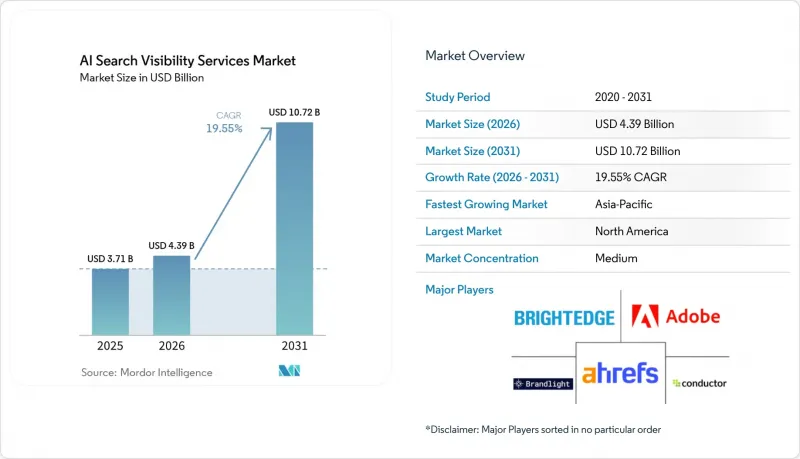
Mordor Intelligence에 의하면, AI 검색 가시성 서비스 시장 규모는 2025년 37억 1,000만 달러로 평가되었고, 2026년 43억 9,000만 달러에서 2031년까지 107억 2,000만 달러로 확대될 것으로 예측되며, 2026-2031년 연평균 복합 성장률(CAGR)은 19.55%를 나타낼 전망입니다.
본 보고서는 서비스 유형별(AI 검색 전략·컨설팅 서비스, AI 컨텐츠 최적화 서비스, AI 검색 최적화 서비스, AI 인용·지식 관리 서비스, 기타), 최종 사용자별(소매 및 전자상거래, 미디어 및 엔터테인먼트, IT 및 통신, 헬스케어 및 생명과학, 기타), 지역별로 분류되어 있습니다. 시장 전망은 금액(달러) 기준으로 제시되어 있습니다.
세계의 AI 검색 가시성 서비스 시장 동향 및 인사이트
증가하는 제로클릭 디스커버리와 AI를 통한 구매 프로세스
AI 답변 엔진은 고객이 기존 검색 결과 페이지에 도달하거나, 상품 페이지를 읽거나, 문의를 보내기 전에 브랜드가 평가받게 되므로 발견 과정을 혁신하고 있습니다. 2026년 첫 4개월 동안, 미국 내 구글 검색에서 제로 클릭 행동의 비율은 68.01%에 달했습니다. 2026년 중반까지 검색 쿼리의 43%에 구글 AI 개요(Google AI Overviews)가 표시될 것으로 예상되며, 이는 전년 동기 15%에서 증가한 수치로, 인용된 답변에 노출되거나 질문이 발생했을 때 답변 엔진이 활용 가능한 상태에 있는 것의 중요성을 부각시키고 있습니다. 2025년 소비자 조사에 따르면, AI 검색 사용자는 정보를 찾을 때 기존 검색 방식보다 AI를 더 중시하는 경향이 나타났습니다. 이에 따라 AI 검색 가시성 서비스 시장은 기존 랭킹 서비스보다 구매 퍼널의 상단에 위치하게 됩니다. 가시성이 처음 고려되는 브랜드의 범위를 좌우하기 때문입니다. 또한, 여러 공급업체 간의 비교·검토가 필요한 제품을 취급하는 기업의 경우, 조기에 가시성을 확보하는 것이 중요합니다.
SEO 지표에서 AI 가시성 KPI로의 기업 전환
기업의 지출은 기존 검색 지표에서 인용 빈도, 모델 점유율, AI를 통한 전환율 등의 지표로 이동하고 있습니다. 조사 대상인 고위 마케팅 책임자의 94%가 2026년에 AEO와 GEO에 대한 투자를 늘릴 계획을 세우고 있으며, 기업들은 디지털 마케팅 예산의 평균 12%를 이러한 활동에 할당하고 있었습니다. 또한, 조사 대상 기업 리더의 65%가 2026년 마케팅 예산의 최소 25%를 AI 검색 최적화에 할당하고 있어, 이러한 프로그램이 실험적인 활동에서 계획적인 활동으로 전환되고 있음을 보여줍니다. 측정 체계는 여전히 미흡한 것으로 나타났으며, 앞서 언급한 2025년 조사에서 AI 검색 성과를 체계적으로 추적하고 있는 브랜드는 고작 16%에 그쳤습니다. 이러한 격차로 인해, 실용적인 보고 기법을 확립하고, 의미 있는 기준선을 정의하며, 가시성 향상 노력을 상업적 성과로 연결할 수 있는 제공업체에 대한 수요가 발생하고 있습니다. 또한, 이로 인해 교육, 도입 지원, 분석이 AI 검색 가시성 서비스 시장에서 중심적인 역할을 담당하게 되었습니다.
불투명한 모델의 작동 방식과 어트리뷰션의 사각지대
AI에 의한 인용은 측정 가능한 웹사이트 방문이나 그 근거가 되는 정보원의 선택에 관한 명확한 기록을 남기지 않은 채 사용자에게 영향을 미치는 경우가 많기 때문에 측정이 단기적인 주요 제약 요인으로 작용하고 있습니다. 케임브리지 대학교가 실제 환경에서 이루어진 약 1만 4,000건의 LLM 대화를 조사한 연구에 따르면, Gemini의 답변 중 92%에서 클릭 가능한 인용 출처가 제공되지 않은 것으로 밝혀졌습니다. 이 조사에서는 시스템이 인용한 페이지보다 관련성이 더 높은 페이지를 평가하고 있을 가능성이 있음이 드러났으며, 이로 인해 답변의 근거가 된 정보원의 가시성이 저하되고, 게시자가 그 기여도를 파악하는 능력이 제한되고 있습니다. 또한, 서버 측 AI 에이전트에 의한 요청은 JavaScript를 우회하여 기존 분석 도구의 대상 범위에서 제외되는 경우도 있습니다. 이로 인해 기업은 AI의 답변으로 인해 발생한 모든 상업적 영향에 대해 라스트 클릭 어트리뷰션을 적용할 수 없게 됩니다. 구매자가 인용과 하류 수익을 연결하거나, 결과를 익숙한 웹 분석 지표와 비교할 수 없는 경우, 가치 입증 주기가 장기화될 가능성이 있습니다.
부문 분석
2025년, AI 컨텐츠 최적화 서비스는 AI 검색 가시성 서비스 시장 점유율의 34.80%를 차지했습니다. 이 범주에는 AI 시스템이 디지털 컨텐츠에 접근하고 해석하는 것을 지원하는 스키마 구현, 크롤링 가능성 감사, 엔티티 해결 워크플로가 포함됩니다. 기타 활동은 접근 가능한 페이지와 일관성 있는 구조화된 정보에 의존하기 때문에 이러한 서비스는 종종 기업 프로그램의 출발점이 됩니다. 기술적 검토를 통해 브랜드 가시성을 저하시키는 차단된 경로, 불완전한 마크업, 불명확한 엔티티 간 관계를 파악할 수 있습니다. AI 검색 전략 및 컨설팅 서비스는 기업이 GEO(생성 엔진 최적화) 이니셔티브를 기존 검색, 컨텐츠, 분석 팀과 통합해야 하기 때문에 여전히 중요합니다. 또한 AI 컨텐츠 최적화 서비스는 AI 기반 검색에 대응하기 위해 기존 자료를 조정해야 하는 조직을 지원합니다. 2026년 5월, Semrush는 AI 가시성 데이터베이스를 32개국으로 확대하고, 2억 6,100만 건의 LLM 프롬프트를 수록한 데이터베이스를 보고했습니다. 이는 시장 전반에 걸친 모니터링에 사용되는 데이터 인프라의 규모를 여실히 보여줍니다. 기업들이 여러 검색 엔진에 걸친 인용 정보를 추적함에 따라 AI 검색 모니터링 및 분석 서비스의 중요성은 점점 더 커지고 있습니다.
AI 인용 및 지식 관리 서비스는 2026-2031년 연평균 성장률(CAGR) 19.96%를 나타낼 것으로 예측됩니다. 이러한 성장은 에이전트가 브랜드, 그 제품, 그리고 그 권위를 평가할 때 사용하는 구조화된 사실을 관리해야 할 필요성을 반영합니다. Model Context Protocol(MCP)은 지속적인 세션의 오버헤드 없이 에이전트가 브랜드가 관리하는 데이터 레이어에 접근할 수 있도록 지원할 수 있습니다. Agentic AI Foundation은 2026년 7월, MCP 2026-07-28 사양 업데이트를 공개하며, 이를 위해 스테이트리스(stateless)이자 HTTP 네이티브인 아키텍처를 확립했습니다. 2026년 Adobe의 ‘Catalog Agent’ 역시 LLM 봇이 크롤링할 수 있는 구조화된 제품 정보에 초점을 맞추고 있었습니다. 엔티티 관리와 에이전트가 접근할 수 있는 컨텐츠를 결합한 제공업체는 AI와의 상호작용 전반에 걸쳐 신뢰할 수 있는 정보가 필요한 조직을 지원할 수 있습니다. 이 서비스 범주는 AI 검색 가시성 서비스 시장에 지속적인 데이터 거버넌스 업무로 나아가는 길을 제시하고 있습니다. 또한 개별 페이지에서 기업의 정보 환경의 품질과 일관성으로 주목을 전환하는 계기가 되기도 합니다.
지역별 분석
2025년, 북미는 매출의 44.51%를 차지했습니다. 이 지역에는 기업의 디지털 마케팅 예산이 집중되어 있고 검색 운영도 성숙해 있어, 공급업체는 검색 성과 관리에 정통한 팀과 협력하기 쉬운 환경에 있습니다. 미국 기업들은 GEO 프로그램의 초기 도입자이며, 답변 엔진이 검색 발견 과정에서 더 큰 역할을 수행하게 됨에 따라 AI 가시성 지표로 신속하게 전환했습니다. 2026년, 기업들은 디지털 마케팅 예산의 평균 12%를 AEO 및 GEO 활동에 할당했습니다. 북미의 AI 검색 가시성 서비스 시장은 구매자들이 전문 제공업체를 활용하고, 새로운 보고 기법을 시험적으로 도입하며, 대규모 디지털 포트폴리오 전체에 프로그램을 전개하기 위한 예산과 운영상의 성숙도를 모두 갖추고 있어 여전히 중요한 위치를 차지하고 있습니다.
유럽에서는 상용 도입과 컨텐츠 거버넌스의 필요성이 시장을 형성하고 있습니다. 독일, 영국, 프랑스는 중요한 시장입니다. 이들 국가의 기업들은 AI 검색의 광범위한 도입에 대비하고 있으며, 현지 언어, 규제, 컨텐츠 관리 요건을 고려해야 하기 때문입니다. 2026년 초, 독일 검색 쿼리의 15%-25%에 Google AI Overviews가 표시되었습니다. EU AI법의 GPAI 행동 강령이 2026년 8월 2일부터 시행됨에 따라, 책임감 있는 AI 대응 컨텐츠 거버넌스에 대한 관심이 높아졌으며, 유럽 기업 프로그램에서 AI 검색 가시성 서비스 시장에 대한 규정 준수 관련 근거가 더욱 견고해졌습니다.
아시아태평양은 2031년까지 연평균 성장률(CAGR) 20.12%로 확대될 것으로 예측됩니다. 이러한 성장은 모바일 우선 AI 활용, 로컬 모델의 확대, 단일 세계 접근 방식으로는 효과가 떨어지는 다양한 검색 엔진 환경에 의해 뒷받침되고 있습니다. 인도는 지역 언어 및 국내 모델의 도입으로 인해 최적화, 컨텐츠 검토, 프롬프트 모니터링에 있어 현지화된 접근 방식이 필요하기 때문에 복잡한 상황에 처해 있습니다. 중국은 바이두(Baidu)의 ‘Ernie Bot’, 알리바바(Alibaba)의 ‘Tongyi Qianwen’, 바이트댄스(ByteDance)의 ‘Doubao’가 서유럽 검색 엔진과는 다른 현지화된 데이터와 인용 패턴을 사용한다는 점에서 독특합니다. 따라서 아시아태평양의 AI 검색 가시성 서비스 시장은 여러 시장에 걸친 모니터링의 혜택을 누릴 수 있습니다. 반면, 남미, 중동 및 아프리카는 여전히 초기 단계에 있는 지역이며, Semrush는 2026년 5월에 아르헨티나, 칠레, 사우디아라비아, 남아프리카공화국을 AI 가시성 데이터베이스에 추가했습니다.
기타 혜택
- 엑셀 형식 시장 예측(ME) 시트
- 3개월간의 애널리스트 지원
자주 묻는 질문
목차
제1장 서론
제2장 조사 방법
제3장 주요 요약
제4장 시장 구도
제5장 시장 규모 및 성장 예측
제6장 경쟁 구도
제7장 시장 기회 및 향후 전망
AJY 26.09.03According to Mordor Intelligence, the AI search visibility services market size is projected to expand from USD 3.71 billion in 2025 and USD 4.39 billion in 2026 to USD 10.72 billion by 2031, registering a CAGR of 19.55% between 2026 to 2031.
This report is Segmented by Service Type (AI Search Strategy and Consulting Services, AI Content Optimization Services, AI Search Optimization Services, AI Citation and Knowledge Management Services, and More), End User (Retail and E-Commerce, Media and Entertainment, IT and Telecom, Healthcare and Life Sciences, and More), and Geography. The Market Forecasts are Provided in Terms of Value (USD).
Global AI Search Visibility Services Market Trends and Insights
Rising Zero-Click Discovery and AI-Mediated Buying Journeys
AI answer engines are changing the discovery process because a brand can be evaluated before a customer reaches a conventional results page, reads a product page, or submits an inquiry. Zero-click behavior reached 68.01% of U.S. Google searches in the first 4 months of 2026. Google AI Overviews appeared in 43% of search queries by mid-2026, up from 15% a year earlier, underscoring the importance of appearing in cited responses and being available to answer engines when a question is asked. AI search users also placed more weight on AI than traditional search when seeking information, according to the 2025 consumer research. This puts the AI search visibility services market closer to the top of the buying funnel than conventional ranking services because visibility can shape the initial set of brands considered. It also makes early visibility important for companies whose products require comparison and consideration across several vendors.
Enterprise Shift from SEO Metrics to AI Visibility KPIs
Enterprise spending is moving from traditional search metrics toward measures such as citation frequency, share of model, and AI referral conversion. 94% of surveyed senior marketing leaders planned to increase AEO and GEO investment in 2026, while enterprises allocated an average 12% of digital marketing budgets to these activities. It also stated that 65% of surveyed enterprise leaders allocated at least 25% of their 2026 marketing budget to AI search optimization, indicating that these programs are becoming a planned rather than experimental activity. Measurement remains incomplete, as only 16% of brands systematically tracked AI search performance in the cited 2025 survey. This gap creates demand for providers that can establish practical reporting methods, define meaningful baselines, and connect visibility activity to commercial outcomes. It also makes education, implementation support, and analytics central to the AI search visibility services market.
Opaque Model Behavior and Attribution Blind Spots
Measurement is the main near-term constraint because AI citations often influence users without producing a measurable website visit or a clear record of the underlying source selection. Research from Cambridge University examining nearly 14,000 real-world LLM conversations found that Gemini did not provide a clickable citation in 92% of its answers. The same research showed that a system may evaluate more relevant pages than it cites, reducing the visibility of the sources that informed an answer and limiting a publisher's ability to identify its contribution. Server-side AI agent requests can also avoid JavaScript and remain outside the scope of conventional analytics tools. This prevents firms from applying last-click attribution to all commercial influence generated by AI answers. Longer proof-of-value cycles can follow when buyers cannot connect citations to downstream revenue or compare results to familiar web analytics metrics.
Other drivers and restraints analyzed in the detailed report include:
- Higher Conversion Quality From AI-Referred Visits
- Growing Adoption of Structured Content, Schema, and Entity Optimization
- Fragmented AI Engine Source Preferences and Measurement Standards
For complete list of drivers and restraints, kindly check the Table Of Contents.
Segment Analysis
AI Content Optimization Services held 34.80% of the AI search visibility services market share in 2025. The category includes schema implementation, crawlability audits, and entity resolution workflows that help AI systems access and interpret digital content. These services are often the starting point for an enterprise program because other activities depend on accessible pages and consistent, structured information. Technical reviews can identify blocked paths, incomplete markup, and unclear entity relationships that reduce a brand's visibility. AI Search Strategy and Consulting Services remain important because enterprises must integrate GEO work with existing search, content, and analytics teams. AI Content Optimization Services also support organizations that need to adapt existing material for AI-assisted discovery. In May 2026, Semrush expanded its AI Visibility Database to 32 countries and reported a database of 261 million LLM prompts, illustrating the scale of the data infrastructure used for cross-market monitoring. Monitoring and Analytics Services are becoming increasingly relevant as companies track citations across multiple answer engines
AI Citation and Knowledge Management Services are projected to grow at a CAGR of 19.96% from 2026 to 2031. This growth reflects the need to manage the structured facts that agents use when assessing a brand, its products, and its authority. The Model Context Protocol can support agent access to brand-controlled data surfaces without persistent session overhead. The Agentic AI Foundation released the MCP 2026-07-28 specification update in July 2026, which established a stateless, HTTP-native architecture for this purpose. Adobe's Catalog Agent in 2026 also focused on the structured product information that LLM bots can crawl. Providers that combine entity management with agent-accessible content can support organizations that need reliable information across AI interactions. This service category gives the AI search visibility services market a path toward recurring data governance work. It also shifts attention from isolated pages toward the quality and consistency of a company's information environment.
Complete Report Scope:
- By Service Type
- AI Search Strategy and Consulting Services
- AI Content Optimization Services
- AI Search Optimization Services
- AI Citation and Knowledge Management Services
- AI Search Monitoring and Analytics Services
- By End User
- Retail and E-commerce
- Media and Entertainment
- IT and Telecom
- BFSI
- Healthcare and Life Sciences
- Automotive
- Other End Users
- By Geography
- North America
- United States
- Canada
- Mexico
- South America
- Brazil
- Argentina
- Chile
- Rest of South America
- Europe
- Germany
- United Kingdom
- France
- Italy
- Spain
- Rest of Europe
- Asia-Pacific
- China
- Japan
- India
- South Korea
- Australia
- Rest of Asia-Pacific
- Middle East
- Saudi Arabia
- United Arab Emirates
- Qatar
- Rest of Middle East
- Africa
- South Africa
- Egypt
- Nigeria
- Rest of Africa
- North America
Geography Analysis
North America held 44.51% of revenue in 2025. The region has a large concentration of enterprise digital marketing budgets and mature search operations, which gives providers access to teams already familiar with search performance management. U.S. organizations were early adopters of GEO programs and moved quickly toward AI visibility measures as answer engines gained a larger role in discovery. Enterprises allocated an average 12% of digital marketing budgets to AEO and GEO activities in 2026. The AI search visibility services market in North America remains important because buyers have both the budget and the operational maturity to use specialized providers, test new reporting methods, and extend programs across large digital portfolios.
Europe is shaped by commercial adoption and the need for content governance. Germany, the United Kingdom, and France are important markets because enterprises in these countries are preparing for wider AI search adoption and must consider local language, regulatory, and content management requirements. Google AI Overviews appeared in 15%-25% of German queries in early 2026. The EU AI Act's GPAI Code of Practice became enforceable from August 2, 2026, increasing attention to responsible AI-accessible content governance and giving the AI search visibility services market a stronger compliance-related rationale in European enterprise programs.
Asia-Pacific is projected to expand at a CAGR of 20.12% through 2031. Growth is supported by mobile-first AI use, expanding local models, and a diverse search engine environment that makes a single global approach less effective. India presents complexity because regional languages and domestic model deployment require a local approach to optimization, content review, and prompt monitoring. China is distinct because Baidu's Ernie Bot, Alibaba's Tongyi Qianwen, and ByteDance's Doubao use localized data and citation patterns that differ from Western engines. The AI search visibility services market in Asia-Pacific can therefore benefit from multi-market monitoring, while South America, the Middle East, and Africa remain earlier-stage regions and Semrush added Argentina, Chile, Saudi Arabia, and South Africa to its AI Visibility Database in May 2026.
- Adobe Inc.
- BrightEdge Technologies, Inc.
- Conductor LLC
- Ahrefs Pte. Ltd.
- Brandlight Inc.
- OtterlyAI GmbH
- Scrunch AI, Inc.
- AthenaHQ, Inc.
- Search Atlas LLC
- First Answer, Inc.
- Aethon AI, Inc.
- iGEO, Inc.
- Onsomble, Inc.
- Seerly, Inc.
Additional Benefits:
- The market estimate (ME) sheet in Excel format
- 3 months of analyst support
TABLE OF CONTENTS
1 INTRODUCTION
- 1.1 Study Assumptions and Market Definition
- 1.2 Scope of the Study
2 RESEARCH METHODOLOGY
3 EXECUTIVE SUMMARY
4 MARKET LANDSCAPE
- 4.1 Market Overview
- 4.2 Market Drivers
- 4.2.1 Rising Zero-Click Discovery and AI-Mediated Buying Journeys
- 4.2.2 Enterprise Shift From SEO Metrics to AI Visibility KPIs
- 4.2.3 Higher Conversion Quality From AI-Referred Visits
- 4.2.4 Growing Adoption of Structured Content, Schema, and Entity Optimization
- 4.2.5 Rapid Expansion of MCP and Agent-Accessible Brand Surfaces
- 4.2.6 Cross-Engine Localization Gaps Driving Multi-Market Monitoring Demand
- 4.3 Market Restraints
- 4.3.1 Opaque Model Behavior and Attribution Blind Spots
- 4.3.2 Fragmented AI Engine Source Preferences and Measurement Standards
- 4.3.3 Crawl-to-Click Imbalance Weakening Publisher Incentives
- 4.3.4 Content Control, Licensing, and Crawler Compliance Risks
- 4.4 Industry Value Chain Analysis
- 4.5 Impact of Macroeconomic Factors on the Market
- 4.6 Regulatory Landscape
- 4.7 Technological Outlook
- 4.8 Porter's Five Forces Analysis
- 4.8.1 Threat of New Entrants
- 4.8.2 Bargaining Power of Buyers
- 4.8.3 Bargaining Power of Suppliers
- 4.8.4 Threat of Substitutes
- 4.8.5 Industry Rivalry
5 MARKET SIZE AND GROWTH FORECASTS (VALUE)
- 5.1 By Service Type
- 5.1.1 AI Search Strategy and Consulting Services
- 5.1.2 AI Content Optimization Services
- 5.1.3 AI Search Optimization Services
- 5.1.4 AI Citation and Knowledge Management Services
- 5.1.5 AI Search Monitoring and Analytics Services
- 5.2 By End User
- 5.2.1 Retail and E-commerce
- 5.2.2 Media and Entertainment
- 5.2.3 IT and Telecom
- 5.2.4 BFSI
- 5.2.5 Healthcare and Life Sciences
- 5.2.6 Automotive
- 5.2.7 Other End Users
- 5.3 By Geography
- 5.3.1 North America
- 5.3.1.1 United States
- 5.3.1.2 Canada
- 5.3.1.3 Mexico
- 5.3.2 South America
- 5.3.2.1 Brazil
- 5.3.2.2 Argentina
- 5.3.2.3 Chile
- 5.3.2.4 Rest of South America
- 5.3.3 Europe
- 5.3.3.1 Germany
- 5.3.3.2 United Kingdom
- 5.3.3.3 France
- 5.3.3.4 Italy
- 5.3.3.5 Spain
- 5.3.3.6 Rest of Europe
- 5.3.4 Asia-Pacific
- 5.3.4.1 China
- 5.3.4.2 Japan
- 5.3.4.3 India
- 5.3.4.4 South Korea
- 5.3.4.5 Australia
- 5.3.4.6 Rest of Asia-Pacific
- 5.3.5 Middle East
- 5.3.5.1 Saudi Arabia
- 5.3.5.2 United Arab Emirates
- 5.3.5.3 Qatar
- 5.3.5.4 Rest of Middle East
- 5.3.6 Africa
- 5.3.6.1 South Africa
- 5.3.6.2 Egypt
- 5.3.6.3 Nigeria
- 5.3.6.4 Rest of Africa
- 5.3.1 North America
6 COMPETITIVE LANDSCAPE
- 6.1 Market Concentration
- 6.2 Strategic Moves
- 6.3 Market Share Analysis
- 6.4 Company Profiles (includes Global Level Overview, Market Level Overview, Core Segments, Financials as available, Strategic Information, Market Rank/Share, Products and Services, Recent Developments)
- 6.4.1 Adobe Inc.
- 6.4.2 BrightEdge Technologies, Inc.
- 6.4.3 Conductor LLC
- 6.4.4 Ahrefs Pte. Ltd.
- 6.4.5 Brandlight Inc.
- 6.4.6 OtterlyAI GmbH
- 6.4.7 Scrunch AI, Inc.
- 6.4.8 AthenaHQ, Inc.
- 6.4.9 Search Atlas LLC
- 6.4.10 First Answer, Inc.
- 6.4.11 Aethon AI, Inc.
- 6.4.12 iGEO, Inc.
- 6.4.13 Onsomble, Inc.
- 6.4.14 Seerly, Inc.
7 MARKET OPPORTUNITIES AND FUTURE OUTLOOK
- 7.1 White-Space and Unmet-Need Assessment