|
시장보고서
상품코드
2119284
석고보드 라이너 : 시장 점유율 분석, 업계 동향 및 통계, 성장 예측(2026-2031년)Plaster Board Liner - Market Share Analysis, Industry Trends & Statistics, Growth Forecasts (2026 - 2031) |
||||||
 Mordor Intelligence
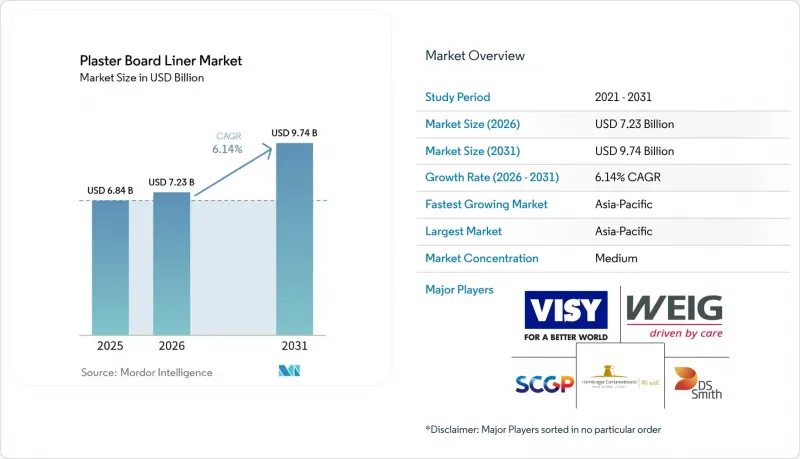
Mordor Intelligence에 의하면, 석고보드 라이너 시장 규모는 2025년에 68억 4,000만 달러로 평가되었습니다. 2026년 72억 3,000만 달러에서 2031년까지 97억 4,000만 달러로 확대되어 예측 기간(2026-2031년) CAGR은 6.14%가 된다고 전망되고 있습니다.
본 보고서는 유형별(석고보드 라이너의 표면재 및 뒷면재), 소재별(재생 섬유계, 버진 섬유계 등), 용도별(벽·칸막이, 천장 등), 지역별(아시아태평양, 북미, 유럽, 남미, 중동 및 아프리카)로 분류되어 있습니다. 시장 전망은 금액(달러) 기준으로 제시되어 있습니다.
세계의 석고보드 라이너 시장 동향 및 인사이트
경량 건식 벽체 공법의 확대
경량 석고보드 시스템으로의 전환에 따라, 표준 라이너의 인장 강도를 뛰어넘는 성능 요건이 요구되고 있습니다. 보드의 경량화에는 더 높은 치수 안정성과, 부피 중량 감소 하에서도 견고한 접착성이 요구됩니다. 이러한 요인들이 결합됨에 따라, 평량(basis weight)을 보다 정밀하게 제어한 엔지니어링 면지에 대한 수요가 증가하고 있습니다. 경량 보드는 구조적 하중 제한이 있는 리모델링 프로젝트에서 특히 중요합니다. 이러한 프로젝트에서는 기존 건축 구조에 가해지는 부담을 줄일 수 있으므로 건식 공법이 선호됩니다. 따라서 보드 제조업체가 경량 설계를 채택하여 자사 제품의 차별화를 꾀함으로써, 석고보드용 라이너 시장은 혜택을 받게 될 것입니다.
특정 경량 배합을 통해 패널 무게를 20%에서 30%까지 줄인 실적이 있습니다. 중공 마이크로스피어 골재는 시판되는 보드 설계에 채택되고 있는 접근 방식 중 하나입니다. 이러한 변화로 인해 보드 표면 및 석고 코어 주변에서 라이너 성능의 중요성이 높아지고 있습니다. 표면지는 제조 공정에서 일관된 접착력을 유지하면서 직접 마감 처리가 가능해야 합니다. 뒷면지는 보드의 무게가 경감된 경우에도 코어와의 접착력을 지속적으로 유지해야 합니다. 이를 통해 자재 사용량을 불필요하게 늘리지 않고도 기술 사양을 충족할 수 있는 공급업체에게는 새로운 비즈니스 기회가 생깁니다.
보드 제조업체는 주택 리노베이션, 임차인 시설 개보수, 공공시설 개보수에서 경량 제품을 활용할 수 있습니다. 이러한 프로젝트에서는 신축 골조 공사에 비해 제약 사항이 적은 경우가 많습니다. 프로젝트 구성이 변화함에 따라 강도나 표면 특성이 향상된 라이너 등급에 대한 수요가 높아질 가능성이 있습니다. 또한, 보드의 혁신과 라이너 선정 간의 연계성도 강화됩니다. 시험 능력과 안정적인 섬유 공급원을 갖춘 공급업체는 이러한 변화에 대응하기 쉬운 입장에 있습니다. 기술적 성능이 단순한 범용 용지 구매가 아닌 사양상의 요건이 됨에 따라, 라이너 시장의 가치는 높아집니다.
재활용 건축자재 및 저탄소 건축자재에 대한 수요 증가
재생 섬유는 자원 회수와 건축의 지속가능성 요건을 양립시키기 위해 라이너 생산의 핵심 요소로 자리 잡고 있습니다. 재생 펄프는 전 세계 석고보드용 라이너지의 섬유 투입량의 58%를 차지하고 있으며, 이를 통해 매년 180만 톤 이상의 폐지가 매립 처분을 피하고 있습니다. 이러한 수치는 석고보드용 라이너지 시장에서 재생 섬유가 차지하는 역할을 여실히 보여줍니다. 다만, 회수되는 폐지의 유형에 따라 재생 원료의 품질이 다르기 때문에 제조업체는 여전히 섬유의 품질 관리를 수행해야 합니다. 라이너용 등급의 섬유에는 신뢰성 높은 보드 생산을 보장하기 위해 일관된 강도, 성형성 및 표면 특성이 요구됩니다.
2026년 『Scientific Reports』지에 게재된 연구에 따르면, 재생지 섬유는 석고 복합재료의 파괴 거동을 취성에서 연성으로 변화시키는 것으로 밝혀졌습니다. 이 연구에서는 시험 대상 복합재료에서 유리 섬유 보강재에 필적하는 하중 저항성 향상이 보고되었습니다. 이 연구 결과는 높은 재활용 함유율 소재 사용과 관련된 오랜 기간의 성능상 우려를 해소해 줍니다. 또한, 제품 설계 시 기계적 신뢰성이 요구되는 상황에서 재생 섬유의 사용을 뒷받침하는 근거가 되기도 합니다. 더 나아가, 회수 원료를 효과적으로 세척, 선별, 혼합할 수 있는 제지 공장의 상업적 가치도 높여줍니다. 따라서 공정 관리를 통해 기능적 성능이 확보된다면, 석고보드 라이너 시장은 재활용 함량 향상으로부터 혜택을 누릴 수 있습니다.
유럽에서 재생 석고 및 순환형 자재 흐름의 중요성이 커지고 있다는 사실은 프랑스의 석고보드 제조업체가 2025년에 23만 7,000톤의 석고 폐기물을 재활용했다는 사실에서 잘 드러납니다. 이는 전년 대비 15% 증가한 수치로, 처리 상한선인 39만 5,000톤을 향해 나아가고 있음을 보여줍니다. 이러한 추세에 따라 라이너 조달은 보다 광범위한 순환형 건설 시스템의 일부로 자리매김하고 있습니다. 구매자들은 재활용 함량, 재활용 가능성, 그리고 수명 주기 성능을 입증하는 서류를 점점 더 많이 요구하고 있습니다. 이러한 요구 사항은 추적 가능한 섬유 시스템과 신뢰할 수 있는 환경 제품 정보를 보유한 공급업체에게 유리하게 작용하고 있습니다.
폐지 및 에너지 비용의 변동
원자재 비용 변동은 라이너 제조업체에게 지속적인 과제로 남아 있습니다. 재생 섬유지의 등급은 천연가스에 68% 의존하고 있습니다. 유럽의 천연가스 가격은 2025년 2분기에 2024년 2분기와 비교해 18% 상승했습니다. 에너지 가격 변동은 펄프화, 건조, 운송 비용에 동시에 영향을 미칠 가능성이 있습니다. 또한 회수율이나 경쟁적인 판지 수요에 변화가 생기면 재생 섬유 비용도 급격히 변동할 수 있습니다. 이러한 변동으로 인해 효과적인 구매 관리 체제를 갖추지 못한 공급업체에게는 가격 책정 및 이익률 관리가 어려워집니다.
MWh당 10유로 상승할 때마다 영향을 크게 받는 종이 유형의 경우, 변동 생산 비용이 톤당 최대 20유로 증가할 가능성이 있습니다. 이러한 사업 리스크는 생산 능력, 품질 관리 시스템 및 제품 개발에 대한 투자 능력에 영향을 미칩니다. 생산자는 이러한 영향을 완화하기 위해 에너지 가격 헤지 계약을 체결하거나, 보다 효율적인 공장 운영을 모색할 가능성이 있습니다. 그러나 모든 기업이 동일한 규모나 계약상 지위에 있는 것은 아닙니다. 소규모 일반 공급업체는 비용이 급등할 경우 더 큰 압박에 직면할 가능성이 있습니다. 따라서 라이너 시장은 투입 비용 관리와 건설 수요 모두에 여전히 민감한 상황에 놓여 있습니다.
재활용 펄프의 확보 가능성도 제지 공장에 있어 불확실성의 요인 중 하나입니다. 2025년 북미에서 골판지 원지 생산 능력이 축소됨에 따라 재활용 펄프 공급이 부족해지고, 사용 후 골판지(OCC)의 가격 변동이 심화되었습니다. 라이너 제조업체들은 다른 종이 및 포장용 등급 제조업체들과 이용 가능한 원료를 놓고 경쟁하고 있습니다. 또한, 특히 수거 시스템에 부담이 가해질 경우 섬유의 품질에도 편차가 발생합니다. 첨단 선별 및 세척 기술이 없다면 재활용 함량 제고 목표를 달성하기가 더욱 어려워질 수 있습니다. 이로 인해 확립된 수거 네트워크와 기술적 처리 능력을 갖춘 통합형 공급업체에게 우위가 생깁니다.
부문별 분석
2025년, 석고보드용 라이너의 표면지는 시장 점유율의 55.56%를 차지했으며, 2031년까지 연평균 성장률(CAGR) 6.83%를 나타낼 것으로 예측됩니다. 석고보드 1장당 표면 시트와 뒷면 시트가 필요하기 때문에 표면지의 기본적인 시장 점유율이 뒷받침되고 있습니다. 또한, 표면지는 직접적인 장식 기능도 수행하기 때문에 표면 품질은 상업적으로 중요한 요소가 됩니다. 표면지의 인장 강도는 7 kN/m를 초과하여 표준 등급인 5.8 kN/m를 상회했습니다. 이러한 요건을 충족하기 위해서는 다층 크라프트 기술이나 더 엄격한 평량 허용 오차가 필요할 수 있습니다. 기술 요건의 높아짐이 석고보드용 라이너 시장에서 엔지니어링 표면지 등급으로의 전환을 촉진하고 있습니다.
내화성, 방음성, 내습성을 갖춘 보드의 등장으로 고사양 표면지의 용도가 확대되고 있습니다. 보드 제조업체들은 표면지 층을 활용하여 마감 품질을 향상시키고 제품을 차별화하고 있습니다. 내셔널 지프섬의 ‘2025 EVOLVE’ 시리즈는 곰팡이와 습기에 강한 제품을 포함한 3가지 변형 제품 모두에서 100% 재생지를 표면지로 채택하고 있습니다. 이 사례는 라이너 선정이 보드 제품 제안의 일부가 될 수 있음을 보여줍니다. 따라서 표면지는 업계 전반에서 주도적인 역할을 수행함과 동시에, 더 높은 부가가치를 지닌 사양으로 나아가는 길을 열어줍니다.
석고보드의 라이너인 뒷면지는 표면지만큼 주목받지는 않지만, 기술적으로는 여전히 중요합니다. 보드의 무게를 줄이기 위해 뒷면지에는 경량화가 요구되는 경향이 강해지고 있습니다. 가벼운 완제품 보드를 지지하면서도 코어와의 접착력을 유지해야 합니다. 이로 인해 뒷면지 등급을 취급하는 공급업체에게는 독자적인 개발 경로가 생겨나고 있습니다. 평량 감소는 섬유 사용량 감소로 이어지지만, 한편으로는 강도의 일관성과 기계적 성능에 대한 요구도 높아집니다. 보드 제조업체가 제품의 신뢰성을 훼손하지 않으면서 경량화를 도모하는 가운데, 뒷면지 공급업체의 존재 의의는 여전히 큽니다.
지역별 분석
아시아태평양은 2025년 석고보드용 라이너 시장의 45.31%를 차지했으며, 2031년까지 연평균 성장률(CAGR) 7.12%를 나타낼 것으로 예측됩니다. 중국 도시 지역의 고밀도화와 인도에서 정식 건설의 확대가 이 지역의 주요 성장 요인으로 작용하고 있습니다. 인도의 표시 의무화와 중국의 포름알데히드 배출 제한으로 인해 인증된 라이너 제품에 대한 조달 경향이 강해지고 있습니다. 품질 실적이 확인되지 않은 공급업체는 지정된 보드 프로그램 수주 경쟁에서 더욱 어려운 상황에 직면할 가능성이 있습니다. 따라서 아시아태평양에서는 높은 기초 수요와 강화되는 제품 보증 요건이 맞물려 있으며, 이 지역의 석고보드 라이너 시장 규모는 보드 생산 능력 확대와 인증 제품의 보급 확대를 통해 뒷받침되고 있습니다.
북미와 유럽은 합쳐서 2위 수요 지역을 형성하고 있으며, 그 수요 동향은 리모델링 활동 및 규제 주도형 프리미엄화와 밀접하게 관련되어 있습니다. 미국의 개보수 지출은 연간 4,000억 달러를 초과하며, 주택 착공 건수가 둔화되는 상황에서도 석고보드 교체 및 인테리어 개보수를 뒷받침하고 있습니다. 유럽 시장은 전 세계 라이너 밸류체인에서 재활용 함유율이 가장 높으며, 재생 섬유 처리 능력, 안정적인 기술적 성능, 그리고 환경 관련 인증 서류를 갖춘 공급업체가 유리한 입지를 점하고 있습니다.
프랑스에서는 2025년에 23만 7,000톤의 2차 석고 재료를 재이용하여 전년 대비 15% 증가했습니다. 독일에서는 2038년까지 석탄을 단계적으로 폐지함에 따라, 기존에 중요한 원료원이었던 배연 탈황(FGD) 석고공급량이 감소하고 있습니다. 이러한 상황으로 인해 순환형 자재 시스템과 추적성이 확보된 원료 공급에 대한 관심이 높아지고 있습니다. 환경제품선언(EPD)은 유럽 시장 전체의 공공 부문 입찰 참여에 영향을 미칠 가능성이 있으며, 신뢰할 수 있는 데이터와 재활용 네트워크를 보유한 라이너 제조업체는 이러한 조달 방식에서 유리한 입장에 있습니다.
남미, 중동 및 아프리카는 건설 프로젝트 주도 수요 지역이지만, 현지 내 라이너 생산은 제한적입니다. 브라질의 석고보드 시장 확대는 기존의 습식 공법을 대신해 건식 공법이 보급됨에 따라 남미 지역에 새로운 기회를 창출하고 있습니다. 생고뱅은 바이아주 페이라 데 산타나에 새로운 생산 라인에 투자하고 있으며, 완공 시 생산 능력을 75% 증대시켜 라틴아메리카 최대의 석고보드 제조 시설이 될 예정입니다. 이 투자는 라이너 수요 측면에서 현지 보드 생산 능력이 얼마나 중요한지를 여실히 보여주고 있습니다. 새로운 보드 공장이 신뢰할 수 있는 종이 원료와 기술 지원을 필요로 할 경우, 지역 공급업체들이 혜택을 볼 가능성이 있습니다.
기타 혜택 :
- 엑셀 형식 시장 예측(ME) 시트
- 3개월간의 애널리스트 지원
자주 묻는 질문
목차
제1장 서론
제2장 조사 방법
제3장 개요
제4장 시장 구도
제5장 시장 규모 및 성장 예측
제6장 경쟁 구도
제7장 시장 기회 및 향후 전망
KTHAccording to Mordor Intelligence, the plaster board liner market size was estimated at USD 6.84 billion in 2025 and is estimated to grow from USD 7.23 billion in 2026 to USD 9.74 billion by 2031, at a CAGR of 6.14% during the forecast period (2026-2031).
This report is Segmented by Type (Plasterboard Liner Face and Plasterboard Liner Back), Material (Recycled Fiber-Based, Virgin Fiber-Based, and More), Application (Walls and Partitions, Ceilings, and More), and Geography (Asia-Pacific, North America, Europe, South America, and Middle-East and Africa). The Market Forecasts are Provided in Terms of Value (USD).
Global Plaster Board Liner Market Trends and Insights
Expansion of Lightweight Drywall Construction
The shift toward lightweight gypsum board systems raises performance requirements beyond standard liner tensile strength. Lower board weight requires greater dimensional stability and stronger bonding at reduced grammage. This combination supports demand for engineered face papers with tighter control over basis weight. Lightweight boards are especially relevant in renovation projects with structural load limits. Such projects favor dry construction because it reduces pressure on existing building structures. The plasterboard liner market, therefore, benefits when board makers use lightweight designs to differentiate their products.
Panel-weight reductions of 20% to 30% have been recorded in certain lightweight formulations. Hollow-microsphere aggregates represent one approach used in commercial board designs. These changes increase the importance of liner performance at the board surface and around the gypsum core. Face paper must support direct decoration while maintaining consistent adhesion during manufacture. The back paper must continue to support core adhesion even where board weight is reduced. This creates opportunities for suppliers that can meet technical specifications without unnecessarily increasing material use.
Board makers can use lightweight products in residential upgrades, tenant improvements, and institutional refurbishment. These projects often face restrictions that are less relevant in new-build shell construction. A change in project mix can lift demand for liner grades with improved strength and surface characteristics. It also creates a stronger link between board innovation and liner selection. Suppliers with testing capability and stable fiber inputs are better positioned to respond. The liner market gains value when technical performance becomes a specified requirement rather than a generic paper purchase.
Rising Demand for Recycled and Low-Carbon Building Materials
Recycled fiber has become central to liner production because it aligns material recovery with building sustainability requirements. Recycled pulp represented 58% of global gypsum-facing paper fiber input, diverting more than 1.8 million tons of waste paper from landfills each year. These figures illustrate the role of recovered fiber in the plasterboard liner market. Producers must still control fiber quality because recycled furnish can vary across collection streams. Liner grades require consistent strength, formation, and surface properties to ensure reliable board production.
A 2026 Scientific Reports study found that recycled paper fibers changed the fracture behavior of gypsum composites from brittle to ductile. The study reported improved load resistance comparable to that of glass-fiber reinforcement in the tested composites. This evidence addresses a longstanding performance concern regarding the use of high-recycled-content materials. It supports the use of recovered fiber where product designs require mechanical reliability. It also reinforces the commercial value of mills capable of effectively cleaning, sorting, and blending recovered inputs. The plasterboard liner market can therefore benefit from recycled content when process control protects functional performance.
The growing importance of recycled gypsum and circular material flows in Europe is highlighted by French plasterboard manufacturers reintegrating 237,000 tons of gypsum waste in 2025, reflecting a 15% year-over-year increase toward a processing ceiling of 395,000 tons. These developments place liner procurement within a wider circular construction system. Buyers increasingly require documentation showing recycled content, recyclability, and lifecycle performance. This requirement favors suppliers with traceable fiber systems and credible environmental product information.
Volatility in Recovered Paper and Energy Costs
Input cost volatility is a persistent challenge for liner manufacturers. Recycled-fiber paper grades have a 68% dependence on natural gas. European natural gas prices rose 18% in the second quarter of 2025 compared with the second quarter of 2024. Energy price changes can affect pulping, drying, and transport costs simultaneously. Recovered fiber costs can also move quickly when collection rates or competing board demand change. These movements make pricing and margin management difficult for suppliers without effective purchasing controls.
Each EUR 10 per MWh increase could add up to EUR 20 per ton in variable production costs for highly exposed grades. This operational exposure affects the ability to invest in capacity, quality systems, and product development. Producers may seek hedged energy contracts or more efficient mill operations to reduce this effect. However, not every company has the same scale or contracting position. Smaller merchant suppliers can face greater pressure when costs rise rapidly. The liner market, therefore, remains sensitive to both input cost management and construction demand.
Recovered fiber availability is another source of uncertainty for mills. North American containerboard capacity closures in 2025 tightened recovered-fiber supply and increased Old Corrugated Containers (OCC) price swings. Liner producers compete with other paper and packaging grades for usable material. Fiber quality also varies, especially when collection systems are under pressure. Higher recycled-content targets can become harder to meet without advanced sorting and cleaning. This creates an advantage for integrated suppliers with established recovery networks and technical processing capability.
Other drivers and restraints analyzed in the detailed report include:
- Growth of Fire-Rated and Acoustic Board Specifications
- Accelerating Renovation and Interior Retrofit Activity
- Construction-Cycle and Housing-Start Sensitivity
For complete list of drivers and restraints, kindly check the Table Of Contents.
Segment Analysis
Plasterboard liner face paper held 55.56% of the plasterboard liner market share in 2025 and is projected to grow at a 6.83% CAGR through 2031. Each gypsum board requires a face sheet and a back sheet, which supports the basic share position of face paper. Face paper also serves as direct decoration, making surface quality commercially important. Face paper tensile strength exceeded 7 kN/m, compared with 5.8 kN/m for standard grades. This requirement can call for multilayer kraft technology and tighter basis-weight tolerances. Higher technical requirements support the shift toward engineered face paper grades in the plasterboard liner market.
Fire-rated, acoustic, and moisture-resistant boards expand the use of high-specification face paper. Board makers use the outer paper layer to support finish quality and product differentiation. National Gypsum's 2025 EVOLVE line uses 100% recycled paper encasing across three variants, including a mold- and moisture-resistant product. This example shows how liner selection can form part of a board's product proposition. Face paper, therefore, combines shared leadership with a path toward higher-value specifications.
Plasterboard liner back paper remains technically important despite receiving less attention than face paper. Back paper is increasingly specified at reduced grammage to contain board weight. It must preserve core adhesion while supporting a lighter finished board. This creates a separate development path for suppliers serving back paper grades. Reduced grammage can lower fiber use but also increases requirements for consistent strength and machine performance. Back paper suppliers remain relevant as board makers seek to reduce weight without compromising product reliability.
Complete Report Scope:
- By Type
- Plasterboard Liner Face
- Plasterboard Liner Back
- By Material
- Recycled Fiber-Based
- Virgin Fiber-Based
- Mixed Fiber-Based
- Others
- By Application
- Walls and Partitions
- Ceilings
- Others (External Sheathing, Acoustic Assemblies, Decorative and Specialty Applications)
- By Geography
- Asia-Pacific
- China
- India
- Japan
- South Korea
- ASEAN Countries
- Rest of Asia-Pacific
- North America
- United States
- Canada
- Mexico
- Europe
- Germany
- United Kingdom
- France
- Italy
- NORDIC Countries
- Rest of Europe
- South America
- Brazil
- Argentina
- Rest of South America
- Middle-East and Africa
- Saudi Arabia
- South Africa
- Rest of Middle-East and Africa
- Asia-Pacific
Geography Analysis
Asia-Pacific held 45.31% of the plasterboard liner market share in 2025 and is forecast to grow at a 7.12% CAGR through 2031. China's urban densification and India's formal construction expansion are key regional drivers. Indian marking mandates and Chinese formaldehyde emission limits are shaping procurement toward certified liner products. Suppliers without verified quality records may find it harder to compete for specified board programs. Asia-Pacific, therefore, combines high base demand with growing product assurance requirements. The plasterboard liner market size in the region is supported by growth in board capacity and wider adoption of certified products.
North America and Europe form the second-largest combined demand area, with a demand profile more closely linked to renovation activity and regulatory-driven premiumization. U.S. improvement and repair spending exceeds USD 400 billion annually, supporting drywall replacement and interior upgrades even when housing starts soften. European markets have the highest recycled-content intensity in the global liner value chain, favoring suppliers with recovered-fiber capability, stable technical performance, and environmental documentation.
France reintegrated 237,000 tons of secondary gypsum material in 2025, representing a 15% year-over-year increase. Germany's coal phase-out by 2038 is reducing the availability of flue gas desulfurization (FGD) gypsum, a historically significant input source. These conditions are increasing attention to circular material systems and traceable input supplies. Environmental product declarations can influence access to public-sector tenders across European markets, and liner producers with credible data and recycling links are better positioned for this procurement approach.
South America, the Middle-East, and Africa are construction-program-led demand areas with limited domestic liner production. Brazil's drywall expansion is creating opportunities in South America as dry construction systems replace traditional wet methods. Saint-Gobain is investing in a new production line in Feira de Santana, Bahia, designed to increase capacity by 75% and become Latin America's largest drywall facility upon completion. This investment underscores the importance of local board capacity for liner demand. Regional suppliers may benefit where new board plants require reliable paper inputs and technical support.
- Alier S.A.
- ASIA PAPER MFG.CO.,LTD
- DS Smith
- Gulf Ply
- INDEVCO Paper Making
- National Gypsum Services Company
- PABCO Gypsum
- Republic Paperboard Company, LLC
- Saint-Gobain
- SCG PACKAGING
- Sure Paper Co., Ltd.
- Visy
- W. Hamburger GmbH
- WEIG Group
- Yoshino Gypsum Co., Ltd.
Additional Benefits:
- The market estimate (ME) sheet in Excel format
- 3 months of analyst support
TABLE OF CONTENTS
1 Introduction
- 1.1 Study Assumptions and Market Definition
- 1.2 Scope of the Study
2 Research Methodology
3 Executive Summary
4 Market Landscape
- 4.1 Market Overview
- 4.2 Market Drivers
- 4.2.1 Expansion of Lightweight Drywall Construction
- 4.2.2 Rising Demand for Recycled and Low-Carbon Building Materials
- 4.2.3 Growth of Fire-Rated and Acoustic Board Specifications
- 4.2.4 Accelerating Renovation and Interior Retrofit Activity
- 4.2.5 Captive Liner Supply Integration by Gypsum Board Producers
- 4.3 Market Restraints
- 4.3.1 Volatility in Recovered Paper and Energy Costs
- 4.3.2 Construction-Cycle and Housing-Start Sensitivity
- 4.3.3 Recycled-Fiber Contamination and Performance Variability
- 4.4 Value Chain Analysis
- 4.5 Porter's Five Forces Analysis
- 4.5.1 Threat of New Entrants
- 4.5.2 Bargaining Power of Suppliers
- 4.5.3 Bargaining Power of Buyers
- 4.5.4 Threat of Substitutes
- 4.5.5 Competitive Rivalry
5 Market Size and Growth Forecasts (Value)
- 5.1 By Type
- 5.1.1 Plasterboard Liner Face
- 5.1.2 Plasterboard Liner Back
- 5.2 By Material
- 5.2.1 Recycled Fiber-Based
- 5.2.2 Virgin Fiber-Based
- 5.2.3 Mixed Fiber-Based
- 5.2.4 Others
- 5.3 By Application
- 5.3.1 Walls and Partitions
- 5.3.2 Ceilings
- 5.3.3 Others (External Sheathing, Acoustic Assemblies, Decorative and Specialty Applications)
- 5.4 By Geography
- 5.4.1 Asia-Pacific
- 5.4.1.1 China
- 5.4.1.2 India
- 5.4.1.3 Japan
- 5.4.1.4 South Korea
- 5.4.1.5 ASEAN Countries
- 5.4.1.6 Rest of Asia-Pacific
- 5.4.2 North America
- 5.4.2.1 United States
- 5.4.2.2 Canada
- 5.4.2.3 Mexico
- 5.4.3 Europe
- 5.4.3.1 Germany
- 5.4.3.2 United Kingdom
- 5.4.3.3 France
- 5.4.3.4 Italy
- 5.4.3.5 NORDIC Countries
- 5.4.3.6 Rest of Europe
- 5.4.4 South America
- 5.4.4.1 Brazil
- 5.4.4.2 Argentina
- 5.4.4.3 Rest of South America
- 5.4.5 Middle-East and Africa
- 5.4.5.1 Saudi Arabia
- 5.4.5.2 South Africa
- 5.4.5.3 Rest of Middle-East and Africa
- 5.4.1 Asia-Pacific
6 Competitive Landscape
- 6.1 Market Concentration
- 6.2 Strategic Moves
- 6.3 Market Share (%)/Ranking Analysis
- 6.4 Company Profiles (includes Global Overview, Market Overview, Core Segments, Financials as available, Strategic Information, Products and Services, and Recent Developments)
- 6.4.1 Alier S.A.
- 6.4.2 ASIA PAPER MFG.CO.,LTD
- 6.4.3 DS Smith
- 6.4.4 Gulf Ply
- 6.4.5 INDEVCO Paper Making
- 6.4.6 National Gypsum Services Company
- 6.4.7 PABCO Gypsum
- 6.4.8 Republic Paperboard Company, LLC
- 6.4.9 Saint-Gobain
- 6.4.10 SCG PACKAGING
- 6.4.11 Sure Paper Co., Ltd.
- 6.4.12 Visy
- 6.4.13 W. Hamburger GmbH
- 6.4.14 WEIG Group
- 6.4.15 Yoshino Gypsum Co., Ltd.
7 Market Opportunities and Future Outlook
- 7.1 White-Space and Unmet-Need Assessment