

|
시장보고서
상품코드
2114381
중동 및 아프리카의 석고보드 시장 : 시장 점유율 분석, 업계 동향 및 통계, 성장 예측(2026-2031년)Middle-East And Africa Gypsum Board - Market Share Analysis, Industry Trends & Statistics, Growth Forecasts (2026 - 2031) |
||||||
 Mordor Intelligence
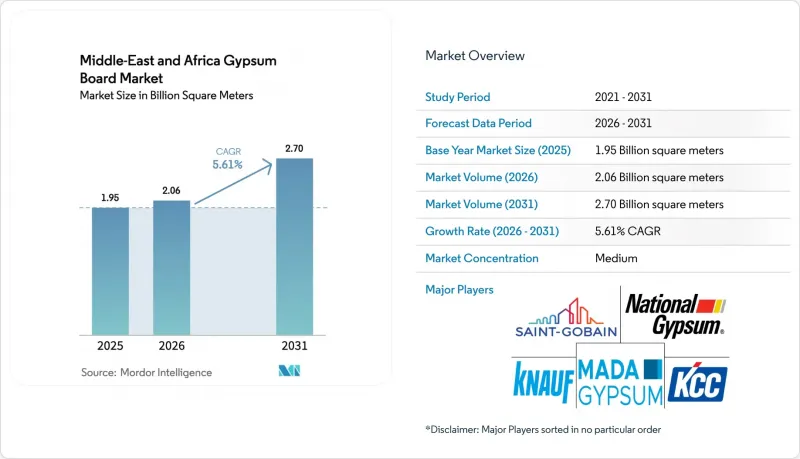
Mordor Intelligence에 의하면, 중동 및 아프리카 석고보드 시장 규모는 2025년 19억 5,000만 평방미터로 평가되었고, 2026년에는 20억 6,000만 평방미터로 추정되고, 2026-2031년 CAGR 5.61%로 성장을 지속할 전망이며, 2031년까지 27억 평방미터에 이를 것으로 예측됩니다.
본 보고서는 보드 유형별(벽용 보드, 천장용 보드, 프리데코레이트 보드, 내화 보드), 최종 용도 분야별(주택, 상업시설, 공공시설, 산업·창고), 지역별(사우디아라비아, 아랍에미리트, 카타르, 쿠웨이트, 이란, 남아프리카공화국, 나이지리아, 케냐, 기타 중동 및 아프리카 국가)로 분류되어 있습니다. 시장 예측은 수량(제곱미터) 단위로 제시되어 있습니다.
중동 및 아프리카의 석고보드 시장 동향 및 인사이트
사우디아라비아 및 UAE의 정부 자금 지원 계획 중인 메가 프로젝트
2023년 1-3분기 동안 대규모 정부 주도 프로젝트의 계약액은 550억 달러를 초과했으며, 공사 기간 단축을 위해 표준화된 경량 칸막이 자재에 의존하는 단계별 납품 일정이 확정되었습니다. NEOM만 해도 주택 단위의 약 30%에 공장 제작된 내벽 조립체를 의무화하고 있어, 이로 인해 보드 수요가 몇 년 앞당겨지고 있습니다. 레드 씨 프로젝트, 뉴 무라바, 키디야는 수백만 제곱미터 규모의 초고속 건설을 통해 연면적에 추가 면적을 확보하고 있으며, 두바이 2040 계획에서는 이미 방대한 파이프라인에 상업용 타워, 학교, 의료시설이 잇달아 추가되고 있습니다. 개발업자들이 내화 석고 보드를 선택하는 이유는 고층 건축 설계에서 중요한 우려 사항인 구조 중량 증가를 초래하지 않으면서도 GCC의 새로운 시험 기준을 충족하기 위해서입니다. 금융 기관과 보험사는 현재 이러한 기준을 계약 조항에 포함시키고 있으며, 중동 및 아프리카의 석고보드 시장 전반에 걸쳐 특수 보드에 대한 수요를 사실상 제도화하고 있습니다.
GCC의 호텔·리조트 자산에서 관광 주도형 석고보드 인테리어 수요
카타르는 2025년에 400만 명의 관광객을 맞이했습니다. 이러한 급증에 따라 100억 카타르 리얄(27억 5,000만 달러) 규모의 호텔 자금 조달 계획이 수립되었으며, 신속한 리모델링에 대한 기준이 상향 조정되었습니다. 라스 알 하이마에 위치한 알 마르잔 섬의 윈 리조트는 2027년 초 개장을 예정하고 있으며, 객실과 백오피스용 복도만으로도 15만 제곱미터 이상의 내화 석고 보드가 필요할 것으로 예측됩니다. ‘비전 2030’은 사우디아라비아의 연간 방문객 수를 1억 명으로 늘리는 것을 목표로 하고 있으며, 이는 약 50만 개의 신규 호텔 객실에 해당합니다. 복도와 공용 구역을 포함하면 객실당 평균 150제곱미터의 보드가 필요합니다. 프로젝트 팀은 마감 처리가 완료되고 내습성이 뛰어난 패널을 선호하여 채택하고 있습니다. 이는 펀치리스트 처리 기간을 단축하고, 정기적인 보수 공사 중 발생하는 가동 중단 시간을 최소화할 수 있기 때문입니다. 이러한 사양으로 인해 고가이자 고성능인 SKU가 작업 분할 구조(WBS)에 포함되며, 중동 및 아프리카 석고보드 시장의 연중 출하를 뒷받침하고 있습니다.
종이 표면 보드의 수분 및 곰팡이 손상에 대한 취약성
상대 습도가 80%를 초과하면 종이 표면재 위의 곰팡이 증식이 가속화되며, 걸프 지역 아파트 현장 감사 결과, 표준 보드에 2년 이내에 육안으로 확인 가능한 곰팡이가 발생한 것으로 확인되었습니다. 건설업자는 유리 섬유 매트나 시멘트 섬유로 만든 대체재를 지정할 수도 있지만, 이러한 대체재는 15-25%의 가격 프리미엄이 붙으며, 대부분의 지방 자치 단체 건축 기준에서는 아직 의무화되어 있지 않습니다. 기존 공조 시스템이 50-60%의 습도를 유지하는 경우는 드물기 때문에 리모델링 공사는 특히 이 문제에 취약합니다. 조기 교체 비용은 과거 석고 보드가 석조보다 우수하다고 여겨졌던 ‘총 소유 비용’이라는 주장에 타격을 입히게 됩니다.
부문 분석
내화 보드 시장은 2031년까지 연평균 성장률(CAGR) 6.68%로 확대될 전망이며, 2024년 GCC(걸프협력회의) 내화 시험 기준 개정에 따라 고층 빌딩의 코어 부분에 유형 X 또는 C 조립 구조가 의무화됨에 따라 5.61%라는 기준치를 상회하는 성장률을 보이고 있습니다. 2025년에도 벽용 보드는 중동 및 아프리카 석고보드 시장 점유율의 46.12%를 차지했으나, 특히 호텔업계의 리모델링 공사나 모듈식 포드에서 천장용 패널 및 사전 마감 처리된 패널의 사양 채택이 진행되고 있어 그 우위는 점차 낮아지고 있습니다. 건축가들은 유형 C 패널이 높은 코어 밀도와 유리 섬유를 결합하여 2시간 내화 성능에 있어 구조적 완전성을 유지할 수 있다는 점을 높이 평가했습니다. 이는 두바이에서 일련의 파사드 화재가 발생한 이후, 보험사가 현재 요구하고 있는 요건이기도 합니다. Glasroc X와 같은 프리미엄 천장 보드는 30-40%의 가격 프리미엄이 붙지만, 공항 콘코스나 리조트 로비 등 음향 성능이나 처짐 저항이 중시되는 프로젝트에서는 입찰에서 수주에 성공하고 있습니다.
또한, 특수 보드는 시멘트계 대체재에 비해 함유된 탄소량이 적기 때문에 UAE의 ‘에스티다마’나 사우디아라비아의 개정판 SBC 601 에너지 장에서 평가 점수를 획득할 수 있습니다. 따라서 각 제조업체는 가동 중단 시간을 최소화하면서 표준 배치와 내화 배치를 전환할 수 있는 가마를 우선적으로 선택하고 있으며, NEOM의 멀티 패키지 계약을 통해 일반적인 다양한 수주 구성에 대응할 수 있게 되었습니다. 모듈식 공장의 규모 확대에 따라, 대형 보드는 기존의 1.20×2.40미터 표준 크기에서 수직 방향의 이음매를 줄이고 1제곱미터당 작업 시간을 단축하는 3미터의 특별 주문 크기로 전환될 것입니다. 이러한 변화는 중동 및 아프리카 석고보드 시장에서 벽용 보드가 점점 더 상품화되어 가는 상황 속에서도, 이익률을 유지하기 위한 제품 차별화로 이어질 것입니다.
기타 특전 :
- 엑셀 형식 시장 예측(ME) 시트
- 3개월간의 애널리스트 지원
자주 묻는 질문
목차
제1장 서론
제2장 조사 방법
제3장 주요 요약
제4장 시장 구도
제5장 시장 규모 및 성장 예측(면적 : 평방미터)
제6장 경쟁 구도
제7장 시장 기회 및 향후 전망
AJY 26.08.26According to Mordor Intelligence, the Middle-East and Africa gypsum board market size is expected to grow from 1.95 Billion square meters in 2025 to 2.06 Billion square meters in 2026 and is forecast to reach 2.70 Billion square meters by 2031 at 5.61% CAGR over 2026-2031.
This report is Segmented by Board Type (Wall Board, Ceiling Board, Pre-Decorated Board, and Fire-Resistant Board), End-Use Sector (Residential, Commercial, Institutional, and Industrial and Warehouse), and Geography (Saudi Arabia, UAE, Qatar, Kuwait, Iran, South Africa, Nigeria, Kenya, and Rest of Middle-East and Africa). The Market Forecasts are Provided in Terms of Volume (Square Meters).
Middle-East And Africa Gypsum Board Market Trends and Insights
Government-Funded Pipeline Megaprojects in Saudi Arabia and UAE
Massive sovereign programs exceeded USD 55 billion in awarded contracts during the first three quarters of 2023 and have locked in phased delivery schedules that rely on standardized, lightweight partitions for faster close-out. NEOM alone mandates factory-made interior wall assemblies for roughly 30% of its residential units, pulling board demand forward several years. The Red Sea Project, New Murabba, and Qiddiya add millions of square meters of ultra-fast-track floor area, and Dubai 2040 is layering commercial towers, schools, and health-care facilities on an already deep pipeline. Developers opt for fire-rated drywall because it satisfies new GCC test standards without adding structural weight, a critical concern in high-rise design. Lenders and insurers now embed these standards into covenants, effectively institutionalizing demand for specialty boards across the Middle-East and Africa gypsum board market.
Tourism-Led Demand for Drywall Fit-Outs in GCC Hospitality Assets
Qatar welcomed 4 million visitors in 2025, a surge that has prompted a QAR 10 billion (USD 2.75 billion) hotel funding plan and raised the bar for rapid refurbishments. The Wynn Resort on Al Marjan Island in Ras Al Khaimah is scheduled for early 2027 opening and alone requires more than 150,000 square meters of fire-resistant drywall in guestrooms and back-of-house corridors. Vision 2030 aims for 100 million annual visitors to Saudi Arabia, which translates into roughly 500,000 new hotel keys; each room carries an average of 150 square meters of board when corridors and amenity areas are included. Project teams favor pre-decorated and moisture-resistant panels because they compress punch-list cycles and minimize downtime during periodic upgrades. These specifications lock premium-priced, high-performance SKUs into work-breakdown structures, underpinning year-round shipments in the Middle-East and Africa gypsum board market.
Susceptibility of Paper-Faced Boards to Water and Mold Damage
Relative humidity above 80% accelerates fungal growth on paper facings, and field audits in Gulf apartments have found visible mold on standard boards within two years. Builders can specify fiberglass-mat or cement-fiber alternatives, but those carry 15-25% price premiums and are not yet mandatory in most municipal codes. Renovation work is especially exposed because existing HVAC systems rarely maintain 50-60% humidity. Premature replacement costs dent the total-cost-of-ownership narrative that once favored gypsum over masonry.
Other drivers and restraints analyzed in the detailed report include:
- Fast-Track Prefab and Modular Construction Uptake Across MEA
- Mandated Energy-Efficient Building Codes
- Volatile Natural-Gypsum Mining Royalties and Freight Costs
For complete list of drivers and restraints, kindly check the Table Of Contents.
Segment Analysis
Fire-resistant board is growing at a 6.68% CAGR to 2031 and is outpacing the 5.61% baseline because 2024 updates to GCC fire-test standards require Type X or C assemblies in high-rise cores. Wall board still represented 46.12% of the Middle-East and Africa gypsum board market share in 2025, but its dominance is slipping as ceiling and pre-decorated panels climb the specification ladder, particularly in hospitality retrofits and modular pods. Architects value the fact that Type C panels combine higher core density with glass fiber to maintain structural integrity for two-hour ratings, something insurers now demand since a series of facade fires in Dubai. Premium ceiling boards such as Glasroc X sell at 30-40% price premiums yet win bids where acoustic performance and sag resistance matter, for example in airport concourses and resort lobbies.
Specialty boards also carry lower embodied carbon than cementitious alternates, so they earn points under UAE Estidama and Saudi Arabia's updated SBC 601 energy chapter. Manufacturers therefore prioritize kilns that can toggle between standard and fire-resistant batches with minimal downtime, helping them meet mixed order profiles common on NEOM multi-package contracts. As modular factories scale, large-format boards will migrate from 1.20 X 2.40 meter staples to custom 3 meter lengths that reduce vertical joints, trimming labor minutes per square meter. That shift embeds product differentiation that protects margins even when wall board becomes more commoditized in the Middle-East and Africa gypsum board market.
Complete Report Scope:
- By Board Type
- Wall Board
- Ceiling Board
- Pre-decorated Board
- Fire-resistant Board
- By End-use Sector
- Residential
- Commercial
- Institutional (Healthcare and Education)
- Industrial and Warehouse
- By Geography
- Saudi Arabia
- United Arab Emirates
- Qatar
- Kuwait
- Egypt
- Iran
- South Africa
- Nigeria
- Kenya
- Rest of Middle-East and Africa
List of Companies Covered in this Report:
- AYHACO
- Diamond Frames Pvt. Ltd.
- El Khayyat Gypsum
- Etex Group
- Global Gypsum Company LLC
- Gypsemna
- KCC Corporation
- Knauf Group
- Kuwait Gypsum Company
- Mada Gypsum Company
- National Gypsum Services Company
- Saint-Gobain
- United Mining Industries
Additional Benefits:
- The market estimate (ME) sheet in Excel format
- 3 months of analyst support
TABLE OF CONTENTS
1 Introduction
- 1.1 Study Assumptions and Market Definition
- 1.2 Scope of the Study
2 Research Methodology
3 Executive Summary
4 Market Landscape
- 4.1 Market Overview
- 4.2 Market Drivers
- 4.2.1 Government-Funded Pipelines Megaprojects in Saudi Arabia and UAE
- 4.2.2 Tourism-Led Demand for Drywall Fit-Outs in GCC Hospitality Assets
- 4.2.3 Fast-Track Prefab and Modular Construction Uptake Across MEA
- 4.2.4 Mandated Energy-Efficient Building Codes
- 4.2.5 Circular-Economy Push for Gypsum Recycling And Synthetic Gypsum Quotas
- 4.3 Market Restraints
- 4.3.1 Susceptibility of Paper-Faced Boards to Water and Mold Damage
- 4.3.2 Volatile Natural-Gypsum Mining Royalties and Freight Costs
- 4.3.3 Rising Availability of Cement Fibre and Calcium-Silicate Substitutes
- 4.4 Value Chain Analysis
- 4.5 Porter's Five Forces
- 4.5.1 Bargaining Power of Suppliers
- 4.5.2 Bargaining Power of Buyers
- 4.5.3 Threat of New Entrants
- 4.5.4 Threat of Substitutes
- 4.5.5 Competitive Rivalry
5 Market Size and Growth Forecasts (Area in square meters)
- 5.1 By Board Type
- 5.1.1 Wall Board
- 5.1.2 Ceiling Board
- 5.1.3 Pre-decorated Board
- 5.1.4 Fire-resistant Board
- 5.2 By End-use Sector
- 5.2.1 Residential
- 5.2.2 Commercial
- 5.2.3 Institutional (Healthcare and Education)
- 5.2.4 Industrial and Warehouse
- 5.3 By Geography
- 5.3.1 Saudi Arabia
- 5.3.2 United Arab Emirates
- 5.3.3 Qatar
- 5.3.4 Kuwait
- 5.3.5 Egypt
- 5.3.6 Iran
- 5.3.7 South Africa
- 5.3.8 Nigeria
- 5.3.9 Kenya
- 5.3.10 Rest of Middle-East and Africa
6 Competitive Landscape
- 6.1 Market Concentration
- 6.2 Strategic Moves
- 6.3 Market Share(%)/Ranking Analysis
- 6.4 Company Profiles (includes Global-level Overview, Market-level Overview, Core Segments, Financials as available, Strategic Information, Market Rank/Share, Products and Services, Recent Developments)
- 6.4.1 AYHACO
- 6.4.2 Diamond Frames Pvt. Ltd.
- 6.4.3 El Khayyat Gypsum
- 6.4.4 Etex Group
- 6.4.5 Global Gypsum Company LLC
- 6.4.6 Gypsemna
- 6.4.7 KCC Corporation
- 6.4.8 Knauf Group
- 6.4.9 Kuwait Gypsum Company
- 6.4.10 Mada Gypsum Company
- 6.4.11 National Gypsum Services Company
- 6.4.12 Saint-Gobain
- 6.4.13 United Mining Industries
7 Market Opportunities and Future Outlook
- 7.1 White-Space and Unmet-Need Assessment
- 7.2 Growing Awareness on Energy Efficient Policy


