

|
시장보고서
상품코드
2114380
아시아태평양의 석고보드 : 시장 점유율 분석, 업계 동향 및 통계, 성장 예측(2026-2031년)Asia-Pacific Gypsum Board - Market Share Analysis, Industry Trends & Statistics, Growth Forecasts (2026 - 2031) |
||||||
 Mordor Intelligence
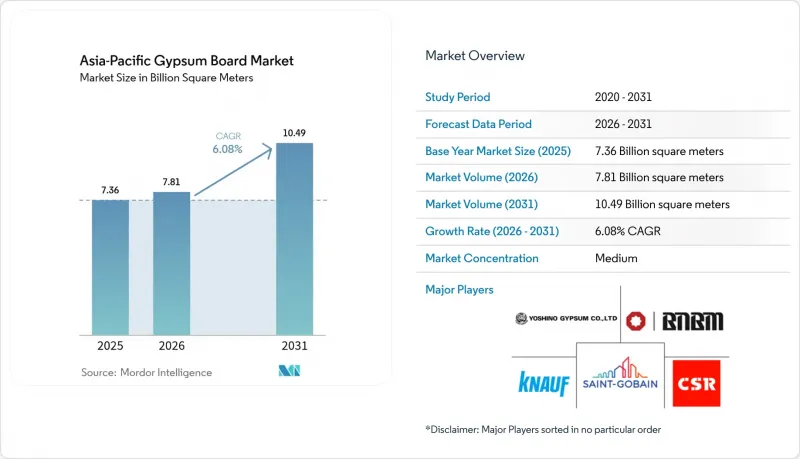
Mordor Intelligence에 의하면, 2026년 아시아태평양의 석고보드 시장 규모는 78억 1,000만 평방미터로 추정되고 있으며, 2025년 73억 6,000만 평방미터에서 2031년에는 104억 9,000만 평방미터에 이를 것으로 예측됩니다.
2026-2031년 연평균 성장률(CAGR)은 6.08%를 나타낼 전망입니다.
본 보고서는 보드 유형(벽용 보드, 천장용 보드, 사전 마감 보드, 기타), 두께(1/2인치, 5/8인치, 기타), 최종 용도 건축물 유형(주택, 상업, 공공시설, 산업), 지역(중국, 인도,일본, 한국, 태국, 필리핀, 베트남, 기타)별로 분류되어 있습니다. 시장 전망은 수량(제곱미터) 단위로 제시되어 있습니다.
아시아태평양의 석고보드 시장 동향 및 인사이트
급속한 도시화와 주택 건설 붐
중국, 인도, 베트남, 인도네시아에서는 매년 수백만 명의 도시 인구가 지속적으로 증가하고 있으며, 그 결과 발생하는 공동 주택에 대한 수요가 실내 칸막이용 석고보드의 대량 조달을 뒷받침하고 있습니다. 개발업자들은 구조적 하중을 경감하고 층별 완공 기간을 단축할 수 있기 때문에 표준화된 드라이월 시스템을 선호하여 채택하고 있습니다. 중국의 지방 도시 자치단체들은 수평 방향의 무질서한 확장보다는 수직 방향의 밀도 향상을 추진하고 있으며, 내화 성능을 갖춘 벽 구조가 요구되는 교통 허브 주변에 수요가 집중되고 있습니다. 호치민시와 자카르타에서도 유사한 고층화 경향이 나타나고 있으며, 땅값이 치솟는 가운데 단기간에 건설 가능한 고층 아파트가 준공까지의 기간을 단축하고 있습니다. 숙련된 미장공 부족을 완화하기 위해 건설업체들이 노동 집약적인 벽돌 쌓기 공사를 단계적으로 폐지함에 따라, 석고보드 채택이 확대되고 있습니다. 장기적인 인구 동향 예측에 따르면, 도시 주변부로의 이주가 앞으로도 계속될 것으로 나타나고 있으며, 이는 아시아태평양의 석고보드 시장에서 꾸준한 수량 증가를 뒷받침하고 있습니다.
정부 주도의 저소득층 주택 및 인프라 정비 프로그램
중국과 인도의 저비용 주택을 위한 공공 지출 패키지는 상업용 부동산의 경기 사이클이 둔화되더라도 범용 벽체용 보드를 소비하는 주택 착공 건수의 최저선을 보장하고 있습니다. 보조금 제도에서는 일반적으로 1제곱미터당 자재비 상한선이 정해져 있어, 공급업체는 생산 및 물류 효율화를 도모할 수밖에 없습니다. 예산 상한선으로 인해 고급 마감재의 보급은 제한되고 있지만, 안전 기준에 따라 복도, 계단실, 습기가 많은 장소에는 내화성 및 내습성 패널의 사용이 의무화되어 있습니다. 그린 빌딩 요건에 따라 2025년 이후 중국 내 모든 신규 프로젝트는 ESGB 시스템에서 최소 1성급 기준을 충족해야 하며, 이에 따라 비용 상한선을 충족하는 저배출 배합에 대한 수요가 증가하고 있습니다. 태국과 필리핀에서는 팬데믹 이후의 회복과 연계된 경제 부양책에 힘입어, 인증된 석고 솔루션을 지정하는 학교 및 병원 프로젝트가 가속화되고 있습니다.
습도가 높은 기후에서 습기 및 곰팡이에 대한 취약성
쿠알라룸푸르의 평균 상대 습도는 대부분의 달에 80%를 초과하며, 이 수준에서는 처리되지 않은 석고가 수증기를 쉽게 흡수하여 곰팡이 번식을 촉진합니다. 실내 공기질에 대한 우려로 인해 동남아시아의 여러 개발업자들은 욕실과 주방에 산화마그네슘 패널이나 시멘트 보드를 지정하기 시작하면서, 표준 석고 제품에 대한 수요가 변화하고 있습니다. 제조업체 측은 발수성 첨가제나 유리섬유 표면재로 대응하고 있지만, 높은 가격과 시공 기술 습득에 시간이 걸리기 때문에 저가 주택에서의 도입은 더딘 실정입니다. 습기 제거를 방해하는 길게 이어지는 몬순 시즌과 간헐적인 전력 공급으로 인해, 열대 지역 전체에서 이러한 제약 요인이 지속되고 있습니다.
부문 분석
일본과 호주의 대도시권에서 리모델링 일정이 앞당겨지는 가운데, 프리데코레이티드 보드는 2031년까지 연평균 성장률(CAGR) 6.78%의 성장이 예상됩니다. 2025년 기준, 벽용 보드는 아시아태평양의 석고보드 시장 점유율의 39.62%를 차지하며 대규모 주택 및 사무실 건설의 기반을 이루고 있습니다. 천장용 보드는 개방형 캠퍼스에서 음향 요구 사항이 높아짐에 따라 혜택을 보고 있는 반면, 내습성 패널은 호텔 및 레스토랑 업계의 화장실에서 인기를 얻고 있습니다.
디지털 프린트 라미네이트 및 UV 경화 코팅 기술의 발전으로, 입주자의 입·퇴거에 따른 마모를 견딜 수 있는 공장 마감 처리가 가능해졌습니다. 시공업체는 현장에서 필요한 전문 인력을 줄이고, 인도 전 결함 수정으로 인한 지연을 줄일 수 있게 되었으며, 이러한 이점은 패널 단가가 30-40% 더 비싸다는 점을 상쇄하고 있습니다. 내충격성, 납 코팅, 곰팡이 방지 등의 특수 보드는 병원이나 데이터센터와 같은 틈새 시장을 충족시키며, 아시아태평양의 석고보드 시장에서 활동하는 공급업체의 수익 다각화를 촉진하고 있습니다.
기타 혜택
- 엑셀 형식 시장 예측(ME) 시트
- 3개월간의 애널리스트 지원
자주 묻는 질문
목차
제1장 서론
제2장 조사 방법
제3장 주요 요약
제4장 시장 구도
제5장 시장 규모와 성장 예측
제6장 경쟁 구도
제7장 시장 기회와 향후 전망
LSH 26.08.26According to Mordor Intelligence, Asia-Pacific gypsum board market size in 2026 is estimated at 7.81 billion square meters, growing from 2025 value of 7.36 billion square meters with 2031 projections showing 10.49 billion square meters, growing at 6.08% CAGR over 2026-2031.
This report is Segmented by Board Type (Wall Board, Ceiling Board, Pre-Decorated Board, and Others), Thickness (1/2-inch, 5/8-inch, and Other Thicknesses), End-Use Building Type (Residential, Commercial, Institutional, and Industrial), and Geography (China, India, Japan, South Korea, Thailand, Philippines, Vietnam, and More). The Market Forecasts are Provided in Terms of Volume (Square Meters).
Asia-Pacific Gypsum Board Market Trends and Insights
Rapid Urbanization and Residential Construction Boom
China, India, Vietnam, and Indonesia continue to add millions of urban residents every year, and the resulting demand for multifamily housing sustains bulk procurement of gypsum board for interior partitions. Developers prefer standardized dry-wall systems because they cut structural loads and accelerate floor turnover. Local authorities in secondary Chinese cities promote vertical density rather than horizontal sprawl, concentrating demand around transit hubs that rely on fire-rated wall assemblies. Similar verticalization appears in Ho Chi Minh City and Jakarta, where quick-build apartment towers shorten delivery cycles amid land-price inflation. Gypsum board adoption benefits as contractors phase out labor-intensive brickwork to mitigate skilled-mason shortages. Long-term demographic forecasts point to continued migration into peri-urban zones, supporting steady volume growth in the Asia-Pacific gypsum board market.
Government-Led Affordable Housing and Infrastructure Programs
Public spending packages earmarked for low-cost housing in China and India guarantee a baseline of unit starts that consume commodity wallboard even when commercial real-estate cycles soften. Subsidy frameworks typically fix maximum material cost per square meter, forcing suppliers to optimize production and logistics efficiencies. While budget ceilings limit penetration of premium finishes, safety clauses require fire- and moisture-resistant panels in corridors, stairwells, and wet areas. Green building mandates that all new Chinese projects meet at least one star under the ESGB system from 2025 onward, raising demand for low-emission formulations that satisfy cost caps. In Thailand and the Philippines, stimulus packages linked to post-pandemic recovery accelerate school and hospital projects that specify certified gypsum solutions.
Susceptibility to Moisture and Mould in Humid Climates
Average relative humidity in Kuala Lumpur exceeds 80% for most months, a level at which untreated gypsum readily absorbs water vapor and supports mould colonies. Indoor air-quality concerns have led several Southeast Asian developers to specify magnesium-oxide panels or cement boards for bathrooms and kitchens, diverting demand from standard gypsum. Manufacturers respond with hydrophobic additives and fiberglass facers, yet price premiums and installation learning curves slow adoption in budget housing. Persistent monsoon seasons and intermittent power supply, which curtail de-humidification, sustain this restraint across tropical geographies.
Other drivers and restraints analyzed in the detailed report include:
- Adoption of Lightweight Dry-Construction Techniques
- Demand for Energy-Efficient and Fire-Resistant Interiors
- Volatile Gypsum and Energy Costs
For complete list of drivers and restraints, kindly check the Table Of Contents.
Segment Analysis
Pre-decorated boards captured 6.78% CAGR growth prospects through 2031 as renovation schedules tighten across metro Japan and Australia. Wall board retained 39.62% Asia-Pacific gypsum board market share in 2025, anchoring bulk residential and office builds. Ceiling boards benefit from heightened acoustic requirements in open-plan campuses, while moisture-resistant panels gain favor in hospitality restrooms.
Advances in digital-print laminates and UV-cured coatings enable factory finishes that withstand abrasion during tenant turnover. Contractors reduce trades on site and cut punch-list delays, an advantage that offsets panels' 30-40% higher unit price. Specialty boards-impact-resistant, lead-lined, or mold-inhibiting-address hospital and data-center niches, extending revenue diversity for suppliers active in the Asia-Pacific gypsum board market.
Complete Report Scope:
- By Board Type
- Wall Board
- Ceiling Board
- Pre-decorated Board
- Others
- By Thickness
- 1/2-inch
- 5/8-inch
- Other Thicknesses
- By End-use Building Type
- Residential
- Commercial
- Institutional
- Industrial
- By Geography
- China
- India
- Japan
- South Korea
- Thailand
- Philippines
- Vietnam
- Indonesia
- Malaysia
- Australia and New Zealand
- Rest of Asia-Pacific
List of Companies Covered in this Report:
- Beijing New Building Material (BNBM)
- China National Building Material (CNBM)
- CHIYODA UTE Co., Ltd.
- CSR Ltd
- Eagle Materials Inc.
- Etex Group
- Georgia-Pacific Gypsum LLC
- India Gypsum Pvt Ltd
- Jason Plasterboard (Jiaxing) Co. Ltd
- KCC Corporation
- Knauf Group
- National Gypsum Co. (Saudi)
- Saint-Gobain
- Taishan Gypsum Co., Ltd.
- United Mining Industries
- USG Boral
- VANS Gypsum
- Yoshino Gypsum Co., Ltd.
Additional Benefits:
- The market estimate (ME) sheet in Excel format
- 3 months of analyst support
TABLE OF CONTENTS
1 Introduction
- 1.1 Study Assumptions & Market Definition
- 1.2 Scope of the Study
2 Research Methodology
3 Executive Summary
4 Market Landscape
- 4.1 Market Overview
- 4.2 Market Drivers
- 4.2.1 Rapid urbanisation and residential construction boom
- 4.2.2 Government-led affordable-housing and infrastructure programs
- 4.2.3 Adoption of lightweight dry-construction techniques
- 4.2.4 Demand for energy-efficient and fire-resistant interiors
- 4.2.5 Notable growth in renovation projects
- 4.3 Market Restraints
- 4.3.1 Susceptibility to moisture and mould in humid climates
- 4.3.2 Volatile gypsum and energy costs
- 4.3.3 Competition from potential alternatives
- 4.4 Value Chain Analysis
- 4.5 Porter's Five Forces
- 4.5.1 Bargaining Power of Suppliers
- 4.5.2 Bargaining Power of Buyers
- 4.5.3 Threat of New Entrants
- 4.5.4 Threat of Substitutes
- 4.5.5 Degree of Competition
- 4.6 Price Analysis
5 Market Size and Growth Forecasts (Volume)
- 5.1 By Board Type
- 5.1.1 Wall Board
- 5.1.2 Ceiling Board
- 5.1.3 Pre-decorated Board
- 5.1.4 Others
- 5.2 By Thickness
- 5.2.1 1/2-inch
- 5.2.2 5/8-inch
- 5.2.3 Other Thicknesses
- 5.3 By End-use Building Type
- 5.3.1 Residential
- 5.3.2 Commercial
- 5.3.3 Institutional
- 5.3.4 Industrial
- 5.4 By Geography
- 5.4.1 China
- 5.4.2 India
- 5.4.3 Japan
- 5.4.4 South Korea
- 5.4.5 Thailand
- 5.4.6 Philippines
- 5.4.7 Vietnam
- 5.4.8 Indonesia
- 5.4.9 Malaysia
- 5.4.10 Australia and New Zealand
- 5.4.11 Rest of Asia-Pacific
6 Competitive Landscape
- 6.1 Market Concentration
- 6.2 Strategic Moves
- 6.3 Market Share(%)/Ranking Analysis
- 6.4 Company Profiles (includes Global level Overview, Market level overview, Core Segments, Financials as available, Strategic Information, Market Rank/Share for key companies, Products and Services, and Recent Developments)
- 6.4.1 Beijing New Building Material (BNBM)
- 6.4.2 China National Building Material (CNBM)
- 6.4.3 CHIYODA UTE Co., Ltd.
- 6.4.4 CSR Ltd
- 6.4.5 Eagle Materials Inc.
- 6.4.6 Etex Group
- 6.4.7 Georgia-Pacific Gypsum LLC
- 6.4.8 India Gypsum Pvt Ltd
- 6.4.9 Jason Plasterboard (Jiaxing) Co. Ltd
- 6.4.10 KCC Corporation
- 6.4.11 Knauf Group
- 6.4.12 National Gypsum Co. (Saudi)
- 6.4.13 Saint-Gobain
- 6.4.14 Taishan Gypsum Co., Ltd.
- 6.4.15 United Mining Industries
- 6.4.16 USG Boral
- 6.4.17 VANS Gypsum
- 6.4.18 Yoshino Gypsum Co., Ltd.
7 Market Opportunities and Future Outlook
- 7.1 White-space and Unmet-need Assessment


