

|
시장보고서
상품코드
2119381
진균 검사 키트 : 시장 점유율 분석, 업계 동향 및 통계, 성장 예측(2026-2031년)Fungal Testing Kits - Market Share Analysis, Industry Trends & Statistics, Growth Forecasts (2026 - 2031) |
||||||
 Mordor Intelligence
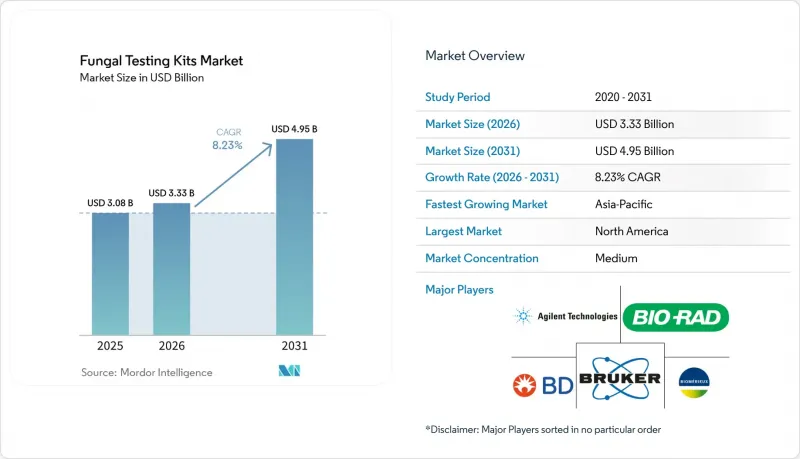
Mordor Intelligence에 의하면, 진균 검사 키트 시장 규모는 2025년 30억 8,000만 달러로 평가되었습니다. 2026년에는 33억 3,000만 달러로 확대되어 2026년부터 2031년에 걸쳐 CAGR 8.23%로 성장을 지속하여, 2031년에는 49억 5,000만 달러에 이를 것으로 예측됩니다.
본 보고서는 용도(임상 진단, 식품 및 농업 등), 기술(분자진단, 면역 측정법 등), 검사 유형(분자 검사, 발색 검사 등), 검체 유형(피부, 소변 등), 최종 사용자(진단 검사 기관 등) 및 지역(북미, 유럽, 아시아태평양 등)별로 분류되어 있습니다. 시장 전망은 금액(달러) 기준으로 제시되어 있습니다.
세계의 진균 검사 키트 시장 동향 및 인사이트
침습성 진균 감염증의 부담 증가
침습성 진균 감염증의 부담 증가는 진균 검사 키트 시장 수요를 견인하는 주요 시장 성장 촉진요인입니다. 2024년 조사에 따르면, 매년 650만 건의 생명을 위협하는 침습성 진균 감염증이 발생하며, 380만 명이 이와 관련하여 사망하는 것으로 추정됩니다. 중증 환자는 특히 높은 위험에 처해 있으며, 2025년 조사에 따르면 중환자실 환경에서 166만 명 이상의 사망이 보고되었습니다. 치료되지 않은 침습성 칸디다증의 경우 30일 내 사망률이 35%에서 45%에 달할 수 있어, 급성기 의료에서 진단 지연은 용납될 수 없는 상황입니다. 기존의 배양법은 3일에서 7일이 소요될 수 있기 때문에 병원에서는 분자진단 및 항원 검사를 점점 더 중시하고 있습니다. 이러한 변화는 부가가치가 높은 검사 워크플로우를 촉진하는 동시에, 공급업체가 판매량을 늘리기 위해 대폭적인 가격 양보를 해야 할 필요성을 줄여주고 있습니다.
마이코톡신 규제 및 기후 변화와 관련된 오염 위험
식품 안전 규제로 인해 농업 공급망 전반에 걸쳐 곰팡이 검사 키트에 대한 지속적인 수요가 발생하고 있습니다. EU 시행규칙 2023/2782는 미코톡신 관리를 위한 시료 채취 및 분석 방법을 규정하고 있으며, 이후 개정을 통해 그 적용 범위가 더 많은 식품 매트릭스로 확대되었습니다. ISO 23719 : 2025는 곡물 및 곡물 제품 내 17유형의 미코톡신을 측정하기 위한 검증된 UHPLC-MS/MS 방법을 확립했습니다. 이러한 규제로 인해 검사 기관은 단일 미코톡신 검사에서 한 번의 측정으로 여러 분석 대상 물질을 평가할 수 있는 시스템으로의 전환이 촉진되고 있습니다. 기후 변화에 따른 아플라톡신 및 푸모니신 오염의 변화는 남유럽 및 동유럽 전역의 옥수수 및 밀에 의존하는 공급망에 추가적인 압박을 가하고 있습니다. 그 결과, 저비용 신속 검사와 고처리량 검사를 위한 실험실 등급 분석법 사이의 경계가 더욱 명확해지고 있습니다.
고도화된 워크플로우에서의 비용 및 표준화 장벽
MALDI-TOF 질량 분석법, 전체 유전체 시퀀싱 및 메타유전체 시퀀싱은 기존의 배양법으로는 얻을 수 없는 상세한 정보를 제공합니다. 그러나 장비, 시약 및 운영 비용이 높아 여전히 많은 현장에서의 도입을 저해하고 있습니다. 세계보건기구(WHO)는 2025년, 특히 저·중소득 국가에서 이용 가능한 진단법이 많은 경우 시간이 오래 걸리고, 부정확하며, 비싸고, 범위도 제한적이라고 지적했습니다. 이러한 비용 격차로 인해 고소득 국가의 병원에서는 첨단 시스템이 도입되는 반면, 기타 시설에서는 면역 분석법이나 배양법에 의존할 수밖에 없는 양극화가 발생하고 있습니다. 또한, 범진균 및 메타유전체 검사에 관한 기준이 불완전한 점도 다기관 검증이나 규제 당국의 심사를 어렵게 만들고 있습니다. 결과당 비용을 절감하는 다중 검사는 한 번의 측정으로 균종 검출과 내성 마커 검출을 결합함으로써 이러한 두 가지 장벽을 완화할 가능성이 있습니다.
부문별 분석
2025년, 임상 진단 부문은 진균 검사 키트 시장 점유율의 46.37%를 차지했습니다. 이 부문은 중환자 치료, 종양학, 이식 현장에서의 활용에 힘입고 있으며, 이러한 상황에서는 신속한 동정이 항진균 치료 결정에 영향을 미칩니다. WHO는 칸디다 아우리스(Candida auris) 및 아스페르길루스 푸미가타스(Aspergillus fumigatus)와 같은 최우선 병원체와 관련된 높은 사망률로 인해, 임상 현장을 진단 분야에 대한 투자의 주요 대상으로 지정했습니다. 식품 및 농업 분야는 두 번째로 큰 응용 분야입니다. 이 분야 수요는 EU 규정에 따른 미코톡신 모니터링 의무와 FDA의 조치 수준 규제 시행에 힘입어 뒷받침되고 있습니다. 이러한 의무로 인해 검사는 선택적 구매가 아닌 지속적인 업무상의 필요 사항이 되었습니다.
환경 모니터링 시장은 2031년까지 연평균 성장률(CAGR) 8.98%를 나타낼 것으로 예측됩니다. 이 용도에서의 곰팡이 검사 키트 시장 규모는 제약 업계의 클린룸, 급수 시스템 및 공조 장치에 대한 모니터링 수요에 의해 뒷받침되고 있습니다. 또한, 오염 상황의 변화에 따라 건축 환경 내 곰팡이 위험도 더욱 큰 주목을 받고 있습니다. ISO/IEC 17025 인증 요건 및 USP <797> 규격에 따라, 시설에서는 정기적인 배양 플레이트 검사에서 정량적인 결과를 얻을 수 있는 기법으로의 전환이 진행되고 있습니다. 수의학 및 화장품 안전 분야의 응용은 여전히 소규모 시장에 머물러 있습니다. 이러한 분야에서는 항진균제 내성이 규제상의 우려로 대두되고 있는 식용 동물에 대한 검사를 포함하여 초기 단계의 혁신 활동이 활발해지고 있습니다.
2025년, 분자진단 기술은 기술 매출의 38.74%를 차지했습니다. PCR 기반 시스템은 몇 시간 이내에 결과를 제공하며, 배양법으로는 일반적으로 동등한 속도로 얻을 수 없는 종 수준의 식별 정확도를 실현합니다. 진균 검사 키트 시장에는 qPCR, LAMP, 디지털 드롭렛 PCR 및 CRISPR 기반 분석법이 포함됩니다. 2025년 리뷰에서는 거의 실시간으로 진균 동정 및 내성 예측을 지원하는 휴대용 분자진단 도구가 소개되었습니다. QIAGEN사는 2026년 4월, CE-IVDR 인증을 획득한 ‘QIAstat-Dx BCID GPF Plus AMR Panel’을 출시했습니다. 이 제품은 양성 혈액 배양 검체에서 1시간 만에 20종의 진균 및 그람양성균 표적과 10종의 내성 마커를 검출합니다. 이러한 패널은 동정 정보와 내성 정보를 하나의 워크플로우에 통합하고 있습니다.
면역측정법은 2031년까지 연평균 성장률(CAGR) 9.23%를 나타낼 것으로 예측됩니다. 이러한 수요는 배양보다 조기에 감염 징후를 감지할 수 있는 β-D-글루칸 및 갈락토만난 측정법의 활용을 반영합니다. 또한 상황에 따라 침습적인 검체 채취를 피할 수도 있습니다. 면역측정법을 활용한 진균 검사 키트 시장의 성장은 일상적인 임상 선별 검사 및 분산형 검사와의 호환성에 힘입고 있습니다. 진균 검사 키트 시장에서는 식품 및 환경 검사 분야에서 배양 키트와 소모품 수요가 여전히 큰 비중을 차지하고 있습니다. 저렴한 비용과 간편한 조작성은 일상적인 모니터링 업무에 적합합니다.
지역별 분석
2025년, 북미는 진균 검사 키트 시장의 36.72% 점유율을 차지했습니다. 이 지역에는 확립된 임상 검사 네트워크, 분자 검사에 대한 보험 환급 제도, 그리고 CDC(미국 질병통제예방센터) 및 항생제 내성 검사 네트워크(Antimicrobial Resistance Laboratory Network)를 통한 적극적인 감시 체계가 구축되어 있습니다. 미국 내 칸디다 아우리스(Candida auris) 임상 사례 수는 2024년에 6,197건을 넘어섰으며, 의료 현장에서 신속한 선별 검사 및 종 특이적 검사의 실시가 촉진되고 있습니다. 지역별 수요의 대부분은 미국이 차지하고 있지만, 캐나다와 멕시코에서는 3차 의료기관에서의 진단에 대한 투자가 증가하고 있습니다. 2025년 7월 워터스(Waters)사와 BD사의 생명과학 및 진단 솔루션 사업부 간에 체결된 거래는 175억 달러의 평가액을 기록했으며, 통합된 사업부는 규제 대상이며 대량 처리가 요구되는 진단 워크플로우에 주력할 것으로 예측됩니다.
2025년, 유럽은 지역별 규모에서 2위를 차지했습니다. 독일은 핵심 시장이며, EU의 IVDR(체외진단 의료기기 규정)로의 전환은 인증 기관의 규정 준수 요건을 충족할 수 있는 제조업체에 유리하게 작용하고 있습니다. 이러한 전환으로 인해 진균 검사 키트의 품질 기준이 높아지는 한편, 분류 재검토 대상이 되는 제품을 보유한 중소기업에게는 진입 장벽이 발생하고 있습니다. EU의 미코톡신 규제는 독일, 프랑스, 이탈리아, 스페인 전역에서 반복적으로 실시되는 식품 안전 검사의 법적 근거를 제공합니다. QIAGEN은 2026년 7월, 유럽에서 ‘QIAstat-Dx BCID GN Plus AMR Panel’을 출시하여, 자사의 전체 패널에서 혈류 검사 대상을 33종의 병원체 및 28종의 내성 마커로 확대했습니다. 이러한 규제 환경 하에서 광범위한 증후군 패널을 시장에 출시함에 있어, 인증 획득은 진균 검사 키트 시장의 상용화에 있어 중요한 조건이 됩니다.
아시아태평양은 2031년까지 연평균 성장률(CAGR) 13.67%를 나타낼 것으로 예측됩니다. 중국은 WS/T 497-2026을 통해 침습성 진균증에 관한 국가 검사 기준을 제정하고 있으며, 이를 통해 상업적 조달을 위한 길이 더욱 명확해졌습니다. 인도는 의료 체계의 확대와 크립토코쿠스 수막염에 취약한 인구가 많다는 점에서 큰 잠재력을 지니고 있습니다. 일본, 한국, 호주에서는 첨단 진단 기술과 식품 안전 시스템을 통해 수요가 확대되고 있습니다. 중동 및 아프리카는 GCC 국가들의 의료 현대화에 힘입고 있으나, 검사실 인프라 및 콜드체인 부족과 같은 과제가 남아 있습니다. 남미 지역도 브라질의 농업 부문 및 미코톡신 규제 적합성 검사 수요를 통해 성장이 예상됩니다.
기타 혜택 :
- 엑셀 형식 시장 예측(ME) 시트
- 3개월간의 애널리스트 지원
자주 묻는 질문
목차
제1장 서론
제2장 조사 방법
제3장 개요
제4장 시장 구도
제5장 시장 규모 및 성장 예측
제6장 경쟁 구도
제7장 시장 기회 및 향후 전망
KTH 26.09.02According to Mordor Intelligence, the fungal testing kits market size is expected to grow from USD 3.08 billion in 2025 to USD 3.33 billion in 2026 and is forecast to reach USD 4.95 billion by 2031 at 8.23% CAGR over 2026-2031.
This report is Segmented by Application (Clinical Diagnostics, Food & Agriculture, and More), Technology (Molecular Diagnostics, Immunoassays, and More), Test Type (Molecular Test, Chromogenic Test, and More), Sample Type (Skin, Urine, and More), End User (Diagnostic Laboratories and More), and Geography (North America, Europe, Asia-Pacific, and More). The Market Forecasts are Provided in Terms of Value (USD).
Global Fungal Testing Kits Market Trends and Insights
Rising Burden of Invasive Fungal Infections
The growing burden of invasive fungal infections is a core demand driver for the fungal testing kits market. A 2024 review estimated 6.5 million life-threatening invasive fungal infections each year and 3.8 million related deaths. Critically ill populations carry a particularly high risk, and a 2025 review reported more than 1.66 million deaths in critical-care settings. Untreated invasive candidiasis can have a 30-day mortality of 35% to 45%, making delayed diagnosis difficult to accept in acute care. Traditional culture methods can require 3 to 7 days, so hospitals increasingly favor molecular and antigen-based testing. This shift supports higher-value testing workflows and limits the need for vendors to use large price concessions to build volume.
Mycotoxin Compliance and Climate-Related Contamination Risk
Food safety rules are creating recurring demand for fungal testing kits across agricultural supply chains. EU Implementing Regulation 2023/2782 sets sampling and analysis methods for mycotoxin controls, and later amendments extended its coverage to additional food matrices. ISO 23719:2025 established a validated UHPLC-MS/MS method for measuring 17 mycotoxins in cereals and cereal products. These rules encourage laboratories to replace single-toxin testing with systems that can assess several analytes in one run. Climate-related changes in aflatoxin and fumonisin contamination add pressure in maize- and wheat-dependent supply chains across Southern and Eastern Europe. The result is a clearer divide between lower-cost rapid tests and laboratory-grade methods for high-throughput inspection.
Cost and Standardization Barriers for Advanced Workflows
MALDI-TOF mass spectrometry, whole-genome sequencing, and metagenomic sequencing provide details that conventional culture methods cannot match. Their instrument, reagent, and operating costs still limit uptake in many settings. The World Health Organization stated in 2025 that available diagnostics are often slow, inaccurate, expensive, and limited in scope, especially in low- and middle-income countries. This cost gap creates a two-tier pattern, with advanced systems adopted by high-income hospitals while other facilities rely on immunoassays or culture. Incomplete standards for pan-fungal and metagenomic assays also make multisite validation and regulatory review harder. Multiplexed tests that lower the cost per result may ease both barriers by combining species detection and resistance markers in a single run.
Other drivers and restraints analyzed in the detailed report include:
- Faster Culture-Independent Diagnostics and Resistance Surveillance
- Decentralized and Near-Patient Testing
- Infrastructure Gaps and Clinical Interpretation Limits
For complete list of drivers and restraints, kindly check the Table Of Contents.
Segment Analysis
Clinical diagnostics held 46.37% of the fungal testing kits market share in 2025. The segment is supported by use in intensive care, oncology, and transplant settings, where fast identification influences antifungal treatment decisions. The WHO identified clinical settings as a primary destination for diagnostic investment because of the mortality associated with critical-priority pathogens such as Candida auris and Aspergillus fumigatus. Food and agriculture is the second-largest application areas. Its demand is supported by the required mycotoxin surveillance under EU rules and FDA action-level enforcement. These obligations make testing a recurring operational need rather than a discretionary purchase.
Environmental monitoring is forecast to grow at a 8.98% CAGR through 2031. The fungal testing kits market size for this application is supported by monitoring needs in pharmaceutical cleanrooms, water systems, and air-handling units. Mold risk in built environments is also receiving greater attention as contamination conditions change. ISO/IEC 17025 accreditation requirements and USP <797> standards are pushing facilities beyond periodic culture plates toward methods with quantitative outputs. Veterinary and cosmetic safety uses remain smaller applications. They are attracting early innovation activity, including testing in food-producing animals where antifungal resistance is emerging as a regulatory concern.
Molecular diagnostics held 38.74% of technology revenue in 2025. PCR-based systems offer results within hours and species-level resolution that culture cannot usually deliver at the same speed. The fungal testing kits market includes qPCR, LAMP, digital droplet PCR, and CRISPR-based assays. A 2025 review described portable molecular tools that support near-real-time fungal identification and resistance prediction. QIAGEN launched its CE-IVDR-certified QIAstat-Dx BCID GPF Plus AMR Panel in April 2026, detecting 20 fungal and gram-positive targets and 10 resistance markers in 1 hour from positive blood cultures. Such panels combine identification and resistance information in one workflow.
Immunoassays are forecast to grow at a 9.23% CAGR through 2031. Their demand reflects the use of beta-D-glucan and galactomannan assays, which can provide infection signals earlier than culture. They can also avoid invasive specimen collection in some settings. The fungal testing kits market growth in immunoassays is supported by their fit with routine clinical screening and decentralized testing. The fungal testing kits market retains substantial culture-kit and consumable volumes in food and environmental testing. Their low cost and simple operation remain appropriate for routine monitoring work.
Complete Report Scope:
- By Application
- Clinical Diagnostics
- Food & Agriculture
- Environmental Monitoring
- Others
- By Technology
- Molecular Diagnostics
- Immunoassays
- Culture-based Kits & Consumables
- By Test Type
- Molecular Test
- Chromogenic Test
- Immunoassay Test
- Culture-Based Test
- Antifungal Susceptibility Test
- Others
- By Sample Type
- Skin
- Urine
- Vaginal Secretion
- Blood
- Others
- By End User
- Diagnostic Laboratories
- Hospitals and Clinics
- Research Institutes
- Others
- By Geography
- North America
- United States
- Canada
- Mexico
- Europe
- Germany
- United Kingdom
- France
- Italy
- Spain
- Rest of Europe
- Asia-Pacific
- China
- India
- Japan
- Australia
- South Korea
- Rest of Asia-Pacific
- Middle East and Africa
- GCC
- South Africa
- Rest of Middle East and Africa
- South America
- Brazil
- Argentina
- Rest of South America
- North America
Geography Analysis
North America held 36.72% of the fungal testing kits market share in 2025. The region has established clinical laboratory networks, reimbursement mechanisms for molecular tests, and active surveillance through the CDC and the Antimicrobial Resistance Laboratory Network. Candida auris clinical cases in the United States exceeded 6,197 in 2024, prompting faster screening and species-specific testing in healthcare settings. The United States accounts for most regional demand, while Canada and Mexico are increasing investment in tertiary-hospital diagnostics. The July 2025 transaction involving Waters and BD's Biosciences and Diagnostic Solutions business was valued at USD 17.5 billion and is expected to focus the combined business on regulated, high-volume diagnostic workflows.
Europe held the second-largest regional position in 2025. Germany is an anchor market, and the EU IVDR transition favors manufacturers that can meet Notified Body compliance requirements. The transition raises the quality threshold for fungal kits, while creating barriers for smaller companies with products subject to revised classification. EU mycotoxin rules provide a legally enforceable base of recurring food-safety testing across Germany, France, Italy, and Spain. QIAGEN launched the QIAstat-Dx BCID GN Plus AMR Panel in Europe in July 2026, extending bloodstream testing coverage to 33 pathogen targets and 28 resistance markers across its panels. This regulatory setting makes certification a key condition for fungal testing kits market commercialization of broad syndromic panels.
Asia-Pacific is forecast to grow at a 13.67% CAGR through 2031. China has established national laboratory requirements for invasive fungal disease through WS/T 497-2026, creating a clearer pathway for commercial procurement. India offers substantial potential because of healthcare expansion and a large population vulnerable to cryptococcal meningitis. Japan, South Korea, and Australia add demand through advanced diagnostics and food safety systems. The Middle East and Africa are supported by healthcare modernization in GCC states, but laboratory infrastructure and cold-chain gaps remain. South America also offers growth through Brazil's agricultural sector and its need for mycotoxin compliance testing.
- ADT Biotech
- Agilent Technologies
- Beckton Dickinson
- bioMerieux
- Bio-Rad Laboratories
- Bruker
- Charm Sciences Inc.
- Elitech Group
- EnviroLogix Inc.
- Eurofins
- Roche
- Gold Standard Diagnostics
- HiMedia Laboratories Pvt. Ltd.
- Hygiena LLC
- Merck
- Neogen
- Norgen Biotek
- QIAGEN
- Romer Labs Division Holding GmbH
- Siemens Healthineers
- Thermo Fisher Scientific
- VICAM
- Zymo Research
Additional Benefits:
- The market estimate (ME) sheet in Excel format
- 3 months of analyst support
TABLE OF CONTENTS
1 Introduction
- 1.1 Study Assumptions & Market Definition
- 1.2 Scope of the Study
2 Research Methodology
3 Executive Summary
4 Market Landscape
- 4.1 Market Overview
- 4.2 Market Drivers
- 4.2.1 Rising Burden of Invasive Fungal Infections
- 4.2.2 Expansion of Mycotoxin Compliance Testing
- 4.2.3 Demand for Faster Culture-Independent Diagnostics
- 4.2.4 Growth of Decentralized and Near-Patient Testing
- 4.2.5 Antifungal Resistance Surveillance Requirements
- 4.2.6 Climate-Linked Expansion of Fungal Contamination Risk
- 4.3 Market Restraints
- 4.3.1 High Cost of Advanced Molecular and Mass Spectrometry Workflows
- 4.3.2 Limited Diagnostic Infrastructure in Low- and Middle-Income Countries
- 4.3.3 Incomplete Standardization of Pan-Fungal and Metagenomic Assays
- 4.3.4 Difficulties Differentiating Colonization from Active Infection
- 4.4 Value / Supply-Chain Analysis
- 4.5 Regulatory Landscape
- 4.6 Technological Outlook
- 4.7 Porter's Five Forces Analysis
- 4.7.1 Threat of New Entrants
- 4.7.2 Bargaining Power of Buyers
- 4.7.3 Bargaining Power of Suppliers
- 4.7.4 Threat of Substitutes
- 4.7.5 Competitive Rivalry
5 Market Size & Growth Forecasts (Value, USD)
- 5.1 By Application
- 5.1.1 Clinical Diagnostics
- 5.1.2 Food & Agriculture
- 5.1.3 Environmental Monitoring
- 5.1.4 Others
- 5.2 By Technology
- 5.2.1 Molecular Diagnostics
- 5.2.2 Immunoassays
- 5.2.3 Culture-based Kits & Consumables
- 5.3 By Test Type
- 5.3.1 Molecular Test
- 5.3.2 Chromogenic Test
- 5.3.3 Immunoassay Test
- 5.3.4 Culture-Based Test
- 5.3.5 Antifungal Susceptibility Test
- 5.3.6 Others
- 5.4 By Sample Type
- 5.4.1 Skin
- 5.4.2 Urine
- 5.4.3 Vaginal Secretion
- 5.4.4 Blood
- 5.4.5 Others
- 5.5 By End User
- 5.5.1 Diagnostic Laboratories
- 5.5.2 Hospitals and Clinics
- 5.5.3 Research Institutes
- 5.5.4 Others
- 5.6 By Geography
- 5.6.1 North America
- 5.6.1.1 United States
- 5.6.1.2 Canada
- 5.6.1.3 Mexico
- 5.6.2 Europe
- 5.6.2.1 Germany
- 5.6.2.2 United Kingdom
- 5.6.2.3 France
- 5.6.2.4 Italy
- 5.6.2.5 Spain
- 5.6.2.6 Rest of Europe
- 5.6.3 Asia-Pacific
- 5.6.3.1 China
- 5.6.3.2 India
- 5.6.3.3 Japan
- 5.6.3.4 Australia
- 5.6.3.5 South Korea
- 5.6.3.6 Rest of Asia-Pacific
- 5.6.4 Middle East and Africa
- 5.6.4.1 GCC
- 5.6.4.2 South Africa
- 5.6.4.3 Rest of Middle East and Africa
- 5.6.5 South America
- 5.6.5.1 Brazil
- 5.6.5.2 Argentina
- 5.6.5.3 Rest of South America
- 5.6.1 North America
6 Competitive Landscape
- 6.1 Market Concentration
- 6.2 Market Share Analysis
- 6.3 Company Profiles (includes Global Level Overview, Market Level Overview, Core Segments, Financials as Available, Strategic Information, Market Rank/Share for Key Companies, Products & Services, and Recent Developments)
- 6.3.1 ADT Biotech
- 6.3.2 Agilent Technologies, Inc.
- 6.3.3 Becton, Dickinson and Company
- 6.3.4 bioMerieux SA
- 6.3.5 Bio-Rad Laboratories, Inc.
- 6.3.6 Bruker Corporation
- 6.3.7 Charm Sciences Inc.
- 6.3.8 ELITechGroup
- 6.3.9 EnviroLogix Inc.
- 6.3.10 Eurofins Scientific SE
- 6.3.11 F. Hoffmann-La Roche Ltd
- 6.3.12 Gold Standard Diagnostics
- 6.3.13 HiMedia Laboratories Pvt. Ltd.
- 6.3.14 Hygiena LLC
- 6.3.15 Merck KGaA
- 6.3.16 Neogen Corporation
- 6.3.17 Norgen Biotek Corp.
- 6.3.18 QIAGEN N.V.
- 6.3.19 Romer Labs Division Holding GmbH
- 6.3.20 Siemens Healthineers AG
- 6.3.21 Thermo Fisher Scientific Inc.
- 6.3.22 VICAM
- 6.3.23 Zymo Research Corporation
7 Market Opportunities & Future Outlook
- 7.1 White-space & Unmet-need Assessment


