|
시장보고서
상품코드
2119584
유럽의 센서 : 시장 점유율 분석, 업계 동향 및 통계, 성장 예측(2026-2031년)Europe Sensors - Market Share Analysis, Industry Trends & Statistics, Growth Forecasts (2026 - 2031) |
||||||
 Mordor Intelligence
Mordor Intelligence에 의하면, 유럽의 센서 시장 규모는 2026년에 268억 9,000만 달러에 달하고, 2031년까지 370억 9,000만 달러에 이를 것으로 예측되며, 2026년부터 2031년에 걸쳐 CAGR 6.64%로 성장할 전망입니다.
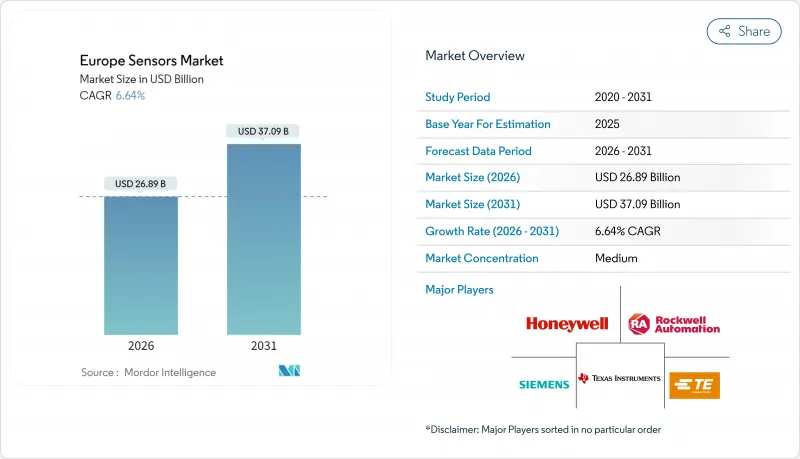
본 보고서는 측정 매개변수(온도, 압력 등), 작동 방식(광학식, 전기저항식, 바이오센서 등), 최종 사용자 산업(자동차, 소비자 가전, 에너지,산업, 의료·웰니스, 건설, 농업·광업 등), 센서 기술(MEMS, 비MEMS), 국가별로 분류되어 있습니다. 시장 예측은 금액(달러) 기준으로 제시되어 있습니다.
유럽의 센서 시장 동향 및 인사이트
자동차 부문 수요 급증
유럽의 자동차 제조업체들은 2026년형 모델 1대당 150-200개의 센서를 탑재하고 있으며, 이는 2020년의 약 100개에서 대폭 증가한 수치입니다. 이러한 급증은 첨단 운전자 보조 시스템(ADAS)을 표준 사양으로 하는 Euro NCAP 프로토콜에 의해 주도되고 있습니다. 레이더, 초음파, 카메라 어레이가 부품 목록의 대부분을 차지하고 있지만, 발레오(Valeo)사의 ‘SCALA 3’과 같이 1,000달러 미만의 저비용 솔리드 스테이트 라이더(LiDAR)가 등장하면서 레벨 3 고속도로 자율 주행을 실현하기 시작했습니다. 또한, 800볼트 배터리 팩의 열 폭주를 감시하는 배터리 관리용 센서도 수요를 뒷받침하고 있습니다. 콘티넨탈이 2025년에 실리콘 카바이드 사업을 인수한 것은 고온 전류 감지 분야에서의 수직 통합 조짐을 보여줍니다. 이러한 동향들이 맞물려 판매량과 평균 판매 가격이 상승하고 있으며, 유럽의 센서 시장의 성장 궤도를 더욱 공고히 하고 있습니다.
인더스트리 4.0 스마트 팩토리의 보급
2025년에는 200만 대 이상의 산업용 IoT 노드가 도입되었으며, 각 노드에는 진동, 온도, 에너지 데이터를 측정하는 3-5개의 센서가 탑재되었습니다. 예지 보전을 통해 예기치 못한 가동 중단 시간을 최대 30%까지 줄일 수 있으며, 개조 비용은 2년 이내에 회수할 수 있습니다. Tier 1 공급업체가 실시간 품질 추적성을 요구함에 따라 지멘스의 ‘Xcelerator’ 플랫폼에서는 연결된 자산 수가 연간 40%의 성장률을 기록했습니다. 엣지 추론으로의 전환에 따라 16비트 ADC와 온보드 DSP를 탑재한 스마트 센서에 대한 수요가 증가하고 있으며, 그 대표적인 예로 2025년 10월 보쉬 센서테크가 출시한 ‘BHI360’을 들 수 있습니다. 이러한 도입 동향은 유럽의 센서 시장의 장기적인 수요 전망을 뒷받침하는 것입니다.
높은 초기 통합 비용
레거시 장비의 개조 비용은 자산 1대당 5,000-1만 5,000유로가 소요되며, 이익률이 10% 미만으로 운영되는 중소기업에게는 큰 장벽이 되고 있습니다. ERP 매핑 통합 비용은 5만-10만 유로 범위이며, 이는 투자 회수 기간을 길게 만들고 있습니다. 압력 및 온도 루프는 여전히 아날로그 상태로 남아 있는 경우가 많아, 장비를 전면 교체하거나 엣지 디지털화를 위한 미들웨어를 도입할 수밖에 없는 상황입니다. 엔드레스 하우저(Endress+Hauser)사의 ‘하트비트 테크놀로지(Heartbeat Technology)’는 장비 교체를 미룰 수 있는 비용 효율적인 타협안으로 주목받고 있습니다. 하드웨어 가격이 더욱 하락하기 전까지는 비용에 대한 우려가 도입을 억제하여, 유럽의 센서 시장의 연평균 성장률(CAGR)을 소폭 둔화시킬 것입니다.
부문 분석
‘기업 지속가능성 보고 지침(CSRD)’에 따라 제3자 검증을 거친 스코프 1-3의 공시가 단계적으로 도입됨에 따라, 환경 측정 장비 시장은 2026년부터 2031년까지 연평균 성장률(CAGR) 8.61%를 나타낼 것으로 예측됩니다. 이 하위 부문에서 유럽의 센서 시장은 미세먼지, NOx 및 VOC 분석 장비가 화학 및 야금 시설 전반의 연속 배출 모니터링 시스템에 데이터를 공급하게 됨에 따라 급속히 확대되고 있습니다. 2025년 8월에 발사된 유럽 우주국(ESA)의 ‘센티넬 5호’로부터의 위성 피드백으로 인해 지상국의 교정 정밀도가 향상되고 센서의 수명이 연장되고 있습니다. 2025년에 26.87%의 점유율을 차지한 온도 센서는 에너지 및 식품 가공 분야의 거래용 유량 측정에서 여전히 필수적인 요소입니다. 유틸리티자가 누수를 감지하기 위해 스마트 계량기를 도입함에 따라 유량계 수요가 증가하고 있습니다. 한편, 근접 센서는 협동 로봇에서 IEC 61496의 중복성 요건을 충족하고 있습니다.
온도, 습도, 압력을 단일 패키지로 측정하는 복합 모듈은 융합(convergence) 추세를 반영하고 있으며, 멀티칩 패키징에 능숙한 공급업체에 이점을 가져다주고 있습니다. 제약용 바이오리액터에서 포도당 및 pH의 실시간 모니터링이 요구됨에 따라, 화학 센서는 틈새 시장에서 주류 시장으로 전환되고 있습니다. 산업의 전동화가 진행됨에 따라 브러쉬리스 DC 모터에 내장된 자기 센서는 계속해서 보급되고 있습니다. 전반적으로 다양한 이용 사례로 인해 ‘측정 매개변수’ 카테고리는 유럽의 센서 시장에서 안정적인 판매량을 견인하는 주역으로 남아 있습니다.
광학 장치는 안전 커튼, 광섬유 변형 센서, 분광 측정 모듈에 힘입어 2025년에도 19.16%의 점유율을 유지했습니다. 한편, 고체 LiDAR는 500달러 미만의 가격 정책으로 인해 창고 자동화 및 농업 기계 분야에서의 활용 기회가 확대되면서 연평균 성장률(CAGR) 8.43%로 성장을 지속하고 있습니다. 서미스터 등의 전기 저항식 센서는 기존의 HVAC(난방·환기·공조) 및 힘 측정 용도로 계속 활용되고 있지만, 이익률 압박에 직면해 있습니다. 혈당나 젖산치를 측정하는 바이오 센서는 현재 휴대용 기기에서도 임상 수준의 정확도를 달성하고 있어, 다항목 분석이 가능한 웨어러블 기기로의 길을 열어주고 있습니다. 정전용량식 및 압전식 센서는 터치 조작이나 초음파 용도로 활용되고 있지만, 기술이 성숙기에 접어들어 성장이 완만한 수준에 머물고 있습니다.
24GHz 단거리 레이더 및 77GHz 장거리 레이더는 사각지대 감지 시스템이나 어댑티브 크루즈 컨트롤 시스템에서 여전히 표준 사양으로 자리 잡고 있으며, NXP와 인피니온이 칩셋 공급을 주도하고 있습니다. 자율주행 플랫폼에서는 중복성이 요구되기 때문에 지각 스택에서 카메라, 레이더, LiDAR 데이터를 융합하는 경향이 강해지고 있으며, 이에 따라 동기화된 타임스탬프가 포함된 출력의 필요성이 높아지고 있습니다. 턴키 방식의 센서 제품군을 제공하는 공급업체들은 유럽의 센서 시장에서 경쟁 우위를 점하고 있습니다.
기타 혜택 :
- 엑셀 형식 시장 예측(ME) 시트
- 3개월간 애널리스트 지원
자주 묻는 질문
목차
제1장 서론
제2장 조사 방법
제3장 주요 요약
제4장 시장 구도
제5장 시장 규모 및 성장 예측
제6장 경쟁 구도
제7장 시장 기회 및 향후 전망
KTH 26.09.10According to Mordor Intelligence, the Europe sensors market size stood at USD 26.89 billion in 2026 and is projected to reach USD 37.09 billion by 2031, advancing at a 6.64% CAGR during 2026-2031.
This report is Segmented by Parameters Measured (Temperature, Pressure, and More), Mode of Operation (Optical, Electrical Resistance, Biosensor, and More), End-User Industry (Automotive, Consumer Electronics, Energy, Industrial, Medical and Wellness, Construction, Agriculture and Mining, and More), Sensor Technology (MEMS, and Non-MEMS), and Country. The Market Forecasts are Provided in Terms of Value (USD).
Europe Sensors Market Trends and Insights
Surging Demand in the Automotive Sector
European automakers integrated 150-200 sensors per 2026 model, up from roughly 100 in 2020, a jump driven by Euro NCAP protocols that make advanced driver-assistance systems standard fitment. Radar, ultrasonic, and camera arrays dominate the bill of materials, yet cost-reduced solid-state LiDAR, such as Valeo's SCALA 3 at sub-USD 1,000, has begun enabling Level 3 highway autonomy. Additional content stems from battery-management sensors monitoring thermal runaway in 800-volt packs. Continental's 2025 acquisition of silicon carbide signals vertical integration in high-temperature current sensing. Together, these trends lift unit volumes and average selling prices, reinforcing the growth trajectory of the Europe sensors market.
Proliferation of Industry 4.0 Smart Factories
More than 2 million industrial IoT nodes were deployed in 2025, each bundling 3-5 sensors for vibration, temperature, and energy data. Predictive maintenance reduces unplanned downtime by up to 30%, justifying retrofit costs within 2 years. Siemens' Xcelerator platform posted 40% annual growth in connected assets as tier-one suppliers demanded real-time quality traceability. The pivot to edge inference boosts demand for smart sensors with 16-bit ADCs and on-board DSPs, typified by Bosch Sensortec's BHI360 launch in October 2025. These deployments underpin long-run demand visibility for the Europe sensors market.
High Initial Integration Costs
Retrofitting legacy equipment costs EUR 5,000-15,000 per asset, a hurdle for SMEs operating on sub-10% margins. Integration fees for ERP mapping range from EUR 50,000 to EUR 100,000, stretching payback timelines. Pressure and temperature loops often remain analog, forcing either rip-and-replace or edge-digitization middleware. Endress+Hauser's Heartbeat Technology is gaining traction as a cost-effective compromise that defers capital replacement. Until hardware prices drop further, cost sensitivities will curb uptake and slightly temper the Europe sensors market CAGR.
Other drivers and restraints analyzed in the detailed report include:
- Acceleration of Electric-Vehicle Adoption
- Rapid Uptake of Industrial IoT Edge-AI Sensors
- Semiconductor Supply-Chain Disruptions
For complete list of drivers and restraints, kindly check the Table Of Contents.
Segment Analysis
Environmental devices are forecast to grow at 8.61% during 2026-2031 as the Corporate Sustainability Reporting Directive phases in third-party-verified Scope 1-3 disclosures. The Europe sensors market for this sub-segment is expanding rapidly because particulate-matter, NOx, and VOC analyzers now feed continuous-emissions-monitoring systems across chemical and metallurgical sites. Satellite feedback from ESA's Sentinel-5, launched in August 2025, improves ground-station calibration and extends sensor life. Temperature sensors, at 26.87% share in 2025, remain indispensable in custody-transfer flows across energy and food processing. Flow instruments are rising as utilities deploy smart meters to spot leaks, while proximity sensors meet IEC 61496 redundancy rules in collaborative robots.
Combination modules that measure temperature, humidity, and pressure in a single package reflect a trend toward convergence that rewards suppliers skilled in multi-chip packaging. Chemical sensors are moving from niche to mainstream as pharmaceutical bioreactors demand real-time glucose and pH monitoring. Magnetic sensors embedded in brushless DC motors continue to proliferate as industrial electrification advances. Overall, diversified use cases ensure the parameters-measured category remains a steady volume driver within the Europe sensors market.
Optical devices retained a 19.16% share in 2025, driven by safety curtains, fiber-optic strain sensors, and spectrometry modules. However, solid-state LiDAR is tracking an 8.43% CAGR as sub-USD 500 pricing opens warehouse automation and agricultural machinery opportunities. Electrical-resistance sensors like thermistors continue to serve legacy HVAC and force applications but face a margin squeeze. Biosensors for glucose and lactate now achieve clinical accuracy in handhelds, setting the stage for multi-analyte wearables. Capacitive and piezoelectric sensors serve touch and ultrasonic applications, though growth is modest given the technology's maturity.
Radar, both 24 GHz short-range and 77 GHz long-range, remains standard in blind-spot and adaptive-cruise systems, with NXP and Infineon leading chipset supply. As autonomous platforms demand redundancy, perception stacks increasingly fuse camera, radar, and LiDAR data, thereby increasing the need for synchronized, time-stamped outputs. Suppliers offering turnkey sensor suites enjoy a competitive edge in the Europe sensors market.
Complete Report Scope:
- By Parameters Measured
- Temperature
- Pressure
- Level
- Flow
- Proximity
- Environmental
- Chemical
- Inertial
- Magnetic
- Vibration
- By Mode of Operation
- Optical
- Electrical Resistance
- Biosensor
- Piezoresistive
- Image
- Capacitive
- Piezoelectric
- LiDAR
- Radar
- By End-User Industry
- Automotive
- Consumer Electronics
- Energy
- Industrial
- Medical and Wellness
- Construction, Agriculture and Mining
- Aerospace
- Defense
- By Sensor Technology
- MEMS
- Non-MEMS
- By Country
- Germany
- United Kingdom
- France
- Italy
- Spain
- Netherlands
- Poland
- Rest of Europe
List of Companies Covered in this Report:
- Texas Instruments Incorporated
- TE Connectivity Ltd
- Honeywell International Inc.
- Rockwell Automation Inc.
- Siemens AG
- STMicroelectronics NV
- AMS AG
- NXP Semiconductors NV
- Infineon Technologies AG
- Bosch Sensortec GmbH
- Sick AG
- ABB Limited
- Omron Corporation
- Continental AG
- Baumer Group
- Pepperl+Fuchs GmbH
- First Sensor AG
- Analog Devices Inc.
- Sensata Technologies Holding PLC
- Balluff GmbH
Additional Benefits:
- The market estimate (ME) sheet in Excel format
- 3 months of analyst support
TABLE OF CONTENTS
1 INTRODUCTION
- 1.1 Study Assumptions and Market Definition
- 1.2 Scope of the Study
2 RESEARCH METHODOLOGY
3 EXECUTIVE SUMMARY
4 MARKET LANDSCAPE
- 4.1 Market Overview
- 4.2 Market Drivers
- 4.2.1 Surging Demand in Automotive Sector
- 4.2.2 Proliferation of Industry 4.0 Smart Factories
- 4.2.3 Acceleration of Electric-Vehicle Adoption
- 4.2.4 Rapid Uptake of Industrial IoT Edge-AI Sensors
- 4.2.5 Mandatory EU Climate-Monitoring Regulations
- 4.2.6 Growth of Smart Infrastructure (Rail, Energy)
- 4.3 Market Restraints
- 4.3.1 High Initial Integration Costs
- 4.3.2 Semiconductor Supply-Chain Disruptions
- 4.3.3 Skills Gap in Sensor Fusion Engineering
- 4.3.4 GDPR-Driven Data-Governance Complexity
- 4.4 Industry Value Chain Analysis
- 4.5 Regulatory Landscape
- 4.6 Technological Outlook
- 4.7 Porter's Five Forces Analysis
- 4.7.1 Bargaining Power of Suppliers
- 4.7.2 Bargaining Power of Consumers
- 4.7.3 Threat of New Entrants
- 4.7.4 Threat of Substitute Products
- 4.7.5 Intensity of Competitive Rivalry
- 4.8 Impact of Macroeconomic Factors on the Market
5 MARKET SIZE AND GROWTH FORECASTS (VALUE)
- 5.1 By Parameters Measured
- 5.1.1 Temperature
- 5.1.2 Pressure
- 5.1.3 Level
- 5.1.4 Flow
- 5.1.5 Proximity
- 5.1.6 Environmental
- 5.1.7 Chemical
- 5.1.8 Inertial
- 5.1.9 Magnetic
- 5.1.10 Vibration
- 5.2 By Mode of Operation
- 5.2.1 Optical
- 5.2.2 Electrical Resistance
- 5.2.3 Biosensor
- 5.2.4 Piezoresistive
- 5.2.5 Image
- 5.2.6 Capacitive
- 5.2.7 Piezoelectric
- 5.2.8 LiDAR
- 5.2.9 Radar
- 5.3 By End-User Industry
- 5.3.1 Automotive
- 5.3.2 Consumer Electronics
- 5.3.3 Energy
- 5.3.4 Industrial
- 5.3.5 Medical and Wellness
- 5.3.6 Construction, Agriculture and Mining
- 5.3.7 Aerospace
- 5.3.8 Defense
- 5.4 By Sensor Technology
- 5.4.1 MEMS
- 5.4.2 Non-MEMS
- 5.5 By Country
- 5.5.1 Germany
- 5.5.2 United Kingdom
- 5.5.3 France
- 5.5.4 Italy
- 5.5.5 Spain
- 5.5.6 Netherlands
- 5.5.7 Poland
- 5.5.8 Rest of Europe
6 COMPETITIVE LANDSCAPE
- 6.1 Market Concentration
- 6.2 Strategic Moves
- 6.3 Market Share Analysis
- 6.4 Company Profiles (includes Global Level Overview, Market Level Overview, Core Segments, Financials as available, Strategic Information, Market Rank/Share, Products and Services, and Recent Developments)
- 6.4.1 Texas Instruments Incorporated
- 6.4.2 TE Connectivity Ltd
- 6.4.3 Honeywell International Inc.
- 6.4.4 Rockwell Automation Inc.
- 6.4.5 Siemens AG
- 6.4.6 STMicroelectronics NV
- 6.4.7 AMS AG
- 6.4.8 NXP Semiconductors NV
- 6.4.9 Infineon Technologies AG
- 6.4.10 Bosch Sensortec GmbH
- 6.4.11 Sick AG
- 6.4.12 ABB Limited
- 6.4.13 Omron Corporation
- 6.4.14 Continental AG
- 6.4.15 Baumer Group
- 6.4.16 Pepperl+Fuchs GmbH
- 6.4.17 First Sensor AG
- 6.4.18 Analog Devices Inc.
- 6.4.19 Sensata Technologies Holding PLC
- 6.4.20 Balluff GmbH
7 MARKET OPPORTUNITIES AND FUTURE OUTLOOK
- 7.1 White-Space and Unmet-Need Assessment