

|
시장보고서
상품코드
2119630
미국의 개인보호장비(PPE) : 시장 점유율 분석, 업계 동향과 통계, 성장 예측(2026-2031년)US Personal Protective Equipment (PPE) - Market Share Analysis, Industry Trends & Statistics, Growth Forecasts (2026 - 2031) |
||||||
 Mordor Intelligence
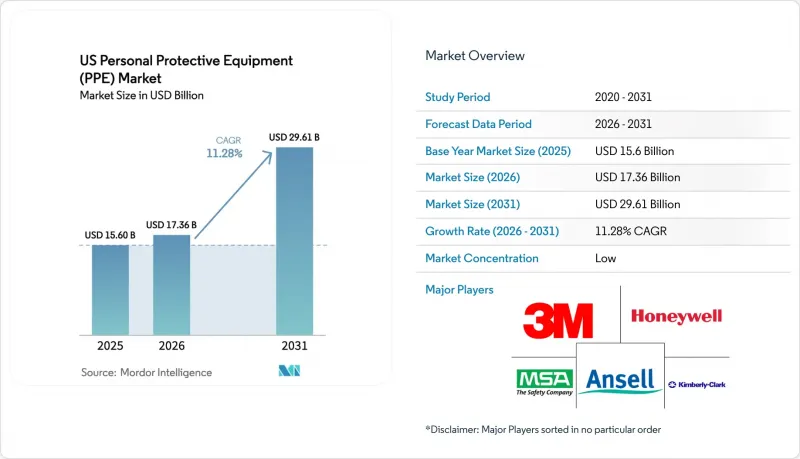
Mordor Intelligence에 따르면 미국의 개인보호장비(PPE) 시장 규모는 2025년에 156억 달러로 평가되며, 2026년 173억 6,000만 달러에서 2031년까지 296억 1,000만 달러에 달할 것으로 추정됩니다.
예측 기간(2026-2031년) 동안 연평균 성장률(CAGR)은 11.28%에 달할 것으로 전망됩니다.
본 보고서는 제품 유형(손 보호구, 보호복, 호흡용 보호구, 보호화 등), 최종사용자(의료·생명과학, 건설, 석유·가스/석유화학,제조, 식품·음료 등), 보호 범주(1차 PPE, 2차 PPE, 스마트/커넥티드 PPE)별로 분류되어 있습니다. 시장 예측은 금액(달러) 기준으로 제시되어 있습니다.
미국 개인보호장비(PPE) 시장의 동향 및 인사이트
OSHA가 적발한 안전 위반 사항이 업데이트 주기를 촉진
OSHA는 2024년에 호흡용 보호구 미비 사항을 네 번째로 많은 위반 사항으로 지적했으며, 눈 및 안면용 보호구는 9위를 기록했습니다. 이는 건설업 및 제조업 전반에 뿌리 깊은 과제가 존재함을 여실히 보여줍니다. 2025년에 최대 3%의 민사 벌금 인상이 제안되어 규정 위반에 따른 비용이 증가함에 따라, 고용주들은 임시 주문 대신 미래를 내다본 일괄 구매로 방향을 전환하고 있습니다. 부상률 분석을 기반으로 한 예측적 법 집행으로 인해 검사 범위가 더욱 확대되고, 교체 시기가 앞당겨지고 있습니다. ANSI 및 NIOSH 인증 규정에 따라 저품질 대체품의 사용이 금지됨에 따라 평균 판매 가격이 지탱되고 있습니다. 이러한 요인들이 복합적으로 작용하여, 미국의 개인보호구 시장에는 수요의 주기적 변동을 완화하는 안정적인 규제에 의한 견인력이 발생하고 있습니다.
미국 내 생산 확대 및 리쇼어링 노력
2022년에는 약 35만 개의 공장 일자리가 미국 본토로 돌아왔으며, 연방 정부의 조달 우선 정책이 국내 PPE 생산을 뒷받침함에 따라 이러한 추세는 2024년까지 더욱 가속화되었습니다. 이에 발맞춰 설비 투자도 확대되었습니다. 3M은 네브래스카주의 생산 라인에 6,700만 달러를 배정하여, 특히 현지 PPE 계약을 목표로 삼았습니다. 미시간주, 테네시주, 조지아주에서 건설이 진행 중인 신규 배터리 공장에서는 리튬이온 배터리로 인한 위험을 줄이기 위해 화학제품 비산용 보호복과 고효율 호흡용 보호구 사용이 의무화되어 있습니다. 이러한 리쇼어링의 급증으로 인해 수요가 미국 내로 재집중되면서 ‘Made in USA’ 라벨에 따른 프리미엄 가격 책정이 뒷받침되고, 대규모 산업 구매자를 대상으로 한 납기 단축으로 이어지고 있습니다.
석유화학 원료 가격 변동이 원자재 비용을 상승시켰고
2024년 폴리프로필렌 및 니트릴 고무 가격이 25-30% 변동함에 따라 일회용 장갑과 마스크의 이익률이 압박을 받았습니다. Cardinal Health는 최신 10-K 보고서에서 원자재 가격 변동을 주요 수익 위험 요인으로 지적했습니다. 듀폰(DuPont) 역시 급등하는 투입 비용을 상쇄하기 위해 가격을 인상한 후 판매량이 감소한 점을 언급하며, 가격 전가 탄력성이 제한적임을 강조하고 있습니다. 따라서 국내 공급업체들은 수익성을 지키기 위해 수지 가격 변동 위험을 헤지하거나 재사용 가능한 제품 라인으로 전환해야 합니다.
부문별 분석
2025년, 미국 개인보호구(PPE) 시장 점유율의 29.55%를 손 보호 장비가 차지했습니다. 이는 건설, 의료, 자동차 조립 각 분야에서의 광범위한 사용에 힘입은 결과입니다. 일회용 니트릴 장갑이 일상적인 소비 패턴을 주도하는 한편, 절단 저항성 및 내화학성 제품은 전문적인 틈새 시장을 공략하고 있습니다. 빈번한 교체 주기와 오염에 대한 우려로 인해 판매 회전율은 높게 유지되고 있으며, 기본 수익은 안정적인 상태를 보이고 있습니다. 호흡용 보호구 시장은 규모는 작지만, 2031년까지 연평균 성장률(CAGR) 13.38%를 기록할 것으로 예측되어 전체 카테고리 중 가장 높은 성장률을 보이고 있습니다. 산불 연기에 대한 규제, 배터리 공장의 위험성, 그리고 OSHA의 단속이 맞물려 하프 마스크형 엘라스토머 시스템 및 동력식 공기 공급 시스템의 사용이 촉진되고 있습니다. 보호복은 특히 방적성 커버올의 사용이 필수적인 배터리 및 반도체 클린룸에서의 생산이 국내로 복귀(리쇼어링)함에 따라 수요가 더욱 증가할 것으로 예상됩니다.
스마트 웨어러블 및 외골격 등을 포함한 기타 시장 규모는 여전히 비교적 작지만, 고용주들이 기술 집약형 솔루션을 시범 도입함에 따라 시장 평균을 상회하는 성장세를 보이고 있습니다. 안구 및 안면 보호구는 OSHA의 시정 권고 목록에 등재됨에 따라 다시 주목을 받고 있으며, 절연 바이저와 김서림 방지 고글에 대한 수요가 증가하고 있습니다. 보호화는 건설업 고용을 뒷받침하는 연방 정부의 인프라 지출 확대에 따라 성장을 이어가고 있습니다. 각 하위 부문에서 ANSI 및 NIOSH 규격이 품질 기준의 토대가 되고 있으며, 이를 통해 미국 제조업체들은 가격 프리미엄을 확보하는 동시에 저품질 수입품의 유입을 억제하고 있습니다.
기타 혜택:
- 엑셀 형식의 시장 예측(ME) 시트
- 3개월간의 애널리스트 지원
자주 묻는 질문
목차
제1장 소개
제2장 조사 방법
제3장 주요 요약
제4장 시장 구도
제5장 시장 규모와 성장 예측
제6장 경쟁 구도
제7장 시장 기회와 향후 전망
KSM 26.09.03According to Mordor Intelligence, the United States personal protective equipment market size was valued at USD 15.6 billion in 2025 and estimated to grow from USD 17.36 billion in 2026 to reach USD 29.61 billion by 2031, at a CAGR of 11.28% during the forecast period (2026-2031).
This report is Segmented by Product Type (Hand Protection, Protective Clothing, Respiratory Protection, Protective Footwear, and More), End User (Healthcare and Life Sciences, Construction, Oil and Gas/Petrochemicals, Manufacturing, Food and Beverage, and More), Protection Category (Primary PPE, Secondary PPE, Smart/Connected PPE). The Market Forecasts are Provided in Terms of Value (USD).
US Personal Protective Equipment (PPE) Market Trends and Insights
OSHA-Enforced Safety Violations Driving Replacement Cycles
OSHA cited respiratory protection lapses as the fourth-most frequent violation in 2024, while eye and face protection placed ninth, spotlighting persistent gaps across construction and manufacturing. Proposed civil penalty hikes of up to 3% in 2025 intensify the cost of non-compliance, nudging employers toward proactive bulk purchases rather than ad-hoc orders. Predictive enforcement, built on injury-rate analytics, further broadens inspection reach and accelerates replacement timelines. ANSI and NIOSH certification rules prevent the use of low-grade substitutes, thereby bolstering average selling prices. Together, these factors provide the United States' personal protective equipment market with a consistent regulatory pull-through that buffers cyclical demand swings.
Expansion of U.S. On-Shore Manufacturing Reshoring Initiatives
Roughly 350,000 factory jobs returned to American soil in 2022, and that wave crested higher through 2024 as federal procurement preferences rewarded domestic PPE output. Capital spending followed: 3M earmarked USD 67 million for its Nebraska lines, expressly targeting local PPE contracts. Emerging battery plants in Michigan, Tennessee, and Georgia now require the use of chemical splash garments and high-efficiency respirators to mitigate hazards associated with lithium-ion batteries. The reshoring surge re-anchors demand inside U.S. borders, supporting premium pricing for "Made in USA" labels and shortening delivery windows for large industrial buyers.
Volatile Petro-Chemical Feedstock Prices Inflating Material Costs
Polypropylene and nitrile rubber swings of 25-30% during 2024 compressed disposable glove and mask margins. Cardinal Health identified raw-material volatility as a principal earnings risk in its latest 10-K. DuPont likewise cited volume contraction after raising prices to offset surging input costs, underscoring limited pass-through elasticity. Domestic suppliers must therefore hedge resin exposure or pivot toward reusable lines to protect profitability.
Other drivers and restraints analyzed in the detailed report include:
- Aging Workforce Boosting Demand for Ergonomic PPE
- Surge in Wildfire Smoke Events Spurring Respiratory PPE Sales
- Counterfeit Imports Diluting Branded PPE Share
For complete list of drivers and restraints, kindly check the Table Of Contents.
Segment Analysis
Hand Protection held 29.55% of the United States personal protective equipment market share in 2025, buoyed by universal use across construction, healthcare, and automotive assembly. Disposable nitrile gloves dominate daily consumption patterns, while cut-resistant and chemical-resistant variants serve specialized niches. Frequent replacement cycles and concerns about contamination keep unit velocity high, stabilizing baseline revenue. Respiratory Protection, although smaller, is projected to log a 13.38% CAGR through 2031, the fastest within the category stack. Wildfire smoke mandates, battery-plant hazards, and OSHA crackdowns converge to propel the use of half-mask elastomeric and powered-air systems. Protective Clothing gains incremental lift from reshoring, particularly in battery and semiconductor cleanrooms that insist on splash-proof coveralls.
The United States personal protective equipment market size for Other Product Types, which include smart wearables and exoskeletons, remains comparatively small but exhibits above-market momentum as employers pilot technology-rich solutions. Eye and Face Protection enjoys renewed attention following its placement on OSHA's citation list, with dielectric visors and anti-fog goggles gaining traction. Protective Footwear grows in tandem with federal infrastructure spending that sustains construction employment. Across sub-segments, ANSI and NIOSH standards anchor quality benchmarks, enabling U.S. producers to command price premiums while deterring low-grade imports.
Complete Report Scope:
- By Product Type
- Hand Protection
- Protective Clothing
- Respiratory Protection
- Protective Footwear
- Eye and Face Protection
- Other Product Types
- By End User
- Healthcare and Life Sciences
- Construction
- Oil and Gas / Petrochemicals
- Manufacturing (Discrete and Process)
- Food and Beverage
- Mining and Metals
- Utilities and Energy (incl. Renewables)
- Public Safety and First Responders
- Other End-User
- By Protection Category
- Primary (Direct-contact) PPE
- Secondary (Contamination Barrier) PPE
- Smart / Connected PPE
List of Companies Covered in this Report:
- 3M Company
- Honeywell International Inc.
- DuPont de Nemours, Inc.
- Kimberly-Clark Corporation
- Ansell Limited
- MSA Safety Incorporated
- Cardinal Health, Inc.
- Medline Industries, LP
- Owens & Minor, Inc.
- Lakeland Industries, Inc.
- Alpha Pro Tech, Ltd.
- Radians, Inc.
- Protective Industrial Products, Inc.
- Magid Glove & Safety Mfg. Co. LLC
- Moldex-Metric, Inc.
- Bullard
- Tingley Rubber Corporation
- Dragerwerk AG & Co. KGaA
- Superior Glove Works Ltd.
- Showa Group
- MCR Safety Inc.
- Pyramex Safety Products LLC
- Klein Tools, Inc.
- Towa Corporation
- Gerson Company
Additional Benefits:
- The market estimate (ME) sheet in Excel format
- 3 months of analyst support
TABLE OF CONTENTS
1 INTRODUCTION
- 1.1 Study Assumptions and Market Definition
- 1.2 Scope of the Study
2 RESEARCH METHODOLOGY
3 EXECUTIVE SUMMARY
4 MARKET LANDSCAPE
- 4.1 Market Overview
- 4.2 Market Drivers
- 4.2.1 OSHA-enforced safety violations driving replacement cycles
- 4.2.2 Expansion of U.S. on-shore manufacturing reshoring initiatives
- 4.2.3 Aging workforce boosting demand for ergonomic PPE
- 4.2.4 Surge in wildfire smoke events spurring respiratory PPE sales
- 4.2.5 AI-enabled fit-testing platforms improving compliance
- 4.2.6 Growth of battery-gigafactories requiring specialty chemical-splash gear
- 4.3 Market Restraints
- 4.3.1 Volatile petro-chemical feedstock prices inflating material costs
- 4.3.2 Counterfeit imports diluting branded PPE share
- 4.3.3 End-user "PPE fatigue" lowering compliance in non-regulated sectors
- 4.3.4 Acute labor shortages limiting domestic production scale-up
- 4.4 Supply-Chain Analysis
- 4.5 Regulatory Landscape
- 4.6 Impact of Macroeconomic Factors on the Market
- 4.7 Impact of COVID-19 and Respiratory Pandemics
- 4.8 Porter's Five Forces Analysis
- 4.8.1 Bargaining Power of Suppliers
- 4.8.2 Bargaining Power of Buyers
- 4.8.3 Threat of New Entrants
- 4.8.4 Threat of Substitutes
- 4.8.5 Intensity of Competitive Rivalry
5 MARKET SIZE AND GROWTH FORECASTS (VALUE)
- 5.1 By Product Type
- 5.1.1 Hand Protection
- 5.1.2 Protective Clothing
- 5.1.3 Respiratory Protection
- 5.1.4 Protective Footwear
- 5.1.5 Eye and Face Protection
- 5.1.6 Other Product Types
- 5.2 By End User
- 5.2.1 Healthcare and Life Sciences
- 5.2.2 Construction
- 5.2.3 Oil and Gas / Petrochemicals
- 5.2.4 Manufacturing (Discrete and Process)
- 5.2.5 Food and Beverage
- 5.2.6 Mining and Metals
- 5.2.7 Utilities and Energy (incl. Renewables)
- 5.2.8 Public Safety and First Responders
- 5.2.9 Other End-User
- 5.3 By Protection Category
- 5.3.1 Primary (Direct-contact) PPE
- 5.3.2 Secondary (Contamination Barrier) PPE
- 5.3.3 Smart / Connected PPE
6 COMPETITIVE LANDSCAPE
- 6.1 Market Concentration
- 6.2 Strategic Moves
- 6.3 Market Share Analysis
- 6.4 Company Profiles (includes Global level Overview, Market level overview, Core Segments, Financials as available, Strategic Information, Market Rank/Share for key companies, Products and Services, and Recent Developments)
- 6.4.1 3M Company
- 6.4.2 Honeywell International Inc.
- 6.4.3 DuPont de Nemours, Inc.
- 6.4.4 Kimberly-Clark Corporation
- 6.4.5 Ansell Limited
- 6.4.6 MSA Safety Incorporated
- 6.4.7 Cardinal Health, Inc.
- 6.4.8 Medline Industries, LP
- 6.4.9 Owens & Minor, Inc.
- 6.4.10 Lakeland Industries, Inc.
- 6.4.11 Alpha Pro Tech, Ltd.
- 6.4.12 Radians, Inc.
- 6.4.13 Protective Industrial Products, Inc.
- 6.4.14 Magid Glove & Safety Mfg. Co. LLC
- 6.4.15 Moldex-Metric, Inc.
- 6.4.16 Bullard
- 6.4.17 Tingley Rubber Corporation
- 6.4.18 Dragerwerk AG & Co. KGaA
- 6.4.19 Superior Glove Works Ltd.
- 6.4.20 Showa Group
- 6.4.21 MCR Safety Inc.
- 6.4.22 Pyramex Safety Products LLC
- 6.4.23 Klein Tools, Inc.
- 6.4.24 Towa Corporation
- 6.4.25 Gerson Company
7 MARKET OPPORTUNITIES AND FUTURE OUTLOOK
- 7.1 White-Space and Unmet-Need Assessment


