|
시장보고서
상품코드
2124303
개인보호장비(PPE) 시장 : 시장 점유율 분석, 업계 동향 및 통계, 성장 예측(2026-2031년)Personal Protective Equipment - Market Share Analysis, Industry Trends & Statistics, Growth Forecasts (2026 - 2031) |
||||||
 Mordor Intelligence
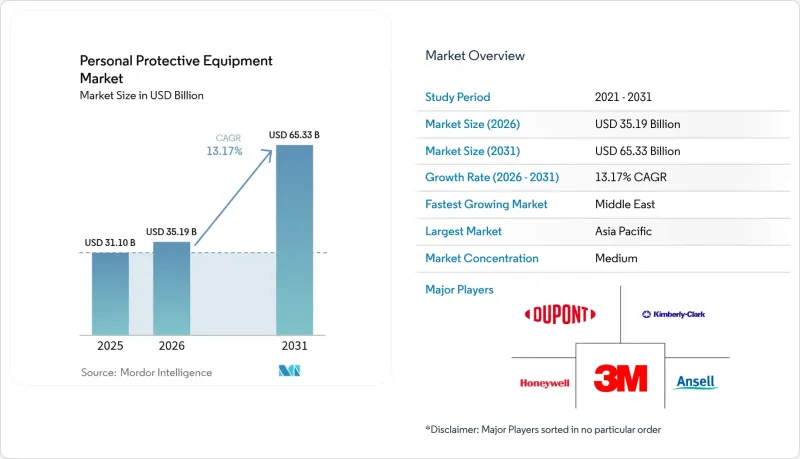
Mordor Intelligence에 의하면, 개인보호장비(PPE) 시장 규모는 2025년 311억 달러로 평가되었고, 2026년에는 351억 9,000만 달러로 추정되고, 2026-2031년 CAGR 13.17%로 성장을 지속할 전망이며, 2031년에는 653억 3,000만 달러에 이를 것으로 예측됩니다.
본 보고서는 제품별(마스크, 호흡용 보호구, 장갑, 보호복, 보호용 안경, 보호용 신발, 헬멧, 추락 방지), 최종 사용자 산업별(헬스케어, 제조업, 건설, 기타), 유통 채널별(기관 대상 직접 계약, 산업용 유통업체, 전자상거래, 소매), 지역별로 분류되어 있습니다. 시장 전망은 금액(달러) 기준으로 제시되어 있습니다.
세계의 개인보호장비(PPE) 시장 동향 및 인사이트
아시아 제조 거점에서의 산업 안전 규제 강화
중국에서 개정된 ‘산업안전보건법’에 따라 고위험 업종은 노출 데이터를 실시간으로 전송하는 커넥티드 PPE의 도입이 의무화됨에 따라, 이 지역 전체에서 고급 제품에 대한 수요가 확대되고 있습니다. 인도의 ‘산업안전보건 및 근로조건법’도 유사한 추세를 이끌어내고 있으며, 이에 따라 Mallcom은 국내 생산 능력 확대를 위해 10억 루피(1,200만 달러)를 투자하고 있습니다. 이에 따라 현지 공급업체들은 저비용 경쟁에서 성능 면에서의 차별화로 전략을 전환하며, 평균 판매 가격을 인상하는 동시에 공급망 전반에 걸친 규정 준수를 강화하고 있습니다.
일회용 PPE에 대한 EU의 더욱 엄격한 에코디자인 및 순환 경제 관련 규제
EU의 새로운 ‘생산자 책임 확대(EPR)’ 제도에 따라 제조업체는 마스크와 장갑의 폐기 후 수거 및 재활용 비용을 부담해야 할 의무가 부과됨에 따라 생분해성 폴리머의 연구 개발이 가속화되고 있습니다. 초기 시범 프로그램에서는 일회용 제품 카테고리에서 최대 60%의 재료가 회수되었으며, UVEX나 3M 독일과 같은 기업들에게 규정 준수는 브랜딩상의 강점으로 작용하고 있습니다.
유럽에서 일회용 합성 고분자에 대한 환경적 반발
의료 분야만 보더라도 2005년 이후 일회용 PPE 사용량은 2배로 증가하여 매립지 부담과 탄소 발자국을 가중시키고 있습니다. 현재 시민 단체들은 석유화학 유래 장갑과 마스크가 기후에 미치는 영향에 주목하고 있으며, 이에 따라 병원들은 입찰 서류에 지속가능성에 관한 조항을 포함시키고 있습니다. 바이오 폴리하이드록시아카노에이트 장갑 등의 대체품은 유망하지만, 여전히 비용이 높고 엄격한 여과 성능 및 인장 강도 요건을 충족하는 데 어려움을 겪고 있습니다. 따라서 각 제조업체는 의무화된 성능 기준을 충족하기 위해 기존 생산 라인을 유지하면서 동시에 연구 개발을 진행해야 하므로, 수익성 압박에 직면해 있습니다. 그 결과, 특히 대량 생산형 일회용 제품에 중점을 두고 있는 기업의 경우 중장기적으로 이익률 확대가 저해될 것입니다.
부문 분석
호흡용 보호구 시장은 사용자에게 비정상적인 호흡 패턴을 경고하는 생체 인식 센서가 내장된 스마트 필터에 힘입어 2031년까지 연평균 성장률(CAGR) 12.48%를 나타낼 것으로 예측됩니다. 장갑은 디지털화된 현장 업무 흐름에 적합한 내절단성 섬유와 터치스크린 대응 코팅에 힘입어 2025년 개인보호장비 시장에서 28.82%의 점유율을 유지했습니다.
설계상의 개선 사항으로는 현재 통기성과 경량화가 중시되고 있습니다. 존스 홉킨스 대학의 전문가들은 기존 일회용 모델을 대체할 수 있는 재사용 가능한 엘라스토머 재질의 호흡용 보호구에 대한 투자를 권장하고 있습니다. 구매자들이 단품 가격이 아닌 수명 주기 비용을 기준으로 장비를 평가하게 됨에 따라, IoT 기능을 갖춘 프리미엄 모델이 기관용 및 전자상거래 채널에서 판매 비중을 확대되고 있습니다.
지역별 분석
2025년, 아시아태평양은 개인보호장비 시장에서 39.05%의 점유율을 차지했습니다. 이는 해당 지역의 거대한 제조 거점과 확대되는 건설 프로젝트에 힘입은 결과입니다. 중국의 화학, 전자, 조선 산업 클러스터가 대량 주문을 주도하는 한편, 인도의 의료기기 부문은 2029년까지 205억 1,000만 달러에 달할 것으로 예상되어 클린룸 등급 소모품에 대한 국내 수요를 끌어올리고 있습니다. 각국 정부는 국내 PPE 생산에 대한 재정적 인센티브를 확대하여 수입 의존도를 낮추고 공급망의 회복력을 강화하고 있습니다.
북미는 OSHA(미국 직업안전보건청)의 엄격한 감독과 석유 및 가스 및 의료 분야에서의 스마트 PPE 조기 도입을 특징으로 하는 견고한 입지를 유지하고 있습니다. 반도체 생산 확대를 위한 연방 정부의 자금 지원으로 인해 오염 방지용 보호복에 대한 수요가 증가할 것으로 예상되며, 이 지역에서 고급 제품에 대한 선호도가 더욱 높아질 것으로 보입니다. 유럽 시장은 환경 규제 준수로 초점을 옮기고 있으며, 순환 경제의 기한이 다가옴에 따라 공급업체들은 회수 체계와 재생 소재를 사용한 제품 라인업을 제공해야 하는 압박을 받고 있습니다. 이러한 지속가능성 관련 요건은 지역 내 조달을 촉진하는 소프트 무역 장벽으로 기능하고 있습니다.
중동은 가장 빠르게 성장하는 지역으로, 사우디아라비아와 아랍에미리트(UAE)에서 진행 중인 총 2조 달러 규모의 메가 프로젝트를 배경으로 2031년 연평균 성장률(CAGR)은 13.86%로 예측됩니다. 각국의 규제에 따라 현장 근로자에게는 국제 인증을 받은 개인보호장비(PPE) 착용이 의무화되어 있어, 명품 브랜드에게 새로운 시장 기회가 열리고 있습니다. 남미에서는 도입 현황에 편차가 보입니다. 브라질에서는 주목을 받은 산업 재해를 계기로 규제 집행이 강화되고 있는 반면, 다른 지역에서는 재정적 제약으로 인해 보급 속도가 둔화되고 있습니다. 아프리카는 장기적인 전망을 가진 기회를 내포하고 있습니다. 산업화와 광업의 확대에 따라 안전 기준 집행이 강화되고 있지만, 공급망은 여전히 발전 단계에 있어 라스트 마일 물류를 현지화할 수 있는 선구자에게 유리한 상황입니다.
기타 혜택
- 엑셀 형식 시장 예측(ME) 시트
- 3개월간의 애널리스트 지원
자주 묻는 질문
목차
제1장 서론
제2장 조사 방법
제3장 주요 요약
제4장 시장 구도
제5장 시장 규모 및 성장 예측
제6장 경쟁 구도
제7장 시장 기회 및 향후 전망
AJY 26.09.11According to Mordor Intelligence, the personal protective equipment market size is expected to grow from USD 31.10 billion in 2025 to USD 35.19 billion in 2026 and is forecast to reach USD 65.33 billion by 2031 at 13.17% CAGR over 2026-2031.
This report is Segmented by Product (Masks, Respirators, Gloves, Suits, Eyewear, Footwear, Helmets, Fall Protection), End-User Industry (Healthcare, Manufacturing, Construction, and More), Distribution Channel (Direct Contracts, Distributors, E-Commerce, Retail), and Geography. The Market Forecasts are Provided in Terms of Value (USD).
Global Personal Protective Equipment Market Trends and Insights
Accelerated workplace-safety mandates in Asian manufacturing hubs
China's updated Work Safety Law obliges high-risk sectors to deploy connected PPE that streams exposure data in real time, boosting premium-grade demand across the region . India's Occupational Safety, Health and Working Conditions Code is generating similar momentum, prompting Mallcom to invest INR 100 crore (USD 12 million) to expand domestic capacity. Local suppliers are therefore pivoting from low-cost competition toward performance differentiation, raising average selling prices and tightening compliance across supply chains.
Stricter EU ecodesign and circularity rules for disposable PPE
The EU's new Extended Producer Responsibility schemes force manufacturers to finance end-of-life collection and recycling of masks and gloves, accelerating R&D in biodegradable polymers. Early pilot programs have recovered up to 60% of materials in single-use categories, turning compliance into a branding advantage for companies such as UVEX and 3M Deutschland.
Environmental Push-Back on Single-Use Synthetic Polymers in Europe
Healthcare alone has doubled disposable PPE use since 2005, amplifying landfill pressures and carbon footprints. Advocacy groups now spotlight the climate impact of petro-chemical gloves and masks, prompting hospitals to insert sustainability clauses into tender documents. Alternatives such as bio-based polyhydroxyalkanoate gloves are promising but still cost a premium and struggle to meet stringent filtration or tensile requirements. Manufacturers therefore face a profitability squeeze as they pursue parallel R&D paths while maintaining current production lines to satisfy mandatory performance standards. The net effect is a medium-to-long-term drag on margin expansion, particularly for firms heavily weighted toward high-volume disposables.
Other drivers and restraints analyzed in the detailed report include:
- Rapid digitalisation of industrial PPE procurement via B2B marketplaces in North America
- Integration of IoT-enabled smart PPE for real-time worker monitoring in oil and gas
- Volatile Nitrile and Latex Prices Disrupting Glove Supply Economics
For complete list of drivers and restraints, kindly check the Table Of Contents.
Segment Analysis
Respiratory Protection is projected to grow at a 12.48% CAGR through 2031, powered by smart filters with embedded biometric sensors that warn users of abnormal breathing patterns. Gloves retained 28.82% personal protective equipment market share in 2025, supported by cut-resistant fibres and touchscreen-compatible coatings that suit digital shop-floor workflows.
Design improvements now emphasise breathability and weight reduction; Johns Hopkins experts recommend investment in reusable elastomeric respirators to replace legacy single-use models. As buyers evaluate gear on lifecycle cost rather than ticket price, premium variants-often IoT-enabled-are gaining shelf space across institutional and e-commerce channels.
Complete Report Scope:
- By Product
- Surgical Masks
- Respirator Masks
- N-Series (N95, N99, N100)
- P-Series (P95, P99, P100)
- R-Series (R95, R99, R100)
- FFP1
- FFP2
- FFP3
- Gloves
- Disposable (Latex)
- Disposable (Nitrile)
- Industrial Re-usable
- Suits and Coveralls
- Aprons and Gowns
- Protective Eyewear and Face Shields
- Hearing Protection
- Earplugs
- Earmuffs
- Protective Footwear
- Safety Shoes
- Rubber Boots
- Helmets and Hard Hats
- Fall Protection
- Harnesses and Lanyards
- Fire-Resistant and Arc-Flash Clothing
- By End-User Industry
- Healthcare and Life Sciences
- Manufacturing (Heavy and Light)
- Construction and Infrastructure
- Oil and Gas, Mining and Metals
- Chemicals and Pharmaceuticals
- Food and Beverage Processing
- Transportation and Logistics
- Military, Law Enforcement and Homeland Security
- By Distribution Channel
- Direct Institutional Contracts
- Industrial Distributors and Wholesalers
- E-commerce and Digital Marketplaces
- Retail (DIY and Hardware Stores)
- By Geography
- North America
- United States
- Canada
- Mexico
- South America
- Brazil
- Argentina
- Rest of South America
- Europe
- Germany
- France
- United Kingdom
- Italy
- Spain
- Nordics (Sweden, Norway, Denmark, Finland, Iceland)
- Benelux (Netherlands, Belgium, Luxembourg)
- Central and Eastern Europe (Poland, Czech Republic, Russia, Others)
- Middle East and Africa
- Saudi Arabia
- United Arab Emirates
- Turkey
- South Africa
- Nigeria
- Kenya
- Rest of Middle East and Africa
- APAC
- China
- Japan
- India
- South Korea
- ASEAN-5 (Indonesia, Thailand, Malaysia, Vietnam, Philippines)
- Australia
- New Zealand
- Rest of APAC
- North America
Geography Analysis
Asia-Pacific held 39.05% of the personal protective equipment market in 2025, underwritten by its outsized manufacturing footprint and expanding construction pipeline. China's chemical, electronics, and ship-building clusters drive bulk orders, while India's medical-device sector is on track to reach USD 20.51 billion by 2029, boosting domestic demand for cleanroom-grade consumables. Governments are scaling fiscal incentives for local PPE production, reducing import dependence and enhancing supply-chain resilience.
North America maintains a robust position characterised by stringent OSHA oversight and early adoption of smart PPE in oil and gas and healthcare. Federal funding for semiconductor expansion is set to lift demand for contamination-control garments, reinforcing the region's premium-product bias. Europe's market is pivoting toward eco-compliance, with circularity deadlines pressuring suppliers to offer take-back schemes and recycled-content portfolios. These sustainability prerequisites act as soft trade barriers that encourage regional sourcing.
The Middle East is the fastest-growing pocket, forecast at a 13.86% CAGR to 2031 on the back of USD 2 trillion worth of mega-projects across Saudi Arabia and the UAE. National regulations now require internationally certified PPE for site workers, opening avenues for premium brands. South America exhibits uneven adoption; Brazil is raising enforcement after high-profile industrial incidents, while fiscal constraints temper acceleration elsewhere. Africa presents a long-horizon opportunity: industrialisation and mining expansion are stepping up enforcement of safety codes, yet supply chains remain nascent, favouring first movers able to localise last-mile distribution.
- 3M Company
- Honeywell International Inc.
- Ansell Ltd
- DuPont de Nemours Inc.
- Kimberly-Clark Corporation
- Cardinal Health Inc.
- Top Glove Corporation Bhd
- MSA Safety Inc.
- Lakeland Industries
- Alpha Pro Tech Ltd.
- Protective Industrial Products (PIP)
- Delta Plus Group
- Dragerwerk AG and Co. KGaA
- JSP Ltd.
- Uvex Safety Group GmbH
- COFRA S.r.l.
- Showa Group
- Radians Inc.
- Bullard
- Moldex-Metric Inc.
Additional Benefits:
- The market estimate (ME) sheet in Excel format
- 3 months of analyst support
TABLE OF CONTENTS
1 INTRODUCTION
- 1.1 Study Assumptions and Market Definition
- 1.2 Scope of the Study
2 RESEARCH METHODOLOGY
3 EXECUTIVE SUMMARY
4 MARKET LANDSCAPE
- 4.1 Market Drivers
- 4.1.1 Accelerated Workplace-Safety Mandates in Asian Manufacturing Hubs
- 4.1.2 Stricter EU Ecodesign and Circularity Rules for Disposable PPE
- 4.1.3 Rapid Digitalisation of Industrial PPE Procurement via B2B Marketplaces in North America
- 4.1.4 Integration of IoT-Enabled Smart PPE for Real-Time Worker Monitoring in Oil and Gas
- 4.1.5 Boom in Clean-Room Expansion for Semiconductor Fabs (Respiratory and Garment Demand)
- 4.1.6 Defence Modernisation Programs Driving Military-Grade Ballistic PPE in Middle East
- 4.2 Market Restraints
- 4.2.1 Environmental Push-back on Single-Use Synthetic Polymers in Europe
- 4.2.2 Volatile Nitrile and Latex Prices Disrupting Glove Supply Economics
- 4.2.3 Compliance Fatigue Among SMEs in Emerging Markets
- 4.2.4 Fragmented Certification Standards Hindering Cross-border Trade
- 4.3 Value / Supply-Chain Analysis
- 4.4 Regulatory Outlook
- 4.5 Technological Outlook
- 4.6 Porter's Five Forces
- 4.6.1 Bargaining Power of Suppliers
- 4.6.2 Bargaining Power of Buyers
- 4.6.3 Threat of New Entrants
- 4.6.4 Threat of Substitutes
- 4.6.5 Intensity of Competitive Rivalry
- 4.7 Assessment of the Impact of COVID-19
- 4.7.1 Production Dynamics - Pure-Play vs. Diversified Vendors
- 4.7.2 Import/Export Regulation Shifts
- 4.7.3 Top 10 PPE Importing and Exporting Countries
- 4.8 Investment Analysis
5 MARKET SIZE AND GROWTH FORECASTS (VALUE)
- 5.1 By Product
- 5.1.1 Surgical Masks
- 5.1.2 Respirator Masks
- 5.1.2.1 N-Series (N95, N99, N100)
- 5.1.2.2 P-Series (P95, P99, P100)
- 5.1.2.3 R-Series (R95, R99, R100)
- 5.1.2.4 FFP1
- 5.1.2.5 FFP2
- 5.1.2.6 FFP3
- 5.1.3 Gloves
- 5.1.3.1 Disposable (Latex)
- 5.1.3.2 Disposable (Nitrile)
- 5.1.3.3 Industrial Re-usable
- 5.1.4 Suits and Coveralls
- 5.1.5 Aprons and Gowns
- 5.1.6 Protective Eyewear and Face Shields
- 5.1.7 Hearing Protection
- 5.1.7.1 Earplugs
- 5.1.7.2 Earmuffs
- 5.1.8 Protective Footwear
- 5.1.8.1 Safety Shoes
- 5.1.8.2 Rubber Boots
- 5.1.9 Helmets and Hard Hats
- 5.1.10 Fall Protection
- 5.1.10.1 Harnesses and Lanyards
- 5.1.11 Fire-Resistant and Arc-Flash Clothing
- 5.2 By End-User Industry
- 5.2.1 Healthcare and Life Sciences
- 5.2.2 Manufacturing (Heavy and Light)
- 5.2.3 Construction and Infrastructure
- 5.2.4 Oil and Gas, Mining and Metals
- 5.2.5 Chemicals and Pharmaceuticals
- 5.2.6 Food and Beverage Processing
- 5.2.7 Transportation and Logistics
- 5.2.8 Military, Law Enforcement and Homeland Security
- 5.3 By Distribution Channel
- 5.3.1 Direct Institutional Contracts
- 5.3.2 Industrial Distributors and Wholesalers
- 5.3.3 E-commerce and Digital Marketplaces
- 5.3.4 Retail (DIY and Hardware Stores)
- 5.4 By Geography
- 5.4.1 North America
- 5.4.1.1 United States
- 5.4.1.2 Canada
- 5.4.1.3 Mexico
- 5.4.2 South America
- 5.4.2.1 Brazil
- 5.4.2.2 Argentina
- 5.4.2.3 Rest of South America
- 5.4.3 Europe
- 5.4.3.1 Germany
- 5.4.3.2 France
- 5.4.3.3 United Kingdom
- 5.4.3.4 Italy
- 5.4.3.5 Spain
- 5.4.3.6 Nordics (Sweden, Norway, Denmark, Finland, Iceland)
- 5.4.3.7 Benelux (Netherlands, Belgium, Luxembourg)
- 5.4.3.8 Central and Eastern Europe (Poland, Czech Republic, Russia, Others)
- 5.4.4 Middle East and Africa
- 5.4.4.1 Saudi Arabia
- 5.4.4.2 United Arab Emirates
- 5.4.4.3 Turkey
- 5.4.4.4 South Africa
- 5.4.4.5 Nigeria
- 5.4.4.6 Kenya
- 5.4.4.7 Rest of Middle East and Africa
- 5.4.5 APAC
- 5.4.5.1 China
- 5.4.5.2 Japan
- 5.4.5.3 India
- 5.4.5.4 South Korea
- 5.4.5.5 ASEAN-5 (Indonesia, Thailand, Malaysia, Vietnam, Philippines)
- 5.4.5.6 Australia
- 5.4.5.7 New Zealand
- 5.4.5.8 Rest of APAC
- 5.4.1 North America
6 COMPETITIVE LANDSCAPE
- 6.1 Market Concentration
- 6.2 Strategic Moves
- 6.3 Market Share Analysis
- 6.4 Company Profiles (includes Global-level Overview, Market-level Overview, Core Segments, Financials as available, Strategic Information, Market Rank/Share, Products and Services, Recent Developments)
- 6.4.1 3M Company
- 6.4.2 Honeywell International Inc.
- 6.4.3 Ansell Ltd
- 6.4.4 DuPont de Nemours Inc.
- 6.4.5 Kimberly-Clark Corporation
- 6.4.6 Cardinal Health Inc.
- 6.4.7 Top Glove Corporation Bhd
- 6.4.8 MSA Safety Inc.
- 6.4.9 Lakeland Industries
- 6.4.10 Alpha Pro Tech Ltd.
- 6.4.11 Protective Industrial Products (PIP)
- 6.4.12 Delta Plus Group
- 6.4.13 Dragerwerk AG and Co. KGaA
- 6.4.14 JSP Ltd.
- 6.4.15 Uvex Safety Group GmbH
- 6.4.16 COFRA S.r.l.
- 6.4.17 Showa Group
- 6.4.18 Radians Inc.
- 6.4.19 Bullard
- 6.4.20 Moldex-Metric Inc.
7 MARKET OPPORTUNITIES AND FUTURE OUTLOOK
- 7.1 White-Space and Unmet-Need Assessment