|
시장보고서
상품코드
2119740
연동형 자동 판매기 시장 : 점유율 분석, 업계 동향과 통계, 성장 예측(2026-2031년)Connected Vending Machine - Market Share Analysis, Industry Trends & Statistics, Growth Forecasts (2026 - 2031) |
||||||
 Mordor Intelligence
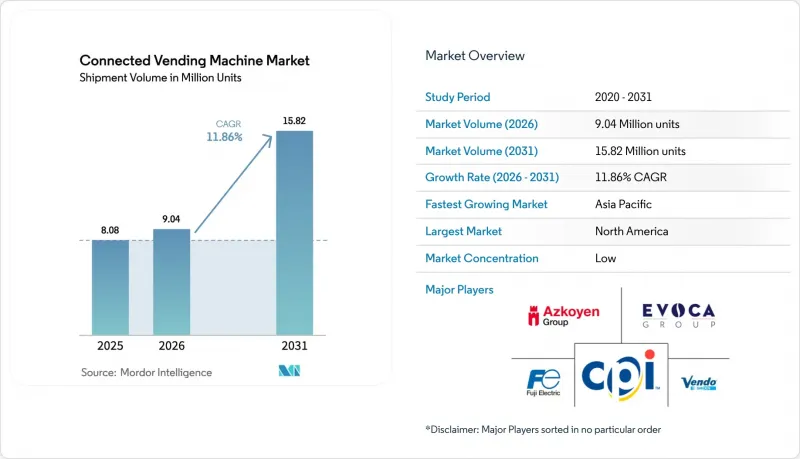
Mordor Intelligence에 의하면, 연동형 자동 판매기 시장 규모는 2025년 808만 대로에서 2026년에는 904만 대로 확대되어 2026년부터 2031년까지 CAGR 11.86%로 성장을 지속하여, 2031년에는 1,582만 대에 이를 것으로 예측됩니다.
본 보고서는 기계 유형(벽걸이형, 탁상형, 독립형 캐비닛), 제품 유형(음료, 스낵 등), 설치 장소·용도(공항, 철도·지하철역, 기타),연결성·기술(텔레메트리 지원, 완전한 IoT 연결, 기타), 결제 기술(지폐·동전, 카드 리더기, 기타), 지역별로 분류되어 있습니다. 시장 예측은 출하 대수 기준으로 제시되어 있습니다.
세계 연동형 자동 판매기 시장 동향 및 인사이트
무현금 결제 및 모바일 결제의 보급 확대
세계 결제 방식의 디지털화에 따라 연동형 자동 판매기 시장은 카드 없는 거래로 전환되고 있습니다. 입지 조건이 좋은 설치 장소에서는 이미 매출의 50%를 카드 없는 거래가 차지하고 있습니다. NFC 지원 스마트폰, 비접촉식 카드, 모바일 지갑의 조합을 통해 결제 마찰이 해소되고, 1회당 구매 금액이 증가하며, 실시간 POS 데이터를 기반으로 한 로열티 프로그램이 가능해집니다. Cantaloupe사의 ‘Engage Pulse’ 리더기는 여러 번의 플레이에 대해 1회 분의 요금만 청구하는 래더 프라이싱을 통해 크레인 게임의 수익을 85% 증가시켰습니다. 사업자는 보다 상세한 고객 분석 데이터를 활용해 상품 진열 계획을 최적화할 수 있을 뿐만 아니라, DyDo가 일본에서 NEC와 공동으로 얼굴 인식 결제 단말기의 시범 도입을 추진하는 등, 생체 인증 지갑이 마찰 없는 결제의 새로운 물결을 예고하고 있습니다.
비접촉식이며 위생적인 소매에 대한 수요
팬데믹 이후 높아진 위험 인식으로 인해 기업들은 고객에게 안심감을 주고 사내 위생 규정을 충족하는 비접촉식 디스펜서 도입을 추진하고 있습니다. 모션 센서, 음성 안내, QR 코드 앱을 갖춘 단말기가 물리적 키패드를 대체하며, 구매 중간에 자외선이나 청색광을 이용한 살균 사이클이 접촉 부위를 소독합니다. 이는 샬럿 더글라스 국제공항에 있는 HMSHost의 셀프 체크아웃 키오스크에서 볼 수 있듯이 말입니다. 원격 대시보드를 통해 청소 기록을 확인할 수 있으므로, 운영자는 시설 관리자에게 규정 준수 여부를 입증할 수 있습니다. 따라서 의료, 기업, 교육 기관에서는 공용 표면에 대한 우려를 최소화하면서 폭넓은 상품 구색을 제공할 수 있는 스마트 기기 도입을 우선시하고 있습니다.
높은 초기 설비 투자(Capex) 및 설치 비용
고급 자동 판매기의 가격은 엔트리급 AI 모델의 경우 4,299달러부터, 다중 온도대 대응 키오스크의 경우 1만 5,000달러 이상으로 폭이 넓어, 소규모 노선 운영 사업자에게는 자금 조달에 부담이 됩니다. 또한, 전원 업그레이드, 통신 회선 계약료, 결제 게이트웨이 수수료와 같은 추가 비용도 발생합니다. 운영 사업자가 선택적으로 설비를 갱신함에 따라 혼합형 자동 판매기 군이 여전히 존재하고 있으며, 이로 인해 완전한 디지털화에 따른 네트워크 효과의 이점을 얻지 못해, 비용에 민감한 지역에서의 네트워크 연결형 자동 판매기 시장 침투가 지연되고 있습니다.
부문 분석
2025년 설치 대수의 59.55%를 독립형 캐비닛이 차지하며, 교통 기관의 대합실이나 캠퍼스에 적합한 폭넓은 SKU 수용 능력을 통해 연동형 자동 판매기 시장의 기반을 다지고 있습니다. 벽걸이형은 건물주가 복도나 휴게실에 부가적인 서비스를 도입하려는 움직임에 힘입어 현재 13.55%의 복합 성장률을 보이고 있습니다. 독립형 연동형 자동 판매기 시장 규모는 여전히 크지만, 콤팩트한 설치형은 바닥 면적을 희생하지 않고 추가 수익을 추구하는 사업자들을 끌어들이고 있습니다.
기술의 소형화에 힘입어 벽걸이형 유닛은 결제 옵션, 원격 텔레메트리, 다온도대 보관 등의 측면에서 대형 모델에 필적하는 성능을 실현하고 있습니다. 터치스크린, LED 조명, 클라우드 기반 SKU 추적 기능이 기본으로 탑재되어 있으며, 경량화된 프레임 덕분에 설치 비용도 절감되었습니다. 이러한 특징 덕분에 안전 기준에 따라 바닥 면적 사용이 제한되는 병원, 학교, 소규모 코워킹 스페이스 등에서 도입이 확대되고 있습니다.
확립된 콜드체인 물류 덕분에 2025년 매출액 중 음료가 37.65%를 차지했으나, 소비자들이 더 건강한 테이크아웃 식사를 선호하게 됨에 따라 신선식품 및 냉동식품은 연평균 13.74%의 성장률을 보이고 있습니다. 사업자들은 HACCP 기준을 충족하기 위해 IoT를 활용한 온도 기록을 활용하고, AI를 통한 가격 인하로 식품 폐기물을 줄임으로써, 기업 내 구내식당의 대안으로서 연동형 자동 판매기 시장의 매력이 높아지고 있습니다.
도쿄에 위치한 ‘다이나믹 샐러드 키오스크’는 폐기물을 줄이기 위해 시간대에 따라 가격을 유연하게 조정함으로써 이 모델의 실현 가능성을 입증하고 있습니다. 새로운 포장 방식 덕분에 식품은 48시간 동안 신선한 상태를 유지하며, 예측 기반의 재고 보충 경로를 통해 공급을 소비 피크에 맞추어 조정하고 있습니다. 이러한 혁신으로 인해 신선식품 자동 판매기에 대한 소비자의 신뢰가 높아지고 있습니다.
지역별 분석
2025년, 북미는 전 세계 매출의 37.25%를 차지했습니다. 이는 정교한 결제 인프라, 기업 내 IoT의 조기 도입, 그리고 기업 캠퍼스나 교통수단에서의 도입을 원활하게 하는 데이터 개인정보 보호에 관한 지원적인 법규를 반영한 결과입니다. 대도시권에서는 무현금 결제 보급률이 80%를 넘어섰기 때문에 사업자들은 AI를 통한 업그레이드를 동일 단말기에서의 매출을 향상시키기 위한 다음 수단으로 보고 있습니다.
아시아태평양은 중국의 제조 규모와 모바일 지갑의 보급에 힘입어 연평균 성장률(CAGR) 14.22%의 궤도에 올라 있습니다. AFEN 등 국내 제조업체들은 연간 12만 대를 생산하여 100개국 이상에 수출하고 있는 반면, 태국의 Tao Bin 단말기군은 QR 코드 및 얼굴 인식 결제 인터페이스를 통해 하루 20만 잔의 음료를 판매하고 있습니다. 자카르타에서 호치민시에 이르는 도시 철도 연장 공사로 인해, 현대적인 키오스크가 통근자들의 편의성을 높이는 핵심 요소로 자리 잡고 있습니다.
유럽에서는 일회용 플라스틱 규제와 네트워크에 연결된 리버스 벤딩 단말기를 뒷받침하는 용기 보증금 제도의 영향으로, 정책 주도적이긴 하지만 안정적인 성장이 나타나고 있습니다. 스칸디나비아 전역에서 TOMRA가 달성한 98%의 병 회수율은 이 모델의 성공을 여실히 보여주고 있으며, 한편 EU의 GDPR(EU 개인정보보호규정)(일반 데이터 보호 규정)에 따라 각 벤더 기업들은 개인 데이터를 단말기 내에 보관하기 위한 엣지 처리로의 전환을 강요받고 있습니다. 중동 및 아프리카, 남미 등 신흥 지역에서는 도입이 초기 단계에 있습니다. 통신 사업자들이 4G/5G를 구축하는 가운데, 자동 판매기 기업들은 공중보건 기관과 제휴하여 로스앤젤레스 카운티의 무료 나록손 키오스크에서 볼 수 있듯이 브랜드 인지도 제고를 도모하고 있습니다.
기타 혜택:
- 엑셀 형식 시장 예측(ME) 시트
- 3개월간의 애널리스트 지원
자주 묻는 질문
목차
제1장 서론
제2장 조사 방법
제3장 개요
제4장 시장 구도
제5장 시장 규모와 성장 예측(출하대수)
제6장 경쟁 구도
제7장 시장 기회와 향후의 동향
JHS 26.09.03According to Mordor Intelligence, the connected vending machine market size is expected to grow from 8.08 million units in 2025 to 9.04 million units in 2026 and is forecast to reach 15.82 million units by 2031 at 11.86% CAGR over 2026-2031.
This report is Segmented by Machine Type (Wall-Mounted, Table-Top, and Stand-Alone Cabinet), Product Type (Beverages, Snacks, and More), Application/Location (Airports, Railway and Metro Stations, and More), Connectivity/Technology (Telemetry-Enabled, Fully IoT-Connected, and More), Payment Technology (Cash and Coin, Card Reader, and More), and Geography. The Market Forecasts are Provided in Terms of Shipments.
Global Connected Vending Machine Market Trends and Insights
Growing Adoption of Cashless and Mobile Payments
Global payment digitalisation is steering the connected vending machine market toward card-free transactions that already represent as much as 50% of sales for well-placed assets. The pairing of NFC smartphones, contactless cards, and mobile wallets removes friction, expands ticket sizes, and unlocks loyalty schemes driven by real-time POS data. Cantaloupe's Engage Pulse reader lifted crane-game revenue 85% through ladder pricing that charges once for multiple plays. Operators gain richer shopper analytics to refine planograms, while biometric wallets signal a next wave of frictionless settlement as DyDo pilots face-pay units with NEC in Japan.
Demand for Contactless, Hygienic Retail
Post-pandemic risk awareness pushes businesses to adopt touch-free dispensing that reassures patrons and satisfies internal health protocols. Machines with motion sensing, voice prompts, and QR-code Apps replace physical keypads, and ultraviolet or blue-light sanitising cycles disinfect contact areas between purchases, as shown by HMSHost's self-checkout kiosks at Charlotte Douglas International Airport. Remote dashboards verify cleaning logs, letting operators demonstrate compliance to facility managers. Healthcare, corporate, and education sites, therefore, prioritise smart fleets that minimise shared-surface concerns while offering extended SKU variety.
High Initial Cap-ex and Installation Outlay
Advanced machines cost from USD 4,299 for entry-level AI models to above USD 15,000 for multi-temperature kiosks, stretching cash flow for small route operators. Additional costs arise from power upgrades, connectivity subscriptions, and payment gateway fees. Mixed fleets often persist because operators retrofit selectively, delaying the network-effect benefits of full digitisation and slowing connected vending machine market penetration in cost-sensitive locales.
Other drivers and restraints analyzed in the detailed report include:
- Retail Automation to Offset Labour Costs
- Rapid Expansion of Transit Hubs (Airport/Rail)
- Vandalism and Security of Unattended Assets
For complete list of drivers and restraints, kindly check the Table Of Contents.
Segment Analysis
Stand-alone cabinets accounted for 59.55% of 2025 placements, anchoring the connected vending machine market with broad SKU capacity that suits transport concourses and campuses. Wall-mounted designs are now compounding at 13.55% as landlords squeeze incremental services into corridors and break-rooms. The connected vending machine market size for stand-alone units remains large, yet compact fixtures attract operators seeking incremental revenue without floor-space trade-offs.
Technological miniaturisation enables wall units to match larger cousins on payment options, remote telemetry, and multi-temperature storage. Touchscreens, LED lighting, and cloud SKU tracking come standard, while lighter frames lower installation costs. These traits lift adoption across hospitals, schools, and boutique co-working sites where safety codes restrict floor obstruction.
Beverages held 37.65% of 2025 revenue due to established cold-chain logistics, but fresh and frozen food is compounding at 13.74% as consumers embrace healthier grab-and-go meals. Operators rely on IoT temperature logs to satisfy HACCP standards and on AI price markdowns to curb spoilage, boosting the connected vending machine market's appeal in corporate dining replacements.
Dynamic salad kiosks in Tokyo, which flex prices by time of day to reduce waste, prove the model's viability. New packaging keeps food fresh for 48 hours, while predictive restocking routes align supply with consumption peaks. These innovations elevate consumer trust in perishable automated retail.
Complete Report Scope:
- By Machine Type
- Wall-mounted
- Table-top
- Stand-alone cabinet
- By Product Type
- Beverages
- Snacks
- Fresh and Frozen Food
- Confectionery
- Others
- By Application
- Airports
- Railway and Metro Stations
- Corporate Offices and Co-working Spaces
- Educational Institutes
- Healthcare Facilities
- Retail and Shopping Centres
- By Connectivity/Technology
- Telemetry-enabled (semi-connected)
- Fully IoT-connected (cloud CMS)
- AI-powered Smart Machines
- Reverse-vending/Deposit-return
- By Payment Technology
- Cash and Coin
- Card Reader (EMV)
- Mobile Wallet/NFC
- Biometric/Face-pay
- By Geography
- North America
- United States
- Canada
- Mexico
- South America
- Brazil
- Argentina
- Chile
- Rest of South America
- Europe
- Germany
- United Kingdom
- France
- Italy
- Spain
- Russia
- Rest of Europe
- Asia-Pacific
- China
- India
- Japan
- South Korea
- Singapore
- Malaysia
- Australia
- Rest of Asia-Pacific
- Middle East and Africa
- Middle East
- United Arab Emirates
- Saudi Arabia
- Turkey
- Rest of Middle East
- Africa
- South Africa
- Nigeria
- Rest of Africa
- Middle East
- North America
Geography Analysis
North America generated 37.25% of global revenue in 2025, reflecting sophisticated payment rails, early enterprise IoT adoption, and supportive data-privacy statutes that streamline deployments in corporate campuses and transportation venues. Cashless acceptance tops 80% across metro areas, so operators view AI upgrades as the next lever to lift same-machine sales.
Asia-Pacific is on a 14.22% CAGR path, underpinned by China's manufacturing scale and mobile-wallet ubiquity. Domestic builders such as AFEN turn out 120,000 units annually, shipping to over 100 nations, while Thailand's Tao Bin fleet moves 200,000 drinks daily through QR and face-pay interfaces. Urban rail extensions from Jakarta to Ho Chi Minh City place modern kiosks front and centre of commuter convenience.
Europe records stable yet policy-driven growth, spurred by single-use plastic rules and container deposit mandates that favour connected reverse vending endpoints. TOMRA's 98% bottle return rate across Scandinavia showcases the model, while EU GDPR pushes vendors toward edge processing to keep personal data on-device. Emerging corridors in the Middle East, Africa, and South America display early-stage adoption; as telecom operators roll out 4G/5G, vending firms partner with public-health bodies, exemplified by LA County's free naloxone kiosks, to build brand familiarity.
- Azkoyen Group
- Fuji Electric Co. Ltd.
- Crane Payment Innovations (CPI)
- Evoca Group
- SandenVendo America
- FAS International S.p.A.
- Bianchi Vending Group S.p.A.
- Rhea Vendors Group
- Seaga Manufacturing Inc.
- Westomatic Vending Services Ltd.
- Jofemar Corporation
- Sielaff GmbH
- Fastcorp Vending LLC
- Automated Merchandising Systems Inc.
- U-Select-It (USI)
- TCN Vending Machine Co. Ltd.
- Haloo Automation Equipment Co. Ltd.
- Futura Vending Pte Ltd.
- Yo-Kai Express Inc.
- Vendekin Technologies Pvt Ltd.
- Nayax Ltd.
- TOMRA Systems ASA
- Vendex International Ltd.
- Royal Vendors Inc.
- Fastenal (Industrial Vending)
Additional Benefits:
- The market estimate (ME) sheet in Excel format
- 3 months of analyst support
TABLE OF CONTENTS
1 INTRODUCTION
- 1.1 Study Assumptions and Market Definition
- 1.2 Scope of the Study
2 RESEARCH METHODOLOGY
3 EXECUTIVE SUMMARY
4 MARKET LANDSCAPE
- 4.1 Market Overview
- 4.2 Market Drivers
- 4.2.1 Growing adoption of cashless and mobile payments
- 4.2.2 Demand for contactless, hygienic retail
- 4.2.3 Retail automation to offset labour costs
- 4.2.4 Rapid expansion of transit hubs (airport/rail)
- 4.2.5 Integration with deposit-return reverse-vending
- 4.2.6 Programmatic DOOH advertising revenue streams
- 4.3 Market Restraints
- 4.3.1 High initial cap-ex and installation outlay
- 4.3.2 Vandalism and security of unattended assets
- 4.3.3 Fragmented connectivity/protocol standards
- 4.3.4 School nutrition regulations limiting SKUs
- 4.4 Industry Value Chain Analysis
- 4.5 Regulatory Landscape
- 4.6 Technological Outlook
- 4.7 Industry Attractiveness - Porter's Five Forces Analysis
- 4.7.1 Bargaining Power of Buyers
- 4.7.2 Bargaining Power of Suppliers
- 4.7.3 Threat of New Entrants
- 4.7.4 Threat of Substitutes
- 4.7.5 Intensity of Competitive Rivalry
- 4.8 Key Metrics
- 4.8.1 User Penetration Rate
- 4.8.2 Average Revenue per User (ARPU)
- 4.9 Impact of Macroeconomic Factors on the Market
5 MARKET SIZE AND GROWTH FORECASTS (SHIPMENTS)
- 5.1 By Machine Type
- 5.1.1 Wall-mounted
- 5.1.2 Table-top
- 5.1.3 Stand-alone cabinet
- 5.2 By Product Type
- 5.2.1 Beverages
- 5.2.2 Snacks
- 5.2.3 Fresh and Frozen Food
- 5.2.4 Confectionery
- 5.2.5 Others
- 5.3 By Application
- 5.3.1 Airports
- 5.3.2 Railway and Metro Stations
- 5.3.3 Corporate Offices and Co-working Spaces
- 5.3.4 Educational Institutes
- 5.3.5 Healthcare Facilities
- 5.3.6 Retail and Shopping Centres
- 5.4 By Connectivity/Technology
- 5.4.1 Telemetry-enabled (semi-connected)
- 5.4.2 Fully IoT-connected (cloud CMS)
- 5.4.3 AI-powered Smart Machines
- 5.4.4 Reverse-vending/Deposit-return
- 5.5 By Payment Technology
- 5.5.1 Cash and Coin
- 5.5.2 Card Reader (EMV)
- 5.5.3 Mobile Wallet/NFC
- 5.5.4 Biometric/Face-pay
- 5.6 By Geography
- 5.6.1 North America
- 5.6.1.1 United States
- 5.6.1.2 Canada
- 5.6.1.3 Mexico
- 5.6.2 South America
- 5.6.2.1 Brazil
- 5.6.2.2 Argentina
- 5.6.2.3 Chile
- 5.6.2.4 Rest of South America
- 5.6.3 Europe
- 5.6.3.1 Germany
- 5.6.3.2 United Kingdom
- 5.6.3.3 France
- 5.6.3.4 Italy
- 5.6.3.5 Spain
- 5.6.3.6 Russia
- 5.6.3.7 Rest of Europe
- 5.6.4 Asia-Pacific
- 5.6.4.1 China
- 5.6.4.2 India
- 5.6.4.3 Japan
- 5.6.4.4 South Korea
- 5.6.4.5 Singapore
- 5.6.4.6 Malaysia
- 5.6.4.7 Australia
- 5.6.4.8 Rest of Asia-Pacific
- 5.6.5 Middle East and Africa
- 5.6.5.1 Middle East
- 5.6.5.1.1 United Arab Emirates
- 5.6.5.1.2 Saudi Arabia
- 5.6.5.1.3 Turkey
- 5.6.5.1.4 Rest of Middle East
- 5.6.5.2 Africa
- 5.6.5.2.1 South Africa
- 5.6.5.2.2 Nigeria
- 5.6.5.2.3 Rest of Africa
- 5.6.5.1 Middle East
- 5.6.1 North America
6 COMPETITIVE LANDSCAPE
- 6.1 Market Concentration
- 6.2 Strategic Moves
- 6.3 Market Share Analysis
- 6.4 Company Profiles (includes Global level Overview, Market level overview, Core Segments, Financials as available, Strategic Information, Market Rank/Share for key companies, Products and Services, and Recent Developments)
- 6.4.1 Azkoyen Group
- 6.4.2 Fuji Electric Co. Ltd.
- 6.4.3 Crane Payment Innovations (CPI)
- 6.4.4 Evoca Group
- 6.4.5 SandenVendo America
- 6.4.6 FAS International S.p.A.
- 6.4.7 Bianchi Vending Group S.p.A.
- 6.4.8 Rhea Vendors Group
- 6.4.9 Seaga Manufacturing Inc.
- 6.4.10 Westomatic Vending Services Ltd.
- 6.4.11 Jofemar Corporation
- 6.4.12 Sielaff GmbH
- 6.4.13 Fastcorp Vending LLC
- 6.4.14 Automated Merchandising Systems Inc.
- 6.4.15 U-Select-It (USI)
- 6.4.16 TCN Vending Machine Co. Ltd.
- 6.4.17 Haloo Automation Equipment Co. Ltd.
- 6.4.18 Futura Vending Pte Ltd.
- 6.4.19 Yo-Kai Express Inc.
- 6.4.20 Vendekin Technologies Pvt Ltd.
- 6.4.21 Nayax Ltd.
- 6.4.22 TOMRA Systems ASA
- 6.4.23 Vendex International Ltd.
- 6.4.24 Royal Vendors Inc.
- 6.4.25 Fastenal (Industrial Vending)
7 MARKET OPPORTUNITIES AND FUTURE TRENDS
- 7.1 White-Space and Unmet-Need Assessment