

|
시장보고서
상품코드
2119747
말레이시아의 데이터센터 서버 시장 : 점유율 분석, 업계 동향과 통계, 성장 예측(2026-2031년)Malaysia Data Center Server - Market Share Analysis, Industry Trends & Statistics, Growth Forecasts (2026 - 2031) |
||||||
 Mordor Intelligence
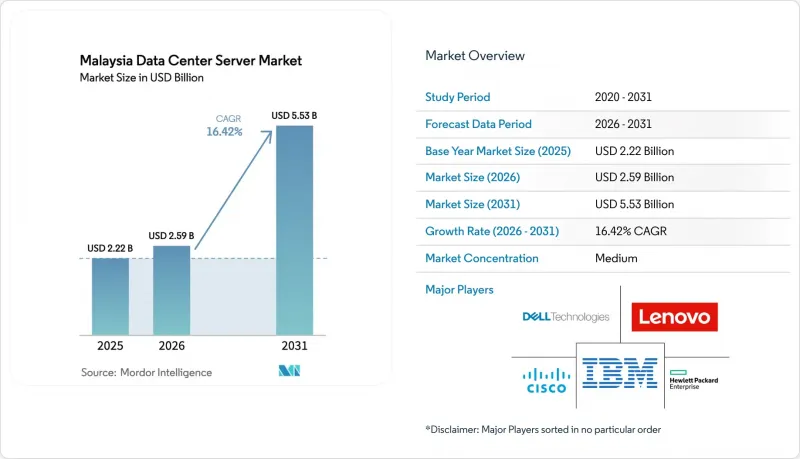
Mordor Intelligence에 의하면, 말레이시아의 데이터센터 서버 시장 규모는 2025년에 22억 2,000만 달러로 평가되었고 2026년 25억 9,000만 달러에서 2031년까지 55억 3,000만 달러에 이를 것으로 예측되며, 예측 기간(2026-2031년) 중 CAGR은 16.42%를 나타낼 전망입니다.
본 보고서는 데이터센터 티어(Tier 1 및 2, Tier 3, Tier 4), 폼 팩터(하프 하이 블레이드, 풀 하이 블레이드 등), 용도(가상화 및 프라이빗 클라우드, 고성능 컴퓨팅 등), 데이터센터 유형(하이퍼스케일러 제공업체 등),최종 사용자 산업(BFSI 등)별로 분류되어 있습니다. 상기 모든 부문에 대해 시장 규모 및 전망은 금액(달러) 단위로 제시되어 있습니다.
말레이시아 데이터센터 서버 시장 동향 및 인사이트
하이퍼스케일 및 코로케이션 데이터센터에 대한 투자 급증
주요 클라우드 제공업체들은 2024년 한 해에만 150억 달러 이상의 투자를 약속했으며, 그 선두에는 구글이 쿠알라룸푸르 대도시권에 20억 달러를 투자해 개설하는 말레이시아 최초의 리전과,마이크로소프트가 2025년 2분기에 구축할 예정인 3곳의 거점입니다. 조호르주는 토지 가격이 비교적 저렴하고 싱가포르와도 가까워, Vantage사의 256MW 규모 사이버자야 콤플렉스나 Princeton Digital Group사의 150MW 규모 AI 대응 JH1 사이트 등 캠퍼스 규모의 건설이 가속화되고 있습니다. 그 결과 랙 수요가 급증하고, AI 추론에 최적화된 수냉식 GPU 서버의 수주가 집중되면서 말레이시아 데이터센터 서버 시장을 더욱 공고히 하고 있습니다.
정부의 ‘클라우드 퍼스트’ 및 디지털 경제에 대한 인센티브
‘MyDIGITAL’ 청사진은 2025년까지 디지털 활동이 차지하는 GDP 비중을 22.6%로 늘리는 것을 목표로 하고 있으며, 공공 부문 워크로드의 80%를 하이브리드 클라우드 환경으로 이전할 것을 요구하고 있습니다. 120억-150억 링깃 상당의 조건부 승인을 통해 하이퍼스케일러 기업들은 현지에서 건설이 가능해졌으며, 한편 ‘클라우드 프레임워크 협정’은 조달을 국내 파트너사로 유도하고 있습니다. 기존의 3계층 스택에서 하이퍼컨버지드 아키텍처로 업그레이드한 각 부처에서는 데이터 액세스 속도 향상과 내결함성 강화가 보고되고 있으며, 지속적인 서버 갱신 주기가 정착되고 있습니다.
인터넷 인프라 확충과 새로운 해저 케이블
SEA-ME-WE 6 및 기타 케이블 시스템에 말레이시아가 참여함으로써, 해당국의 상호 연결 체제가 강화되고, 트랜짓 트래픽 및 CDN 노드를 위한 서버 수요가 창출되고 있습니다. 텔레콤 말레이시아의 광섬유 확장 및 DE-CIX의 피어링 패브릭은 경로의 다양성을 높이고, 트래픽 집약에 필요한 고처리량 네트워크 서버의 구매를 촉진하고 있습니다.
부문 분석
2025년, 말레이시아 데이터센터 서버 시장 점유율의 70.92%를 Tier 3 시설이 차지하고 있으며, 이는 고가용성이 필요한 은행, 통신, 공공 부문의 워크로드에 의해 뒷받침되고 있습니다. 한편, Tier 4 사이트는 연평균 성장률(CAGR) 18.33%로 시장 전체의 성장률을 상회하고 있으며, 이는 하이퍼스케일러가 AI 훈련 클러스터에 대해 ‘99.999%’의 가동률을 강력히 요구하고 있음을 반영합니다. 밴티지(Vantage)사의 사이버자야(Cyberjaya)와 프린스턴 디지털(Princeton Digital)사의 JH1 캠퍼스는 70kW를 초과하는 랙을 유지하기 위한 중복 전원 공급 장치 및 냉수 루프를 갖춘 티어 4의 모범 사례로 꼽힙니다.
이처럼 말레이시아 데이터센터 서버 시장은 양극화가 진행되고 있습니다. Tier 1-2 시설은 엣지 컴퓨팅 및 재해 복구 수요에 대응하는 한편, Tier 3-4 시설은 장기적이고 미션 크리티컬한 수요를 흡수하고 있습니다. 또한, 티어 4의 성장세는 고효율 하드웨어에 인센티브를 제공하는 2026년 친환경 세액 공제 정책과도 부합하여, 기업들이 최신 프로세서 세대와 냉각 기술을 도입하도록 촉진하고 있습니다.
2025년에는 반 높이 블레이드 서버가 접근성, 균형 잡힌 열 설계, 기존 랙과의 손쉬운 통합 덕분에 매출의 62.54%를 차지했습니다. 한편, 1/4 높이 마이크로 블레이드는 컴팩트하고 러기드 서버가 필요한 5G 백홀 구축 및 지역별 MEC 노드의 확산에 힘입어 연평균 성장률(CAGR) 16.61%로 성장하고 있습니다. 페낭에서 전개되고 있는 인텔의 ‘5G 디지털 스쿨’ 프로젝트에서는 마이크로 블레이드 엣지 클러스터가 최소한의 지연으로 AI를 활용한 교육 컨텐츠를 제공합니다.
하이퍼스케일 시설 내에서는 AI 훈련에 풀 하이트 블레이드나 GPU 트레이가 주류를 이루고 있지만, 통신 사업자들은 동시에 지연 시간에 민감한 추론 작업을 위해 마이크로 블레이드도 조달하고 있습니다. 그 결과, 서버 벤더들은 서로 다른 높이의 블레이드를 혼합하여 장착할 수 있는 통합 섀시를 점점 더 적극적으로 판매하고 있으며, 이를 통해 예비 부품 재고를 줄이고 도입을 가속화하고 있습니다. 이는 말레이시아 데이터센터 서버 시장의 조달 주기에서 큰 이점이 됩니다.
기타 혜택:
- 엑셀 형식 시장 예측(ME) 시트
- 3개월간의 애널리스트 지원
자주 묻는 질문
목차
제1장 서론
제2장 조사 방법
제3장 개요
제4장 시장 구도
제5장 시장 규모와 성장 예측
제6장 경쟁 구도
제7장 시장 기회와 향후 전망
JHS 26.09.03According to Mordor Intelligence, the Malaysia data center server market size was valued at USD 2.22 billion in 2025 and estimated to grow from USD 2.59 billion in 2026 to reach USD 5.53 billion by 2031, at a CAGR of 16.42% during the forecast period (2026-2031).
This report is Segmented by Data Center Tier(Tier 1 and 2, Tier 3, Tier 4), Form Factor(Half-Height Blades, Full-Height Blades and More), Application (Virtualisation and Private Cloud, High-Performance Computing and More), Data Center Type(Hyperscalers Provider and More), End User Industry(BFSI and More). The Market Sizes and Forecasts are Provided in Terms of Value (USD) for all the Above Segments.
Malaysia Data Center Server Market Trends and Insights
Surge in Hyperscale & Colocation Data-Center Investments
Major cloud providers pledged more than USD 15 billion in 2024 alone, led by Google's USD 2 billion first Malaysian region in Greater Kuala Lumpur and Microsoft's three-site rollout scheduled for Q2 2025.Johor's comparative land affordability and close distance to Singapore accelerate campus-scale builds such as Vantage's 256 MW Cyberjaya complex and Princeton Digital Group's 150 MW AI-ready JH1 site. The resulting spike in rack demand concentrates orders for liquid-cooled GPU servers optimized for AI inference, reinforcing the Malaysia data center server market.
Government Cloud-First & Digital-Economy Incentives
The MyDIGITAL blueprint targets a 22.6% GDP share from digital activities by 2025 and requires 80% of public-sector workloads to migrate to hybrid cloud environments. Conditional approvals worth RM 12-15 billion allow hyperscalers to build locally, while the Cloud Framework Agreement steers procurement toward domestic partners. Ministries upgrading from legacy three-tier stacks to hyper-converged architectures report faster data access and stronger resiliency, cementing ongoing server refresh cycles.
Expansion of Internet Infrastructure and New Submarine Cables
Malaysia's participation in SEA-ME-WE 6 and other cable systems strengthens its interconnection profile, creating server demand for transit traffic and CDN nodes.Telekom Malaysia's fiber expansion and DE-CIX's peering fabric enhance route diversity and drive purchases of high-throughput network servers needed for traffic aggregation
Other drivers and restraints analyzed in the detailed report include:
- Rising Adoption of Cloud, AI/ML and IoT-Driven Workloads
- 2027 Electricity-Tariff Reform Cutting Industrial Subsidies
- High CapEx for Facility & Server Procurement
For complete list of drivers and restraints, kindly check the Table Of Contents.
Segment Analysis
Tier 3 facilities dominated the Malaysia data center server market share at 70.92% in 2025, supported by banking, telecom, and public-sector workloads that demand high availability. Parallelly, Tier 4 sites are outpacing overall growth at an 18.33% CAGR, reflecting hyperscaler insistence on five-nines uptime for AI training clusters. Vantage's Cyberjaya and Princeton Digital's JH1 campuses exemplify the Tier 4 blueprint, featuring redundant power and chilled-water loops to sustain racks exceeding 70 kW.
The Malaysia data center server market is thus bifurcating: Tier 1-2 footprints meet edge and disaster-recovery needs, whereas Tier 3-4 facilities capture long-term, mission-critical demand. Tier 4's momentum also aligns with the 2026 green-tax credit that rewards high-efficiency hardware, nudging enterprises toward the latest processor generations and cooling techniques.
Half-height blades held 62.54% revenue in 2025 courtesy of their familiarity, balanced thermals, and integration ease into legacy racks. Yet quarter-height micro-blades are expanding at a 16.61% CAGR, propelled by 5G backhaul rollouts and regional MEC nodes that require compact, ruggedised servers. Intel's 5G Digital School venture in Penang showcases micro-blade edge clusters providing AI-enabled educational content with minimal latency.
Within hyperscale halls, full-height blades and GPU trays dominate AI training, but operators simultaneously procure micro-blades for latency-sensitive inference tasks. Consequently, server vendors increasingly market unified chassis able to host mixed-blade heights, lowering spares inventories and accelerating deployment-an advantage in Malaysia data center server market procurement cycles.
Complete Report Scope:
- By Data-Center Tier
- Tier 1 and 2
- Tier 3
- Tier 4
- By Form Factor
- Half-height Blades
- Full-height Blades
- Quarter-height / Micro-blades
- By Application / Workload
- Virtualisation and Private Cloud
- High-Performance Computing (HPC)
- Artificial Intelligence/Machine Learning and Data Analytics
- Storage-centric
- Edge / IoT Gateways
- By Data Center Type
- Hyperscalers/Cloud Service Provider
- Colocation Facilities
- Enterprise and Edge
- By End-use Industry
- BFSI
- IT and Telecom
- Healthcare and Life-Sciences
- Manufacturing and Industry 4.0
- Energy and Utilities
- Government and Defence
- Other End Users
List of Companies Covered in this Report:
- Dell Technologies
- Hewlett Packard Enterprise
- Cisco Systems
- Huawei Technologies
- Lenovo Group
- Super Micro Computer
- IBM Corp.
- Nvidia Corp.
- Inspur Information
- Fujitsu Ltd.
- NEC Corp.
- Oracle Corp.
- Atos SE
- Quanta Cloud Technology (QCT)
- ASUS (Enterprise Server BU)
- Kingston Technology
- Seagate Technology (Server platforms)
- Hyve Solutions
- Wistron (Wiwynn)
- Gigabyte Technology
Additional Benefits:
- The market estimate (ME) sheet in Excel format
- 3 months of analyst support
TABLE OF CONTENTS
1 INTRODUCTION
- 1.1 Study Assumptions and Market Definition
- 1.2 Scope of the Study
2 RESEARCH METHODOLOGY
3 EXECUTIVE SUMMARY
4 MARKET LANDSCAPE
- 4.1 Market Overview
- 4.2 Market Drivers
- 4.2.1 Surge in hyperscale?and?colocation data-center investments
- 4.2.2 Expansion of internet infrastructure and new submarine cables
- 4.2.3 Government cloud-first and Digital Economy incentives (Malaysia Digital, MyDIGITAL)
- 4.2.4 Rising adoption of cloud, AI/ML and IoT-driven workloads
- 4.2.5 Entry of sovereign-fund-backed edge micro-hubs in Tier-2 cities
- 4.2.6 Introduction of 2026 green-tax credit for high-efficiency servers
- 4.3 Market Restraints
- 4.3.1 High CapEx for facility and server procurement
- 4.3.2 FX-linked cost risk from imported hardware
- 4.3.3 2027 electricity-tariff reform cutting industrial subsidies
- 4.3.4 Land scarcity in Greater Kuala Lumpur inflating real-estate costs
- 4.4 Supply-Chain Analysis
- 4.5 Regulatory Landscape
- 4.6 Technological Outlook (liquid cooling, ARM-based servers, DPUs)
- 4.7 Porter's Five Forces Analysis
- 4.7.1 Threat of New Entrants
- 4.7.2 Bargaining Power of Buyers
- 4.7.3 Bargaining Power of Suppliers
- 4.7.4 Threat of Substitutes
- 4.7.5 Intensity of Competitive Rivalry
- 4.8 Assessment of Macroeconomic Factors on the Market
5 MARKET SIZE and GROWTH FORECASTS (VALUE)
- 5.1 By Data-Center Tier
- 5.1.1 Tier 1 and 2
- 5.1.2 Tier 3
- 5.1.3 Tier 4
- 5.2 By Form Factor
- 5.2.1 Half-height Blades
- 5.2.2 Full-height Blades
- 5.2.3 Quarter-height / Micro-blades
- 5.3 By Application / Workload
- 5.3.1 Virtualisation and Private Cloud
- 5.3.2 High-Performance Computing (HPC)
- 5.3.3 Artificial Intelligence/Machine Learning and Data Analytics
- 5.3.4 Storage-centric
- 5.3.5 Edge / IoT Gateways
- 5.4 By Data Center Type
- 5.4.1 Hyperscalers/Cloud Service Provider
- 5.4.2 Colocation Facilities
- 5.4.3 Enterprise and Edge
- 5.5 By End-use Industry
- 5.5.1 BFSI
- 5.5.2 IT and Telecom
- 5.5.3 Healthcare and Life-Sciences
- 5.5.4 Manufacturing and Industry 4.0
- 5.5.5 Energy and Utilities
- 5.5.6 Government and Defence
- 5.5.7 Other End Users
6 COMPETITIVE LANDSCAPE
- 6.1 Market Concentration
- 6.2 Strategic Moves
- 6.3 Market Share Analysis
- 6.4 Company Profiles (includes Global level Overview, Market level overview, Core Segments, Financials as available, Strategic Information, Market Rank/Share for key companies, Products and Services, and Recent Developments)
- 6.4.1 Dell Technologies
- 6.4.2 Hewlett Packard Enterprise
- 6.4.3 Cisco Systems
- 6.4.4 Huawei Technologies
- 6.4.5 Lenovo Group
- 6.4.6 Super Micro Computer
- 6.4.7 IBM Corp.
- 6.4.8 Nvidia Corp.
- 6.4.9 Inspur Information
- 6.4.10 Fujitsu Ltd.
- 6.4.11 NEC Corp.
- 6.4.12 Oracle Corp.
- 6.4.13 Atos SE
- 6.4.14 Quanta Cloud Technology (QCT)
- 6.4.15 ASUS (Enterprise Server BU)
- 6.4.16 Kingston Technology
- 6.4.17 Seagate Technology (Server platforms)
- 6.4.18 Hyve Solutions
- 6.4.19 Wistron (Wiwynn)
- 6.4.20 Gigabyte Technology
7 MARKET OPPORTUNITIES and FUTURE OUTLOOK
- 7.1 White-space and Unmet-need Assessment


