

|
시장보고서
상품코드
2119754
유럽의 데이터센터 서버 시장 : 점유율 분석, 업계 동향과 통계, 성장 예측(2026-2031년)Europe Data Center Server - Market Share Analysis, Industry Trends & Statistics, Growth Forecasts (2026 - 2031) |
||||||
 Mordor Intelligence
Mordor Intelligence에 의하면, 유럽의 데이터센터 서버 시장 규모는 2025년 298억 5,000만 달러에서 2026년에는 322억 2,000만 달러로 확대되어 2026년부터 2031년까지 CAGR 7.95%로 성장을 지속하여, 2031년에는 472억 8,000만 달러에 이를 것으로 예측됩니다.
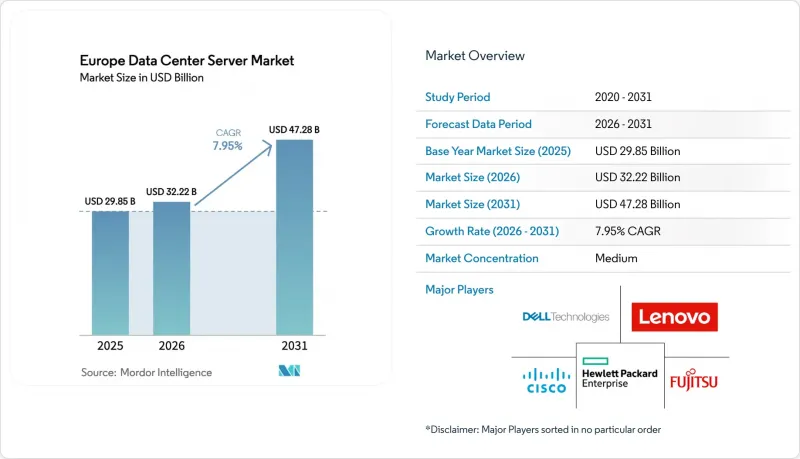
본 보고서는 데이터센터 티어(Tier 1, Tier 2, 기타), 폼 팩터(하프 하이트 블레이드, 풀 하이트 블레이드, 기타),용도(가상화 및 프라이빗 클라우드, 고성능 컴퓨팅, 기타), 데이터센터 유형(하이퍼스케일러 제공업체, 기타), 최종 사용자 산업(은행, 금융서비스 및 보험(BFSI), 기타), 국가별로 분류되어 있습니다. 상기 모든 부문에 대해 시장 규모 및 전망은 금액(미 달러)으로 제시되어 있습니다.
유럽 데이터센터 서버 시장 동향 및 인사이트
클라우드 컴퓨팅 및 X-as-a-Service 도입
각 하이퍼스케일러 기업들은 지역별 가용성 구역을 구축하고 있으며, 이로 인해 랙 스케일 서버에 대한 지속적인 수요가 견인되고 있습니다. 마이크로소프트는 프랑스 북부에 3개의 새로운 데이터센터 건설을 확인한 반면, AWS는 거주 요건을 충족하기 위해 독립적인 유럽용 소버린 클라우드 사업체를 설립했습니다(aws.amazon.com). 네덜란드 사업자에 따르면, 이러한 활동으로 인해 데이터센터는 현재 국내 총생산(GDP)의 7.6%를 차지하는 것으로 추정됩니다. 유니퍼(Uniper)가 1만 명의 직원을 Azure로 이전하여 IT 사고를 50% 줄인 것과 같은 기업 사례는 구체적인 운영상의 이점을 보여줍니다.
5G 구축과 엣지 노드
통신 사업자들은 EU의 엣지 옵저버토리 프로그램(Edge Observatory Programme)에 따라 20밀리초 미만의 지연 시간 목표를 달성하기 위해 기지국 사이트에 마이크로 데이터센터를 구축하고 있습니다. 칼팩(Calpack)사의 그리스 태양열 발전소에 구축된 에릭슨(Ericsson)사의 프라이빗 5G 네트워크는 제조 분야의 활용 사례를 보여주고 있으며, 한편 독일의 엣지 클라우드는 250대 이상의 네트워크 연결 기계를 갖춘 리탈(Rittal)사의 인더스트리 4.0 공장을 지원하고 있습니다.
신규 시설에 대한 자본 지출(CapEx)의 급증
2025년에는 Tier 1 허브의 50에이커 토지 가격이 23% 상승했으며, 전력 할당 대기 시간은 36개월을 초과하고 있습니다. Vantage Data Centers는 독일 내 4개 건설 프로젝트의 자금 조달을 위해 7억 2,000만 유로(8억 2,916만 달러) 규모의 증권화를 활용하여 독창적인 자금 조달 방식을 선보였습니다. 인력 부족도 예산을 끌어올리고 있어, 개발사들은 비용이 여전히 15-20% 저렴한 폴란드와 스페인으로 발판을 옮기고 있습니다.
부문 분석
2025년, 유럽 데이터센터 서버 시장 점유율의 71.62%를 Tier 3 시설이 차지하고 있으며, 이는 비용과 내결함성 간의 균형이 뛰어나다는 것을 보여줍니다. 금융 기관들은 최근 발생한 시스템 중단을 계기로 업그레이드를 가속화하며, 트랜잭션이 중요한 워크로드에 Tier 3를 채택했습니다. DZ BANK는 상시 가동되는 스토리지를 확보하기 위해 Hitachi Vantara EverFlex를 도입함으로써 이러한 추세를 더욱 강화하고 있습니다. AI 및 주권 클라우드 사업자들이 내결함성을 갖춘 가동 시간을 요구하는 가운데, 유럽 데이터센터 서버 시장에서 티어 4 시장 규모는 연평균 9.98%로 확대될 것으로 예측됩니다. 세르비아의 ‘Eviden’ 계약과 같은 정부 주도 슈퍼컴퓨터 프로젝트는 Tier 4의 매력이 높아지고 있음을 뒷받침합니다.
엣지 배포로 인해 중복성보다 근접성이 중시되는 개발 환경에서는 Tier 1/2 제품군의 제한적인 사용이 유지되고 있습니다. 그러나 사고 보고에 관한 EU 지침이 엄격해짐에 따라, 주변 사이트라 하더라도 점차 Tier 3 인증으로 전환될 가능성이 있으며, 이는 유럽 데이터센터 서버 시장 전체의 사양 요건 구조적 향상을 뒷받침하고 있습니다.
2025년에도 하프 하이트 블레이드는 매출의 63.85%를 차지하며, 기존의 가상화 환경을 계속 뒷받침하고 있습니다. Intel Xeon 6을 기반으로 한 Lenovo의 ThinkSystem V4 시리즈는 이 메인스트림 부문을 혁신하고 있습니다. 유럽 데이터센터 서버 시장에서 쿼터 하이트 블레이드 시장 규모는 사업자들이 소매점이나 휴대전화 기지국 내에 마이크로 엣지 노드를 도입함에 따라 연평균 성장률(CAGR) 8.35%로 가장 빠르게 확대되고 있습니다.
풀 하이트 블레이드는 여전히 GPU 클러스터에 필수적입니다. 시스코의 UCS C845A는 4RU 공간에 8개의 NVIDIA GPU를 탑재하여 엄격한 랙 전력 예산을 충족합니다. NVIDIA MGX와 같은 모듈형 레퍼런스 아키텍처를 통해 사업자는 레일을 교체하지 않고도 새로운 가속기 카드를 삽입할 수 있어 자산 수명을 연장하고 총 소유 비용(TCO)을 절감할 수 있습니다.
기타 혜택:
- 엑셀 형식 시장 예측(ME) 시트
- 3개월간의 애널리스트 지원
자주 묻는 질문
목차
제1장 서론
제2장 조사 방법
제3장 개요
제4장 시장 구도
제5장 시장 규모와 성장 예측
제6장 경쟁 구도
제7장 시장 기회와 향후 전망
JHS 26.09.03According to Mordor Intelligence, the Europe data center server market size is expected to grow from USD 29.85 billion in 2025 to USD 32.22 billion in 2026 and is forecast to reach USD 47.28 billion by 2031 at 7.95% CAGR over 2026-2031.
This report is Segmented by Data Center Tier(Tier 1 and 2, and More), Form Factor(Half-Height Blades, Full-Height Blades and More), Application(virtualisation and Private Cloud, High-Performance Computing and More), Data Center Type(Hyperscalers Provider and More), End User Industry(BFSI and More)and by Country. The Market Sizes and Forecasts are Provided in Terms of Value (USD) for all the Above Segments.
Europe Data Center Server Market Trends and Insights
Cloud computing & X-as-a-Service adoption
Hyperscalers are building region-specific availability zones, driving sustained demand for rack-scale servers. Microsoft confirmed three new data centers in Northern France, while AWS formed a standalone European Sovereign Cloud entity to satisfy residency rules aws.amazon.com. Dutch operators estimate that data centers now add 7.6% to the national GDP due to such activity. Enterprise case studies, such as Uniper's migration of 10,000 employees to Azure, resulting in 50% fewer IT incidents, illustrate tangible operational gains.
5G rollout & edge nodes
Operators deploy micro-data-centers at base-station sites to meet sub-20 ms latency targets under the EU Edge Observatory program. Ericsson's private 5G network at Calpak's Greek solar-heater plant shows manufacturing use cases, while German Edge Cloud powers Rittal's Industry 4.0 factory with 250+ networked machines.
Escalating CapEx for new facilities
Land costs for 50-acre plots in tier-1 hubs climbed 23% in 2025, while power-allocation queues exceed 36 months.Vantage Data Centers tapped a EUR 720 million (USD 829.16 million) securitization to fund four German builds, showcasing creative financing. Labor scarcity also inflates budgets, prompting developers to pivot toward Poland and Spain where costs remain 15-20% lower.
Other drivers and restraints analyzed in the detailed report include:
- Hyperscale refresh toward GPU/AI servers
- EU Green Deal incentives for liquid cooling
- Supply-chain squeeze on advanced GPUs/CPUs
For complete list of drivers and restraints, kindly check the Table Of Contents.
Segment Analysis
Tier 3 facilities accounted for 71.62% of Europe data center server market share in 2025, a testament to their cost-to-resilience balance. Financial institutions accelerated upgrades after recent outages, adopting Tier 3 for transaction-critical workloads. DZ BANK deployed Hitachi Vantara EverFlex to secure always-on storage, reinforcing this preference. The Europe data center server market size for Tier 4 is projected to expand 9.98% annually as AI and sovereign-cloud operators demand fault-tolerant uptime. Government supercomputer projects, such as Serbia's Eviden contract, validate the rising appeal of Tier 4.
Edge rollouts sustain limited use of Tier 1/2 suites for development environments where proximity matters more than redundancy. However, stricter EU directives on incident reporting could gradually shift even peripheral sites toward Tier 3 certification, underpinning a structural uplift in specification requirements across the Europe data center server market.
Half-height blades retained 63.85% revenue in 2025, anchoring legacy virtualization estates. Lenovo's ThinkSystem V4 line, built on Intel Xeon 6, refreshes this mainstream segment. Europe data center server market size for quarter-height blades is rising fastest at 8.35% CAGR as operators outfit micro-edge nodes inside retail outlets and cell towers.
Full-height blades remain vital for GPU clusters; Cisco's UCS C845A packs eight NVIDIA GPUs within 4 RU, meeting tight rack-power budgets. Modular reference architectures such as NVIDIA MGX allow operators to drop new accelerator cards without replacing rails, extending asset life and lowering TCO.
Complete Report Scope:
- By Data-Center Tier
- Tier 1 and 2
- Tier 3
- Tier 4
- By Form Factor
- Half-height Blades
- Full-height Blades
- Quarter-height / Micro-blades
- By Application / Workload
- Virtualisation and Private Cloud
- High-Performance Computing (HPC)
- Artificial Intelligence/Machine Learning and Data Analytics
- Storage-centric
- Edge / IoT Gateways
- By Data Center Type
- Hyperscalers/Cloud Service Provider
- Colocation Facilities
- Enterprise and Edge
- By End-use Industry
- BFSI
- IT and Telecom
- Healthcare and Life-Sciences
- Manufacturing and Industry 4.0
- Energy and Utilities
- Government and Defence
- By Geography
- Austria
- Belgium
- Denmark
- France
- Germany
- Ireland
- Italy
- Netherlands
- Norway
- Rest of Europe
List of Companies Covered in this Report:
- Dell Technologies
- Hewlett Packard Enterprise
- Lenovo Group
- Cisco Systems
- Fujitsu
- Huawei Technologies
- Inspur Group
- International Business Machines (IBM)
- Quanta Computer
- Super Micro Computer
- Atos SE
- Advanced Micro Devices (AMD)
- Intel Corporation
- Nvidia Corp.
- Foxconn / Hon Hai (including QCT)
- Gigabyte Technology
- MiTAC / TYAN
- ASRock Rack
- Inventec
- Kingston Technology
Additional Benefits:
- The market estimate (ME) sheet in Excel format
- 3 months of analyst support
TABLE OF CONTENTS
1 INTRODUCTION
- 1.1 Study Assumptions and Market Definition
- 1.2 Scope of the Study
2 RESEARCH METHODOLOGY
3 EXECUTIVE SUMMARY
4 MARKET LANDSCAPE
- 4.1 Market Overview
- 4.2 Market Drivers
- 4.2.1 Adoption of cloud computing and X-as-a-Service
- 4.2.2 Rapid commercial roll-out of 5G and edge nodes
- 4.2.3 Hyperscale refresh cycle toward GPU/AI servers
- 4.2.4 EU Green Deal incentives for liquid-cooled racks
- 4.2.5 Sovereign AI / EU Data Act pushing in-region compute
- 4.2.6 Rise of modular, prefabricated micro-data-centers
- 4.3 Market Restraints
- 4.3.1 Escalating CapEx for new facilities
- 4.3.2 Volatile electricity and carbon prices
- 4.3.3 Supply-chain squeeze on advanced GPUs/CPUs
- 4.3.4 Stricter waste-heat reuse and PUE regulations
- 4.4 Supply-Chain Analysis
- 4.5 Regulatory Landscape (GDPR, EU Data Act, Eco-design)
- 4.6 Technological Outlook (AI accelerators, CXL, liquid cooling)
- 4.7 Porter's Five Forces Analysis
- 4.7.1 Bargaining Power of Buyers
- 4.7.2 Bargaining Power of Suppliers
- 4.7.3 Threat of New Entrants
- 4.7.4 Threat of Substitutes
- 4.7.5 Competitive Rivalry
- 4.8 Assessment of Macroeconomic Factors on the Market
5 MARKET SIZE and GROWTH FORECASTS (VALUE)
- 5.1 By Data-Center Tier
- 5.1.1 Tier 1 and 2
- 5.1.2 Tier 3
- 5.1.3 Tier 4
- 5.2 By Form Factor
- 5.2.1 Half-height Blades
- 5.2.2 Full-height Blades
- 5.2.3 Quarter-height / Micro-blades
- 5.3 By Application / Workload
- 5.3.1 Virtualisation and Private Cloud
- 5.3.2 High-Performance Computing (HPC)
- 5.3.3 Artificial Intelligence/Machine Learning and Data Analytics
- 5.3.4 Storage-centric
- 5.3.5 Edge / IoT Gateways
- 5.4 By Data Center Type
- 5.4.1 Hyperscalers/Cloud Service Provider
- 5.4.2 Colocation Facilities
- 5.4.3 Enterprise and Edge
- 5.5 By End-use Industry
- 5.5.1 BFSI
- 5.5.2 IT and Telecom
- 5.5.3 Healthcare and Life-Sciences
- 5.5.4 Manufacturing and Industry 4.0
- 5.5.5 Energy and Utilities
- 5.5.6 Government and Defence
- 5.6 By Geography
- 5.6.1 Austria
- 5.6.2 Belgium
- 5.6.3 Denmark
- 5.6.4 France
- 5.6.5 Germany
- 5.6.6 Ireland
- 5.6.7 Italy
- 5.6.8 Netherlands
- 5.6.9 Norway
- 5.6.10 Rest of Europe
6 COMPETITIVE LANDSCAPE
- 6.1 Market Concentration
- 6.2 Strategic Moves (MandA, JVs, Funding)
- 6.3 Market Share Analysis
- 6.4 Company Profiles (includes Global level Overview, Market level overview, Core Segments, Financials as available, Strategic Information, Market Rank/Share for key companies, Products and Services, and Recent Developments)
- 6.4.1 Dell Technologies
- 6.4.2 Hewlett Packard Enterprise
- 6.4.3 Lenovo Group
- 6.4.4 Cisco Systems
- 6.4.5 Fujitsu
- 6.4.6 Huawei Technologies
- 6.4.7 Inspur Group
- 6.4.8 International Business Machines (IBM)
- 6.4.9 Quanta Computer
- 6.4.10 Super Micro Computer
- 6.4.11 Atos SE
- 6.4.12 Advanced Micro Devices (AMD)
- 6.4.13 Intel Corporation
- 6.4.14 Nvidia Corp.
- 6.4.15 Foxconn / Hon Hai (including QCT)
- 6.4.16 Gigabyte Technology
- 6.4.17 MiTAC / TYAN
- 6.4.18 ASRock Rack
- 6.4.19 Inventec
- 6.4.20 Kingston Technology
7 MARKET OPPORTUNITIES and FUTURE OUTLOOK
- 7.1 White-space and Unmet-need Assessment


