
|
시장보고서
상품코드
2119786
이탈리아의 위치 기반 서비스 : 시장 점유율 분석, 업계 동향 및 통계, 성장 예측(2026-2031년)Italy Location-Based Services - Market Share Analysis, Industry Trends & Statistics, Growth Forecasts (2026 - 2031) |
||||||
 Mordor Intelligence
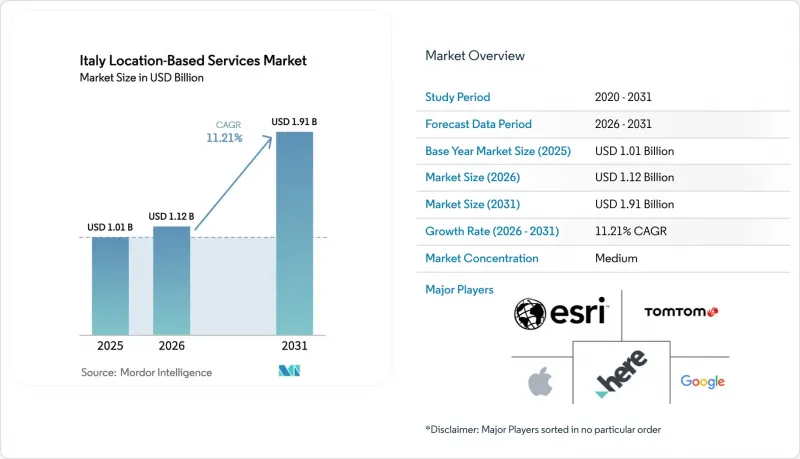
Mordor Intelligence에 의하면, 2026년 이탈리아의 위치 기반 서비스 시장 규모는 11억 2,000만 달러로 추정되고 2025년 10억 1,000만 달러에서 성장하여 2031년에는 19억 1,000만 달러에 이를 것으로 예측됩니다.
2026-2031년 동안 연평균 성장률(CAGR)은 11.21%를 나타낼 것으로 전망됩니다.
본 보고서는 구성 요소(하드웨어, 소프트웨어, 서비스), 기술(GPS/GNSS, Wi-Fi, 기타), 위치 유형(실내, 실외), 배포 모드(On-Premise, 클라우드,엣지·포그), 용도(매핑·내비게이션, 비즈니스 인텔리전스·분석, 위치 기반 광고, 기타), 최종 사용자 산업(운송 및 물류, IT 및 통신, 기타), 지역별로 분류되어 있습니다.
이탈리아의 위치 기반 서비스 시장 동향 및 인사이트
5G 및 NB-IoT의 도입으로 서브미터급 정확도 향상
이탈리아의 통신 사업자들은 도시 전역에 고밀도 스몰 셀 네트워크와 NB-IoT 오버레이를 구축하여, 현장 점검에서 서브미터급 정확도를 실현하는 고정밀 위치 기반 서비스를 제공합니다. TIM은 5,000개 지자체를 NB-IoT로 커버하고 있는 반면, WindTre의 5G 네트워크는 고해상도 위치 정보 처리를 지원하는 1.6Gbps의 피크 속도를 제공합니다. 9,770만 유로 규모의 ‘#Roma5G’ 프로젝트만 보더라도, 수도 전역에 2,200기의 스몰셀과 1,800개의 IoT 센서가 설치되어 있어, 민관 컨소시엄이 어떻게 커버리지 확대를 가속화하고 있는지를 보여주고 있습니다. 토리노 공과대학의 조사에 따르면, 초광대역 시스템이 5G 엣지 노드와 연동함으로써 3.2cm의 정확도가 확인되었으며, 이를 통해 독립형 비콘의 필요성이 줄어듭니다. EOLO의 mm파 독립형 네트워크는 확정적인 위치 측정이 필요한 산업용 이용 사례에서 지연 시간을 더욱 단축합니다.
EU의 디지털 마켓플레이스 법이 앱 수준의 LBS 상호운용성을 촉진
이 법은 개방형 API와 데이터 마이그레이션성을 의무화하여, 오랫동안 이탈리아 지방 자치 단체를 저해해 온 벤더 종속성을 해소하고 있습니다. TIM Urban Genius와 같은 플랫폼은 현재 셀룰러 텔레메트리, IoT 피드, 타사 앱을 통합하여 일관된 스마트 시티 기반을 구축하고 있습니다. 실내 위치 추적 전문 기업인 Nextome는 이 새로운 규제를 활용하여 자사의 SDK를 외부 분석 엔진과 원활하게 연동함으로써, 대상 시장을 병원이나 공장 이외의 분야로 확대되고 있습니다. 230만 유로의 자금을 지원받은 볼차노의 MaaS(Mobility-as-a-Service) 시범 사업은 표준화된 인터페이스를 통해 모빌리티 사업자가 버스, 자전거, 주차장을 단일 위치 기반 서비스로 통합할 수 있음을 보여주고 있습니다. 그 결과, 플랫폼 간의 상호 운용성이 높아지면서 경쟁이 심화되고 기업의 전환 비용이 낮아지는 동시에, 공급업체들은 독자적인 데이터 사일로가 아닌 차별화된 분석 기능 제공으로 방향을 전환하고 있습니다.
GDPR(EU 개인정보보호규정)에 따른 위치 정보 추적에 대한 개인정보 보호 제재
이탈리아 규제 당국은 위치 정보 취급에 미흡한 기업에 대해 막대한 벌금을 부과하고 있으며, 그 일례로 Foodinho가 배달원의 추적 방식에 투명성이 부족하다는 이유로 260만 유로의 벌금을 부과받은 사례가 있습니다. 또한, 대서양 횡단 데이터 전송을 둘러싸고 당국이 Google Analytics 사용을 금지한 것은 전 세계 공급업체들의 규정 준수 우려를 더욱 가중시키고 있습니다. 게다가 현지 법률에서는 모든 위치 정보 추적에 대해 명시적이고 철회 가능한 동의를 의무화하고 있어, 앱 개발자의 관리 부담이 증가하고 있습니다. 그로 인해 발생하는 비용 압박으로 인해 기업들은 해당 지역 내 데이터 거주를 보장할 수 있는 유럽 기반 공급업체로 전환하고 있지만, 일부 중소기업은 법적 명확성이 개선될 때까지 LBS 도입을 연기하기도 합니다.
부문 분석
하드웨어 투자는 현재 이탈리아의 위치 기반 서비스 시장의 기반을 이루고 있으며, 공장 및 교통 시스템 내에 구축된 고밀도 비콘 네트워크를 배경으로 2025년에는 매출의 46.20%를 차지했습니다. FCA 첸토 공장에 350개의 비콘을 도입함으로써 1분당 500달러의 가동 중단 비용을 절감할 수 있었으며, 이는 하드웨어 주도 프로젝트가 여전히 명확한 투자 회수 효과를 가져오고 있음을 보여줍니다. 로마 지하철에서는 경비원의 위치 추적 센서를 도입하여 긴급 대응 시간을 절반으로 단축했습니다. 이는 공공 인프라에서 안전성을 중시한 도입의 중요성을 여실히 보여줍니다. 그럼에도 불구하고, AI 분석을 통해 의사 결정 로직이 엣지 측으로 이동함으로써 인사이트력의 깊이를 해치지 않으면서 지연 시간과 대역폭 비용을 절감할 수 있기 때문에 소프트웨어 플랫폼은 연평균 성장률(CAGR) 13.77%라는 빠른 속도로 성장하고 있습니다.
SECO의 엣지 네이티브 스택은 저전력 모듈과 클라우드 오케스트레이션 계층을 결합하여 동일한 콘솔 내에서 실시간 삼각 측량 및 이력 패턴 분석을 가능하게 합니다. 서비스 부문은 시장 점유율이 가장 낮지만, RF 조사, GDPR(EU 개인정보보호규정) 감사, 용도 설정을 융합한 복잡한 프로젝트를 뒷받침하고 있습니다. 이에 따라 각 벤더들은 자원이 제한된 중소기업을 위해 도입 위험을 완화할 수 있는 매니지드 서비스를 패키지로 제공합니다. 전반적으로 하드웨어 기반은 에너지 수확 태그와 멀티밴드 안테나로 전환되고 있으며, 이탈리아의 위치 기반 서비스 시장에서 소프트웨어의 고도화가 더욱 진행됨에 따라 확장 가능한 기존 시스템에 대한 사후 도입의 기반을 마련하고 있습니다.
GPS/GNSS는 여전히 야외 내비게이션의 주력 기술이며, 2025년에는 라이드셰어, 자동차 텔레매틱스, 소비자용 앱 전체에서 39.65%의 시장 점유율을 확보할 전망입니다. 그러나 이탈리아의 위치 기반 서비스 시장에서 셀룰러 위치 측량 관련 시장 규모는 독립형 5G 및 NB-IoT에 대한 통신 사업자들의 노력에 힘입어 연평균 성장률(CAGR) 14.04%라는 가장 빠른 속도로 성장하고 있습니다. TIM의 전국 규모의 NB-IoT 네트워크는 스마트 미터 태그의 배터리 수명을 10년으로 연장하는 한편, LTE-M 솔루션은 자산 모니터링에서 중간 수준의 대역폭이 필요한 이용 사례를 지원합니다. 창고 내에서는 UWB와 BLE의 병용이 진행되고 있으며, 실제 가동 중인 산업 환경에서의 평균 오차는 3.2cm인 것으로 조사에서 확인되었습니다.
RF 채널을 동적으로 선택하는 하이브리드 엔진이 현재 파일럿 프로젝트를 통해 도입되기 시작했습니다. Siena의 병원용 공간 인텔리전스 제품군은 자기 지문, Wi-Fi 스니퍼, BLE 앵커를 융합하여 임상적 정확도 기준을 충족합니다. 이러한 멀티모달 아키텍처는 자산별로 정확도, 전력 소비, 비용 간의 상충 관계를 어떻게 균형 있게 조정할 수 있는지를 보여줍니다. 그 결과, 각 벤더들은 향후 예정된 주파수 대역 할당에 장기간 대응할 수 있도록 태그 내에 소프트웨어 정의 무선(SDR)을 통합하고 있으며, 이러한 추세는 이탈리아의 위치 기반 서비스 시장에서 기술 교체를 지속시킬 것으로 보입니다.
기타 혜택
- 엑셀 형식 시장 예측(ME) 시트
- 3개월간의 애널리스트 지원
자주 묻는 질문
목차
제1장 서론
제2장 조사 방법
제3장 주요 요약
제4장 시장 구도
제5장 시장 규모 및 성장 예측
제6장 경쟁 구도
제7장 시장 기회 및 향후 동향
KTH 26.09.10According to Mordor Intelligence, the Italy location-Based services market size in 2026 is estimated at USD 1.12 billion, growing from 2025 value of USD 1.01 billion with 2031 projections showing USD 1.91 billion, growing at 11.21% CAGR over 2026-2031.
This report is Segmented by Component (Hardware, Software, and Services), Technology (GPS/GNSS, Wi-Fi, and More), Location Type (Indoor and Outdoor), Deployment Mode (On-Premise, Cloud, and Edge/Fog), Application (Mapping and Navigation, Business Intelligence and Analytics, Location-Based Advertising, and More), End-User Vertical (Transportation and Logistics, IT and Telecom, and More), and Region.
Italy Location-Based Services Market Trends and Insights
5G and NB-IoT Rollout Boosts Sub-Meter Accuracy
Italian operators blanket cities with dense small-cell grids and NB-IoT overlays, enabling precision location services that now reach sub-meter performance in live trials. TIM covers 5,000 municipalities with NB-IoT, while WindTre's 5G network delivers 1.6 Gbps peak speeds that support high-definition positioning flows. The EUR 97.7 million #Roma5G project alone installed 2,200 small cells and 1,800 IoT sensors across the capital, illustrating how public-private consortiums accelerate coverage. Research at Politecnico di Torino confirms 3.2 cm accuracy when ultra-wideband systems interwork with 5G edge nodes, reducing the need for stand-alone beacons. EOLO's mmWave stand-alone network further trims latency for industrial use cases that demand deterministic positioning.
EU Digital Markets Act Catalyzes App-Level LBS Interoperability
The Act enforces open APIs and data portability, dismantling vendor lock-in that long hampered Italian municipalities. Platforms such as TIM Urban Genius now merge cellular telemetry, IoT feeds, and third-party apps into a cohesive smart-city canvas. Indoor-positioning specialist Nextome leverages the new rules to link its SDK seamlessly with external analytics engines, broadening addressable markets beyond hospitals and factories. Bolzano's MaaS pilot, funded with EUR 2.3 million, shows how standardised interfaces let mobility operators stitch together buses, bikes, and parking into a single location-aware service. In turn, rising platform interoperability intensifies competition, lowering switching costs for enterprises and pushing suppliers toward differentiated analytics rather than proprietary data silos.
GDPR-Driven Privacy Sanctions on Geo-Tracking
Italy's regulator imposes hefty fines on companies mishandling location data, exemplified by a EUR 2.6 million penalty levied on Foodinho for non-transparent rider tracking. The authority's ban on Google Analytics over trans-Atlantic transfers magnifies compliance anxiety for global providers. Local law further compels explicit, revocable consent for all geo-tracking, elevating administrative overhead for app developers. Resulting cost pressure nudges enterprises toward Europe-based vendors able to guarantee regional data residency, though smaller firms sometimes delay LBS roll-outs until legal clarity improves.
Other drivers and restraints analyzed in the detailed report include:
- National PNRR Funds for Smart Mobility and ITS Projects
- Retailers' Surge in Location-Based Advertising Spend
- Fragmented Indoor-Positioning Technology Standards
For complete list of drivers and restraints, kindly check the Table Of Contents.
Segment Analysis
Hardware investments anchor today's Italy location-based services market, accounting for 46.20% revenue in 2025 on the back of dense beacon networks within factories and transit systems. The FCA Cento plant's 350-beacon roll-out trimmed downtime costs by USD 500 per minute, illustrating the clear payback that hardware-led projects still deliver. Rome's metro deployed guard-tracking sensors that halve emergency response time, underscoring safety-driven adoption in public infrastructure. Nevertheless, software platforms are growing faster at 13.77% CAGR as AI analytics migrate decision logic to the edge, lowering latency and bandwidth outlays without sacrificing insight depth.
Edge-native stacks from SECO couple low-power modules with a cloud orchestration layer, allowing real-time triangulation and historical pattern mining inside the same console. Services, while the smallest slice, underpin complex projects that blend RF surveys, GDPR audits, and application configuration. Vendors, therefore, bundle managed services to de-risk deployments for resource-constrained SMEs. Collectively, the hardware base is shifting toward energy-harvesting tags and multi-band antennas, laying the foundation for scalable retrofits once software sophistication matures further within the Italy location-based services market.
GPS/GNSS remains the workhorse of outdoor navigation, securing 39.65% market share in 2025 across ride-hailing, automotive telematics, and consumer apps. Yet the Italy location-based services market size attached to cellular positioning grows quickest at 14.04% CAGR, catalysed by operator commitments to stand-alone 5G and NB-IoT. TIM's nationwide NB-IoT layer facilitates decade-long battery life for smart-meter tags, whereas LTE-M options satisfy mid-tier bandwidth use cases in asset monitoring. UWB and BLE overlap grows within warehouses, with research confirming a 3.2 cm mean error in live industrial environments.
Hybrid engines that dynamically select RF paths now surface in pilot projects. Siena's hospital spatial-intelligence suite fused magnetic fingerprinting with Wi-Fi sniffers and BLE anchors to meet clinical precision thresholds. Such multi-modal architectures exemplify how accuracy, power, and cost trade-offs can be balanced per asset. Consequently, vendors embed software-defined radios inside tags to future-proof against emerging spectrum allocations, a trend likely to sustain technology churn within the Italy location-based services market.
Complete Report Scope:
- By Component
- Hardware
- Software
- Services
- By Technology
- GPS/GNSS
- Wi-Fi
- Bluetooth LE and UWB
- Cellular (5G, LTE, NB-IoT)
- Hybrid and Others
- By Location Type
- Indoor
- Outdoor
- By Deployment Mode
- On-premise
- Cloud
- Edge/Fog
- By Application
- Mapping and Navigation
- Business Intelligence and Analytics
- Location-based Advertising
- Social Networking and Entertainment
- Emergency and Public Safety
- Asset Tracking and Fleet Management
- Other Applications
- By End-user Vertical
- Transportation and Logistics
- IT and Telecom
- Healthcare and Life Sciences
- Government and Public Sector
- BFSI
- Hospitality and Tourism
- Manufacturing and Industrial
- Retail and E-commerce
- Other End-user Verticals
- By Region
- Northern Italy
- Central Italy
- Southern Italy and Islands
List of Companies Covered in this Report:
- Google LLC
- Apple Inc.
- HERE Technologies
- TomTom N.V.
- Esri Inc.
- Cisco Systems Inc. (Meraki)
- Ericsson AB
- Nokia Corp. (ALE-Alcatel Lucent Enterprise)
- Huawei Technologies Co. Ltd.
- Samsung Electronics Co. Ltd.
- Qualcomm Technologies Inc.
- Aruba Networks (HPE)
- IBM Corp.
- Juniper Networks Inc.
- Zebra Technologies Corp.
- Mapbox Inc.
- Foursquare Labs Inc.
- Hexagon AB (Hexagon Geospatial)
- Garmin Ltd.
- Vodafone Group Plc
- Telecom Italia (TIM S.p.A.)
- WindTre S.p.A.
- Fastweb S.p.A.
- Iliad Italia S.p.A.
- Telespazio S.p.A.
- SITAONAIR (SITA)
- Telefonica S.A.
Additional Benefits:
- The market estimate (ME) sheet in Excel format
- 3 months of analyst support
TABLE OF CONTENTS
1 INTRODUCTION
- 1.1 Study Assumptions and Market Definition
- 1.2 Scope of the Study
2 RESEARCH METHODOLOGY
3 EXECUTIVE SUMMARY
4 MARKET LANDSCAPE
- 4.1 Market Overview
- 4.2 Market Drivers
- 4.2.1 5G and NB-IoT rollout boosts sub-meter accuracy
- 4.2.2 EU Digital Markets Act catalyzes app-level LBS interoperability
- 4.2.3 National PNRR funds for smart mobility and ITS projects
- 4.2.4 Retailers' surge in location-based advertising spend
- 4.2.5 Industry 4.0 demand for indoor positioning in factories and hospitals
- 4.2.6 Open-data ecosystems (OpenStreetMap, EU Data Spaces) lower entry barriers
- 4.3 Market Restraints
- 4.3.1 GDPR-driven privacy sanctions on geo-tracking
- 4.3.2 Fragmented indoor-positioning technology standards
- 4.3.3 High capex of UWB/BLE beacon roll-outs for SMEs
- 4.3.4 Multipath signal distortion in dense historical city cores
- 4.4 Industry Value Chain Analysis
- 4.5 Regulatory Landscape (GDPR, ePrivacy, AGCOM)
- 4.6 Technological Outlook (UWB, 5G-SA, edge computing)
- 4.7 Industry Attractiveness - Porter's Five Forces Analysis
- 4.7.1 Bargaining Power of Buyers
- 4.7.2 Bargaining Power of Suppliers
- 4.7.3 Threat of New Entrants
- 4.7.4 Threat of Substitutes
- 4.7.5 Intensity of Competitive Rivalry
- 4.8 Impact of Macroeconomic Factors on the Market
5 MARKET SIZE AND GROWTH FORECASTS (VALUES)
- 5.1 By Component
- 5.1.1 Hardware
- 5.1.2 Software
- 5.1.3 Services
- 5.2 By Technology
- 5.2.1 GPS/GNSS
- 5.2.2 Wi-Fi
- 5.2.3 Bluetooth LE and UWB
- 5.2.4 Cellular (5G, LTE, NB-IoT)
- 5.2.5 Hybrid and Others
- 5.3 By Location Type
- 5.3.1 Indoor
- 5.3.2 Outdoor
- 5.4 By Deployment Mode
- 5.4.1 On-premise
- 5.4.2 Cloud
- 5.4.3 Edge/Fog
- 5.5 By Application
- 5.5.1 Mapping and Navigation
- 5.5.2 Business Intelligence and Analytics
- 5.5.3 Location-based Advertising
- 5.5.4 Social Networking and Entertainment
- 5.5.5 Emergency and Public Safety
- 5.5.6 Asset Tracking and Fleet Management
- 5.5.7 Other Applications
- 5.6 By End-user Vertical
- 5.6.1 Transportation and Logistics
- 5.6.2 IT and Telecom
- 5.6.3 Healthcare and Life Sciences
- 5.6.4 Government and Public Sector
- 5.6.5 BFSI
- 5.6.6 Hospitality and Tourism
- 5.6.7 Manufacturing and Industrial
- 5.6.8 Retail and E-commerce
- 5.6.9 Other End-user Verticals
- 5.7 By Region
- 5.7.1 Northern Italy
- 5.7.2 Central Italy
- 5.7.3 Southern Italy and Islands
6 COMPETITIVE LANDSCAPE
- 6.1 Market Concentration
- 6.2 Strategic Moves
- 6.3 Market Share Analysis
- 6.4 Company Profiles (includes Global level Overview, Market level overview, Core Segments, Financials as available, Strategic Information, Market Rank/Share for key companies, Products and Services, and Recent Developments)
- 6.4.1 Google LLC
- 6.4.2 Apple Inc.
- 6.4.3 HERE Technologies
- 6.4.4 TomTom N.V.
- 6.4.5 Esri Inc.
- 6.4.6 Cisco Systems Inc. (Meraki)
- 6.4.7 Ericsson AB
- 6.4.8 Nokia Corp. (ALE-Alcatel Lucent Enterprise)
- 6.4.9 Huawei Technologies Co. Ltd.
- 6.4.10 Samsung Electronics Co. Ltd.
- 6.4.11 Qualcomm Technologies Inc.
- 6.4.12 Aruba Networks (HPE)
- 6.4.13 IBM Corp.
- 6.4.14 Juniper Networks Inc.
- 6.4.15 Zebra Technologies Corp.
- 6.4.16 Mapbox Inc.
- 6.4.17 Foursquare Labs Inc.
- 6.4.18 Hexagon AB (Hexagon Geospatial)
- 6.4.19 Garmin Ltd.
- 6.4.20 Vodafone Group Plc
- 6.4.21 Telecom Italia (TIM S.p.A.)
- 6.4.22 WindTre S.p.A.
- 6.4.23 Fastweb S.p.A.
- 6.4.24 Iliad Italia S.p.A.
- 6.4.25 Telespazio S.p.A.
- 6.4.26 SITAONAIR (SITA)
- 6.4.27 Telefonica S.A.
7 MARKET OPPORTUNITIES AND FUTURE TRENDS
- 7.1 White-Space and Unmet-Need Assessment