
|
시장보고서
상품코드
2122629
위치 기반 서비스 시장 : 시장 점유율 분석, 업계 동향 및 통계, 성장 예측(2026-2031년)Location Based Services - Market Share Analysis, Industry Trends & Statistics, Growth Forecasts (2026 - 2031) |
||||||
 Mordor Intelligence
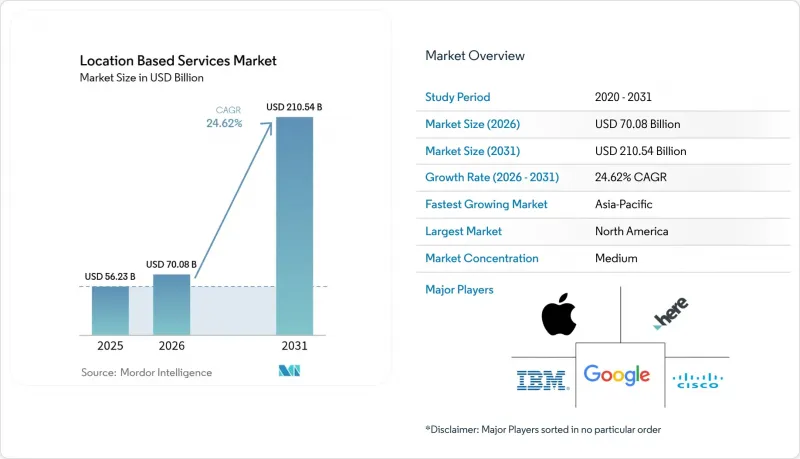
Mordor Intelligence에 의하면, 위치 기반 서비스 시장 규모는 2025년에 562억 3,000만 달러로 평가되었고, 2026년 700억 8,000만 달러에서 2031년까지 2,105억 4,000만 달러에 이를 것으로 예측되며, 예측 기간(2026-2031년) CAGR은 24.62%를 나타낼 전망입니다.
본 보고서는 구성 요소별(하드웨어, 소프트웨어, 서비스), 위치 유형별(실내, 실외), 핵심 기술별(GPS/A-GPS, Wi-Fi 및 WLAN을 이용한 삼각측량 등), 용도별(내비게이션 및 매핑 등), 최종 사용자 산업별(소매 및 FMCG, 운송 및 물류 등), 그리고 지역별로 분류되어 있습니다. 시장 전망은 금액(달러) 기준으로 제시되어 있습니다.
세계의 위치 기반 서비스 시장 동향 및 인사이트
하이퍼로컬 광고 예산의 급증
지오펜싱이 매장 방문객 수 증가에 효과적임이 입증됨에 따라, 마케터들은 2025년에는 예산의 20% 이상을 지역 캠페인에 할당했으며, 이는 2024년의 46%에서 증가한 수치입니다. 구글 맵은 이미 광고 게재를 통해 연간 111억 달러의 수익을 올리고 있습니다. 위치 기반 푸시 알림을 도입한 소매업체들은 매장 내 전환율이 급증하고 있다고 보고하고 있어, 수익 확대에 대한 주장이 뒷받침되고 있습니다. 위치 정보의 정확도 향상은 다이내믹 크리에이티브 최적화(DCO)도 지원하여, 브랜드가 마이크로 마켓에 맞추어 메시지를 최적화할 수 있게 합니다. 그 결과, 위치 기반 서비스 시장은 온라인 구매 의도와 오프라인 구매 경로를 연결하고자 하는 광고 기술 플랫폼, 퍼블리셔, 브랜드로부터 지속적인 수요를 얻고 있습니다.
OECD 시장의 e-911 및 AML 긴급 상황 위치 정보 정확도에 관한 규제
유럽 전자통신 규약(European Electronic Communications Code)에서는 모든 스마트폰에 AML 탑재가 의무화되어 있으며, 긴급 상황의 87%에서 발신자의 좌표를 50m 이내의 정확도로 제공합니다. 영국의 실적을 보면, 셀 ID에 비해 정확도가 4,000배 향상되고 대응 시간이 단축되어 10년 동안 7,500명의 생명을 구할 가능성이 있습니다. 30개국 이상이 AML을 채택하고 있는 반면, 미국에서는 E-911의 수직 방향 정확도에 관한 규제가 강화되고 있습니다. 따라서 통신 사업자들은 위치 정보 코어 시스템 및 핸드오프 API의 업그레이드를 서두르고 있으며, 이로 인해 하이브리드 GNSS, Wi-Fi, 센서 지원형 솔루션에 대한 투자가 촉진되고 있습니다. 사업자들이 네트워크 코어 및 최종 사용자용 앱에 첨단 위치 정보 미들웨어를 통합함에 따라, 규정 준수 관련 예산이 위치 기반 서비스 시장의 확장에 직접적으로 기여하고 있습니다.
위치 정보 개인정보 보호에 대한 소비자의 반발 고조
조사에 따르면, 사용자의 71%는 명시적인 동의를 얻은 경우에만 위치 정보를 공유한다고 답했습니다. GDPR(EU 개인정보보호규정)은 데이터 최소화를 의무화하고 있으며, CCPA는 옵트아웃 제도를 부과하고 있어 상시 추적의 적용 범위가 최대 30% 감소했습니다. 인도의 DPDP법은 추가적인 동의 절차를 도입하고 있어, 서비스 제공업체는 차등 프라이버시(differential privacy)나 연방 학습(federated learning) 모델에 투자할 수밖에 없게 되었고, 이로 인해 엔지니어링 비용이 증가하고 있습니다. 이러한 변화로 인해 데이터 수집 속도가 둔화되어, 위치 기반 서비스 시장의 특정 광고 수익원이 억제되고 있습니다.
부문 분석
기업들이 설계, 도입, 지원을 매니지드 서비스 전문 업체에 위탁한 결과, 2025년 매출의 47.02%를 서비스가 차지했습니다. 한편, 소프트웨어는 연평균 성장률(CAGR) 26.05%를 나타낼 것으로 예측되며, AI 분석이 원시 데이터를 비즈니스 조치로 전환하는 중요성이 부각되고 있습니다. 디지털 트윈 및 커맨드 센터를 통합하는 주요 3PL(제3자 물류) 기업의 사례는 턴키형 제품군이 프리미엄 구독을 유치하는 이유를 여실히 보여줍니다. 한편, 의료시설 내에서 UWB 앵커와 BLE 게이트웨이가 보급됨에 따라 하드웨어 시장도 견조한 성장세를 보이고 있습니다.
Mapbox의 MapGPT와 TomTom의 Azure 통합을 통해 자동차 제조업체가 차량용 장치를 업데이트하지 않고도 무선 업그레이드를 수행할 수 있게 됨에 따라, 위치 기반 서비스 시장의 소프트웨어 구독 규모는 꾸준히 확대되고 있습니다. 서비스 통합업체들은 하드웨어, 클라우드 대시보드, 분석 기능을 묶어 제공함으로써 고객의 총 소유 비용(TCO)을 절감하고 지속적인 수익 전망을 강화하고 있습니다.
GNSS 생태계의 성숙으로 인해 실외 위치 측정이 여전히 주류를 이루고 있지만, 실내 위치 측정의 도입은 급속히 확대되고 있습니다. 2025년 위치 기반 서비스 시장에서 실외 위치 파악의 점유율은 67.94%였으나, 실내 위치 파악은 2031년까지 연평균 성장률(CAGR) 27.45%를 기록할 전망이며, 향후 양자의 점유율이 근접할 것으로 예측됩니다. 병원, 쇼핑몰, 공항에서는 자산 검색 시간을 단축하고 방문객을 유도하기 위해 BLE 및 UWB 태그가 도입되고 있으며, 예측 기간 동안 실내 시장 점유율이 실외 시장을 서서히 따라잡을 것으로 전망됩니다.
하이브리드 솔루션은 GPS, 5G, Wi-Fi, 블루투스 간을 원활하게 전환하여 사용자 경험을 유지합니다. 표준화 컨소시엄은 정확도 벤치마크를 지속적으로 개선하고 있으며, 이로 인해 보정 비용이 절감되고 잠재 수요가 유발되어 위치 기반 서비스 시장 전체가 확대될 것으로 전망됩니다.
지역별 분석
북미는 AML 지원 스마트폰의 보급과 견고한 클라우드 인프라를 배경으로 2025년에는 36.35%라는 최대 점유율을 차지했습니다. HERE Technologies의 10억 달러 규모 AWS 제휴와 같은 고액 계약은 이 지역의 규모를 여실히 보여주고 있습니다. 연방 정부의 E-911 도입 기한에 따라 통신 사업자의 지속적인 투자가 확보되는 한편, 자동차 제조업체들은 레벨 3 자율 주행을 위한 차선 수준의 HD 지도 시범 운영을 진행하고 있습니다.
아시아태평양은 연평균 성장률(CAGR) 25.17%로 가장 빠르게 성장하고 있으며, 2030년까지 모바일 가입자 수는 21억 명에 달하고 GDP에 8,800억 달러를 기여할 것으로 전망됩니다. 중국, 한국, 일본에서의 독립형 5G(SA) 구축은 네트워크 기반 위치 정보 API의 발전을 촉진하고 있습니다. 또한 GAGAN 등의 SBAS 위성 시스템은 정밀 농업 분야에서 GNSS를 보완하는 역할을 하고 있습니다. 각국 정부는 혁신과 개인정보 보호의 균형을 맞추는 데이터 거버넌스 체계를 추진하고 있으며, 이는 국내 생태계 형성을 촉진하고 지역 전체의 위치 기반 서비스 시장 규모를 확대되고 있습니다.
유럽에서는 소비자의 신뢰를 키우는 엄격한 개인정보 보호 대책의 리더십을 통해 꾸준한 성장세를 유지하고 있습니다. 2022년부터 모든 스마트폰에 AML(익명화)이 의무화됨에 따라, 통신 사업자와 PSAP(긴급 신고 접수 센터)의 백엔드 업그레이드가 촉진되고 있습니다. 개인정보 보호를 중시하는 신흥 스타트업 기업들이 GDPR(EU 개인정보보호규정) 준수를 위해 차등 개인정보 보호 기술을 도입하며 서비스의 다양성을 높이고 있습니다. 남유럽 및 동유럽의 도시에서는 신뢰성 높은 드론 위치 측정이 필요한 U-Space 회랑의 시범 운영이 진행되고 있어 새로운 인접 영역이 추가되고 있습니다. 남미, 중동 및 아프리카는 여전히 발전 단계에 있지만, 미래성이 기대되고 있습니다. 브라질에서는 항공 분야에서 SBAS가 채택되고 있는 반면, 걸프 지역의 스마트 시티 프로그램에서는 대형 쇼핑몰에 BLE(Bluetooth Low Energy)를 활용한 모바일 커머스용 비콘이 도입되고 있습니다. 아프리카의 지역 항공 기관들은 ‘SatNav-Africa SBAS’를 통해 협력하고 있으며, 미래의 정밀 농업 및 운송 서비스를 위한 기반 인프라를 구축하고 있습니다. 이러한 노력들이 어우러지면서 위치 기반 서비스 시장의 지리적 범위가 확대되고 있습니다.
기타 혜택 :
- 엑셀 형식 시장 예측(ME) 시트
- 3개월간의 애널리스트 지원
자주 묻는 질문
목차
제1장 서론
제2장 조사 방법
제3장 주요 요약
제4장 시장 구도
제5장 시장 규모 및 성장 예측
제6장 경쟁 구도
제7장 시장 기회 및 향후 동향
AJY 26.09.09According to Mordor Intelligence, the location-based services market size was valued at USD 56.23 billion in 2025 and estimated to grow from USD 70.08 billion in 2026 to reach USD 210.54 billion by 2031, at a CAGR of 24.62% during the forecast period (2026-2031).
This report is Segmented by Component (Hardware, Software, Services), Location Type (Indoor, Outdoor), Core Technology (GPS/A-GPS, Wi-Fi and WLAN Triangulation, and More), Application (Navigation and Mapping, and More), End-User Industry (Retail and FMCG, Transportation and Logistics, and More), and Geography. The Market Forecasts are Provided in Terms of Value (USD).
Global Location Based Services Market Trends and Insights
Explosion of hyper-local advertising budgets
Marketers plan to allocate 20%-plus of budgets to local campaigns in 2025, up from 46% in 2024, as geofencing proves effective for foot-traffic uplift. Google Maps already monetizes USD 11.1 billion annually through ad placements. Retailers adopting location-triggered push notifications report sharp increases in in-store conversions, validating the revenue-expansion thesis. Greater location granularity also supports dynamic creative optimization, letting brands tailor messages to micro-markets. As a result, the location-based services market gains sustained demand from advertising technology platforms, publishers, and brands eager to link online intent with offline purchase paths.
Mandates for e-911 and AML emergency accuracy in OECD markets
The European Electronic Communications Code requires AML on all smartphones, delivering caller coordinates within 50 m for 87% of emergencies . The UK experience shows a 4,000-fold accuracy boost versus Cell-ID, cutting response times and potentially saving 7,500 lives over 10 years. More than 30 nations have adopted AML, while the US is tightening E-911 vertical-accuracy rules. Telcos must therefore upgrade positioning cores and hand-off APIs, fueling spending on hybrid GNSS, Wi-Fi, and sensor-assisted solutions. Compliance budgets directly expand the location-based services market as operators embed advanced location middleware within network cores and end-user apps.
Heightened consumer push-back on location privacy
Surveys show 71% of users will only share location after explicit consent. GDPR mandates data-minimization, while CCPA imposes opt-out mechanics, reducing always-on tracking coverage by up to 30%. India's DPDP Act introduces extra consent layers, compelling providers to invest in differential-privacy and federated-learning models that add engineering cost. These shifts slow data-collection velocity, tempering certain advertising revenue streams inside the location-based services market.
Other drivers and restraints analyzed in the detailed report include:
- Rise of Indoor Positioning via BLE, UWB and Sensor Fusion
- 5G Network Slicing Enabling Sub-meter Latency LBS
- Regulatory fragmentation (GDPR, CCPA, India DPDP Act)
For complete list of drivers and restraints, kindly check the Table Of Contents.
Segment Analysis
Services represented 47.02% of 2025 revenue as enterprises outsourced design, deployment, and support to managed-service experts. Software, however, is forecast to log a 26.05% CAGR, underscoring how AI analytics convert raw pings into business actions. Large 3PLs integrating digital-twin command centers illustrate why turnkey suites attract premium subscriptions. Meanwhile, hardware growth stays positive as UWB anchors and BLE gateways proliferate in healthcare campuses.
The location-based services market size for software subscriptions climbs steadily as Mapbox's MapGPT and TomTom's Azure integrations let automakers push over-the-air upgrades without refreshing on-board units. Service integrators bundle hardware, cloud dashboards, and analytics, ensuring lower total cost of ownership for clients and reinforcing recurring-revenue visibility.
Outdoor positioning still dominates owing to mature GNSS ecosystems, yet indoor deployments are scaling fast. The location-based services market share for outdoor stood at 67.94% in 2025; indoor positioning is tracking a 27.45% CAGR through 2031, suggesting convergence down the line. Hospitals, malls, and airports deploy BLE and UWB tags to cut asset-search cycles and guide visitors, inching the indoor slice toward parity with outdoor during the forecast horizon.
Hybrid solutions hand-off seamlessly between GPS, 5G, Wi-Fi, and Bluetooth, preserving user experience. Standardisation consortia continue refining accuracy benchmarks, which should trim calibration costs and unlock pent-up demand, expanding the overall location-based services market.
Complete Report Scope:
- By Component
- Hardware
- Software
- Services
- By Location Type
- Indoor
- Outdoor
- By Core Technology
- GPS / A-GPS
- Wi-Fi and WLAN Triangulation
- Bluetooth Low Energy (BLE)
- Ultra-Wideband (UWB)
- RFID and NFC
- By Application
- Navigation and Mapping
- Location-Based Advertising and Promotion
- Asset and Fleet Tracking
- Emergency Services and Public Safety
- Gaming and Augmented Reality
- Social Media and Engagement
- By End-user Industry
- Retail and FMCG
- Transportation and Logistics
- Healthcare and Life Sciences
- Telecom and IT Services
- Oil, Gas and Energy
- Government and Public Sector
- Manufacturing and Industrial
- By Geography
- North America
- United States
- Canada
- Mexico
- South America
- Brazil
- Argentina
- Rest of South America
- Europe
- Germany
- United Kingdom
- France
- Italy
- Spain
- Russia
- Rest of Europe
- Asia-Pacific
- China
- Japan
- India
- South Korea
- Australia and New Zealand
- Rest of Asia-Pacific
- Middle East and Africa
- Middle East
- Saudi Arabia
- United Arab Emirates
- Turkey
- Rest of Middle East
- Africa
- South Africa
- Nigeria
- Egypt
- Rest of Africa
- Middle East
- North America
Geography Analysis
North America generated the largest slice at 36.35% in 2025 on the back of AML-ready smartphone penetration and robust cloud infrastructure. High-value contracts such as HERE Technologies' USD 1 billion AWS alliance illustrate the region's scale. Federal E-911 deadlines ensure continuous operator investment, while automotive OEMs trial lane-level HD maps for Level-3 autonomy.
Asia-Pacific is the fastest-growing at 25.17% CAGR, with unique mobile subscribers on track to hit 2.1 billion by 2030 and contribute USD 880 billion to GDP . Standalone 5G rollouts in China, Korea, and Japan foster network-based positioning APIs; SBAS constellations such as GAGAN complement GNSS for precision farming. Governments champion data-governance frameworks that balance innovation with privacy, encouraging domestic ecosystem formation and enlarging the location-based services market size across the region.
Europe maintains steady momentum through stringent privacy leadership that nurtures consumer trust. AML has been mandatory on all smartphones since 2022, catalyzing backend upgrades among carriers and PSAPs. An emerging crop of privacy-focused startups employs differential-privacy to meet GDPR, enriching service diversity. Southern and Eastern European cities trial U-Space corridors requiring reliable drone positioning, adding a new adjacency.South America and Middle East and Africa remain nascent but promising. Brazil adopts SBAS for aviation, while Gulf smart-city programs deploy BLE m-commerce beacons in mega-malls. African regional aviation bodies collaborate on SatNav-Africa SBAS, sowing foundational infrastructure for future precision-agriculture and transport services. Collectively these initiatives broaden the geographic footprint of the location-based services market.
- Google LLC (Alphabet Inc.)
- Apple Inc.
- Cisco Systems, Inc.
- IBM Corporation
- HERE Global B.V. (Nokia Corporation)
- Microsoft Corporation
- Ericsson AB
- Alcatel-Lucent Enterprise International Limited (ALE International)
- Hewlett Packard Enterprise Company (Aruba Networks)
- Zebra Technologies Corporation
- Maxar Technologies Inc.
- Esri Global Inc.
- Qualcomm Technologies Inc.
- Garmin Ltd.
- TomTom N.V.
- Baidu Inc.
- IndoorAtlas Ltd.
- Sewio Networks s.r.o.
- Ubiquicom S.r.l.
- HID Global Corporation (ASSA ABLOY AB)
- Teldio Corporation
- Creativity Software Ltd.
- GL Communications Inc.
Additional Benefits:
- The market estimate (ME) sheet in Excel format
- 3 months of analyst support
TABLE OF CONTENTS
1 INTRODUCTION
- 1.1 Market Definition and Study Assumptions
- 1.2 Scope of the Study
2 RESEARCH METHODOLOGY
3 EXECUTIVE SUMMARY
4 MARKET LANDSCAPE
- 4.1 Market Overview
- 4.2 Market Drivers
- 4.2.1 Explosion of hyper-local advertising budgets
- 4.2.2 Mandates for e-911 and AML emergency accuracy in OECD markets
- 4.2.3 Rise of indoor positioning via BLE, UWB and sensor fusion
- 4.2.4 5G network slicing enabling sub-meter latency LBS
- 4.2.5 Proliferation of 'digital twin' logistics hubs needing RTLS
- 4.2.6 Satellite-based augmentation (SBAS, multi-GNSS) for cm-grade precision
- 4.3 Market Restraints
- 4.3.1 Heightened consumer push-back on location privacy
- 4.3.2 Regulatory fragmentation (GDPR, CCPA, India DPDP Act)
- 4.3.3 Indoor mapping standardisation lag increases integration cost
- 4.3.4 RF-signal multipath and interference in dense urban cores
- 4.4 Value Chain Analysis
- 4.5 Evaluation of Critical Regulatory Framework
- 4.6 Impact Assessment of Key Stakeholders
- 4.7 Technological Outlook
- 4.8 Porter's Five Forces Analysis
- 4.8.1 Bargaining Power of Suppliers
- 4.8.2 Bargaining Power of Consumers
- 4.8.3 Threat of New Entrants
- 4.8.4 Threat of Substitutes
- 4.8.5 Intensity of Competitive Rivalry
- 4.9 Impact of Macro-economic Factors
5 MARKET SIZE AND GROWTH FORECASTS (VALUE)
- 5.1 By Component
- 5.1.1 Hardware
- 5.1.2 Software
- 5.1.3 Services
- 5.2 By Location Type
- 5.2.1 Indoor
- 5.2.2 Outdoor
- 5.3 By Core Technology
- 5.3.1 GPS / A-GPS
- 5.3.2 Wi-Fi and WLAN Triangulation
- 5.3.3 Bluetooth Low Energy (BLE)
- 5.3.4 Ultra-Wideband (UWB)
- 5.3.5 RFID and NFC
- 5.4 By Application
- 5.4.1 Navigation and Mapping
- 5.4.2 Location-Based Advertising and Promotion
- 5.4.3 Asset and Fleet Tracking
- 5.4.4 Emergency Services and Public Safety
- 5.4.5 Gaming and Augmented Reality
- 5.4.6 Social Media and Engagement
- 5.5 By End-user Industry
- 5.5.1 Retail and FMCG
- 5.5.2 Transportation and Logistics
- 5.5.3 Healthcare and Life Sciences
- 5.5.4 Telecom and IT Services
- 5.5.5 Oil, Gas and Energy
- 5.5.6 Government and Public Sector
- 5.5.7 Manufacturing and Industrial
- 5.6 By Geography
- 5.6.1 North America
- 5.6.1.1 United States
- 5.6.1.2 Canada
- 5.6.1.3 Mexico
- 5.6.2 South America
- 5.6.2.1 Brazil
- 5.6.2.2 Argentina
- 5.6.2.3 Rest of South America
- 5.6.3 Europe
- 5.6.3.1 Germany
- 5.6.3.2 United Kingdom
- 5.6.3.3 France
- 5.6.3.4 Italy
- 5.6.3.5 Spain
- 5.6.3.6 Russia
- 5.6.3.7 Rest of Europe
- 5.6.4 Asia-Pacific
- 5.6.4.1 China
- 5.6.4.2 Japan
- 5.6.4.3 India
- 5.6.4.4 South Korea
- 5.6.4.5 Australia and New Zealand
- 5.6.4.6 Rest of Asia-Pacific
- 5.6.5 Middle East and Africa
- 5.6.5.1 Middle East
- 5.6.5.1.1 Saudi Arabia
- 5.6.5.1.2 United Arab Emirates
- 5.6.5.1.3 Turkey
- 5.6.5.1.4 Rest of Middle East
- 5.6.5.2 Africa
- 5.6.5.2.1 South Africa
- 5.6.5.2.2 Nigeria
- 5.6.5.2.3 Egypt
- 5.6.5.2.4 Rest of Africa
- 5.6.5.1 Middle East
- 5.6.1 North America
6 COMPETITIVE LANDSCAPE
- 6.1 Market Concentration
- 6.2 Strategic Moves
- 6.3 Market Share Analysis
- 6.4 Company Profiles (includes Global level Overview, Market level overview, Core Segments, Financials as available, Strategic Information, Market Rank/Share for key companies, Products and Services, and Recent Developments)
- 6.4.1 Google LLC (Alphabet Inc.)
- 6.4.2 Apple Inc.
- 6.4.3 Cisco Systems, Inc.
- 6.4.4 IBM Corporation
- 6.4.5 HERE Global B.V. (Nokia Corporation)
- 6.4.6 Microsoft Corporation
- 6.4.7 Ericsson AB
- 6.4.8 Alcatel-Lucent Enterprise International Limited (ALE International)
- 6.4.9 Hewlett Packard Enterprise Company (Aruba Networks)
- 6.4.10 Zebra Technologies Corporation
- 6.4.11 Maxar Technologies Inc.
- 6.4.12 Esri Global Inc.
- 6.4.13 Qualcomm Technologies Inc.
- 6.4.14 Garmin Ltd.
- 6.4.15 TomTom N.V.
- 6.4.16 Baidu Inc.
- 6.4.17 IndoorAtlas Ltd.
- 6.4.18 Sewio Networks s.r.o.
- 6.4.19 Ubiquicom S.r.l.
- 6.4.20 HID Global Corporation (ASSA ABLOY AB)
- 6.4.21 Teldio Corporation
- 6.4.22 Creativity Software Ltd.
- 6.4.23 GL Communications Inc.
7 MARKET OPPORTUNITIES AND FUTURE TRENDS
- 7.1 White-space and Unmet-need Assessment