
|
시장보고서
상품코드
2119791
독일의 데이터센터 네트워킹 : 시장 점유율 분석, 업계 동향 및 통계, 성장 예측(2026-2031년)Germany Data Center Networking - Market Share Analysis, Industry Trends & Statistics, Growth Forecasts (2026 - 2031) |
||||||
 Mordor Intelligence
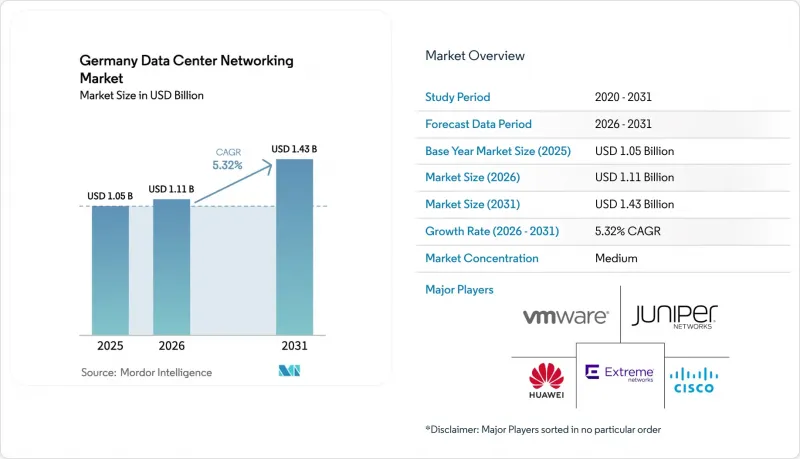
Mordor Intelligence에 의하면, 2026년 독일의 데이터센터 네트워킹 시장 규모는 11억 1,000만 달러로 추정되고 2025년 10억 5,000만 달러에서 확대해, 2031년 예측은 14억 3,000만 달러에 달하고, 2026-2031년에 걸쳐 CAGR 5.32%로 성장할 전망입니다.
본 보고서는 구성 요소(제품 및 서비스), 최종 사용자(IT 및 통신, 은행 및 금융 서비스·보험(BFSI),정부·국방, 기타), 데이터센터 유형(코로케이션, 하이퍼스케일러·클라우드 서비스 제공업체, 엣지·마이크로 데이터센터), 대역폭(10GbE 이하, 25-40GbE, 기타)별로 분류되어 있습니다. 시장 전망은 금액(미 달러) 기준으로 제시되어 있습니다.
독일의 데이터센터 네트워킹 시장 동향 및 인사이트
하이퍼스케일 클라우드 및 코로케이션 거점의 확대
각 하이퍼스케일러 기업들은 AI 훈련용으로 800G 지원 패브릭이나 InfiniBand 클러스터를 지정함으로써 조달 주기를 혁신하고 있습니다. AWS만 해도 프랑크푸르트 리전에 94억 4,000만 달러를 투자하며, 스위치 벤더들에게 고밀도 및 수냉식 플랫폼 제공을 요구하고 있습니다. Digital Realty와 같은 코로케이션 사업자들은 AI 전용 홀을 통해 이에 대응하고 있으며, 멀티 테넌트 세분화가 가능한 프리미엄 상호 연결을 필요로 하는 기업 테넌트를 유치하고 있습니다. 이러한 병행 투자를 통해 장비의 수명 주기는 4년 이하로 단축되었으며, 2선 도시권에서 시너지 효과가 발생하고 있습니다.
정부의 기가비트 전략이 광섬유 및 5G 구축을 가속화
베를린의 ‘기가비트 전략’은 전국 규모의 광섬유 및 5G 구축에 170억 유로(199억 3,000만 달러)를 투자하며, 데이터센터 소유주에게 지방의 백홀 트래픽을 뒷받침하는 대용량 상호연결 도입을 의무화하고 있습니다. 보조금 조건으로 BSI C5 보안 규정 준수가 명시되어 있어, 이에 따라 수요는 유럽에 생산 라인을 보유한 벤더로 쏠리고 있습니다. 또한, 광섬유 밀도 향상으로 인해 소프트웨어 정의 오버레이에 의존하는 분산형 엣지 노드가 가능해져, 새로운 지역 시설을 프랑크푸르트의 인터넷 익스체인지와 연결할 수 있게 됩니다.
FLAP-D의 전력망 제약과 높은 전력 비용
프랑크푸르트의 전력 상한선으로 인해 사업자는 AI 부하를 여러 개의 소규모 홀로 분산할 수밖에 없으며, 그 결과 포트 수와 배선 거리가 증가하고 있습니다. ‘에너지 효율법’에서는 2030년까지 PUE 상한을 1.3으로 규정하고 있으며, 이로 인해 구매자는 가격이 비싸고 저전력 소비를 자랑하는 ASIC, ROI 회수 기간을 연장시키는 수냉식 광모듈을 채택해야 하는 압박을 받고 있습니다. 재생에너지 조달 역시 공간적 제약을 초래합니다. 태양광이나 풍력 발전의 부대 설비가 추가 랙을 설치할 수 있는 부지를 차지하기 때문입니다.
부문 분석
2025년, 독일의 데이터센터 네트워킹 시장 규모에서 제품이 75.30%의 점유율을 차지했습니다. 스위치 업데이트 프로그램은 400G 및 800G 플랫폼으로 전환되고 있으며, 광 인터커넥트 도입은 수냉식 아이슬 설계의 확대에 따라 증가하고 있습니다. 또한, 사업자가 메트로 엣지 패브릭 관리를 일원화함에 따라 SDN 컨트롤러 라이선스 수도 증가하고 있습니다. 서비스 부문은 연평균 성장률(CAGR) 5.61%로 확대될 것으로 예상되며, AI 클러스터 최적화 및 IPv6 전환과 관련된 지속적인 수익원이 추가될 것입니다. 매니지드 네트워크 서비스는 기술 격차를 해소하는 한편, 통합 전문가는 프라이빗 5G 셀을 코어 데이터센터 패브릭에 연결합니다. 기업들이 GPU 중심의 트래픽 패턴에 대응할 수 있도록 팀 재편을 추진함에 따라, 교육 프로그램 도입이 확대되고 있습니다. 이러한 요인으로 인해 2025년 이후에는 서비스 지출이 증가하겠지만, 독일의 데이터센터 네트워킹 시장에서는 2030년까지 하드웨어 지출이 여전히 주류를 차지할 전망입니다.
2025년에도 IT 및 통신 부문은 독일의 데이터센터 네트워킹 시장 점유율의 35.20%를 계속 차지했으며, 그 원동력은 5G 대응을 위해 코어 라우터를 업그레이드하는 통신 사업자와 AI 리전을 확장하는 클라우드 제공업체입니다. DORA(데이터 보호 규정) 준수에 따라 금융 데이터센터에서 스위치 수준의 세분화 및 원격 측정 기능이 강화되고 있습니다. 제조·산업 부문은 연평균 성장률(CAGR) 6.05%를 기록하며, 다른 모든 부문을 상회할 것으로 예측됩니다. 테슬라의 기가팩토리와 같은 시설에서 사용되는 프라이빗 5G는 생산 라인에 인접한 마이크로 데이터센터를 생성하고 있으며, 각각은 저지연 패브릭을 필요로 합니다. 공장에서는 OT 센서 그리드와 IT 분석이 통합되어 있어, 결정론적 트래픽 엔지니어링과 중복된 엣지 집계 계층이 필요하며, 이로 인해 평방미터당 지출이 증가하고 있습니다.
기타 혜택
- 엑셀 형식 시장 예측(ME) 시트
- 3개월간의 애널리스트 지원
자주 묻는 질문
목차
제1장 서론
제2장 조사 방법
제3장 주요 요약
제4장 시장 구도
제5장 시장 규모 및 성장 예측
제6장 경쟁 구도
제7장 시장 기회 및 향후 전망
KTHAccording to Mordor Intelligence, Germany data center networking market size in 2026 is estimated at USD 1.11 billion, growing from 2025 value of USD 1.05 billion with 2031 projections showing USD 1.43 billion, growing at 5.32% CAGR over 2026-2031.
This report is Segmented by Component (Product and Services), End User( IT and Telecommunications, Banking, Financial Services and Insurance (BFSI), Government and Defense and More), Data Center Type (Colocation, Hyperscalers/Cloud Service Providers, Edge/Micro Data Centers), by Bandwidth (<=10 GbE, 25-40 GbE and More). The Market Forecasts are Provided in Terms of Value (USD).
Germany Data Center Networking Market Trends and Insights
Expansion of hyperscale cloud and colocation footprints
Hyperscalers are reshaping procurement cycles by specifying 800G-ready fabrics and InfiniBand clusters for AI training. AWS alone committed USD 9.44 billion to its Frankfurt region, pushing switch vendors to deliver high-density, liquid-cooling-compatible platforms. Colocation operators such as Digital Realty respond with AI-focused halls, drawing enterprise tenants that then require premium interconnects capable of multi-tenant segmentation. These parallel investments compress equipment lifecycles to under four years and create multiplier effects in secondary metros.
Government Gigabit Strategy accelerating fiber and 5G rollout
Berlin's Gigabit Strategy funds EUR 17 billion (USD 19.93 billion) for nationwide fiber and 5G, obliging data-center owners to adopt higher-capacity interconnects that sustain rural back-haul traffic.Grants stipulate adherence to BSI C5 security rules, steering demand toward vendors with European manufacturing lines. Fiber densification also enables distributed edge nodes that rely on software-defined overlays to link new regional facilities with Frankfurt's internet exchanges.
Energy-grid constraints and high electricity costs in FLAP-D
Frankfurt's power caps force operators to distribute AI loads across multiple smaller halls, inflating port counts and cabling runs. The Energy Efficiency Act sets a PUE ceiling of 1.3 by 2030, pushing buyers toward higher-price, low-watt ASICs and liquid-cooled optics that lengthen ROI horizons. Renewable-power sourcing adds spatial constraints because solar or wind adjuncts consume land that could host additional racks.
Other drivers and restraints analyzed in the detailed report include:
- Surging AI/ML traffic driving 400G/800G switch refresh
- Rising edge-data-center deployments for IoT/low latency
- Shortage of certified network-automation engineers
For complete list of drivers and restraints, kindly check the Table Of Contents.
Segment Analysis
Products held 75.30% of Germany data center networking market share in 2025 of Germany data center networking market size. Switch refresh programs shift toward 400G and 800G platforms, and optical interconnect uptake scales with liquid-cooling aisle designs. SDN controller licenses rise as operators centralize management for metro-edge fabrics. Services are forecast to expand at a 5.61% CAGR, adding recurring revenue streams tied to AI-cluster optimisation and IPv6 migration. Managed Network Services absorb the skills gap, while integration specialists link private-5G cells to core data-center fabrics. Training programs see uptake as enterprises re-tool teams for GPU-centric traffic patterns. This mix elevates service spend from 2025 onward, yet hardware outlays remain dominant through 2030 in the Germany data center networking market.
IT and Telecommunications continued to command 35.20% of Germany data center networking market share in 2025, anchored by carriers upgrading core routers for 5G and cloud providers scaling AI regions. DORA compliance bolsters switch-level segmentation and telemetry in financial data centers.Manufacturing and Industrial is projected to register 6.05% CAGR, outpacing all peers. Private 5G at facilities like Tesla's Gigafactory creates micro-data-centers adjacent to production lines, each demanding low-latency fabrics. Factories integrate OT sensor grids with IT analytics, necessitating deterministic traffic engineering and redundant edge aggregation layers that lift spending per square meter.
Complete Report Scope:
- By Component
- Products
- Ethernet Switches
- Routers
- Storage Area Network (SAN)
- Application Delivery Controllers (ADC)
- Network Security Appliances
- Software-Defined Networking (SDN) Controllers
- Optical Interconnects
- Services
- Installation and Integration
- Training and Consulting
- Support and Maintenance
- Managed Network Services
- Products
- By End-User
- IT and Telecommunications
- Banking, Financial Services and Insurance (BFSI)
- Government and Defense
- Media and Entertainment
- Healthcare and Life Sciences
- Manufacturing and Industrial
- Other End-Users
- By Data-Center Type
- Colocation
- Hyperscalers/Cloud Service Providers
- Edge/Micro Data Centers
- By Bandwidth
- Less than 10 GbE
- 25-40 GbE
- 50-100 GbE
- Greater Than 100 GbE
List of Companies Covered in this Report:
- Cisco Systems Inc.
- Juniper Networks Inc.
- VMware Inc.
- Huawei Technologies Co. Ltd.
- Extreme Networks Inc.
- NVIDIA Corp. (Cumulus Networks)
- Dell Technologies Inc.
- NEC Corporation
- IBM Corporation
- Intel Corporation
- Arista Networks Inc.
- Broadcom Inc.
- Hewlett Packard Enterprise (Aruba)
- Nokia Corporation
- ADVA Optical Networking SE
- FS.COM GmbH
- Giax GmbH
- Lenovo Group Ltd.
- NetApp Inc.
- Super Micro Computer Inc.
Additional Benefits:
- The market estimate (ME) sheet in Excel format
- 3 months of analyst support
TABLE OF CONTENTS
1 INTRODUCTION
- 1.1 Study Assumptions and Market Definition
- 1.2 Scope of the Study
2 RESEARCH METHODOLOGY
3 EXECUTIVE SUMMARY
4 MARKET LANDSCAPE
- 4.1 Market Overview
- 4.2 Market Drivers
- 4.2.1 Expansion of hyperscale cloud and colocation footprints
- 4.2.2 Government Gigabit Strategy accelerating fiber and 5G rollout
- 4.2.3 Surging AI/ML traffic driving 400G/800G switch refresh
- 4.2.4 Rising edge-data-center deployments for IoT/low latency
- 4.2.5 Mandatory waste-heat-reuse rules boosting liquid-cooled gear
- 4.2.6 EU sovereign-AI grants funding InfiniBand clusters
- 4.3 Market Restraints
- 4.3.1 Energy-grid constraints and high electricity costs in FLAP-D
- 4.3.2 Shortage of certified network-automation engineers
- 4.3.3 Data-sovereignty (BSI C5) limits foreign white-box adoption
- 4.3.4 Optical-fiber raw-material shortages delaying builds
- 4.4 Supply-Chain Analysis
- 4.5 Regulatory Landscape
- 4.6 Technological Outlook
- 4.7 Porter's Five Forces Analysis
- 4.7.1 Threat of New Entrants
- 4.7.2 Bargaining Power of Buyers
- 4.7.3 Bargaining Power of Suppliers
- 4.7.4 Threat of Substitutes
- 4.7.5 Intensity of Competitive Rivalry
- 4.8 Assessment of Macroeconomic Factors on the Market
5 MARKET SIZE and GROWTH FORECASTS (VALUE)
- 5.1 By Component
- 5.1.1 Products
- 5.1.1.1 Ethernet Switches
- 5.1.1.2 Routers
- 5.1.1.3 Storage Area Network (SAN)
- 5.1.1.4 Application Delivery Controllers (ADC)
- 5.1.1.5 Network Security Appliances
- 5.1.1.6 Software-Defined Networking (SDN) Controllers
- 5.1.1.7 Optical Interconnects
- 5.1.2 Services
- 5.1.2.1 Installation and Integration
- 5.1.2.2 Training and Consulting
- 5.1.2.3 Support and Maintenance
- 5.1.2.4 Managed Network Services
- 5.1.1 Products
- 5.2 By End-User
- 5.2.1 IT and Telecommunications
- 5.2.2 Banking, Financial Services and Insurance (BFSI)
- 5.2.3 Government and Defense
- 5.2.4 Media and Entertainment
- 5.2.5 Healthcare and Life Sciences
- 5.2.6 Manufacturing and Industrial
- 5.2.7 Other End-Users
- 5.3 By Data-Center Type
- 5.3.1 Colocation
- 5.3.2 Hyperscalers/Cloud Service Providers
- 5.3.3 Edge/Micro Data Centers
- 5.4 By Bandwidth
- 5.4.1 Less than 10 GbE
- 5.4.2 25-40 GbE
- 5.4.3 50-100 GbE
- 5.4.4 Greater Than 100 GbE
6 COMPETITIVE LANDSCAPE
- 6.1 Market Concentration
- 6.2 Strategic Moves
- 6.3 Market Share Analysis
- 6.4 Company Profiles (includes Global Overview, Market-level Overview, Core Segments, Financials, Strategic Information, Market Rank/Share, Products and Services, Recent Developments)
- 6.4.1 Cisco Systems Inc.
- 6.4.2 Juniper Networks Inc.
- 6.4.3 VMware Inc.
- 6.4.4 Huawei Technologies Co. Ltd.
- 6.4.5 Extreme Networks Inc.
- 6.4.6 NVIDIA Corp. (Cumulus Networks)
- 6.4.7 Dell Technologies Inc.
- 6.4.8 NEC Corporation
- 6.4.9 IBM Corporation
- 6.4.10 Intel Corporation
- 6.4.11 Arista Networks Inc.
- 6.4.12 Broadcom Inc.
- 6.4.13 Hewlett Packard Enterprise (Aruba)
- 6.4.14 Nokia Corporation
- 6.4.15 ADVA Optical Networking SE
- 6.4.16 FS.COM GmbH
- 6.4.17 Giax GmbH
- 6.4.18 Lenovo Group Ltd.
- 6.4.19 NetApp Inc.
- 6.4.20 Super Micro Computer Inc.
7 MARKET OPPORTUNITIES and FUTURE OUTLOOK
- 7.1 White-space and Unmet-Need Assessment