|
시장보고서
상품코드
2120385
일반의약품(OTC) : 시장 점유율 분석, 업계 동향과 통계, 성장 예측(2026-2031년)Over The Counter Drugs - Market Share Analysis, Industry Trends & Statistics, Growth Forecasts (2026 - 2031) |
||||||
 Mordor Intelligence
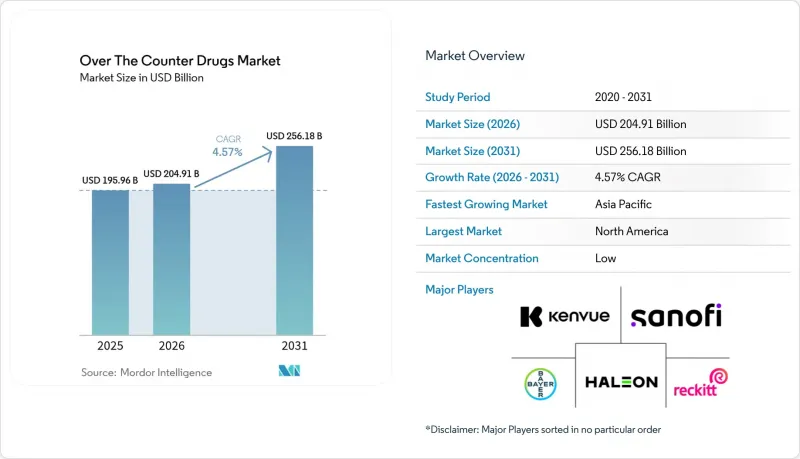
Mordor Intelligence에 따르면 일반의약품(OTC) 시장 규모는 2025년에 1,959억 6,000만 달러로 평가되며, 2026년 2,049억 1,000만 달러에서 2031년까지 2,561억 8,000만 달러에 달할 것으로 예측되고 있으며, 예측 기간(2026-2031년) CAGR은 4.57%에 달할 전망입니다.
이 보고서는 제품 유형(기침·감기·독감, 진통제 등), 제형(정제, 캡슐 등), 유통 채널(병원 약국, 소매 체인 약국 등), 연령대(소아(0-14세) 등), 원료(화학계, 허브·천연계),및 지역(북미, 유럽 등)별로 분류되어 있습니다. 시장 예측은 금액(달러)으로 제시되어 있습니다.
세계 일반의약품 시장의 동향 및 인사이트
자가 관리 및 예방 의료에 대한 소비자의 선호도 증가
화이자(Pfizer)의 공개 정보에 따르면 현재 소비자의 81%가 경미한 증상 발생시 첫 대응 수단으로 OTC 제품을 이용하고 있습니다. 이러한 행동 변화는 일반적인 증상으로 인한 의사 진료 건수를 감소시킬 정도로 크며, 그 결과 처방 관행에도 변화가 생기고 있습니다. 의사들은 더 중증인 경우에만 처방을 내리기 위해, 단계적 치료(step therapy) 프로토콜에서 OTC 사용을 필수적인 요소로 자리매김하는 경향이 강해지고 있습니다. 흥미로운 파생 효과로, 보험사 측이 이러한 동향을 은근히 환영하고 있다는 점을 들 수 있습니다. 왜냐하면 OTC 제품에 1달러가 지출될 때마다 개인의 본인 부담금이 발생하고, 그로 인해 보험 환급 예산의 부담이 경감되기 때문입니다. 이러한 구조를 통해 새로운 법규제 없이도 비용 압박의 균형이 바로잡히게 됩니다.
처방약에서 OTC로의 전환 지속
미국 식품의약국(FDA)은 2025년 1월, ‘비처방약 사용을 위한 추가 조건(ACNU)’ 규정을 법제화하여, 안전성 프로파일이 미묘하게 다른 제품이 OTC 지위로 전환될 수 있는 길을 열었습니다. 컨슈머 헬스케어 제품 협회(CHPA)에 따르면 700개 이상의 제품이 처방약에서 일반의약품으로 전환되었습니다. 별로 주목받지 못한 결과, 수명주기관리 팀은 현재 처방약에서 일반의약품(OTC)으로의 전환을 특허 연장 전략과 어깨를 나란히 하는 주요 전략적 수단으로 간주하고 있으며, 이를 통해 용도 변경이나 재제형화 없이도 성숙한 분자의 상업적 호재를 효과적으로 연장할 수 있게 되었습니다.
브랜드 신뢰도를 훼손하는 위조품 및 규격 미달 제품
전미약국위원회협회(NABP)의 추산에 따르면 온라인 약국 사이트의 96%가 규정을 준수하지 않고 운영되고 있습니다. 이러한 만연은 정품 브랜드 가치를 훼손하고, 나아가 환자의 복약 순응도를 저해하는 병행 시장을 조장하고 있습니다. 전략적 관점에서 볼 때, 대체품의 위협으로 인해 규제 당국이 아직 의무화하지 않은 경우에도 정식 사업자들은 블록체인 기반의 추적 및 트레이서빌리티 솔루션 도입을 서둘러야 하는 상황에 놓여 있습니다. 따라서 조기에 도입한 기업은 ‘공급망 무결성’과 ‘검증된 진위성을 바탕으로 한 마케팅상의 우위’라는 두 가지 이점을 누릴 가능성이 있습니다.
부문 분석
2025년 시점에 기침·감기·독감 치료제가 22.85%로 가장 큰 시장 점유율을 차지하고 있지만, 비타민, 미네랄, 보충제(VMS)는 2026-2031년에 연평균 성장률(CAGR) 7.52%를 기록하며 이 매트릭스 내에서 가장 높은 성장률을 보이고 있습니다. 이러한 추세는 팬데믹 이후 면역에 대한 인식이 높아진 것과 치료에서 예방으로의 광범위한 전환을 반영합니다. 주목할 점은 VMS의 브랜딩이 ‘수면의 질’이나 ‘스트레스 균형’과 같은 기능적 효과에 점점 더 초점을 맞추고 있다는 것입니다. 이는 기술 사양이 아닌 사용자 혜택을 명확히 전달하기 위해 기술 업계에서 오랫동안 사용되어 온 정교한 메시징 기법을 모방한 것입니다.
각 제조사는 스트레스 관리, 수면의 질, 인지 기능 등 소비자들 사이에서 새롭게 대두되고 있는 우려 사항에 대응하여 특정 증상에 특화된 처방에 점점 더 주력하고 있으며, 경쟁이 치열해지는 시장에서 차별화된 포지셔닝을 확립하고 있습니다.
2025년에도 정제는 여전히 시장의 38.25%를 차지하고 있지만, 구미 및 츄어블 제제는 연평균 성장률(CAGR) 9.35%로 확대되고 있습니다. 과자 형태의 제품이 헬스케어 분야에 자리 잡은 것은 감각적인 경험이 오랫동안 정착되어 온 제형을 대체할 수 있음을 보여줍니다. 각 제조사들은 현재 어린이뿐만 아니라 건강 지향적인 성인층에게도 어필하기 위해, 젤라틴을 사용하지 않는 식물 유래 기반 및 저당화 기술에 대한 투자를 진행하고 있습니다. 이러한 방향 전환은 맛과 식감이 제품에 있으며, 필수적인 속성이 되어가고 있으며, 치료 효과와 소비자의 기호라는 기존의 경계가 점차 희미해지고 있다는 전략적 인사이트를 부각시키고 있습니다.
OTC 제제의 혁신 파이프라인은 계속 확대되고 있으며, 지속적 약물전달을 실현하는 경피 패치가 주목을 받고 있을 뿐만 아니라, 소아 및 고령층의 연하 곤란에 대응하는 구강내 분해형 제제도 등장하고 있습니다.
지역별 분석
2025년 34.55%의 시장 점유율 1위는 자가 치료를 촉진하는 높은 본인 부담 비용, 견실한 약국 체인, 그리고 처방약에서 OTC로의 전환에 유리한 규제 환경에 의해 지원되고 있습니다. 2025년 1월부터 시행되고 있는 FDA의 ACNU 프레임워크에 따라 보다 복잡한 분자 화합물에 대해서도 디지털 툴을 활용한 자가 선택이 가능해졌으며, 이러한 정책 전환으로 인해 소프트웨어가 사실상 규제 준수 메커니즘으로 기능하게 되었습니다. 이러한 움직임에 따라 기술 파트너는 의약품 상용화 전략의 핵심으로 부상하고 있습니다.
아시아태평양은 가처분 소득의 증가와 중산층의 소비 의욕 고조에 힘입어 2031년까지 연평균 성장률(CAGR) 8.31%를 기록하며 가장 빠르게 성장하는 지역 시장이 될 전망입니다. 중국 국가약품감독관리국(NMPA)에는 5,000건 이상의 등록된 OTC 제품이 등재되어 있으며, 그중에는 처방약에서 OTC로 전환된 800건 이상이 포함되어 있습니다. 경쟁이 심화됨에 따라 다국적 기업은 포장 언어뿐만 아니라, 지역 임상 지침에 따른 용량 설정의 현지화도 추진하고 있습니다. 이는 기존에 마케팅 현지화에서 뒤처져 있던 분야입니다.
대부분의 관할 구역에서는 온라인 판매가 허용되고 가격 통제도 이루어지지 않고 있지만, 조제 감독 체제를 준수하기 위해 약국 이외의 소매점에서의 판매를 여전히 제한하고 있는 지역도 많습니다. 규제가 세분화되어 있으며, 제조업체는 국가별 SKU 변형을 유지할 수밖에 없으며, 이로 인해 재고 관리의 복잡성은 증가하지만, 현지 건강 문제에 맞춘 세심한 마케팅 메시지를 전개할 수 있게 됩니다. 여기서 얻을 수 있는 중요한 시사점은, 최종 포장을 각국의 할당 단계까지 연기하는 ‘연기 전략’을 채택한 민첩한 공급망이 현재 유럽에서 중요한 경쟁 우위가 되고 있다는 점입니다.
기타 혜택:
- 엑셀 형식의 시장 예측(ME) 시트
- 3개월간의 애널리스트 지원
자주 묻는 질문
목차
제1장 서론
제2장 조사 방법
제3장 개요
제4장 시장 구도
제5장 시장 규모와 성장 예측
제6장 경쟁 구도
제7장 시장 기회와 향후 전망
KSA 26.09.02According to Mordor Intelligence, the over-the-counter (OTC) drugs market size was valued at USD 195.96 billion in 2025 and estimated to grow from USD 204.91 billion in 2026 to reach USD 256.18 billion by 2031, at a CAGR of 4.57% during the forecast period (2026-2031).
This report is Segmented by Product Type (Cough, Cold, and Flu, Analgesics, and More), Formulation Type (Tablets, Capsules and More), Distribution Channel (Hospital Pharmacies, Retail Chain Pharmacies, and More), Age Group (Pediatrics (0-14 Yrs), and More), Source (Chemical-Based and Herbal & Natural) and Geography (North America, Europe, and More). The Market Forecasts are Provided in Terms of Value (USD).
Global Over The Counter Drugs Market Trends and Insights
Rising Consumer Preference For Self-Care And Preventive Health
81% of consumers now turn to an OTC product as the first response to minor ailments, according to Pfizer disclosures. The behavioral shift is large enough to reduce physician footfall for common conditions, which in turn changes prescribing habits: physicians increasingly frame OTC use as an essential component of step-therapy protocols to reserve prescription interventions for higher-acuity needs. An interesting derivative effect is that payers quietly welcome the trend, because every OTC dollar spent introduces a private out-of-pocket contribution that relieves reimbursement budgets, a dynamic that rebalances cost pressures without new legislation.
Continued Rx-to-OTC Switches
The United States Food and Drug Administration (FDA) codified the Additional Conditions for Nonprescription Use (ACNU) rule in January 2025, opening the gate for products with nuanced safety profiles to migrate into OTC status. More than 700 individual products have crossed the prescription wall, notes the Consumer Healthcare Products Association (CHPA). An under-appreciated consequence is that life-cycle management teams now view Rx-to-OTC migration as a mainstream strategic lever alongside patent-extension tactics, effectively lengthening commercial tailwinds for mature molecules without repurposing or reformulating them.
Counterfeit and Substandard Products Undermining Brand Trust
The National Association of Boards of Pharmacy estimates that 96% of online pharmacy sites operate out of compliance. This proliferation fuels a parallel market that erodes legitimate brand equity and, by extension, patient adherence. At a strategic level, the counterfeit threat propels legitimate players toward blockchain-based track-and-trace solutions, even when regulators have not yet mandated them. Early adopters may therefore secure a two-fold benefit: supply-chain integrity and marketing leverage built on verified authenticity.
Other drivers and restraints analyzed in the detailed report include:
- Digital and Omnichannel Pharmacy Proliferation
- Liberalization of Pharmacy and Drug-retail Regulations in Developing Economies
- Price Erosion from Intensifying Retail Competition and Private-label Expansion
For complete list of drivers and restraints, kindly check the Table Of Contents.
Segment Analysis
Cough, cold, and flu remedies retain the largest slice of market share at 22.85% in 2025, yet vitamins, minerals, and supplements (VMS) clock a 7.52% CAGR for 2026-2031, the fastest within the matrix. The trend reflects post-pandemic immunity consciousness and a broader pivot from treatment to prevention. A notable inference is that VMS branding increasingly centers on functional outcomes such as "sleep quality" or "stress balance," mimicking the precision-messaging language long used in the tech sector to articulate user benefits rather than technical specs.
Manufacturers are increasingly focusing on condition-specific formulations that target emerging consumer concerns such as stress management, sleep quality, and cognitive performance, creating differentiated positioning in an increasingly crowded marketplace.
Tablets still account for 38.25% of the market in 2025, but gummies and chewables expand at 9.35% CAGR. The adhesion of confectionery formats to healthcare illustrates how sensory experience can dislodge entrenched dosage forms. Manufacturers now invest in gelatin-free plant bases and reduced sugar profiles to appeal to health-conscious adults, not just children. This pivot underlines a strategic insight: taste and texture are becoming table-stakes product attributes, erasing the historical divide between therapeutic efficacy and consumer indulgence.
The innovation pipeline for OTC formulations continues to expand, with transdermal patches gaining traction for consistent drug delivery and orally disintegrating formats addressing swallowing difficulties in pediatric and geriatric populations.
Complete Report Scope:
- By Product Type
- Cough, Cold & Flu
- Analgesics
- Gastrointestinal
- Dermatology
- Vitamins, Minerals & Supplements (VMS)
- Weight Management
- Ophthalmic
- Sleep Aids
- Oral Care
- Smoking Cessation
- Antihistamines / Allergy
- Ear Care
- Wound Care
- Other Products
- By Formulation Type
- Tablets
- Capsules & Softgels
- Liquids & Syrups
- Powders & Granules
- Ointments & Creams
- Sprays & Inhalers
- Gummies & Chewables
- Transdermal Patches
- By Distribution Channel
- Hospital Pharmacies
- Retail Chain Pharmacies
- Independent Pharmacies & Drugstores
- Online Pharmacies
- Other Channels
- By Age Group
- Pediatrics (0-14 yrs)
- Adults (15-64 yrs)
- Geriatrics (65+ yrs)
- By Source
- Chemical-based
- Herbal & Natural
- Geography
- North America
- United States
- Canada
- Mexico
- Europe
- Germany
- United Kingdom
- France
- Italy
- Spain
- Rest of Europe
- Asia-Pacific
- China
- Japan
- India
- Australia
- South Korea
- Rest of Asia-Pacific
- Middle East and Africa
- GCC
- South Africa
- Rest of Middle East and Africa
- South America
- Brazil
- Argentina
- Rest of South America
- North America
Geography Analysis
Market share leadership at 34.55% in 2025 is underpinned by high out-of-pocket costs that foster self-medication, robust pharmacy chains, and a favorable regulatory climate for Rx-to-OTC switches. The FDA's ACNU framework, operational since January 2025, allows digital tools to guide self-selection for more complex molecules, a policy shift that effectively converts software into a regulatory compliance mechanism. This dynamic nudges tech partners into the core of drug-commercialization strategies.
At an 8.31% CAGR, Asia-Pacific represents the fastest-growing regional chunk through 2031, driven by rising disposable income and growing middle-class aspirations. China's National Medical Products Administration lists more than 5,000 registered OTC products, including over 800 switches from prescription status. The sharpening competitive stakes spur multinational firms to localize not just packaging language but also dose strengths aligned with regional clinical guidelines-an adaptation that historically lagged behind marketing localization.
Most jurisdictions permit online sales and refrain from price controls, yet many still restrict non-pharmacy retail to safeguard dispensing oversight. The fragmented rulebook obliges manufacturers to maintain country-specific SKU variants, which inflates inventory complexity but allows micro-targeted marketing claims attuned to local health concerns. A sophisticated takeaway emerges: agile supply chains that use postponement strategies, delaying final packaging until country allocation, is now a material competitive advantage in Europe.
- Kenvue Brands LLC
- Bayer
- Haleon Group
- Sanofi
- Reckitt Benckiser Group
- Pfizer
- Viatris
- Perrigo Company
- Takeda Pharmaceuticals
- Boehringer Ingelheim
- Sun Pharmaceuticals Industries
- Teva Pharmaceutical Industries
- Glenmark Pharmaceuticals
- Dr. Reddy's Laboratories
- Piramal Enterprises Ltd.
- Church & Dwight
- Procter & Gamble
- Prestige Consumer Healthcare
- Hisamitsu Pharmaceutical
- Lupin
Additional Benefits:
- The market estimate (ME) sheet in Excel format
- 3 months of analyst support
TABLE OF CONTENTS
1 Introduction
- 1.1 Study Assumptions & Market Definition
- 1.2 Scope of the Study
2 Research Methodology
3 Executive Summary
4 Market Landscape
- 4.1 Market Overview
- 4.2 Market Drivers
- 4.2.1 Rising Consumer Preference for Self-Care and Preventive Health
- 4.2.2 Continued Rx-to-OTC Switches Across Multiple Therapeutic Classes
- 4.2.3 Proliferation of Digital & Omnichannel Pharmacy Platforms
- 4.2.4 Liberalization of Pharmacy & Drug Retail Regulations in Developing Economies
- 4.2.5 Rapidly Ageing Population Elevating Demand for Chronic OTC Management
- 4.2.6 Post-Pandemic Focus on Respiratory & Immunity Products
- 4.3 Market Restraints
- 4.3.1 Counterfeit & Substandard Products Undermining Brand Trust in Emerging Markets
- 4.3.2 Price Erosion from Intensifying Retail Competition & Private-Label Expansion
- 4.3.3 Safety Concerns over Misuse and Adverse Events Limiting Category Expansion
- 4.3.4 Tightening Regulatory Surveillance and Track-and-Trace Mandates Increasing Compliance Costs
- 4.4 Supply-Chain Analysis
- 4.5 Porter's Five Forces
- 4.5.1 Threat of New Entrants
- 4.5.2 Bargaining Power of Buyers/Consumers
- 4.5.3 Bargaining Power of Suppliers
- 4.5.4 Threat of Substitute Products
- 4.5.5 Intensity of Competitive Rivalry
5 Market Size & Growth Forecasts (Value, USD)
- 5.1 By Product Type
- 5.1.1 Cough, Cold & Flu
- 5.1.2 Analgesics
- 5.1.3 Gastrointestinal
- 5.1.4 Dermatology
- 5.1.5 Vitamins, Minerals & Supplements (VMS)
- 5.1.6 Weight Management
- 5.1.7 Ophthalmic
- 5.1.8 Sleep Aids
- 5.1.9 Oral Care
- 5.1.10 Smoking Cessation
- 5.1.11 Antihistamines / Allergy
- 5.1.12 Ear Care
- 5.1.13 Wound Care
- 5.1.14 Other Products
- 5.2 By Formulation Type
- 5.2.1 Tablets
- 5.2.2 Capsules & Softgels
- 5.2.3 Liquids & Syrups
- 5.2.4 Powders & Granules
- 5.2.5 Ointments & Creams
- 5.2.6 Sprays & Inhalers
- 5.2.7 Gummies & Chewables
- 5.2.8 Transdermal Patches
- 5.3 By Distribution Channel
- 5.3.1 Hospital Pharmacies
- 5.3.2 Retail Chain Pharmacies
- 5.3.3 Independent Pharmacies & Drugstores
- 5.3.4 Online Pharmacies
- 5.3.5 Other Channels
- 5.4 By Age Group
- 5.4.1 Pediatrics (0-14 yrs)
- 5.4.2 Adults (15-64 yrs)
- 5.4.3 Geriatrics (65+ yrs)
- 5.5 By Source
- 5.5.1 Chemical-based
- 5.5.2 Herbal & Natural
- 5.6 Geography
- 5.6.1 North America
- 5.6.1.1 United States
- 5.6.1.2 Canada
- 5.6.1.3 Mexico
- 5.6.2 Europe
- 5.6.2.1 Germany
- 5.6.2.2 United Kingdom
- 5.6.2.3 France
- 5.6.2.4 Italy
- 5.6.2.5 Spain
- 5.6.2.6 Rest of Europe
- 5.6.3 Asia-Pacific
- 5.6.3.1 China
- 5.6.3.2 Japan
- 5.6.3.3 India
- 5.6.3.4 Australia
- 5.6.3.5 South Korea
- 5.6.3.6 Rest of Asia-Pacific
- 5.6.4 Middle East and Africa
- 5.6.4.1 GCC
- 5.6.4.2 South Africa
- 5.6.4.3 Rest of Middle East and Africa
- 5.6.5 South America
- 5.6.5.1 Brazil
- 5.6.5.2 Argentina
- 5.6.5.3 Rest of South America
- 5.6.1 North America
6 Competitive Landscape
- 6.1 Market Concentration
- 6.2 Market Share Analysis
- 6.3 Company Profiles (includes Global level Overview, Market level overview, Core Business Segments, Financials, Headcount, Key Information, Market Rank, Market Share, Products and Services, and analysis of Recent Developments)
- 6.3.1 Kenvue Brands LLC
- 6.3.2 Bayer AG
- 6.3.3 Haleon Group
- 6.3.4 Sanofi S.A.
- 6.3.5 Reckitt Benckiser Group plc
- 6.3.6 Pfizer Inc.
- 6.3.7 Viatris Inc.
- 6.3.8 Perrigo Company plc
- 6.3.9 Takeda Pharmaceutical Co. Ltd.
- 6.3.10 Boehringer Ingelheim International GmbH
- 6.3.11 Sun Pharmaceutical Industries Ltd.
- 6.3.12 Teva Pharmaceutical Industries Ltd.
- 6.3.13 Glenmark Pharmaceuticals Ltd.
- 6.3.14 Dr. Reddy's Laboratories Ltd.
- 6.3.15 Piramal Enterprises Ltd.
- 6.3.16 Church & Dwight Co. Inc.
- 6.3.17 Procter & Gamble Co.
- 6.3.18 Prestige Consumer Healthcare Inc.
- 6.3.19 Hisamitsu Pharmaceutical Co. Inc.
- 6.3.20 Lupin Ltd.
7 Market Opportunities & Future Outlook
- 7.1 White-space & Unmet-Need Assessment