

|
시장보고서
상품코드
2120483
북미의 위치 분석 : 시장 점유율 분석, 업계 동향 및 통계, 성장 예측(2026-2031년)North America Location Analytics - Market Share Analysis, Industry Trends & Statistics, Growth Forecasts (2026 - 2031) |
||||||
 Mordor Intelligence
Mordor Intelligence에 의하면, 북미의 위치 분석 시장 규모는 2025년에 52억 2,000만 달러로 평가되었습니다. 2026년 60억 6,000만 달러에서 2031년까지 127억 6,000만 달러에 이를 것으로 예상되며, 예측 기간(2026-2031년) CAGR은 16.06%를 나타낼 전망입니다.
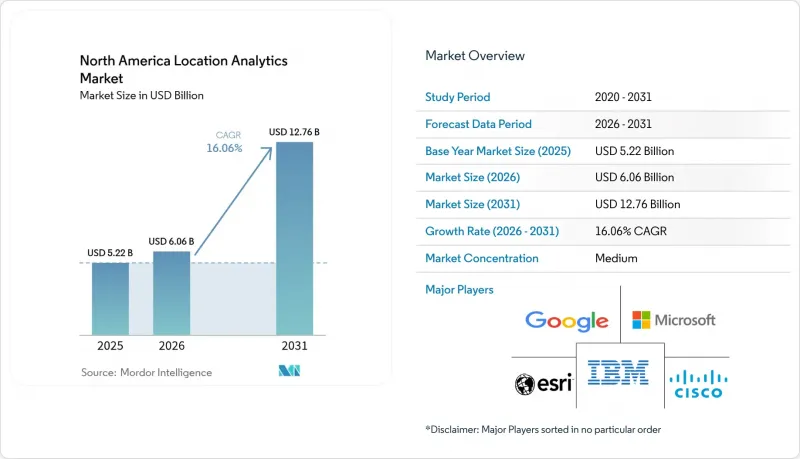
본 보고서는 위치 유형별(실내, 실외), 배포 모델별(On-Premise, 클라우드, 기타), 구성 요소별(솔루션, 기타), 기술별(GPS·GNSS, Wi-Fi, 기타),최종 사용자 산업별(소매 및 전자상거래, 은행 및 금융 서비스·보험(BFSI), 제조업, 정부·국방, 기타), 용도별(리스크 관리, 기타), 국가별로 분류되어 있습니다. 시장 예측은 금액(미 달러) 기준으로 제시되어 있습니다.
북미의 위치 분석 시장 동향 및 인사이트
옴니채널 소매업에서 지오마케팅 캠페인의 급증
소매업체들은 지오펜싱 도구와 CRM 제품군을 결합하여 실시간 프로모션을 전개함으로써 매장 수준의 전환율 향상을 도모하고 있습니다. 쇼룸 최적화에 관한 조사에 따르면, 매장 내 전략적인 상품 배치와 지리적 도달 범위 확대를 통해 매출과 소비자의 신뢰도가 높아지는 것으로 나타났습니다. 오프라인 매장과 온라인의 융합이 진행됨에 따라, 차별화된 위치 기반 컨텐츠는 순수 전자상거래 사업자가 재현할 수 없는 고객 충성도를 높이는 수단이 되고 있습니다.
개인정보 보호 및 소비자 옵트아웃 관련 규제 강화
캘리포니아주 CCPA(캘리포니아 소비자 개인정보 보호법)에 따른 일제 단속은 위치 정보의 개인적 특성에 초점을 맞추어, 명시적인 옵트아웃과 더욱 엄격한 동의 절차를 의무화하고 있습니다. 기업은 현재 모든 분석 스택에 개인정보 보호 엔지니어링을 통합해야 하며, 규정 준수를 유지하기 위해 데이터의 세분화 수준을 조정해야 하는 경우도 있습니다.
부문별 분석
GPS 및 GNSS가 운송 및 물류의 기반이 되고 있기 때문에 2025년에도 실외 서비스는 북미의 위치 분석 시장 점유율의 54.35%를 유지했습니다. 한편, 실내 위치 추적은 CBRS 지원 프라이빗 5G 및 초광대역(UWB)의 도입으로 1미터 미만의 정확도를 확보하며 연평균 성장률(CAGR) 17.85%로 성장하고 있습니다. 제조업체는 자산 수준의 가시화를 위해 이 기술을 도입하고 있으며, 병원에서는 고가의 장비 추적에 활용하고 있습니다.
하이브리드 수요 증가에 따라 벤더들은 실내 및 실외 레이어를 통합하여 단일 ‘진실의 원천(single source-of-truth)’이 되는 대시보드를 구축해야 할 필요가 있습니다. 인더스트리 4.0의 청사진에서는 작업자의 안전을 확보하기 위한 지오존(geo-zone)과 지속적인 좌표 스트림이 필요한 무인 운반차(AGV)가 요구되고 있습니다. 이에 따라 북미의 위치 분석 시장은 실외에서 발생하는 GPS 드리프트와 실내에서 발생하는 멀티패스 현상을 보정하는 멀티모달 엔진으로 전환되고 있습니다.
2025년 시점에서도 On-Premise 시스템은 북미의 위치 분석 시장 규모의 59.20%를 차지했으며, 이는 규제가 엄격한 산업에서 데이터 주권이 우선시되고 있음을 반영합니다. 클라우드 옵션은 사용량 기반 과금 방식의 처리 및 네이티브 협업 기능이 자본 지출(CAPEX)에 제약이 있는 기업들을 끌어들이고 있어 연평균 성장률(CAGR) 19.6%로 확대되고 있습니다. 또한, 저지연 이용 사례를 위해 엣지 추론과 클라우드 모델링을 결합한 하이브리드 아키텍처도 증가하고 있습니다.
프라이빗 CBRS 네트워크는 클라우드 오케스트레이션과 데이터 주권을 모두 충족하는 온사이트형 대안을 제공하여, 공장이 퍼블릭 클라우드에 얽매이는 것을 피할 수 있는 길을 열어줍니다. GeoParquet와 같은 형태의 혁신을 통해 ETL 오버헤드를 최소화함으로써, 이전에는 전문적인 GIS 스크립트가 필요했던 워크플로우도 애자일하게 운영할 수 있게 되었습니다.
기타 혜택
- 엑셀 형식 시장 예측(ME) 시트
- 3개월간의 애널리스트 지원
자주 묻는 질문
목차
제1장 서론
제2장 조사 방법
제3장 주요 요약
제4장 시장 구도
제5장 시장 규모 및 성장 예측
제6장 경쟁 구도
제7장 시장 기회 및 향후 전망
KTH 26.09.04According to Mordor Intelligence, the North America location analytics market size was valued at USD 5.22 billion in 2025 and estimated to grow from USD 6.06 billion in 2026 to reach USD 12.76 billion by 2031, at a CAGR of 16.06% during the forecast period (2026-2031).
This report is Segmented by Location (Indoor, Outdoor), Deployment Model (On-Premises, Cloud and More), Component (Solutions and More), Technology (GPS / GNSS, Wi-Fi and More), End-User Vertical (Retail, Banking, Manufacturing, Government, and More), Application (Risk Management and More), and by Country. The Market Forecasts are Provided in Terms of Value (USD).
North America Location Analytics Market Trends and Insights
Surge in Omni-Channel Retail Geo-Marketing Campaigns
Retailers pair geofencing tools with CRM suites to trigger real-time promotions, driving higher conversion at store level. Showroom optimization research indicates that strategic in-store product placement and geographic reach expansion lift sales and consumer confidence. As brick-and-click convergence deepens, differentiated location content becomes a loyalty lever that pure-play e-commerce cannot replicate.
Heightened Privacy and Consumer Opt-Out Regulations
California's CCPA enforcement sweep spotlights the personal nature of geolocation data, requiring explicit opt-outs and stronger consent flows. Enterprises must now embed privacy engineering into every analytics stack, sometimes trimming data granularity to stay compliant.
Other drivers and restraints analyzed in the detailed report include:
- Proliferation of IoT Sensors & Connected Devices
- Accelerated Adoption of Cloud-Native Geospatial Analytics Platforms
- Corporate Demand for Hybrid Workplace Occupancy Intelligence
- High Total Cost of Ownership for Real-Time Indoor Systems
For complete list of drivers and restraints, kindly check the Table Of Contents.
Segment Analysis
Outdoor services retained 54.35% North America location analytics market share in 2025 as GPS/GNSS underpins transportation and logistics. Indoor positioning, however, compounds at 17.85% CAGR, powered by sub-meter accuracy from CBRS-enabled private 5G and ultra-wideband deployments. Manufacturers embed the technology for asset-level visibility, while hospitals apply it to track high-value equipment.
Growing hybrid demand obliges vendors to fuse indoor and outdoor layers into single source-of-truth dashboards. Industry 4.0 blueprints call for worker safety geozones and automated guided vehicles requiring continuous coordinate streams. The North America location analytics market therefore pivots to multi-modal engines that reconcile GPS drift outdoors with multipath corrections indoors.
On-premise systems still accounted for 59.20% of the North America location analytics market size in 2025, reflecting data-sovereignty priorities among heavily regulated sectors. Cloud options are scaling at a 19.6% CAGR as pay-as-you-go processing and native collaboration entice enterprises with limited capex. Hybrid architectures are also rising, combining edge inference with cloud modeling for low-latency use cases.
Private CBRS networks offer an on-site alternative that marries cloud orchestration with sovereign data paths, giving factories a route around public-cloud lock-in. Format innovations such as GeoParquet minimize ETL overhead, unlocking agile workflows that previously demanded specialist GIS scripting.
Complete Report Scope:
- By Location Type
- Indoor
- Outdoor
- By Deployment Model
- On-premise
- Cloud
- Hybrid
- Edge (on-device)
- By Component
- Solutions
- Services
- By Technology
- GPS / GNSS
- Wi-Fi
- Bluetooth Low-Energy (BLE)
- Ultra-Wideband (UWB)
- Cellular (4G/5G incl. CBRS)
- RFID & NFC
- Magnetic & Other
- By End-User Vertical
- Retail & E-Commerce
- Banking, Financial Services & Insurance (BFSI)
- Manufacturing
- Healthcare & Life Sciences
- Government & Defense
- Energy & Utilities
- Transportation & Logistics
- Telecom & IT
- Real Estate & Smart Buildings
- Other Verticals
- By Application
- Risk Management
- Supply Chain & Inventory Optimization
- Sales & Marketing Optimization
- Facility & Asset Management
- Workforce & Field-Force Management
- Remote Monitoring & Predictive Maintenance
- Emergency & Disaster Response Management
- Customer Experience & Engagement
- Fraud & Compliance Analytics
- Others
- By Country
- United States
- Canada
- Mexico
List of Companies Covered in this Report:
- Cisco Systems Inc.
- SAP SE
- Esri Inc.
- Aruba Networks (HPE Development LP)
- IBM Corporation
- SAS Institute Inc.
- Pitney Bowes Inc.
- HERE Global BV
- TIBCO Software Inc.
- Ericsson Inc.
- Microsoft Corporation
- Google LLC
- Oracle Corporation
- Alteryx Inc.
- Mapbox Inc.
- CARTO
- Trimble Inc.
- Zebra Technologies Corp.
- Inpixon
- Foursquare Labs Inc.
- Precisely
- TomTom N.V.
- Mapsted Corp.
Additional Benefits:
- The market estimate (ME) sheet in Excel format
- 3 months of analyst support
TABLE OF CONTENTS
1 INTRODUCTION
- 1.1 Study Assumptions & Market Definition
- 1.2 Scope of the Study
2 RESEARCH METHODOLOGY
3 EXECUTIVE SUMMARY
4 MARKET LANDSCAPE
- 4.1 Market Overview
- 4.2 Market Drivers
- 4.2.1 Surge in omni-channel retail geo-marketing campaigns
- 4.2.2 Proliferation of IoT sensors & connected devices
- 4.2.3 Accelerated adoption of cloud-native geospatial analytics platforms
- 4.2.4 Corporate demand for hybrid workplace occupancy intelligence
- 4.2.5 Availability of CBRS private-5G improving indoor location accuracy
- 4.3 Market Restraints
- 4.3.1 Heightened privacy and consumer opt-out regulations
- 4.3.2 High total cost of ownership for real-time indoor location systems
- 4.3.3 Shortage of geospatial data-science talent
- 4.4 Value / Supply-Chain Analysis
- 4.5 Regulatory Landscape
- 4.6 Technological Outlook
- 4.7 Porters Five Forces
- 4.7.1 Bargaining Power of Buyers
- 4.7.2 Bargaining Power of Suppliers
- 4.7.3 Threat of New Entrants
- 4.7.4 Threat of Substitute Products
- 4.7.5 Intensity of Competitive Rivalry
5 MARKET SIZE & GROWTH FORECASTS (VALUE)
- 5.1 By Location Type
- 5.1.1 Indoor
- 5.1.2 Outdoor
- 5.2 By Deployment Model
- 5.2.1 On-premise
- 5.2.2 Cloud
- 5.2.3 Hybrid
- 5.2.4 Edge (on-device)
- 5.3 By Component
- 5.3.1 Solutions
- 5.3.2 Services
- 5.4 By Technology
- 5.4.1 GPS / GNSS
- 5.4.2 Wi-Fi
- 5.4.3 Bluetooth Low-Energy (BLE)
- 5.4.4 Ultra-Wideband (UWB)
- 5.4.5 Cellular (4G/5G incl. CBRS)
- 5.4.6 RFID & NFC
- 5.4.7 Magnetic & Other
- 5.5 By End-User Vertical
- 5.5.1 Retail & E-Commerce
- 5.5.2 Banking, Financial Services & Insurance (BFSI)
- 5.5.3 Manufacturing
- 5.5.4 Healthcare & Life Sciences
- 5.5.5 Government & Defense
- 5.5.6 Energy & Utilities
- 5.5.7 Transportation & Logistics
- 5.5.8 Telecom & IT
- 5.5.9 Real Estate & Smart Buildings
- 5.5.10 Other Verticals
- 5.6 By Application
- 5.6.1 Risk Management
- 5.6.2 Supply Chain & Inventory Optimization
- 5.6.3 Sales & Marketing Optimization
- 5.6.4 Facility & Asset Management
- 5.6.5 Workforce & Field-Force Management
- 5.6.6 Remote Monitoring & Predictive Maintenance
- 5.6.7 Emergency & Disaster Response Management
- 5.6.8 Customer Experience & Engagement
- 5.6.9 Fraud & Compliance Analytics
- 5.6.10 Others
- 5.7 By Country
- 5.7.1 United States
- 5.7.2 Canada
- 5.7.3 Mexico
6 COMPETITIVE LANDSCAPE
- 6.1 Market Concentration
- 6.2 Strategic Moves
- 6.3 Market Share Analysis
- 6.4 Company Profiles (includes Global level Overview, Market level overview, Core Segments, Financials as available, Strategic Information, Market Rank/Share for key companies, Products & Services, and Recent Developments)
- 6.4.1 Cisco Systems Inc.
- 6.4.2 SAP SE
- 6.4.3 Esri Inc.
- 6.4.4 Aruba Networks (HPE Development LP)
- 6.4.5 IBM Corporation
- 6.4.6 SAS Institute Inc.
- 6.4.7 Pitney Bowes Inc.
- 6.4.8 HERE Global BV
- 6.4.9 TIBCO Software Inc.
- 6.4.10 Ericsson Inc.
- 6.4.11 Microsoft Corporation
- 6.4.12 Google LLC
- 6.4.13 Oracle Corporation
- 6.4.14 Alteryx Inc.
- 6.4.15 Mapbox Inc.
- 6.4.16 CARTO
- 6.4.17 Trimble Inc.
- 6.4.18 Zebra Technologies Corp.
- 6.4.19 Inpixon
- 6.4.20 Foursquare Labs Inc.
- 6.4.21 Precisely
- 6.4.22 TomTom N.V.
- 6.4.23 Mapsted Corp.
7 MARKET OPPORTUNITIES & FUTURE OUTLOOK
- 7.1 White-space & Unmet-need Assessment


