
|
시장보고서
상품코드
2120515
북미의 종이 포장 : 시장 점유율 분석, 업계 동향 및 통계, 성장 예측(2026-2031년)North America Paper Packaging - Market Share Analysis, Industry Trends & Statistics, Growth Forecasts (2026 - 2031) |
||||||
 Mordor Intelligence
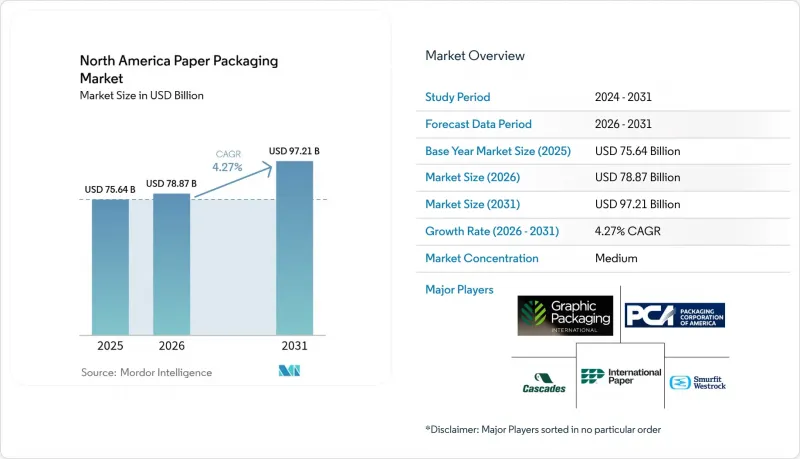
Mordor Intelligence에 의하면, 북미의 종이 포장 시장 규모는 2025년에 756억 4,000만 달러로 평가되었습니다. 2026년 788억 7,000만 달러에서 2031년까지 972억 1,000만 달러에 이를 것으로 예상되며, 예측 기간(2026-2031년) CAGR은 4.27%를 나타낼 전망입니다.
본 보고서는 소재 유형(크래프트지, 판지 등), 제품 유형(연질 종이 포장, 경질 종이 포장), 포장 형태(1차 포장, 2차 포장 등), 최종 이용 산업(식품, 음료, 헬스케어 및 의약품 등), 지역(미국, 캐나다, 멕시코)별로 분류되어 있습니다. 시장 전망은 금액(달러) 기준으로 제시되어 있습니다.
북미의 종이 포장 시장 동향 및 인사이트
전자상거래의 급속한 성장이 골판지 상자 수요를 견인
온라인 소매의 폭발적인 성장에 힘입어 2024년 골판지 상자 출하량은 18% 증가하여 북미의 종이 포장 시장을 지속적으로 견인했습니다. 현재 소비자 직접 판매 브랜드들은 제품을 보호하면서도 친환경성을 어필할 수 있는 적절한 크기에 브랜드 이미지를 반영한 상자를 원하고 있습니다. 인터내셔널 페이퍼(International Paper)의 전자상거래 부문은 2024년 4분기에 25%의 성장을 기록하며, 이러한 호재의 규모를 여실히 보여주었습니다. 디지털 인쇄기를 통해 긴 설정 시간 없이도 고화질 인쇄가 가능해져, 시즌 한정판이나 인플루언서 주도형 아트워크를 저비용으로 구현할 수 있습니다. 최종 소비자와 가까운 풀필먼트 센터는 배송 기간을 단축하고, 도시 지역 허브 주변에 수요를 집중시키기 때문에 지역 시트 공장에 유리하게 작용하고 있습니다. 골판지 표면에 내장된 스마트 코드나 NFC 태그는 데이터 루프를 형성하여 재고 계획 개선과 구매 후 고객 참여 증진에 기여합니다.
일회용 플라스틱에 관한 규제 변화
캘리포니아주의 SB 54 법안은 2032년까지 일회용 플라스틱 포장을 65% 감축할 것을 의무화하고 있으며, 캐나다의 전국적인 금지 조치로 인해 이미 일반적인 플라스틱 제품이 매장에서 사라지고, 그 수요가 섬유 기반 솔루션으로 이동하고 있습니다. 미국 12개 주의 ‘확대 생산자 책임(EPR)’ 법과 맞물려, 이러한 조치들로 인해 2027년까지 북미의 종이 포장 시장에서 23억 달러 규모의 추가적인 고정 수요가 창출될 전망입니다. PFAS 규제가 외식 산업의 형태를 재편하는 가운데, 배리어 코팅에 대한 전문 지식을 갖춘 컨버터들은 선구자로서의 우위를 확보하고 있습니다. 규제의 확실성으로 인해 지속 가능한 제지 공장에 대한 자본 투자가 가속화되고 있으며, 이로 인해 여전히 기존의 필름 라미네이션에 의존하고 있는 소규모 경쟁사들에 비해 대기업들이 선점 우위를 확보하고 있습니다.
섬유 공급의 변동성과 산림 파괴의 위험
2024년 펄프 가격의 22% 변동은 브리티시 컬럼비아주의 산불과 생물 다양성 보호를 목적으로 한 벌목 할당량 축소 때문이었습니다. 버진 펄프 공급 감소로 인해 제지 회사들은 폐지(OCC)에 대한 의존도를 높일 수밖에 없게 되었지만, 전자상거래용 골판지 상자가 가정에서 더 오랫동안 사용됨에 따라 재활용 물량이 공급을 따라잡는 데 어려움을 겪고 있습니다. 그 결과, 북미의 종이 포장 시장은 원자재 비용 상승을 흡수할 수밖에 없게 되었고, 이는 완제품 가격에 파급되고 있습니다. 인증 제도로 인해 규정 준수 비용이 증가하는 한편, 미국 남동부 산림을 강타한 허리케인 등으로 인한 물류 혼란으로 인해 가공업체들은 지역을 넘나들며 조달처를 다각화할 수밖에 없는 상황입니다. 재고 완충 장치는 충격을 완화해 주지만, 이익률에 민감한 환경에서는 자본을 묶어두게 됩니다.
부문 분석
2025년, 골판지는 북미의 종이 포장 시장의 53.92%를 차지하며, 전자상거래 주문 처리의 핵심으로서의 입지를 공고히 했습니다. 판지는 규모는 작지만, 프리미엄 브랜드들이 지속가능성과 진열 시의 호소력을 전달하는 고화질 그래픽이 적용된 카톤을 채택하고 있어 연평균 성장률(CAGR) 6.07%로 가장 빠른 성장이 예상됩니다. 북미의 종이 포장 시장에서 판지 제품이 차지하는 시장 규모는 2031년까지 현저하게 확대될 것으로 예측됩니다. Billerud사의 ‘FibreForm’과 같은 배리어 코팅이 적용된 등급은 과거 플라스틱에서만 볼 수 있었던 산소 투과성 기준에 필적하게 되어, 신선 식품 및 냉장 식품 유통 채널로의 진출이 가능해졌습니다. 각 골판지 제조업체들은 재생 소재 사용 의무를 활용하여 사용 후 소비자 포장재가 많이 포함된 라이너를 판매하고 있지만, 섬유 부족과 폐지(OCC) 가격 변동이 이익률에 압박을 주고 있습니다.
경량 마이크로 플루팅, 첨단 전분계 접착제, AI를 활용한 골판지 제조기를 통해 상자 제조 공장은 적층 강도를 저하시키지 않고 재료 중량을 줄일 수 있으며, 이는 브랜드 소유자에게 운송 비용 절감으로 이어집니다. 판지 가공업체들은 UV 잉크 시스템이나 호일을 사용하지 않는 메탈라이제이션 기술을 활용하여, 패키지의 재활용성을 유지하면서도 촉각적 매력을 높임으로써 북미의 종이 포장 시장 내 화장품 및 영양 보조 식품 분야에서의 입지를 확대되고 있습니다. 수직 통합형 대기업은 원가 수준에서 재고를 확보하고 있는 반면, 독립계 골판지 제조업체는 공급 리스크를 완화하기 위해 조달 제휴를 맺고 있습니다.
2025년, 북미의 종이 포장 시장에서 플렉서블 종이 포장은 54.05%의 점유율을 유지했습니다. 이는 다층 필름을 대체하는 퀵서비스용 랩, 스탠드업 파우치, 사셰 등이 뒷받침한 결과입니다. 이 부문의 연평균 성장률(CAGR)은 4.97%로, 가공업체들이 PE에 필적하는 밀봉 강도를 지닌 열밀봉 가능한 코팅을 도입하고 있다는 점에서 그 중요성을 입증하고 있습니다. 접이식 상자나 골판지 트레이와 같은 경질 포장은 매장 내 견고성과 내충격성이 요구되는 상황에서 여전히 필수적입니다. 그러나 브랜드들이 소재 사용량 감소와 개봉 편의성을 추구함에 따라 수요는 연포장 쪽으로 이동하고 있습니다.
몬디(Mondi)의 단일 소재 배리어 페이퍼를 통해 스낵 제조업체는 알루미늄이나 EVOH 사용을 피할 수 있고, 재활용 과정을 간소화하며, 브랜드의 지속가능성 평가를 높일 수 있습니다. 한편, 경질 포장 제조업체들은 정밀한 다이 커팅과 중첩 설계를 통해 혁신을 꾀하고, 공극률을 대폭 줄임으로써 북미의 종이 포장 시장에서 출하 단위당 환경 부하를 줄이고 있습니다. 두 제품 카테고리 모두 대량 생산에서 개인화를 실현하기 위해 디지털 장식을 모색하고 있지만, 재고 위험이 최소화되어 있기 때문에 시즌 한정 SKU의 대부분은 플렉서블 패키지가 차지하고 있습니다.
기타 혜택 :
- 엑셀 형식 시장 예측(ME) 시트
- 3개월간의 애널리스트 지원
자주 묻는 질문
목차
제1장 서론
제2장 조사 방법
제3장 주요 요약
제4장 시장 구도
제5장 시장 규모 및 성장 예측
제6장 경쟁 구도
제7장 시장 기회 및 향후 전망
KTH 26.09.10According to Mordor Intelligence, the North America paper packaging market size was valued at USD 75.64 billion in 2025 and estimated to grow from USD 78.87 billion in 2026 to reach USD 97.21 billion by 2031, at a CAGR of 4.27% during the forecast period (2026-2031).
This report is Segmented by Material Type (Kraft Paper, Paperboard, and More), Product Type (Flexible Paper Packaging, Rigid Paper Packaging), Packaging Format (Primary Packaging, Secondary Packaging, and More), End-Use Industry (Food, Beverage, Healthcare and Pharmaceuticals, and More), and Geography (United States, Canada, Mexico). The Market Forecasts are Provided in Terms of Value (USD).
North America Paper Packaging Market Trends and Insights
E-commerce Boom Elevates Corrugated-Box Demand
Explosive online retail growth lifted corrugated-box shipments by 18% in 2024 and continues to reinforce the North America paper packaging market. Direct-to-consumer brands now demand right-sized, brandable boxes that protect products while showcasing eco-credentials. International Paper's e-commerce segment expanded 25% in Q4 2024, underscoring the scale of this tailwind. Digital presses allow high-graphics runs without lengthy setups, enabling seasonal or influencer-driven artwork at low cost. Fulfillment centers nearer to end consumers shorten delivery windows and concentrate demand around urban hubs, advantaging local sheet plants. Smart codes and NFC tags embedded on corrugated surfaces create data loops that improve inventory planning and enhance post-purchase engagement.
Regulatory Shift from Single-Use Plastics
California's SB 54 requires a 65% reduction in single-use plastic packaging by 2032, and Canada's nationwide ban has already removed common plastic items from shelves, redirecting volumes toward fiber solutions. Together with Extended Producer Responsibility laws in 12 U.S. states, these measures generate an additional USD 2.3 billion in captive demand by 2027 for the North America paper packaging market. Converters with barrier-coating expertise gain first-mover advantage as PFAS restrictions reshape food service formats. Governance certainty accelerates capital commitments in sustainable mills, giving scale players a head start over smaller rivals still reliant on legacy film laminates.
Fiber-Supply Volatility and Deforestation Risk
Pulp price swings of 22% in 2024 stemmed from wildfires in British Columbia and tighter harvest quotas aimed at biodiversity protection. Virgin supply dips force mills to rely more on OCC, yet recycling streams struggle to keep pace as e-commerce boxes circulate longer inside households. The North America paper packaging market thus absorbs higher raw-material costs that ripple into finished goods pricing. Certification schemes raise compliance expenses, while logistics disruptions-such as hurricanes hitting Southeast U.S. forests-compel converters to diversify sources across regions. Inventory buffers mitigate shocks but tie up capital in a margin-sensitive environment.
Other drivers and restraints analyzed in the detailed report include:
- Brand Push for Sustainable Packaging
- Digital Printing Enables Mass-Customization
- Lightweight Flexible-Plastic Competition
For complete list of drivers and restraints, kindly check the Table Of Contents.
Segment Analysis
Corrugated board controlled 53.92% of the North America paper packaging market in 2025, cementing its position as the backbone of e-commerce fulfillment. Paperboard, while smaller, is slated for the fastest expansion at 6.07% CAGR as premium brands adopt high-graphics cartons that communicate sustainability and shelf appeal. The North America paper packaging market size attributable to paperboard formats is projected to widen noticeably through 2031. Barrier-coated grades, such as Billerud's FibreForm, now match oxygen-transmission benchmarks formerly exclusive to plastic, opening entree into fresh produce and chilled-food channels. Corrugated manufacturers leverage recycled-content mandates to market high-post-consumer liners, but fiber scarcity and OCC volatility put pressure on margins.
Lightweight micro-fluting, advanced starch adhesives, and AI-guided corrugators help box plants trim material weight without sacrificing stacking strength, translating into freight savings for brand owners. Paperboard converters bank on UV-ink systems and foil-free metallization to elevate tactile cues while keeping packs recyclable, broadening the North America paper packaging market appeal among cosmetics and nutraceuticals. Vertically integrated majors secure pulp at cost while independent carton makers strike sourcing alliances to buffer supply risk.
Flexible paper formats retained a 54.05% share of the North America paper packaging market in 2025, buoyed by quick-service wraps, stand-up pouches, and sachets that replace multilayer films. The segment's 4.97% CAGR underscores its relevance as converters integrate heat-sealable coatings that rival PE's seal strength. Rigid options like folding cartons and corrugated trays remain indispensable where on-shelf rigidity and impact resistance rule. However, demand bleeds toward flexibles when brands pursue material reduction and unboxing convenience.
Monomaterial barrier papers from Mondi let snack makers forego aluminum or EVOH, simplifying recycling streams and enhancing brand sustainability scores. Conversely, rigid producers innovate through precision die-cutting and nested designs that slash void ratios, reducing the North America paper packaging market size footprint per shipped item. Both product classes explore digital embellishment to unlock personalization at volume, but flexibles capture the lion's share of seasonal SKUs thanks to minimal inventory risk.
Complete Report Scope:
- By Material Type
- Kraft Paper
- Paperboard
- Corrugated Board
- Other Material Types
- By Product Type
- Flexible Paper Packaging
- Pouches and Bags
- Wraps and Films
- Other Flexible Paper Packaging
- Rigid Paper Packaging
- Folding Carton
- Corrugated Boxes
- Other Rigid Paper Packaging
- Flexible Paper Packaging
- By Packaging Format
- Primary Packaging
- Secondary Packaging
- Tertiary / Transit Packaging
- By End-Use Industry
- Food
- Beverage
- Healthcare and Pharmaceuticals
- Personal Care and Cosmetics
- Industrial and Electronic
- Other End-Use Industries
- By Country
- United States
- Canada
- Mexico
List of Companies Covered in this Report:
- International Paper Company
- Smurfit WestRock
- Packaging Corporation of America
- Graphic Packaging Holding Company
- Cascades Inc.
- Georgia-Pacific LLC
- Sonoco Products Company
- Amcor plc
- Mondi plc
- Clearwater Paper Corporation
- Sealed Air Corporation
- ProAmpac Holdings Inc.
- Pratt Industries Inc.
- Huhtamaki Oyj
- Pactiv Evergreen Inc.
- Reynolds Group Holdings Ltd.
- Kruger Packaging L.P.
- Stora Enso Oyj
Additional Benefits:
- The market estimate (ME) sheet in Excel format
- 3 months of analyst support
TABLE OF CONTENTS
1 INTRODUCTION
- 1.1 Study Assumptions and Market Definition
- 1.2 Scope of the Study
2 RESEARCH METHODOLOGY
3 EXECUTIVE SUMMARY
4 MARKET LANDSCAPE
- 4.1 Market Overview
- 4.2 Market Drivers
- 4.2.1 E-commerce boom elevates corrugated-box demand
- 4.2.2 Regulatory shift from single-use plastics
- 4.2.3 Brand push for sustainable packaging
- 4.2.4 Digital printing enables mass-customisation
- 4.2.5 Cold-chain meal-kit insulation needs
- 4.2.6 Scope-3 emissions accounting favours fibre
- 4.3 Market Restraints
- 4.3.1 Fibre-supply volatility and deforestation risk
- 4.3.2 Lightweight flexible-plastic competition
- 4.3.3 Energy-price shocks for recycled mills
- 4.3.4 Railcar shortages bottleneck containerboard
- 4.4 Impact of Macroeconomic Factors on the Market
- 4.5 Industry Value Chain Analysis
- 4.6 Regulatory Landscape
- 4.7 Technological Outlook
- 4.8 Porter's Five Forces Analysis
- 4.8.1 Bargaining Power of Suppliers
- 4.8.2 Bargaining Power of Buyers
- 4.8.3 Threat of New Entrants
- 4.8.4 Threat of Substitutes
- 4.8.5 Intensity of Competitive Rivalry
5 MARKET SIZE AND GROWTH FORECASTS (VALUE)
- 5.1 By Material Type
- 5.1.1 Kraft Paper
- 5.1.2 Paperboard
- 5.1.3 Corrugated Board
- 5.1.4 Other Material Types
- 5.2 By Product Type
- 5.2.1 Flexible Paper Packaging
- 5.2.1.1 Pouches and Bags
- 5.2.1.2 Wraps and Films
- 5.2.1.3 Other Flexible Paper Packaging
- 5.2.2 Rigid Paper Packaging
- 5.2.2.1 Folding Carton
- 5.2.2.2 Corrugated Boxes
- 5.2.2.3 Other Rigid Paper Packaging
- 5.2.1 Flexible Paper Packaging
- 5.3 By Packaging Format
- 5.3.1 Primary Packaging
- 5.3.2 Secondary Packaging
- 5.3.3 Tertiary / Transit Packaging
- 5.4 By End-Use Industry
- 5.4.1 Food
- 5.4.2 Beverage
- 5.4.3 Healthcare and Pharmaceuticals
- 5.4.4 Personal Care and Cosmetics
- 5.4.5 Industrial and Electronic
- 5.4.6 Other End-Use Industries
- 5.5 By Country
- 5.5.1 United States
- 5.5.2 Canada
- 5.5.3 Mexico
6 COMPETITIVE LANDSCAPE
- 6.1 Market Concentration
- 6.2 Strategic Moves
- 6.3 Market Share Analysis
- 6.4 Company Profiles {(includes Global-level Overview, Market-level Overview, Core Segments, Financials as available, Strategic Information, Market Rank/Share for key companies, Products and Services, and Recent Developments)}
- 6.4.1 International Paper Company
- 6.4.2 Smurfit WestRock
- 6.4.3 Packaging Corporation of America
- 6.4.4 Graphic Packaging Holding Company
- 6.4.5 Cascades Inc.
- 6.4.6 Georgia-Pacific LLC
- 6.4.7 Sonoco Products Company
- 6.4.8 Amcor plc
- 6.4.9 Mondi plc
- 6.4.10 Clearwater Paper Corporation
- 6.4.11 Sealed Air Corporation
- 6.4.12 ProAmpac Holdings Inc.
- 6.4.13 Pratt Industries Inc.
- 6.4.14 Huhtamaki Oyj
- 6.4.15 Pactiv Evergreen Inc.
- 6.4.16 Reynolds Group Holdings Ltd.
- 6.4.17 Kruger Packaging L.P.
- 6.4.18 Stora Enso Oyj
7 MARKET OPPORTUNITIES AND FUTURE OUTLOOK
- 7.1 White-space and Unmet-need Assessment