

|
시장보고서
상품코드
2120541
정밀농업 : 시장 점유율 분석, 업계 동향 및 통계, 성장 예측(2026-2031년)Precision Farming - Market Share Analysis, Industry Trends & Statistics, Growth Forecasts (2026 - 2031) |
||||||
 Mordor Intelligence
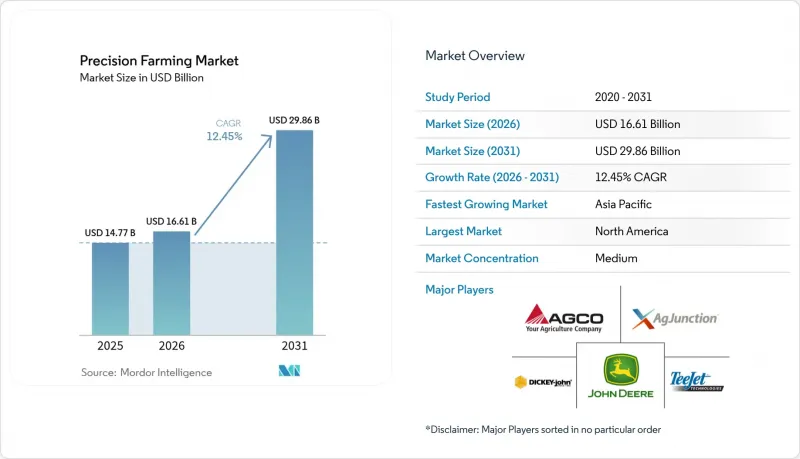
Mordor Intelligence에 의하면, 2026년 정밀농업 시장 규모는 166억 1,000만 달러로 추정되고 2025년 147억 7,000만 달러에서 확대해, 2031년에는 298억 6,000만 달러에 이를 것으로 예측됩니다.
2026년부터 2031년까지 연평균 성장률(CAGR) 12.45%로 성장할 것으로 전망됩니다.
본 보고서는 기술별(가이드 시스템, 원격 감지, 가변 비율 기술, 드론·무인 항공기(UAV), 기타), 구성 요소별(하드웨어, 소프트웨어, 서비스), 용도별(수확량 모니터링, 가변 살포, 농지 매핑, 토양 및 작물 건강 상태 모니터링, 기타), 농장 규모별(소규모, 중규모, 대규모 농장), 지역별로 분류되어 있습니다. 시장 예측은 금액(달러) 기준으로 제시되어 있습니다.
세계의 정밀농업 시장 동향 및 인사이트
대규모 농장에서 GNSS 지원 자동 조향 시스템 도입 급증
1,000헥타르를 초과하는 농장의 GNSS 자동 조향 시스템 도입률은 70%에 달하며, 중규모 농장의 52%를 상회하고 있습니다. 이러한 추세는 더 많은 위성 대역을 포착하여 수렴 속도를 높이는 존 디어(John Deere)사의 ‘StarFire 7000’ 수신기의 보급에 힘입어 정밀농업 시장을 더욱 형성하고 있습니다. 스페이스X(SpaceX)의 ‘스타링크(Starlink)’는 휴대전화 네트워크를 이용할 수 없는 지역에서도 안내 데이터를 백홀로 전송하여, 사업자가 밤낮을 가리지 않고 자율 주행을 할 수 있도록 지원합니다. AGCO의 ‘아웃런(OutRun)’ 개조 설치 키트는 타사 브랜드 트랙터에도 호환되므로, 다양한 기계 유형이 혼재된 농장에서 조향 기능을 쉽게 업그레이드할 수 있습니다. 인력 부족이 심화되는 가운데, 부족한 운전자를 대신해 로봇을 도입함으로써 완벽하게 일직선인 줄을 유지하고, 작업 중복을 억제하며, 디젤 연료를 절약할 수 있어 그 가치는 더욱 높아지고 있습니다. 연료비 절감과, 작물 재배 기간이 제한된 상황에서 기계의 가동 시간을 최대한 활용함으로써 투자 대비 효과는 더욱 높아집니다.
다중 스펙트럼 및 열화상 드론 센서의 급격한 비용 하락
현재 전 세계적으로 30만 대 이상의 농업용 드론이 5억 헥타르 이상의 농지를 관리하고 있으며, DJI의 ‘Mavic 3 Multispectral’은 과거 대규모 농장만이 이용할 수 있었던 가격대를 밑돌고 있습니다. 몬태나주의 밀 농장에서 실시한 검사 결과, 스팟 살포용 드론을 WEED-IT 비전 시스템과 결합함으로써 제초제 사용량을 90-95% 줄일 수 있는 것으로 나타났습니다. 센서의 소형화로 탑재 중량이 줄어들어, 엽록소나 수관 수분량을 측정하기 위한 분광 분해능을 유지하면서도 비행 지속 시간이 2배로 늘어났습니다. 브라질과 미국의 규제 완화로 시야 외 비행의 운용 범위가 확대되어 광활한 농지에서 도입이 가속화되고 있습니다. AI를 활용한 이상 감지를 통해 영양 스트레스를 육안보다 1주일 빨리 파악할 수 있게 되어, 생산자는 수확량 감소가 발생하기 전에 적절한 대책을 강구할 수 있게 되었습니다.
서로 다른 제조업체의 기계 간 데이터 상호 운용성 격차
생산자의 약 73%가 여러 OEM 제조업체의 트랙터, 파종기, 살포기를 병용하고 있으며, 이는 데이터 사일로를 생성하여 종단간 분석을 방해하고 있습니다. OGC의 SensorThings API는 지리 공간 데이터 및 농업 기계 데이터를 위한 범용 래퍼를 제공하겠다고 약속하고 있지만, 독자적인 형식의 파일과 서로 다른 CAN 버스 프로토콜이 원활한 데이터 흐름을 방해하고 있습니다. AGCO와 Trimble의 합작 사업인 ‘PTx’는 브랜드에 구애받지 않는 조향 기능과 데이터 동기화를 약속하고 있지만, 구형 기계에 사후 장착하려면 막대한 비용이 소요되며 딜러의 전문 지식이 필요합니다. 유럽에서의 개방형 표준 및 MQTT 전송 계층 추진은 긍정적인 신호이지만, 상품화를 우려하는 중소 벤더들의 도입은 더딘 실정입니다. 표준화가 진전되지 않으면 농업 종사자들은 계속해서 USB 메모리나 클라우드 포털을 활용해야만 하며, 완전한 자율화가 가져다줄 생산성 향상의 혜택을 충분히 누리지 못하게 될 것입니다.
부문별 분석
2025년, 가이던스 시스템은 정밀농업 시장에서 37.45%라는 최고 점유율을 유지했습니다. 이는 기복이 심한 지형에서도 기계를 1인치 이하의 정밀도로 유도하는 견고한 GNSS 수신기에 의해 뒷받침되고 있습니다. 가변 시비 기술 분야의 정밀농업 시장 규모는 2031년까지 연평균 성장률(CAGR) 13.55%로 확대될 것으로 예측됩니다. 이는 비료 및 농약 가격의 급등으로 인해 표적 시비가 촉진되고 있기 때문입니다. 드론을 활용한 원격 감지 분야에서는 보다 저렴한 다중 스펙트럼 센서가 활용되고 있으며, DJI의 보고에 따르면 지도 데이터를 기반으로 혼합 살포기를 제어함으로써 농약 사용량을 67.78% 절감할 수 있었다고 합니다. 벤처 자금이 엣지 AI 플랫폼으로 이동하는 가운데, 로봇 도입이 확대되고 있습니다. Four Growers와 Bonsai Robotics는 50만 에이커 규모의 농지에서 수확 자동화를 위해 총 2,400만 달러를 조달했습니다. 위성 IoT는 이 시스템을 보완하여, 휴대전화 신호가 닿지 않는 농지에서 전송되는 센서 데이터를 중계함으로써 자율 주행 모듈용 모델을 항상 최신 상태로 유지합니다.
엣지와 클라우드 분석은 연계되어 작동합니다. 엣지 하드웨어가 영상 스트림을 실시간으로 처리하는 한편, 클라우드 엔진이 계절적 패턴을 분석합니다. John Deere의 2세대 자율 주행 스택은 이 두 계층을 통합하여, 금세기 말까지 옥수수와 대두의 완전한 자율 주행을 실현하는 것을 목표로 하고 있습니다. 농업 종사자들은 단일 브랜드의 장비로 교체하기보다 여러 브랜드의 장비를 혼합한 차량을 개조하는 것을 점점 더 선호하고 있으며, AGCO는 고비용이 드는 트랙터 교체를 불필요하게 만드는 ‘OutRun’ 키트를 통해 이러한 변화를 잘 활용했습니다. 이러한 동향을 고려할 때, 오픈 API와 하드웨어에 의존하지 않는 구성 요소를 결합한 기술 공급업체야말로 경작 면적 확대를 가장 효과적으로 포착할 수 있는 위치에 있습니다.
2025년에는 센서, 컨트롤러, 드론, 자율 주행 플랫폼을 포함한 하드웨어가 정밀농업 시장의 51.20%를 차지했습니다. 그러나 엣지 AI가 네트워크 연결이 끊긴 경우에도 수 초 이내에 실행 가능한 배합을 제공하기 때문에 소프트웨어 매출은 연평균 성장률(CAGR) 13.40%로 증가하고 있습니다. 센서는 우표 크기 정도로 소형화되어, 소규모 농업 종사자라도 가변율 관개 지도의 기반이 되는 고밀도 토양 수분 측정 그리드를 도입할 수 있게 되었습니다. 존 디어(John Deere)사의 G5-Plus와 같은 디스플레이는 이더넷 기능을 탑재하여 작업 기기에서 운전석으로 더 풍부한 데이터 세트를 전송합니다. 차량용 컴퓨터는 GNSS, 머신 비전, 텔레메트리를 단일 보드에 통합하여 자율 주행 루프의 지연을 대폭 줄이고 있습니다.
농업 사업자들이 소프트웨어 패치 적용이나 사이버 위협의 실시간 모니터링을 제3자 파트너에 의존하게 됨에 따라, 관리형 서비스 분야의 정밀농업 시장 규모는 확대될 전망입니다. CNH와 Raven의 데이터 분석 제품군은 AI 기반 선택적 살포를 통해 제초제 사용량을 77% 줄여줍니다. 위성 백홀을 통해 농장 작업 중 배합 데이터의 동기화가 보장되며, 4G 통신을 이용할 수 없는 농지의 77%에 있어 이는 매우 중요한 페일세이프 기능이 됩니다. 하드웨어 이익률이 압박받는 가운데, 각 벤더들은 업데이트, 알고리즘, 탄소 크레딧 보고 대시보드를 묶은 구독 서비스를 통해 지속적인 수익원을 모색하고 있습니다.
지역별 분석
북미는 2025년, 성숙한 GNSS 네트워크, 확립된 딜러 생태계, 탄소 프로그램에서 디지털 기록을 인정하는 규제 환경의 뒷받침을 받아 지역 점유율 41.15%를 유지했습니다. 신흥 지역에 비해 시장 성장률은 정체되어 있지만, 이는 2025년 농업 종사자 인식 조사에서 상품 가격 변동을 배경으로 신중한 자본 계획이 나타난 것도 한 원인입니다. 구형 디스플레이의 활발한 교체 주기와 완전한 기계 자율화로의 확대로 인해, 이 대륙 수요 하한선은 유지될 전망입니다.
아시아태평양은 정밀농업 시장에서 13.95%라는 가장 높은 성장률을 기록했습니다. 이는 2028년까지 8억 8,621만 달러에 달할 것으로 예상되는 인도의 스마트 농업 시장과, 중국의 디지털 농업에 대한 정책적 의무화가 원동력이 되고 있습니다. 정부 자금을 통한 위성 군집, 저비용 드론, 농촌 지역 광대역 투자가 소규모 농업 종사자들의 농지에 대한 도입을 뒷받침하고 있습니다. 2024년에는 12억 달러가 넘는 벤처 캐피털 자금이 자동화된 과수원용 살포기 및 투입 자재 대출을 센서로 검증된 농장 데이터와 연계하는 농업 핀테크 신용 평가에 집중되었습니다. 호주에서는 만성적인 노동력 부족을 완화하기 위한 자율 주행형 대규모 농기계 군의 도입으로 경작 면적이 점차 확대되고 있습니다.
유럽에서는 2030년까지 화학 물질 사용량을 50% 감축하도록 의무화하는 환경 규제 하에서 착실하게 진전되고 있으며, 정밀 살포가 규제 준수의 수단으로 자리 잡고 있습니다. 독일에서 실시된 현장 검사에서는 수확량을 희생하지 않고도 농약 사용량을 10-20% 줄일 수 있음이 확인되어, 농업 종사자들의 신뢰가 높아지고 있습니다. 라틴아메리카의 도입 속도는 지역별로 차이가 있습니다. 브라질과 아르헨티나에서는 가뭄으로 인한 수입 감소로 2024년 트랙터 구매가 14% 감소했으나, 규제 완화로 인해 드론을 이용한 살포는 가속화되었습니다. 중동 및 아프리카에서는 도입이 아직 초기 단계에 있습니다. 사하라 이남 아프리카의 농업 종사자들에게 RTK 네트워크 커버리지가 40%에서 정체된 상황에서 위성 IoT는 생명줄과도 같지만, 비용 대비 효과 문제와 기술력 부족으로 인해 도입 속도가 더딘 임베디드니다.
기타 혜택
- 엑셀 형식 시장 예측(ME) 시트
- 3개월간의 애널리스트 지원
자주 묻는 질문
목차
제1장 서론
제2장 조사 방법
제3장 주요 요약
제4장 시장 구도
제5장 시장 규모 및 성장 예측
제6장 경쟁 구도
제7장 시장 기회 및 향후 전망
KTH 26.09.04According to Mordor Intelligence, precision farming market size in 2026 is estimated at USD 16.61 billion, growing from 2025 value of USD 14.77 billion with 2031 projections showing USD 29.86 billion, growing at 12.45% CAGR over 2026-2031.

This report is Segmented by Technology (Guidance Systems, Remote Sensing, Variable-Rate Technology, Drones and UAVs, and More), Component (Hardware, Software, and Services), Application (Yield Monitoring, Variable-Rate Application, Field Mapping, Soil and Crop Health Monitoring, and More), Farm Size (Small, Medium, and Large Farms), and Geography. The Market Forecasts are Provided in Terms of Value (USD).
Global Precision Farming Market Trends and Insights
GNSS-Enabled Auto-Steering on Large Farms
Adoption of GNSS auto-steering has reached 70% on farms over 1,000 ha versus 52% on midsize holdings, a trend increasingly shaping the precision farming market, aided by John Deere's StarFire 7000 receiver that locks onto more satellite bands for faster convergence. SpaceX Starlink backhauls the guidance data where cellular networks fail, letting operators run autonomous passes throughout the day and night. AGCO's OutRun retrofit kit democratizes steering upgrades for mixed fleets, supporting tractors from rival brands. Labor shortages heighten the value proposition by substituting scarce operators with robotics that maintain perfectly straight rows, suppress overlap, and conserve diesel. Return on investment is amplified through reduced fuel costs and higher field-hour utilization that push machinery farther during tight planting windows.
Rapid Cost Declines in Multispectral/Thermal Drone Sensors
More than 300,000 agricultural drones now treat over 500 million ha worldwide, with DJI's Mavic 3 Multispectral priced below the threshold once reserved for large farms. Farm trials on Montana wheat show 90-95% herbicide savings when spot-spray drones are paired with WEED-IT vision systems. Sensor miniaturization has lowered payload weight, doubling flight endurance while preserving spectral resolution for chlorophyll and canopy moisture readings. Regulatory easing in Brazil and the United States has widened the operational envelope for beyond-visual-line-of-sight flights, accelerating adoption on broad-acre crops. AI-enabled anomaly detection now flags nutrient stress a week sooner than the naked eye, letting growers intervene before yield loss sets in.
Data-Interoperability Gaps Among Mixed-Brand Machinery
Roughly 73% of growers operate tractors, planters, and sprayers from multiple OEMs, creating data silos that handicap end-to-end analytics. The OGC SensorThings API promises a universal wrapper for geospatial and machinery data, yet proprietary file formats and differing CAN bus protocols block seamless flows. AGCO's PTx Trimble venture pledges brand-agnostic steering and data sync, but retrofits on legacy rigs are costly and require dealership expertise. Europe's push for open standards and MQTT transport layers is a positive signal, though adoption lags smaller vendors who fear commoditization. Without convergence, farmers continue to juggle USB sticks and cloud portals, capping the productivity gains that full autonomy could deliver.
Other drivers and restraints analyzed in the detailed report include:
- Carbon-Credit Schemes Rewarding Variable-Rate Input Cuts
- Satellite IoT Constellations for Sub-Inch Telemetry
- Rural Cybersecurity Threats Targeting Farm OT Networks
For complete list of drivers and restraints, kindly check the Table Of Contents.
Segment Analysis
Guidance Systems held the leading 37.45% precision farming market share in 2025, sustained by robust GNSS receivers that steer machinery to sub-inch paths under variable terrain. The precision farming market size for Variable-Rate Technology is forecast to grow at a 13.55% CAGR through 2031, driven by rising fertilizer and chemical prices that incentivize targeted application. Drone-based remote sensing leverages cheaper multispectral payloads, with DJI reporting a 67.78% cut in chemical volumes when maps feed prescription sprayers. Robots are gaining traction as venture funding pivots to edge-AI platforms; Four Growers and Bonsai Robotics collectively raised USD 24 million to automate harvesting on 500,000 acres. Satellite IoT rounds out the stack, relaying sensor inputs from fields outside cellular reach so models stay current for autonomy modules.
Edge and cloud analytics work in tandem: edge hardware processes vision streams in real time, while cloud engines crunch seasonal patterns. John Deere's second-generation autonomy stack merges both layers to target full corn and soybean autonomy by decade's end. Farmers increasingly prefer mixed-fleet retrofits over single-brand replacements, a shift AGCO capitalized on with its OutRun kit that omits a high-cost tractor swap. Given these dynamics, technology suppliers who pair open APIs with hardware-agnostic components are best positioned to capture incremental acreage.
Hardware captured 51.20% of the precision farming market in 2025, covering sensors, controllers, drones, and autonomous platforms. Yet, software revenue is climbing at a 13.40% CAGR as edge-AI delivers actionable prescriptions within seconds, even when the network drops. Sensors have shrunk to postage-stamp footprints, letting small farms afford dense soil-moisture grids that feed variable-rate irrigation maps. Displays like John Deere's G5-Plus add Ethernet to pass richer datasets from implements back to the cab. On-board computers integrate GNSS, machine vision, and telemetry onto a single board, slashing latency for autonomy loops.
The precision farming market size for managed services is set to widen as operators lean on third-party partners to patch software and monitor cyber threats in real time. Data analytics suites from CNH and Raven trim herbicide by 77% with AI-directed selective spraying. Satellite backhaul ensures prescriptions sync during fieldwork, a crucial fail-safe for 77% of cropland without 4G. As hardware margins compress, vendors seek recurring revenue through subscriptions that bundle updates, algorithms, and carbon-credit reporting dashboards.
Complete Report Scope:
- By Technology
- Guidance Systems
- GNSS / GPS
- GIS
- Variable-Rate Technology
- Variable-Rate Fertilizer
- Variable-Rate Seeding
- Variable-Rate Pesticide
- Remote Sensing
- Drones and UAVs
- Robotics and Autonomous Equipment
- Edge and Cloud Analytics Platforms
- Other Technologies
- Guidance Systems
- By Component
- Hardware
- Sensors and Actuators
- Controllers and Displays
- On-board Computing and Connectivity
- Software
- Farm-Management SaaS
- Data Analytics and AI
- Services
- Integration and Consulting
- Managed Services
- Hardware
- By Application
- Yield Monitoring
- Variable-Rate Application
- Field Mapping
- Soil and Crop Health Monitoring
- Irrigation Management
- Crop Scouting
- Harvest Automation and Logistics
- Other Applications
- By Farm Size
- Small Farms (less than 100 ha)
- Medium Farms (100 - 1,000 ha)
- Large Farms (greater than 1,000 ha)
- By Geography
- North America
- United States
- Canada
- Mexico
- South America
- Brazil
- Argentina
- Rest of South America
- Europe
- Germany
- United Kingdom
- France
- Spain
- Italy
- Netherlands
- Rest of Europe
- Asia-Pacific
- China
- Japan
- India
- Australia
- South Korea
- Rest of Asia-Pacific
- Middle East and Africa
- Middle East
- Saudi Arabia
- United Arab Emirates
- Turkey
- Rest of Middle East
- Africa
- South Africa
- Nigeria
- Kenya
- Rest of Africa
- Middle East
- North America
Geography Analysis
North America retained 41.15% regional share in 2025, aided by mature GNSS networks, an established dealer ecosystem, and a regulatory environment that recognizes digital records for carbon programs. The market has plateaued in growth rate relative to emerging regions, partly because 2025 farmer sentiment surveys show cautious capital plans amid volatile commodity prices. Nevertheless, active replacement cycles for legacy displays and expansion into full-machine autonomy should preserve the continent's demand floor.
The Asia-Pacific region recorded the fastest growth rate of 13.95% in the precision farming market, propelled by India's smart-ag market, projected to reach USD 886.21 million by 2028, and China's policy mandates around digital agriculture. Government-funded satellite constellations, low-cost drones, and rural broadband investments underpin adoption across smallholder plots. Venture capital flows of more than USD 1.2 billion in 2024 concentrated on automated orchard sprayers and agri-fintech credit scoring that ties input loans to sensor-verified field data. Australia adds incremental acreage with autonomous broad-acre fleets that alleviate chronic labor shortages.
Europe advances steadily under environmental legislation requiring a 50% cut in chemicals by 2030, positioning precision spraying as a compliance lever. Field trials in Germany confirm 10-20% pesticide reductions without yield sacrifice, bolstering farmer confidence. Latin America's adoption pace diverges: Brazil and Argentina slowed tractor purchases by 14% in 2024 due to drought-linked income declines, yet accelerated drone spraying after regulatory relaxation. The Middle East and Africa remain early in the curve; satellite IoT is a lifeline for Sub-Saharan growers where RTK networks stall at 40% coverage, but affordability and skills gaps temper speed.
- Deere and Company
- Trimble Inc.
- AGCO Corporation
- CNH Industrial N.V.
- Raven Industries
- Topcon Positioning Systems
- Lindsay Corporation
- TeeJet Technologies
- DICKEY-john
- BASF Digital Farming (xarvio)
- Yara International ASA
- Climate Corp (Bayer)
- Hexagon Agriculture
- CropX Technologies
- DJI Agriculture
- Farmers Edge
- Granular
- Ag Leader Technology
- Kubota Smart Agri
- Sentera
Additional Benefits:
- The market estimate (ME) sheet in Excel format
- 3 months of analyst support
TABLE OF CONTENTS
1 INTRODUCTION
- 1.1 Study Assumptions and Market Definition
- 1.2 Scope of the Study
2 RESEARCH METHODOLOGY
3 EXECUTIVE SUMMARY
4 MARKET LANDSCAPE
- 4.1 Market Overview
- 4.2 Market Drivers
- 4.2.1 Surge in GNSS-enabled auto-steering adoption on large farms
- 4.2.2 Rapid cost declines in multispectral/thermal drone sensors
- 4.2.3 Government carbon-credit schemes rewarding variable-rate input cuts
- 4.2.4 Integration of satellite IoT constellations for sub-inch field telemetry
- 4.2.5 Insurance discounts for farms deploying AI-based risk scoring
- 4.2.6 Venture funding shift from farm-management SaaS to edge-AI robotics
- 4.3 Market Restraints
- 4.3.1 Data-interoperability gaps among mixed-brand machinery
- 4.3.2 Rural cybersecurity threats targeting farm OT networks
- 4.3.3 Plateauing RTK-network coverage in Sub-Saharan Africa
- 4.3.4 Farmer resistance to algorithmic decision loss of autonomy
- 4.4 Industry Ecosystem Analysis
- 4.5 Regulatory Landscape
- 4.6 Technological Outlook
- 4.7 Porter's Five Forces Analysis
- 4.7.1 Bargaining Power of Buyers
- 4.7.2 Bargaining Power of Suppliers
- 4.7.3 Threat of New Entrants
- 4.7.4 Threat of Substitutes
- 4.7.5 Intensity of Competitive Rivalry
5 MARKET SIZE AND GROWTH FORECASTS (VALUE)
- 5.1 By Technology
- 5.1.1 Guidance Systems
- 5.1.1.1 GNSS / GPS
- 5.1.1.2 GIS
- 5.1.2 Variable-Rate Technology
- 5.1.2.1 Variable-Rate Fertilizer
- 5.1.2.2 Variable-Rate Seeding
- 5.1.2.3 Variable-Rate Pesticide
- 5.1.3 Remote Sensing
- 5.1.4 Drones and UAVs
- 5.1.5 Robotics and Autonomous Equipment
- 5.1.6 Edge and Cloud Analytics Platforms
- 5.1.7 Other Technologies
- 5.1.1 Guidance Systems
- 5.2 By Component
- 5.2.1 Hardware
- 5.2.1.1 Sensors and Actuators
- 5.2.1.2 Controllers and Displays
- 5.2.1.3 On-board Computing and Connectivity
- 5.2.2 Software
- 5.2.2.1 Farm-Management SaaS
- 5.2.2.2 Data Analytics and AI
- 5.2.3 Services
- 5.2.3.1 Integration and Consulting
- 5.2.3.2 Managed Services
- 5.2.1 Hardware
- 5.3 By Application
- 5.3.1 Yield Monitoring
- 5.3.2 Variable-Rate Application
- 5.3.3 Field Mapping
- 5.3.4 Soil and Crop Health Monitoring
- 5.3.5 Irrigation Management
- 5.3.6 Crop Scouting
- 5.3.7 Harvest Automation and Logistics
- 5.3.8 Other Applications
- 5.4 By Farm Size
- 5.4.1 Small Farms (less than 100 ha)
- 5.4.2 Medium Farms (100 - 1,000 ha)
- 5.4.3 Large Farms (greater than 1,000 ha)
- 5.5 By Geography
- 5.5.1 North America
- 5.5.1.1 United States
- 5.5.1.2 Canada
- 5.5.1.3 Mexico
- 5.5.2 South America
- 5.5.2.1 Brazil
- 5.5.2.2 Argentina
- 5.5.2.3 Rest of South America
- 5.5.3 Europe
- 5.5.3.1 Germany
- 5.5.3.2 United Kingdom
- 5.5.3.3 France
- 5.5.3.4 Spain
- 5.5.3.5 Italy
- 5.5.3.6 Netherlands
- 5.5.3.7 Rest of Europe
- 5.5.4 Asia-Pacific
- 5.5.4.1 China
- 5.5.4.2 Japan
- 5.5.4.3 India
- 5.5.4.4 Australia
- 5.5.4.5 South Korea
- 5.5.4.6 Rest of Asia-Pacific
- 5.5.5 Middle East and Africa
- 5.5.5.1 Middle East
- 5.5.5.1.1 Saudi Arabia
- 5.5.5.1.2 United Arab Emirates
- 5.5.5.1.3 Turkey
- 5.5.5.1.4 Rest of Middle East
- 5.5.5.2 Africa
- 5.5.5.2.1 South Africa
- 5.5.5.2.2 Nigeria
- 5.5.5.2.3 Kenya
- 5.5.5.2.4 Rest of Africa
- 5.5.5.1 Middle East
- 5.5.1 North America
6 COMPETITIVE LANDSCAPE
- 6.1 Market Concentration
- 6.2 Strategic Moves
- 6.3 Market Share Analysis
- 6.4 Company Profiles (includes Global level Overview, Market level overview, Core Segments, Financials as available, Strategic Information, Market Rank/Share for key companies, Products and Services, and Recent Developments)
- 6.4.1 Deere and Company
- 6.4.2 Trimble Inc.
- 6.4.3 AGCO Corporation
- 6.4.4 CNH Industrial N.V.
- 6.4.5 Raven Industries
- 6.4.6 Topcon Positioning Systems
- 6.4.7 Lindsay Corporation
- 6.4.8 TeeJet Technologies
- 6.4.9 DICKEY-john
- 6.4.10 BASF Digital Farming (xarvio)
- 6.4.11 Yara International ASA
- 6.4.12 Climate Corp (Bayer)
- 6.4.13 Hexagon Agriculture
- 6.4.14 CropX Technologies
- 6.4.15 DJI Agriculture
- 6.4.16 Farmers Edge
- 6.4.17 Granular
- 6.4.18 Ag Leader Technology
- 6.4.19 Kubota Smart Agri
- 6.4.20 Sentera
7 MARKET OPPORTUNITIES AND FUTURE OUTLOOK
- 7.1 White-space and Unmet-Need Assessment


