

|
시장보고서
상품코드
2124966
유럽의 정밀농업 : 시장 점유율 분석, 업계 동향과 통계, 성장 예측(2026-2031년)Europe Precision Farming - Market Share Analysis, Industry Trends & Statistics, Growth Forecasts (2026 - 2031) |
||||||
 Mordor Intelligence
Mordor Intelligence에 의하면, 유럽의 정밀농업 시장 규모는 2026년에 26억 2,000만 달러로 추정되고, 2031년까지 47억 5,000만 달러에 이를 것으로 예측되며, CAGR은 12.64%를 기록할 전망입니다.
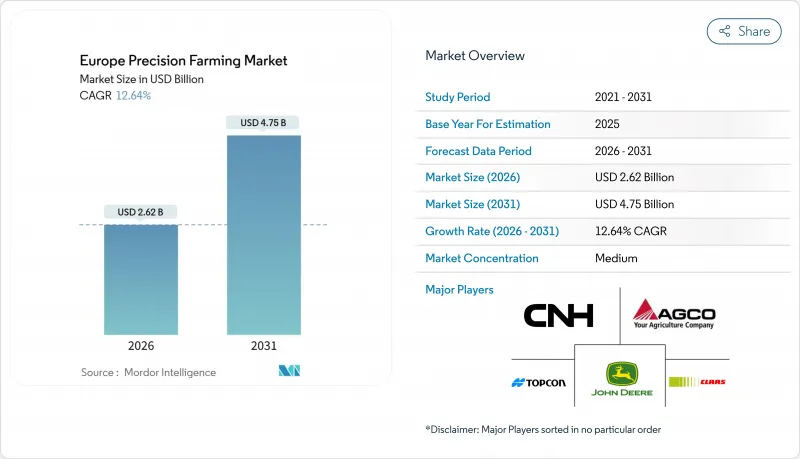
본 보고서는 기술별(가이드 시스템, 원격 감지 등), 구성 요소별(하드웨어, 소프트웨어, 서비스),용도별(수확량 모니터링, 가변 시비 등), 농장 규모별(소규모 등), 작물 유형별(곡물 등), 지역별(독일, 프랑스 등)로 분류되어 있습니다. 시장 예측은 금액(달러)으로 표시되어 있습니다.
유럽의 정밀농업 시장 동향 및 인사이트
디지털 도입을 가속화하는 정부 보조금
유럽연합(EU) 회원국들은 공동농업정책(CAP) 예산에서 수십억을 정밀농업 지원에 할당하여, 소규모 농가의 하드웨어 비용 상당 부분을 보조하고 있습니다. 프랑스에서는 소프트웨어 이용료에 대한 세액 공제 제도를 마련하여, 이를 통해 더 많은 농가가 디지털 플랫폼을 이용하도록 장려하고 있습니다. 2024년에는 이러한 세액 공제를 통해 7억 5,600만 유로(8억 3,000만 달러)가 회수되었는데, 이는 5년 전 제도가 도입되었을 당시의 2억 7,700만 유로(3억 500만 달러)에서 증가한 수치입니다. 독일은 자율형 농업 기계를 대상으로 한 대규모 보조금 프로그램을 시작했으며, 도입을 가속화하기 위해 생산자 협동조합을 우선적으로 지원하고 있습니다. 보조금 제도는 동유럽에서 특히 큰 영향력을 발휘하고 있으며, 해당 지역의 사업자들은 첨단 센서 네트워크로 직접 전환함으로써 도입 주기를 단축하고 있습니다. 이러한 재정 지원으로 인해 위험에 대한 인식이 완화되고, 은행 대출이 촉진되며, 정밀 농업 시장 전체의 기초적인 수요가 증가하고 있습니다.
AI, IoT, 5G를 활용한 분석 기술의 급속한 발전
현재 유럽 농지의 대부분에서 5G의 농촌 지역 커버리지가 확대되고 있어, 트랙터에서 클라우드 기반 모델로의 실시간 동영상 스트리밍이 가능해졌습니다. 기상 데이터와 연동된 IoT 토양 센서는 수확량 저하를 초래하지 않으면서도 상당한 절수 효과를 입증하고 있어, 커넥티드 시스템의 즉각적인 이점을 보여주고 있습니다. 첨단 살포 기술을 도입한 농가에서는 제초제 사용량이 대폭 감소했다는 보고가 있어, 비용 절감과 환경적 이점이 확인되고 있습니다. 엣지 컴퓨팅을 통해 지연 시간이 밀리초 단위로 단축되어, 자율 시스템이 고랑별로 파종량을 조정할 수 있게 되었습니다. AI와 연결성이 결합되면서 정밀 농업은 단순한 상황 파악에서 구체적인 행동 지침으로 진화했으며, 디지털화된 농장과 기존 농장 간의 격차를 더욱 벌리고 있습니다.
인력 부족이 자율형 기계의 보급을 촉진
농업 종사자 수는 꾸준히 감소하고 있어, 임금 상승과 성수기의 병목 현상을 더욱 심각하게 만들고 있습니다. 인건비가 높은 국가에서는 자율 주행 트랙터가 이미 수천 시간 동안 무인 운행을 수행하며 농장 운영 부담을 경감시키고 있습니다. 새로운 시스템 덕분에 한 명의 조작자가 여러 대의 기계를 동시에 모니터링할 수 있게 되어 현장 효율이 3배 향상되었습니다. 인건비 상승이 지속되는 가운데, 과일 및 채소 재배 현장에서는 로봇 수확기가 도입되고 있습니다. 자율 주행 차량에 대한 규제 당국의 승인은 더 광범위한 도입의 길을 열어주고 있으며, 노동력 부족 해결에 있어 자동화가 중심적인 역할을 할 것임을 시사하고 있습니다.
부문 분석
가이드 시스템은 유럽의 정밀 농업 시장에서 여전히 핵심을 이루고 있으며, 2025년에는 43.5%라는 최대 점유율을 차지할 것으로 전망됩니다. 이러한 우위는 곡물 농장에서의 광범위한 도입에 기인하며, 자동 조향 기능이 탑재된 콤바인은 연료비와 인건비를 즉각적으로 절감해 주고 있습니다. 디지털 활용 능력에 대한 요구 사항이 최소화되어 사용하기 쉬우며, 꾸준한 교체 수요가 보장되고 있습니다. 그러나 도입 기반이 성숙해짐에 따라 성장은 둔화되고 있으며, 신규 도입보다는 단계적인 업그레이드로 초점이 이동하고 있습니다. 안내 시스템은 기존의 수익원으로 여전히 확고한 입지를 차지하고 있으며, 가장 정착된 기술로서의 역할을 강화하고 있습니다.
대조적으로, 드론은 가장 빠르게 성장하는 기술로, 2031년까지 연평균 성장률(CAGR) 11.1%로 확대되고 있습니다. 그 매력은 혁신에 대한 투자에 있으며, 선진적인 농가들은 드론 이미지와 위성 지도를 통합하여 가변 시비 계획을 정교화하고 있습니다. 기업 소프트웨어가 원시 이미지를 실용적인 시비 구역으로 변환함에 따라, 초기 애호가층을 넘어 도입이 확대되고 있습니다. 원격 감지, 엣지 센서, 디지털 트윈과 같은 신흥 도구는 저비용 프로세서와 확대되는 5G 연결에 힘입어 탄력을 받고 있습니다. 드론은 혁신에 대한 투자가 정밀 농업의 기술 구성을 어떻게 변화시키고 있는지를 여실히 보여줍니다.
하드웨어는 여전히 지출의 대부분을 차지하고 있으며, 2025년 유럽의 정밀농업 시장 규모에서 48.2%라는 가장 큰 점유율을 차지하고 있습니다. GPS 수신기, 카메라, 컨트롤러와 같은 내구성이 뛰어난 장비는 여전히 밭 작업에 필수적입니다. 단가는 하락하고 있지만, 농장이 생산성을 유지하기 위해서는 구체적인 도구가 필요하기 때문에 총 수요는 견조합니다. 하드웨어의 확고한 역할은 그 지속적인 중요성을 보장하지만, 성장 궤도는 디지털 솔루션에 비해 완만합니다. 이 부문은 정밀 농업에서 물리적 인프라에 대한 뿌리 깊은 수요를 반영하며, 시장의 기반을 지탱하고 있습니다.
반면, 소프트웨어는 가장 빠르게 성장하는 분야로, 2031년까지 연평균 성장률(CAGR) 11.2%로 확대되고 있습니다. 각 벤더들은 지속적인 업그레이드를 가능하게 하고 초기 비용을 절감하는 구독형 클라우드 모델로 전환하고 있습니다. 이러한 아키텍처는 그동안 자금 면에서 장벽에 직면해 있던 중규모 농업 경영자들을 끌어들이고 있습니다. 또한, 농장에서는 보정, 데이터 정제, 농학적 해석이 필요하기 때문에 서비스 수익도 병행하여 증가하고 있습니다. 예지 보전 및 분석 서비스의 구독형 모델이 주류를 이루고 있으며, 소프트웨어가 명확한 성장 동력으로 작용하고 있습니다. 이러한 급속한 변화는 디지털 플랫폼이 구성 요소의 구조를 어떻게 재구성하고 있는지를 여실히 보여주고 있습니다.
기타 혜택:
- 엑셀 형식 시장 예측(ME) 시트
- 3개월간의 애널리스트 지원
자주 묻는 질문
목차
제1장 서론
제2장 조사 방법
제3장 주요 요약
제4장 시장 구도
제5장 시장 규모와 성장 예측
제6장 경쟁 구도
제7장 시장 기회와 향후 전망
LSH 26.09.14According to Mordor Intelligence, the Europe precision farming market size is estimated to be USD 2.62 billion in 2026 and is forecast to climb to USD 4.75 billion by 2031, delivering a 12.64% CAGR.
This report is Segmented by Technology (Guidance System, Remote Sensing, and More), by Components (Hardware, Software, and Services), by Application (Yield Monitoring, Variable Rate Application, and More), by Farm Size (Small Scale, and More), by Crop Type (Cereals and Grains, and More) and by Geography (Germany, France, and More). The Market Forecasts are Provided in Terms of Value (USD).
Europe Precision Farming Market Trends and Insights
Government Subsidies Accelerating Digital Adoption
European Union member states have earmarked billions from the Common Agricultural Policy budget to support precision farming, reimbursing a significant share of the hardware costs for smallholdings. France offers tax credits on software fees, which encourage more farmers to enroll in digital platforms. In 2024, it collected €756 million (USD 830 million) from these tax credits, up from €277 million (USD 305 million) at its introduction five years earlier. Germany launched a major grant program for autonomous machinery, prioritizing producer cooperatives to accelerate adoption. Subsidies are particularly influential in Eastern Europe, where operators leapfrog directly to advanced sensor networks, compressing adoption cycles. This financial support reduces risk perceptions, unlocks bank lending, and lifts baseline demand across the precision farming market.
Rapid AI, IoT, and 5G Enabled Analytics
Rural 5G coverage now extends across much of European farmland, enabling real-time video streams from tractors to cloud-based models. IoT soil sensors linked with weather data have demonstrated significant water savings without yield loss, showing the immediate benefits of connected systems. Farmers using advanced spraying technologies have reported sharp reductions in herbicide use, confirming cost savings and environmental gains. Edge computing trims latency to milliseconds, allowing autonomous systems to adjust seeding row by row. Together, AI and connectivity elevate precision farming from descriptive mapping to prescriptive action, widening the gap between digitized and analog farms.
Labor Scarcity Spurring Autonomous Machinery
The agricultural workforce has declined steadily, raising wages and magnifying peak-season bottlenecks. Autonomous tractors are now operating thousands of driverless hours in countries where labor costs are high, easing pressure on farm operations. New systems allow one operator to supervise multiple machines simultaneously, tripling efficiency in the field. Robotic harvesters are being adopted in fruit and vegetable operations as wage bills continue to climb. Regulatory approvals for autonomous vehicles are paving the way for wider rollouts, signaling that automation will play a central role in addressing labor shortages.
Other drivers and restraints analyzed in the detailed report include:
- Shift Toward Low Input Sustainable Food Systems
- High Upfront Retrofit Hardware Costs
- Fragmented Data Privacy and Interoperability Rules
For complete list of drivers and restraints, kindly check the Table Of Contents.
Segment Analysis
Guidance systems remain the backbone of the Europe precision farming market share, with the largest share in 2025 at 43.5%. Their dominance stems from widespread adoption across cereal farms, where auto-steer combines deliver immediate fuel and labor savings. Minimal digital literacy requirements make them accessible, ensuring strong replacement demand. Yet growth is moderating as the installed base matures, shifting focus toward incremental upgrades rather than new installations. Guidance systems continue to anchor legacy revenue streams, reinforcing their role as the most established technology.
Drones, by contrast, represent the fastest-growing technology, advancing at an 11.1% CAGR through 2031. Their appeal lies in innovation spending, as progressive growers integrate drone imagery with satellite maps to refine variable rate prescriptions. Enterprise software converts raw imagery into actionable zones, driving adoption beyond early enthusiasts. Emerging tools such as remote sensing, edge sensors, and digital twins are gaining traction, supported by low-cost processors and expanding 5G connectivity. Drones illustrate how innovation spending is reshaping the technology mix in precision farming.
Hardware continues to dominate spending, capturing the largest share in the 2025 Europe precision farming market size at 48.2%. Durable equipment such as GPS receivers, cameras, and controllers remains essential for field operations. Even as unit prices decline, aggregate demand is resilient because farms require tangible tools to sustain productivity. Hardware's entrenched role ensures its continued importance, though its growth trajectory is slower compared to digital solutions. The segment reflects the enduring need for physical infrastructure in precision farming, anchoring the market's foundation.
Software, however, is the fastest-growing component, expanding at an 11.2% CAGR through 2031. Vendors are migrating to subscription-based cloud models, which enable continuous upgrades and reduce upfront costs. This architecture attracts medium-scale operators who previously faced capital hurdles. Service revenue also rises in parallel, as farms require calibration, data cleaning, and agronomic interpretation. Predictive maintenance and analytics subscriptions are becoming mainstream, positioning software as the clear growth engine. The accelerating shift highlights how digital platforms are reshaping the component landscape.
Complete Report Scope:
- By Technology
- Guidance System
- GPS / GNSS
- GIS Decision-Support Platforms
- Remote Sensing (Satellite and Proximal)
- Variable-Rate Technology
- Variable-Rate Fertilizer
- Variable-Rate Seeding
- Variable-Rate Pesticide
- Drones / UAV
- On-farm Edge Sensors and IoT Networks
- Other / Emerging Tech (Robotic Weeders, Digital Twins)
- Guidance System
- By Component
- Hardware
- Software
- Services
- By Application
- Yield Monitoring
- Variable-Rate Application
- Field Mapping (GIS)
- Soil and Crop-Health Monitoring
- Crop Scouting and Pest Detection
- Farm Business and Compliance Management
- By Farm Size
- Small-scale
- Medium-scale
- Large-scale
- By Crop Type
- Cereals and Grains
- Oilseeds and Pulses
- Fruits and Vegetables
- Vineyards and Specialty Crops
- Others
- By Geography
- Germany
- France
- United Kingdom
- Italy
- Spain
- Netherlands
- Poland
- Rest of Europe
List of Companies Covered in this Report:
- AGCO Corporation
- Deere & Company
- CNH Industrial N.V.
- Topcon Corporation
- CLAAS KGaA mbH
- AG Leader Technology Inc.
- Hexagon AB
- Corteva Agriscience
- SZ DJI Technology Co., Ltd.
- Yara International ASA
- Kubota Holdings Co., Ltd.
- Farmers Edge Inc.
- Pottinger Landtechnik GmbH
- Agrifac Machinery B.V.
- Spraying Systems Co. (TeeJet Technologies)
Additional Benefits:
- The market estimate (ME) sheet in Excel format
- 3 months of analyst support
TABLE OF CONTENTS
1 Introduction
- 1.1 Study Assumptions and Market Definition
- 1.2 Scope of the Study
2 Research Methodology
3 Executive Summary
4 Market Landscape
- 4.1 Market Overview
- 4.2 Market Drivers
- 4.2.1 Government subsidies are accelerating digital adoption
- 4.2.2 Rapid AI, IoT- and 5G-enabled on-farm analytics
- 4.2.3 Shift toward low-input, sustainable food
- 4.2.4 Labor scarcity spurring fully autonomous machinery
- 4.2.5 Growing venture funding for ag-robotics startups
- 4.2.6 Climate-risk insurance discounts for precision farms
- 4.3 Market Restraints
- 4.3.1 High upfront retrofit hardware costs
- 4.3.2 Fragmented data-privacy interoperability rules
- 4.3.3 Digital-skills gap among aging farmers
- 4.3.4 Limited financing options for mid-size growers
- 4.4 Regulatory Landscape
- 4.5 Technological Outlook
- 4.6 Porter's Five Forces Analysis
- 4.6.1 Bargaining Power of Suppliers
- 4.6.2 Bargaining Power of Buyers
- 4.6.3 Threat of New Entrants
- 4.6.4 Threat of Substitutes
- 4.6.5 Intensity of Competitive Rivalry
5 Market Size and Growth Forecasts (Value)
- 5.1 By Technology
- 5.1.1 Guidance System
- 5.1.1.1 GPS / GNSS
- 5.1.1.2 GIS Decision-Support Platforms
- 5.1.2 Remote Sensing (Satellite and Proximal)
- 5.1.3 Variable-Rate Technology
- 5.1.3.1 Variable-Rate Fertilizer
- 5.1.3.2 Variable-Rate Seeding
- 5.1.3.3 Variable-Rate Pesticide
- 5.1.4 Drones / UAV
- 5.1.5 On-farm Edge Sensors and IoT Networks
- 5.1.6 Other / Emerging Tech (Robotic Weeders, Digital Twins)
- 5.1.1 Guidance System
- 5.2 By Component
- 5.2.1 Hardware
- 5.2.2 Software
- 5.2.3 Services
- 5.3 By Application
- 5.3.1 Yield Monitoring
- 5.3.2 Variable-Rate Application
- 5.3.3 Field Mapping (GIS)
- 5.3.4 Soil and Crop-Health Monitoring
- 5.3.5 Crop Scouting and Pest Detection
- 5.3.6 Farm Business and Compliance Management
- 5.4 By Farm Size
- 5.4.1 Small-scale
- 5.4.2 Medium-scale
- 5.4.3 Large-scale
- 5.5 By Crop Type
- 5.5.1 Cereals and Grains
- 5.5.2 Oilseeds and Pulses
- 5.5.3 Fruits and Vegetables
- 5.5.4 Vineyards and Specialty Crops
- 5.5.5 Others
- 5.6 By Geography
- 5.6.1 Germany
- 5.6.2 France
- 5.6.3 United Kingdom
- 5.6.4 Italy
- 5.6.5 Spain
- 5.6.6 Netherlands
- 5.6.7 Poland
- 5.6.8 Rest of Europe
6 Competitive Landscape
- 6.1 Market Concentration
- 6.2 Strategic Moves
- 6.3 Market Share Analysis
- 6.4 Company Profiles (Includes Global Level Overview, Market Level Overview, Core Segments, Financials as Available, Strategic Information, Market Rank/Share for Key Companies, Products and Services, and Recent Developments)
- 6.4.1 AGCO Corporation
- 6.4.2 Deere & Company
- 6.4.3 CNH Industrial N.V.
- 6.4.4 Topcon Corporation
- 6.4.5 CLAAS KGaA mbH
- 6.4.6 AG Leader Technology Inc.
- 6.4.7 Hexagon AB
- 6.4.8 Corteva Agriscience
- 6.4.9 SZ DJI Technology Co., Ltd.
- 6.4.10 Yara International ASA
- 6.4.11 Kubota Holdings Co., Ltd.
- 6.4.12 Farmers Edge Inc.
- 6.4.13 Pottinger Landtechnik GmbH
- 6.4.14 Agrifac Machinery B.V.
- 6.4.15 Spraying Systems Co. (TeeJet Technologies)


