|
시장보고서
상품코드
2120555
북미의 LiDAR : 시장 점유율 분석, 업계 동향 및 통계, 성장 예측(2026-2031년)North America LiDAR - Market Share Analysis, Industry Trends & Statistics, Growth Forecasts (2026 - 2031) |
||||||
 Mordor Intelligence
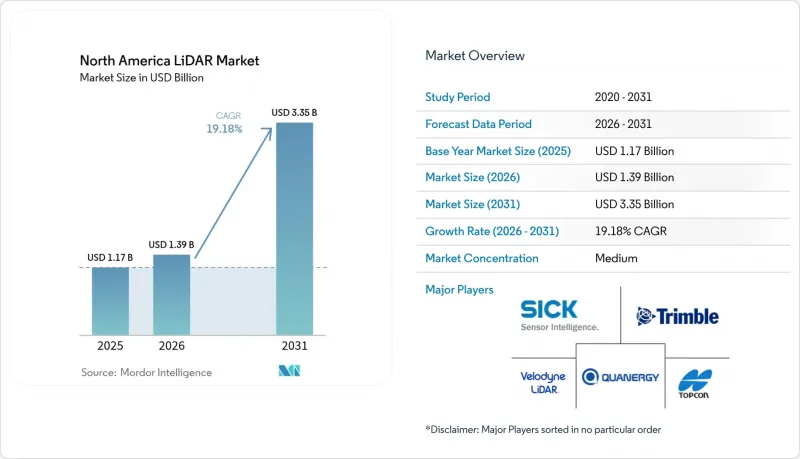
Mordor Intelligence에 의하면, 2026년 북미의 LiDAR 시장 규모는 13억 9,000만 달러로 추정되고 2025년 11억 7,000만 달러에서 확대해, 2031년에는 33억 5,000만 달러에 이를 것으로 예측됩니다.
2026-2031년 동안 연평균 성장률(CAGR) 19.18%로 성장할 것으로 전망됩니다.
본 보고서는 제품별(항공 LiDAR, 지상형 LiDAR, 모바일·UAV용 LiDAR), 유형별(기계식 LiDAR, 솔리드 스테이트 LiDAR), 범위별, 구성 요소별(레이저 스캐너, GPS·GNSS 수신기, 기타), 용도별(복도 매핑·측량, ADAS·자율주행차, 기타), 최종 사용자별(자동차, 엔지니어링·건설 회사, 기타), 지역별로 분류되어 있습니다. 시장 전망은 금액(달러) 기준으로 제시되어 있습니다.
북미의 LiDAR 시장 동향 및 인사이트
솔리드 스테이트 LiDAR 통합에 따른 자동차 생산 프로그램 가속화
솔리드 스테이트 센서는 제한된 시범 프로젝트에서 주류 생산 프로그램으로 전환되고 있습니다. 볼보(Volvo)의 EX90에 루미나르(Luminar)製 센서를 양산 공급하는 것은 높은 신뢰성과 기계적 복잡성 감소에 대한 OEM 각사의 신뢰를 입증하고 있습니다. BMW의 i7과 폭스바겐의 ID.Buzz는 레벨 3 기능을 구현하기 위해 이노비즈(Innoviz)의 유닛을 채택한 반면, 도요타는 칩 수준의 비용 절감을 달성하여 중형 부문에서의 채택을 가능하게 했습니다. 헤사이(Hesai)가 세계 자동차 시장에서 37%의 점유율을 차지하고 있다는 사실은 규모의 경제가 가격 경쟁을 가속화하고 있음을 여실히 보여줍니다. 유닛 경제성이 향상되는 가운데, 북미의 LiDAR 시장에서는 대형 차량용 FMCSA(연방 도로 교통 안전국)의 자동 긴급 제동 규제에 대응하기 위해 전기 픽업 트럭에 센서 탑재가 진행되고 있습니다.
BVLOS 드론 운영을 통한 인프라 모니터링의 혁신
캐나다 교통부(Transport Canada)의 2025년 RPAS 규정에 따라 중형 드론을 활용한 시야 외(BVLOS) 운용이 승인되어, 외딴 지역의 주에서 비용 대비 효율이 높은 LiDAR를 이용한 회랑 매핑이 가능해졌습니다. 미국 FAA의 파트 107 면제 규정 또한 국경 남쪽에서 유사한 유연성을 반영하고 있어, 공공시설 및 철도 점검을 가속화하고 있습니다. NOAA의 고고도 BVLOS 캠페인은 운영 측면에서의 성숙도를 보여주고 있는 반면, 민간 사업자들은 eVTOL 기체에 경량 스캐너를 탑재하여 한 번의 비행으로 수천 킬로미터를 조사했습니다. 이를 통해 얻어진 데이터는 수작업 점검 비용을 절감하고, 자산 관리자를 위한 클라우드 기반 디지털 트윈을 뒷받침하고 있습니다.
비용 경쟁력 문제로 인한 일반 시장 보급의 한계
LiDAR 장치의 가격은 여전히 레이더 대체품의 3-5배 수준이며, 이는 3만 달러 미만의 차량에 탑재되는 것을 방해하고 있습니다. Luminar의 ‘Halo’ 로드맵은 50%의 가격 인하를 목표로 하고 있지만, 2028년 이전에 주류 제품과 동등한 가격 수준에 도달하는 것은 여전히 어렵습니다. Hesai와 같은 중국 공급업체들은 낮은 인건비와 수직 통합된 광학 시스템을 바탕으로 가격 경쟁을 심화시키고 있습니다. 북미 공장은 자동화를 통해 대응하고 있지만, 감가상각 일정에 따라 북미의 LiDAR 시장의 급격한 가격 변동은 억제되고 있습니다.
부문별 분석
2025년 북미의 LiDAR 시장에서 지상 설치형 시스템은 매출의 41.30%를 차지했습니다. 고정밀 건설 측량에 대한 수요가 매출을 뒷받침하고 있지만, 이 부문의 성장률은 낮은 두 자릿수에 그치고 있습니다. 건설업체들은 고속도로 확장이나 교량 개보수 공사에서 재현성 있는 기준점을 확보할 수 있는 삼각대 설치형 장비를 높이 평가했습니다. 그러나 ClearSkies Geomatics의 렌탈 모델은 구매 장벽을 낮추어 제조업체의 이익률을 압박하는 한편, 도입 대수를 확대시키고 있습니다.
행정 기관에 의한 선형 자산의 디지털화가 진행됨에 따라, 모바일 및 UAV 플랫폼은 연평균 성장률(CAGR) 24.2%로 성장하고 있습니다. RIEGL을 탑재한 VTOL 드론은 지상 팀에 비해 10배 빠른 속도로 송전선을 점검할 수 있어, 산불로 인한 배상 책임에 직면한 유틸리티자를 지원하고 있습니다. Phase One의 통합형 카메라·레이저 포드는 비행 시간을 40% 단축하여 투자 수익률(ROI)을 향상시킵니다. 측량 업체들이 데이터 안정화를 위해 견고한 IMU를 탑재함에 따라, 항공기 운영 사업자들은 다년간의 점검 계약을 수주하여 센서에 대한 지속적인 주문으로 이어지고 있습니다. 이러한 전환으로 인해 기동성이 뛰어난 공급업체 시장 점유율이 확대되고, 북미의 LiDAR 시장 전체의 서비스 수익이 향상될 것입니다.
기계식 아키텍처는 검증된 측정 범위와 확립된 공급망 덕분에 2025년 북미의 LiDAR 시장 규모에서 여전히 62.10%의 점유율을 차지했습니다. 회전 미러 방식은 360도 커버리지가 내구성에 대한 우려를 상쇄하기 때문에 고속도로 매핑용 밴 및 항공 수심 측량에 채택되고 있습니다. 그러나 유지보수 주기와 조립의 복잡성으로 인해 수명 주기 비용이 급증하고 있습니다.
솔리드 스테이트 방식은 웨이퍼 레벨 광학 기술로 인해 가동 부품이 줄어들어 연평균 성장률(CAGR) 21.2%로 성장을 지속하고 있습니다. 교세라의 퓨전 센서는 카메라와 LiDAR 층을 통합하여 시차 없는 인식을 실현하고 있어, 더 얇은 케이스를 원하는 OEM 업체들에게 매력적입니다. 헥사곤의 단일 광자 모듈은 초당 1,400만 영국 포인트를 처리하여 중고도 항공기에서 고속 회랑 스캔을 가능하게 합니다. 생산량이 확대됨에 따라 2028년까지 단가는 기계식 제품과 동등해질 것으로 예측되며, 북미의 LiDAR 시장에서 칩 통합형 공급업체를 활용한 설계 채택이 확대될 전망입니다.
기타 혜택
- 엑셀 형식 시장 예측(ME) 시트
- 3개월간의 애널리스트 지원
자주 묻는 질문
목차
제1장 서론
제2장 조사 방법
제3장 주요 요약
제4장 시장 구도
제5장 시장 규모 및 성장 예측
제6장 경쟁 구도
제7장 시장 기회 및 향후 전망
KTH 26.09.04According to Mordor Intelligence, North America LiDAR market size in 2026 is estimated at USD 1.39 billion, growing from 2025 value of USD 1.17 billion with 2031 projections showing USD 3.35 billion, growing at 19.18% CAGR over 2026-2031.
This report is Segmented by Product (Aerial LiDAR, Ground-Based LiDAR), Type (Mechanical LiDAR, Solid-State LiDAR), Range, Component (Laser Scanners, GPS/GNSS Receiver and More), Application (Corridor Mapping and Surveying, ADAS and Autonomous Vehicles, and More), End-User (Automotive, Engineering and Construction Firms, and More), and Geography. The Market Forecasts are Provided in Terms of Value (USD).
North America LiDAR Market Trends and Insights
Solid-State LiDAR Integration Accelerates Automotive Production Programs
Solid-state sensors are moving from limited pilots into mainstream production programs. Luminar's series supply on Volvo's EX90 confirms OEM confidence in higher reliability and reduced mechanical complexity. BMW's i7 and Volkswagen's ID.Buzz integrate Innoviz units for Level 3 capability, while Toyota reports chip-level cost reductions that open mid-segment adoption. Hesai's 37% global automotive share underscores how scale economics force price competition. As unit economics improve, the North America LiDAR market embeds sensors in electric pickups to satisfy forthcoming FMCSA automatic emergency braking rules for heavy vehicles.
BVLOS Drone Operations Transform Infrastructure Monitoring
Transport Canada's 2025 RPAS regulations authorize medium-sized drones for beyond-visual-line-of-sight operations, enabling cost-effective LiDAR corridor mapping in remote provinces. FAA Part 107 waivers mirror this flexibility south of the border, accelerating utility and rail inspections. NOAA's high-altitude BVLOS campaigns demonstrate operational maturity, while commercial operators deploy lightweight scanners on eVTOL craft to survey thousands of kilometres per flight. Resulting data reduces manual inspection costs and fuels cloud-based digital twins for asset managers.
Cost Competitiveness Challenges Limit Mass-Market Penetration
LiDAR units still cost three to five times more than radar alternatives, deterring inclusion in sub-USD 30,000 vehicles. Luminar's Halo roadmap targets a 50% price cut, yet mainstream parity remains elusive before 2028. Chinese suppliers such as Hesai pressure margins through lower labour costs and vertically integrated optics. North American factories respond with automation, but depreciation schedules constrain rapid price movements in the North America LiDAR market.
Other drivers and restraints analyzed in the detailed report include:
- Digital Twin Infrastructure Projects Drive Long-Term Demand
- Smart-Corridor Initiatives Leverage Federal Infrastructure Funding
- Workforce Development Gaps Constrain Project Execution
For complete list of drivers and restraints, kindly check the Table Of Contents.
Segment Analysis
Ground-based systems held 41.30% of 2025 revenue in the North America LiDAR market. Continued demand for high-accuracy construction staking anchors sales, yet the segment's growth lags at low-double-digit rates. Contractors value tripod-mounted units for repeatable benchmarks during highway widening and bridge retrofits. However, rental models from ClearSkies Geomatics reduce ownership barriers, trimming manufacturer margins but enlarging the installed base.
Mobile and UAV platforms grow at 24.2% CAGR as agencies digitize linear assets. RIEGL-based VTOL drones cover transmission lines 10 times faster than terrestrial teams, supporting utilities facing wildfire liability. Phase One's integrated camera-laser pods cut flight hours 40%, enhancing ROI. As survey firms embed robust IMUs to stabilize data, fleet operators win multi-year inspection contracts, feeding sustained sensor orders. This migration boosts share for agile suppliers and elevate service revenues across the North America LiDAR market.
Mechanical architectures still command 62.10% share of the North America LiDAR market size in 2025 thanks to proven range and established supply chains. Rotating mirror designs service highway mapping vans and airborne bathymetric surveys where 360-degree coverage outweighs durability concerns. Yet maintenance intervals and assembly complexity inflate lifecycle costs.
Solid-state variants post 21.2% CAGR as wafer-level optics deliver fewer moving parts. Kyocera's fusion sensor merges camera and LiDAR layers for parallax-free perception, attractive to OEMs demanding slimmer housings. Hexagon's single-photon module pushes 14 million points per second, enabling fast corridor scans from mid-altitude aircraft. As volume scales, per-unit cost is projected to reach parity with mechanical peers by 2028, shifting design wins toward chip-integrated suppliers within the North America LiDAR market.
Complete Report Scope:
- By Product
- Aerial LiDAR
- Ground-based LiDAR
- Mobile and UAV LiDAR
- By Type
- Mechanical LiDAR
- Solid-state LiDAR
- By Range
- Short-range (<100 m)
- Medium-range (100-300 m)
- Long-range (>300 m)
- By Component
- Laser Scanners
- GPS/GNSS Receiver
- Inertial Measurement Unit (IMU)
- Camera and Other Sensors
- By Application
- Corridor Mapping and Surveying
- ADAS and Autonomous Vehicles
- Engineering and Construction
- Environmental and Forestry
- Security and Law Enforcement
- By End-User
- Automotive
- Engineering and Construction Firms
- Industrial and Utilities
- Aerospace and Defense
- Federal and State Government Agencies
- By Country
- United States
- Canada
- Mexico
List of Companies Covered in this Report:
- Ouster Inc. (incl. Velodyne)
- Teledyne Optech
- Trimble Inc.
- Leica Geosystems AG (Hexagon)
- Innoviz Technologies
- Sick AG
- Topcon Corporation
- LeddarTech Inc.
- Faro Technologies Inc.
- DENSO Corporation
- RoboSense (USA)
- AEye Inc.
- Luminar Technologies Inc.
- Valeo SA
- Quanergy Systems Inc.
- Hesai Technology (NA operations)
- Phoenix LiDAR Systems
- Geo-SLAM Ltd.
- RIEGL Laser Measurement Systems
- MicroVision Inc.
- Neptec Technologies Corp.
- Phantom Intelligence Inc.
- Continental AG
Additional Benefits:
- The market estimate (ME) sheet in Excel format
- 3 months of analyst support
TABLE OF CONTENTS
1 INTRODUCTION
- 1.1 Study Assumptions and Market Definition
- 1.2 Scope of the Study
2 RESEARCH METHODOLOGY
3 EXECUTIVE SUMMARY
4 MARKET LANDSCAPE
- 4.1 Market Overview
- 4.2 Market Drivers
- 4.2.1 Rapid integration of solid-state LiDAR in Level-3 autonomous vehicle programs by U.S. OEMs
- 4.2.2 FAA BVLOS waivers accelerating commercial drone corridor mapping demand in Canada
- 4.2.3 Surging investments in digital-twin projects for aging U.S. transportation infrastructure
- 4.2.4 LiDAR-enriched Smart-Corridor initiatives under U.S. IIJA funding (2024-2028)
- 4.2.5 Early-mover adoption of LiDAR-embedded ADAS by electric-truck makers to meet stricter FMCSA safety mandates
- 4.2.6 North-American forestry and environmental agencies pivoting to LiDAR for wildfire-risk modelling post-2023 mega-fires
- 4.3 Market Restraints
- 4.3.1 Persistent price-premium vs. radar/vision in mass-produced L2+ vehicles
- 4.3.2 Skilled-talent scarcity in LiDAR data processing delaying state-DOT projects
- 4.3.3 Export-control restrictions on high-performance lasers limiting Canadian aerospace suppliers
- 4.3.4 Post-merger procurement uncertainty after Velodyne-Ouster consolidation
- 4.4 Value / Supply-Chain Analysis
- 4.5 Regulatory Outlook
- 4.6 Technological Outlook
- 4.7 Porter's Five Forces Analysis
- 4.7.1 Bargaining Power of Buyers/Consumers
- 4.7.2 Bargaining Power of Suppliers
- 4.7.3 Threat of New Entrants
- 4.7.4 Threat of Substitute Products
- 4.7.5 Intensity of Competitive Rivalry
- 4.8 Investment Analysis
5 MARKET SIZE AND GROWTH FORECASTS (VALUE)
- 5.1 By Product
- 5.1.1 Aerial LiDAR
- 5.1.2 Ground-based LiDAR
- 5.1.3 Mobile and UAV LiDAR
- 5.2 By Type
- 5.2.1 Mechanical LiDAR
- 5.2.2 Solid-state LiDAR
- 5.3 By Range
- 5.3.1 Short-range (<100 m)
- 5.3.2 Medium-range (100-300 m)
- 5.3.3 Long-range (>300 m)
- 5.4 By Component
- 5.4.1 Laser Scanners
- 5.4.2 GPS/GNSS Receiver
- 5.4.3 Inertial Measurement Unit (IMU)
- 5.4.4 Camera and Other Sensors
- 5.5 By Application
- 5.5.1 Corridor Mapping and Surveying
- 5.5.2 ADAS and Autonomous Vehicles
- 5.5.3 Engineering and Construction
- 5.5.4 Environmental and Forestry
- 5.5.5 Security and Law Enforcement
- 5.6 By End-User
- 5.6.1 Automotive
- 5.6.2 Engineering and Construction Firms
- 5.6.3 Industrial and Utilities
- 5.6.4 Aerospace and Defense
- 5.6.5 Federal and State Government Agencies
- 5.7 By Country
- 5.7.1 United States
- 5.7.2 Canada
- 5.7.3 Mexico
6 COMPETITIVE LANDSCAPE
- 6.1 Market Concentration
- 6.2 Strategic Moves
- 6.3 Market Share Analysis
- 6.4 Company Profiles (includes Global-level Overview, Market-level Overview, Core Segments, Financials, Strategic Info, Market Rank/Share, Products and Services, Recent Developments)
- 6.4.1 Ouster Inc. (incl. Velodyne)
- 6.4.2 Teledyne Optech
- 6.4.3 Trimble Inc.
- 6.4.4 Leica Geosystems AG (Hexagon)
- 6.4.5 Innoviz Technologies
- 6.4.6 Sick AG
- 6.4.7 Topcon Corporation
- 6.4.8 LeddarTech Inc.
- 6.4.9 Faro Technologies Inc.
- 6.4.10 DENSO Corporation
- 6.4.11 RoboSense (USA)
- 6.4.12 AEye Inc.
- 6.4.13 Luminar Technologies Inc.
- 6.4.14 Valeo SA
- 6.4.15 Quanergy Systems Inc.
- 6.4.16 Hesai Technology (NA operations)
- 6.4.17 Phoenix LiDAR Systems
- 6.4.18 Geo-SLAM Ltd.
- 6.4.19 RIEGL Laser Measurement Systems
- 6.4.20 MicroVision Inc.
- 6.4.21 Neptec Technologies Corp.
- 6.4.22 Phantom Intelligence Inc.
- 6.4.23 Continental AG
7 MARKET OPPORTUNITIES AND FUTURE OUTLOOK
- 7.1 White-space and Unmet-need Assessment