

|
시장보고서
상품코드
2120579
유럽의 일반외과용 기기 : 시장 점유율 분석, 업계 동향 및 통계, 성장 예측(2026-2031년)Europe General Surgical Devices - Market Share Analysis, Industry Trends & Statistics, Growth Forecasts (2026 - 2031) |
||||||
 Mordor Intelligence
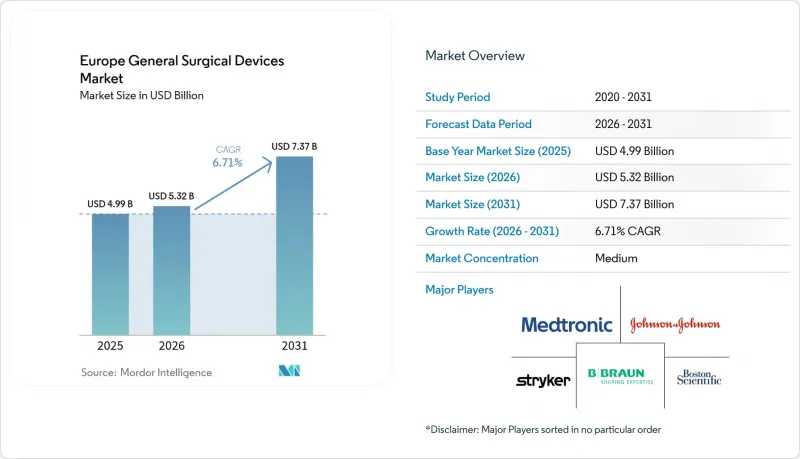
Mordor Intelligence에 의하면, 유럽의 일반외과용 기기 시장 규모는 2025년에 49억 9,000만 달러로 평가되었습니다. 2026년 53억 2,000만 달러에서 2031년까지 73억 7,000만 달러에 이를 것으로 예상되며, 예측 기간(2026-2031년) CAGR은 6.71%를 나타낼 전망입니다.
본 보고서는 제품별(휴대용 수술 기구, 복강경용 기기, 전기 수술 기기, 상처 봉합용 기기 등), 수술 기법별(개복 수술, 최소 침습 수술), 용도별(산부인과·비뇨기과, 심장외과, 정형외과 등), 국가별(독일, 영국 등)로 분류되어 있습니다. 시장 전망은 금액(달러) 기준으로 제시되어 있습니다.
유럽의 일반외과용 기기 시장 동향 및 인사이트
저침습 수술에 대한 수요 증가
유럽 전역의 의료 서비스 제공업체들은 회복 기간 단축과 입원 병상 확보를 목적으로 개복 수술에서 최소 침습 수술로 계속 전환하고 있습니다. 영국 국민건강서비스(NHS)는 2035년까지 연간 50만 건의 로봇 보조 수술이 시행될 것으로 예측하고 있으며, 이는 도입이 급격히 확대되고 의료기기의 교체 주기가 가속화될 것임을 시사합니다. 북유럽의 의료시설들도 이러한 추세를 반영하여, 탈장 교정 및 기타 연조직 수술을 지원하기 위해 120대 이상의 로봇 플랫폼을 도입하고 있습니다. 하이브리드, 바이폴라, 초음파 등 다양한 모달리티를 결합한 올림푸스사의 ‘ESG-410’과 같은 에너지 기반 기기는 외과의사들이 다기능 도구를 추구하는 가운데, 이러한 광범위한 전환의 혜택을 받고 있습니다. 보스턴 사이언티피크(Boston Scientific)의 워크플로우 자문 솔루션을 도입한 병원에서는 경카테터 수술 건수가 40% 증가하여, 디지털 통합이 처리 능력을 얼마나 향상시키는지 보여주고 있습니다.
고령화와 수술 건수 증가
65세 이상 인구는 특히 독일, 이탈리아, 스페인에서 급속히 증가하고 있으며, 이러한 인구 통계학적 변화가 관절 치환술, 심혈관 중재술 및 복잡한 종양 절제술 증가를 뒷받침하고 있습니다. 프랑스의 경우, 보험 환급액 삭감에도 불구하고 인공 고관절 치환술 시행률은 여전히 OECD 회원국 중 8위를 차지하고 있어 잠재적 수요가 높다는 점이 부각되고 있습니다. 외래수술센터(ASC)는 메디케어에 부합하는 유리한 보상 체계와 사모펀드의 투자에 힘입어, 심장내과를 가장 빠르게 성장하는 전문 분야로 꼽고 있습니다. 중환자 전문의 부족으로 인해 외과와 중환자 치료 서비스의 통합이 더욱 진행되고 있으며, 현재 유럽 전역 ICU 병상의 70%를 마취과 의사가 관리하고 있습니다.
EU-MDR 규정 준수 비용 및 승인 지연
규정 준수를 위해서는 기본 분석에 5,000유로부터, 클래스 III 임상시험의 경우 50만 유로에 달하는 비용이 소요될 수 있어, 이로 인해 중소기업의 현금 흐름이 압박받고 제품 포트폴리오의 합리화가 촉진되고 있습니다. 추정 50만 건의 의료기기를 심사하는 인증 기관은 단 43곳밖에 남아 있지 않아, 승인 주기가 길어지고 출시가 지연되고 있습니다. 업계 조사에 따르면, 의료기기 제조업체의 절반이 규제 부담을 이유로 EU 내 제품 포트폴리오를 철회하거나 축소할 계획인 것으로 나타났습니다.
부문 분석
2025년, 핸드헬드 기기는 유럽의 일반외과용 기기 시장에서 34.02%의 점유율을 유지했으며, 이는 일상적인 시술에서 널리 보급되어 있음을 반영합니다. 그러나 로봇 및 컴퓨터 지원 시스템은 임상 현장에서의 수용 확대와 건당 비용 감소를 배경으로, 2031년까지 연평균 성장률(CAGR) 8.96%를 기록하며 모든 카테고리를 능가하는 성장을 보일 것으로 전망됩니다. 올림푸스의 ‘THUNDERBEAT’ 및 ‘VISERA 4K’ 플랫폼은 영상 진단 기술과 에너지 기술이 융합되어 조직의 조작성과 가시성을 향상시키는 대표적인 사례입니다. 메드트로닉의 ‘PlasmaBlade’는 기존 전기 메스보다 훨씬 낮은 온도에서 작동하여 부수적인 손상을 줄여줍니다. 센서와 무선 연결 기능을 통합한 하이브리드 기기는 프리미엄 부문과 가치 부문 간의 경쟁 격차를 더욱 벌릴 것으로 예측됩니다.
2세대 로봇 시스템은 기존의 비용 및 설치 면적 제약을 해소하여 중규모 의료 기관에서의 도입을 촉진하고 있습니다. 유럽의 일반외과용 기기 시장 공급업체들은 고객과의 유대 관계를 강화하기 위해 자본 설비와 디지털 워크플로우 소프트웨어를 세트로 판매하는 움직임을 강화하고 있습니다. Virtual-Ports사의 CE 마크를 획득한 복강경용 액세서리와 존슨앤드존슨사의 Ottava 호환 발전기는 새로운 로봇 생태계에 적응한, 목표가 명확한 제품 업데이트의 좋은 예입니다. 상처 봉합 시스템 및 트로카 제품군은 당일 수술의 확산으로 혜택을 보고 있으며, 일회용 옵션을 통해 멸균 병목 현상과 감염 위험이 완화되고 있습니다.
2025년, 유럽의 일반외과용 기기 시장 규모의 71.62%를 최소 침습 수술 기술이 차지하며, 연평균 성장률(CAGR) 8.08%로 확대되고 있어 표준 치료법으로서의 입지를 공고히 했습니다. 광학 시스템, 에너지 전달 및 촉각 피드백의 향상으로 외과의는 더 작은 절개 부위로도 복잡한 병변을 처리할 수 있게 되었습니다. 개복 수술은 외상이나 대형 종양 절제에서 여전히 중요한 역할을 하고 있지만, 그 시행 건수는 꾸준히 감소하고 있습니다.
Hugo 플랫폼에서 보고된 신속한 도킹 시간은 마취 시간 단축 및 수술 회전율 향상으로 이어지는 누적적인 효율 향상을 보여줍니다. HoloSurge사의 3D 홀로그래피 기술은 시범 단계에 접어들어 간담도계 수술에서 보다 안전한 절제 평면을 확립하는 데 도움을 주고 있습니다. 유럽의 일반외과용 기기 시장의 진출기업들은 외과의사들이 새로운 학습 곡선을 신속하게 습득할 수 있도록 훈련 센터에 막대한 투자를 하고 있습니다. 이는 보험사로부터의 지원 및 기술 인증을 획득하기 위한 전제조건이 되고 있습니다.
기타 혜택 :
- 엑셀 형식 시장 예측(ME) 시트
- 3개월간의 애널리스트 지원
자주 묻는 질문
목차
제1장 서론
제2장 조사 방법
제3장 주요 요약
제4장 시장 구도
제5장 시장 규모 및 성장 예측
제6장 경쟁 구도
제7장 시장 기회 및 향후 전망
KTH 26.09.10According to Mordor Intelligence, the Europe general surgical devices market size was valued at USD 4.99 billion in 2025 and estimated to grow from USD 5.32 billion in 2026 to reach USD 7.37 billion by 2031, at a CAGR of 6.71% during the forecast period (2026-2031).
This report is Segmented by Product (Hand-Held Surgical Instruments, Laparoscopic Devices, Electrosurgical Devices, Wound Closure Devices, and More), Procedure Approach (Open Surgery, and Minimally Invasive Surgery), Application (Gynecology and Urology, Cardiology, Orthopedic, and More) and Country (Germany, United Kingdom, and More). The Market Forecasts are Provided in Terms of Value (USD).
Europe General Surgical Devices Market Trends and Insights
Rising demand for minimally invasive procedures
Healthcare providers across Europe continue to transition from open to minimally invasive techniques, aiming to cut recovery times and free inpatient capacity. NHS England projects 500,000 robotic-assisted operations annually by 2035, signaling a steep adoption curve that will accelerate capital equipment refresh cycles. Nordic centers mirror this trend, installing more than 120 robotic platforms to support hernia repairs and other soft-tissue interventions. Energy-based devices such as Olympus ESG-410, which combine hybrid, bipolar, and ultrasonic modalities, are benefiting from the broader shift as surgeons seek multifunctional tools. Hospitals deploying Boston Scientific workflow-advisory solutions report 40% higher transcatheter volumes, illustrating how digital integration multiplies throughput.
Aging population & procedure volume growth
Citizens aged >= 65 represent a fast-growing cohort, particularly in Germany, Italy, and Spain, and this demographic shift fuels an uptick in joint replacements, cardiovascular interventions, and complex oncology resections. France still ranks 8th among OECD nations for hip replacement rates despite reimbursement cuts, underscoring latent demand. Ambulatory surgery centers (ASCs) have flagged cardiology as their highest-growth specialty, aided by favorable Medicare-aligned payments and private equity investment. Intensivist shortages prompt a tighter integration of surgery and critical-care services, with anesthesiologists now managing 70% of ICU beds across Europe.
EU-MDR compliance costs & approval delays
Conformity assurance can cost from EUR 5,000 for basic analyses to EUR 500,000 for Class III trials, squeezing SME cash flows and prompting portfolio rationalization. Only 43 notified bodies remain to review an estimated 500,000 devices, leading to extended approval cycles and deferred launches. Industry surveys show half of device makers plan to withdraw or limit EU portfolios due to regulatory burdens.
Other drivers and restraints analyzed in the detailed report include:
- Rapid innovations in laparoscopic & robotic systems
- Shift toward day-case surgeries & disposable kits
- Purchasing-group price pressure on OEM margins
For complete list of drivers and restraints, kindly check the Table Of Contents.
Segment Analysis
Hand-held instruments retained a 34.02% Europe general surgical devices market share in 2025, reflecting their ubiquity in routine interventions. Robotic and computer-assisted systems, however, are set to outpace all categories at a 8.96% CAGR to 2031, powered by broader clinical acceptance and falling per-procedure costs. Olympus THUNDERBEAT and VISERA 4K platforms illustrate how imaging and energy technologies converge to enhance tissue handling and visualization. Medtronic's PlasmaBlade operates at significantly lower temperatures than legacy electrocautery, reducing collateral damage. Hybrid devices that integrate sensors and wireless connectivity are poised to stretch the competitive gap between premium and value tiers.
Second-generation robotics address prior cost and footprint limitations, opening adoption among mid-sized centers. Europe general surgical devices market vendors increasingly bundle capital equipment with digital workflow software to create stickier customer relationships. Virtual-Ports' CE-marked laparoscopic accessories and Johnson & Johnson's Ottava-compatible generator exemplify targeted product updates that fit new robotic ecosystems. Wound-closure systems and trocar lines benefit from the day-case push, with single-use options mitigating sterilization bottlenecks and infection risk.
Minimally invasive techniques accounted for 71.62% of the Europe general surgical devices market size in 2025 and are advancing at an 8.08% CAGR, consolidating their position as the preferred standard of care. Improved optics, energy delivery, and haptic feedback allow surgeons to tackle complex pathologies with smaller incisions. Open surgery maintains a vital role for trauma and large tumor resections but is ceding volume steadily.
Fast docking times reported for the Hugo platform illustrate cumulative efficiency gains that reduce anesthesia duration and improve turnover. HoloSurge's 3D holography enters pilot phases, supporting safer resection planes in hepatobiliary cases. Europe general surgical devices market participants invest heavily in training centers to help surgeons climb new learning curves quickly, a prerequisite for payer support and technology credentialing.
Complete Report Scope:
- By Product Type
- Hand-held Surgical Instruments
- Laparoscopic Devices
- Electrosurgical Devices
- Wound-Closure Devices
- Trocars and Access Systems
- Robotic and Computer-Assisted Systems
- Other Products
- By Procedure Approach
- Open Surgery
- Minimally Invasive Surgery
- By Application
- Gynecology and Urology
- Cardiology
- Orthopedic
- Neurology
- General and Bariatric Surgery
- Oncology
- Other Applications
- By End User
- Hospitals
- Ambulatory Surgical Centers
- Specialty Clinics
- By Country
- Germany
- United Kingdom
- France
- Italy
- Spain
- Rest of Europe
List of Companies Covered in this Report:
- B. Braun
- Johnson & Johnson (Ethicon / DePuy Synthes)
- Medtronic
- Stryker
- Olympus
- Boston Scientific
- Integer Holdings
- Conmed
- Smiths Group
- Zimmer Biomet
- Karl Storz SE
- Becton Dickinson & Co.
- Teleflex
- Coloplast
- Cooper Companies (Cooper Surgical)
- Erbe Elektromedizin
- Richard Wolf
- Intuitive Surgical
- Smiths Group
- Applied Medical Resources
- Surgical Innovations Group plc
Additional Benefits:
- The market estimate (ME) sheet in Excel format
- 3 months of analyst support
TABLE OF CONTENTS
1 Introduction
- 1.1 Study Assumptions & Market Definition
- 1.2 Scope of the Study
2 Research Methodology
3 Executive Summary
4 Market Landscape
- 4.1 Market Overview
- 4.2 Market Drivers
- 4.2.1 Rising demand for minimally-invasive procedures
- 4.2.2 Aging population and procedure volume growth
- 4.2.3 Rapid innovations in laparoscopic & robotic systems
- 4.2.4 Shift toward day-case surgeries & disposable kits
- 4.2.5 Favourable, procedure-linked reimbursement structures
- 4.2.6 Expansion of private hospital groups and ambulatory surgery centres
- 4.3 Market Restraints
- 4.3.1 EU-MDR compliance costs & approval delays
- 4.3.2 Purchasing-group price pressure on OEM margins
- 4.3.3 OR staff shortages constraining throughput
- 4.3.4 Persistent supply-chain vulnerabilities
- 4.4 Regulatory Landscape
- 4.5 Technological Outlook
- 4.6 Porter's Five Forces Analysis
- 4.6.1 Threat of New Entrants
- 4.6.2 Bargaining Power of Buyers
- 4.6.3 Bargaining Power of Suppliers
- 4.6.4 Threat of Substitutes
- 4.6.5 Competitive Rivalry
5 Market Size & Growth Forecasts (Value)
- 5.1 By Product Type
- 5.1.1 Hand-held Surgical Instruments
- 5.1.2 Laparoscopic Devices
- 5.1.3 Electrosurgical Devices
- 5.1.4 Wound-Closure Devices
- 5.1.5 Trocars and Access Systems
- 5.1.6 Robotic and Computer-Assisted Systems
- 5.1.7 Other Products
- 5.2 By Procedure Approach
- 5.2.1 Open Surgery
- 5.2.2 Minimally Invasive Surgery
- 5.3 By Application
- 5.3.1 Gynecology and Urology
- 5.3.2 Cardiology
- 5.3.3 Orthopedic
- 5.3.4 Neurology
- 5.3.5 General and Bariatric Surgery
- 5.3.6 Oncology
- 5.3.7 Other Applications
- 5.4 By End User
- 5.4.1 Hospitals
- 5.4.2 Ambulatory Surgical Centers
- 5.4.3 Specialty Clinics
- 5.5 By Country
- 5.5.1 Germany
- 5.5.2 United Kingdom
- 5.5.3 France
- 5.5.4 Italy
- 5.5.5 Spain
- 5.5.6 Rest of Europe
6 Competitive Landscape
- 6.1 Market Concentration
- 6.2 Market Share Analysis
- 6.3 Company Profiles (includes Global level Overview, Market level overview, Core Segments, Financials as available, Strategic Information, Market Rank/Share for key companies, Products & Services, and Recent Developments)
- 6.3.1 B. Braun Melsungen AG
- 6.3.2 Johnson & Johnson (Ethicon / DePuy Synthes)
- 6.3.3 Medtronic plc
- 6.3.4 Stryker Corporation
- 6.3.5 Olympus Corporation
- 6.3.6 Boston Scientific Corporation
- 6.3.7 Integer Holdings Corporation
- 6.3.8 Conmed Corporation
- 6.3.9 Smith & Nephew plc
- 6.3.10 Zimmer Biomet Holdings
- 6.3.11 Karl Storz SE
- 6.3.12 Becton Dickinson & Co.
- 6.3.13 Teleflex Incorporated
- 6.3.14 Coloplast A/S
- 6.3.15 Cooper Companies (Cooper Surgical)
- 6.3.16 Erbe Elektromedizin GmbH
- 6.3.17 Richard Wolf GmbH
- 6.3.18 Intuitive Surgical Inc.
- 6.3.19 Smiths Medical
- 6.3.20 Applied Medical Resources
- 6.3.21 Surgical Innovations Group plc
7 Market Opportunities & Future Outlook
- 7.1 White-space & Unmet-Need Assessment


