

|
시장보고서
상품코드
2120671
영국의 일반 외과용 기기 : 시장 점유율 분석, 업계 동향 및 통계, 성장 예측(2026-2031년)United Kingdom General Surgical Devices - Market Share Analysis, Industry Trends & Statistics, Growth Forecasts (2026 - 2031) |
||||||
 Mordor Intelligence
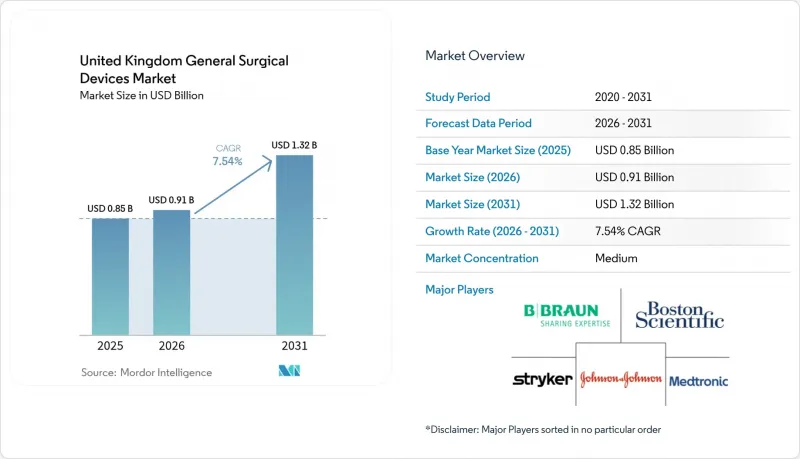
영국의 일반 외과용 기기 시장 규모는 2025년에 8억 5,000만 달러로 평가되었습니다. 2026년 9억 1,000만 달러에서 2031년까지 13억 2,000만 달러에 이를 것으로 예상되며, 예측 기간(2026-2031년) CAGR은 7.54%를 나타낼 전망입니다.
본 보고서는 제품별(휴대용 기기, 복강경용 기기, 전기 수술용 기기, 상처 봉합용 기기 등), 수술 기법별(개복 수술, 최소 침습 수술), 용도별(산부인과·비뇨기과, 심장내과 등), 최종 사용자별(병원, 외래수술센터(ASC) 등)로 분류되어 있습니다. 시장 전망은 금액(달러) 기준으로 제시되어 있습니다.
영국의 일반 외과용 기기 시장 동향 및 인사이트
저침습 의료기기에 대한 수요 증가
로봇 및 복강경 플랫폼은 기존의 수술법을 지속적으로 대체하고 있으며, 포츠머스의 퀸 알렉산드라 병원에서는 모든 최소 침습 당일 수술을 다빈치 시스템으로 전환하여 대상 환자의 입원 일수를 단축하고 있습니다. Versius Surgical Registry에 따르면, 2,083건의 수술에서 전환율은 5.4%에 불과하여, 그 신뢰성과 외과의사들의 높은 지지를 입증하고 있습니다. 사우샘프턴 소아병원이 영국 최초로 소아용 로봇 보조 신장 수술을 시행한 이후, 소아 분야에서의 도입도 확대되고 있습니다. ‘Versius Clinical Insights’ 등의 분석 모듈 통합을 통해 실시간 벤치마크가 제공되어 신규 사용자의 학습 곡선이 단축되고 있습니다.
외상 및 만성 질환 유병률 증가
선택적 의료 회복 계획에서는 정형외과용 로봇 기술이 주목받고 있습니다. 버킹·하버링·레드브리지(BHR) 병원 그룹에서는 2024년 중반까지 Mako 로봇을 이용한 로봇 보조 관절 치환술을 100건 시행하여, 정확도 향상과 조기 가동화를 달성했습니다. PICO Single Use와 같은 음압상처치료 시스템은 복잡한 상처에 대한 적용 범위를 확대하고 있으며, 감염 발생률과 입원 일수를 줄이고 있습니다. geko 신경근 자극 장치는 하지 정맥성 궤양의 치유 확률을 68% 향상시켰으며, 장기적인 상처 관리 비용을 15% 절감했습니다. 이러한 일련의 움직임으로 인해 수술 건수가 증가하고, 병원 전체의 의료기기 수요가 다양화되고 있습니다.
MDR/UKCA의 엄격한 규제 일정
브렉시트에 따른 규제 차이로 인해 2028년 이후부터는 신규 의료기기에 UKCA 마크 표시가 의무화되지만, 그 전까지는 이행 조치로서 CE 마크가 부착된 제품의 계속 사용이 허용됩니다. 제조업체는 2025년 6월까지 새로운 스키마에 부합하는 사고 보고 데이터 피드를 구축해야 하므로, 규정 준수 비용이 증가하고 있습니다. 해외 기업은 영국 내 책임자를 지정해야 하며, 이로 인해 행정 절차가 복잡해지고 제품 출시 일정이 지연될 것입니다.
부문별 분석
영국의 일반 외과용 기기 시장에서 휴대용 의료기기는 2025년 매출의 32.74%를 차지했습니다. 이 부문의 영국의 일반 외과용 기기 시장 규모는 2025년에 2억 8,000만 달러에 달했으며, 2031년까지 연평균 성장률(CAGR) 6.18%로 확대될 것으로 전망됩니다. 병원에서는 휴대성과 다학제적 범용성이 높이 평가되어, 자본 집약적인 로봇에 비해 사용률이 극대화되고 있습니다. 생체 흡수성 전기 자극 봉합사가 주도하는 상처 봉합용 기기는 치유 가속화 및 감염 위험 감소라는 근거에 힘입어 연평균 성장률(CAGR) 8.59%로 가장 빠르게 성장할 전망입니다.
끊임없는 기술 혁신으로 인해 전기 메스, 복강경용 글라스파, 액세스 트로커에 대한 수요가 뒷받침되고 있습니다. NHS 공급망이 추진하는 표준화된 수술 팩을 통해, 준비 시간과 물류의 복잡성을 줄여주는 일체형 기기 키트의 조달이 진행되고 있습니다. 국내 제조업체들은 품질이 보장된 유럽산 강재와 부가가치가 높은 서비스 제공을 통해 수입품과의 경쟁에 대응하고 있습니다.
2025년, 최소 침습 수술은 영국의 일반 외과용 기기 시장 점유율의 72.88%를 차지했습니다. 이는 환자의 부담을 줄이고, 회복을 앞당기며, 자원 활용을 최적화하는 수술에 대한 NHS의 전략적 노력을 반영한 것으로, 연평균 성장률(CAGR) 8.34%로 확대될 것으로 예측됩니다. 경험이 부족한 의료기관에서 최소 침습 승모판 수술을 도입한 결과, 기존 기법과 동등한 치료 성과를 보인 한편, 입원 일수를 7일에서 5일로 대폭 단축하는 데 성공했습니다.
개복 수술은 직접적인 시야 확보와 촉각 피드백이 필요한 복잡한 사례에서 여전히 중요성을 유지하고 있으며, 외상, 응급 및 전문적인 처치 분야에서 안정적인 수요를 보이며 나머지 시장 점유율을 차지하고 있습니다. 저침습적 접근 방식으로의 수술법 전환에 따라 수술팀에 대한 교육 수요가 발생하고 있으며, AI를 활용한 교육 시스템을 통해 복강경 수술 기술의 습득 및 정착도가 향상되고 있는 것으로 나타났습니다.
기타 혜택 :
- 엑셀 형식 시장 예측(ME) 시트
- 3개월간의 애널리스트 지원
자주 묻는 질문
목차
제1장 서론
제2장 조사 방법
제3장 주요 요약
제4장 시장 구도
제5장 시장 규모 및 성장 예측
제6장 경쟁 구도
제7장 시장 기회 및 향후 전망
KTH 26.09.04According to Mordor Intelligence, the United Kingdom general surgical devices market size was valued at USD 0.85 billion in 2025 and estimated to grow from USD 0.91 billion in 2026 to reach USD 1.32 billion by 2031, at a CAGR of 7.54% during the forecast period (2026-2031).
This report is Segmented by Product (Handheld Devices, Laparoscopic Devices, Electrosurgical Devices, Wound Closure Devices, and More), Procedure Approach (Open Surgery, and Minimally Invasive Surgery), Application (Gynecology and Urology, Cardiology, and More) and End User (Hospitals, Ambulatory Surgical Centres and More). The Market Forecasts are Provided in Terms of Value (USD).
United Kingdom General Surgical Devices Market Trends and Insights
Rising demand for minimally invasive devices
Robotic and laparoscopic platforms continue to displace open techniques, with Portsmouth's Queen Alexandra Hospital converting all keyhole day-case procedures to Da Vinci systems and cutting length of stay for eligible patients. The Versius Surgical Registry recorded only 5.4% conversions in 2,083 procedures, underscoring reliability and surgeon acceptance. Paediatric adoption is growing after Southampton Children's Hospital performed the UK's first robotic kidney surgery in children. Integration of analytics modules, such as Versius Clinical Insights, supplies real-time benchmarks that shorten learning curves for new users.
Increasing prevalence of trauma & chronic diseases
Elective-care recovery plans highlight orthopedic robotics: Barking, Havering and Redbridge (BHR) Hospitals logged 100 robotic joint replacements by mid-2024 with the Mako robot, citing accuracy gains and faster mobilisation. Negative-pressure wound therapy systems like PICO Single Use are scaling for complex wounds, lowering infection incidence and length of stay. The geko neuromuscular stimulator improved venous-leg-ulcer healing probability by 68%, offering 15% cost offsets on long-term wound care. Collectively, these dynamics lift procedure volumes and diversify device demand across hospitals.
Stringent MDR/UKCA regulatory timelines
Brexit-driven divergence requires UKCA marking for new devices from 2028, while transitional relief permits CE-marked products until then. Manufacturers must create incident-report data feeds conforming to new schemas by June 2025, elevating compliance costs. Overseas firms must appoint UK Responsible Persons, adding logistical layers and delaying launch timelines.
Other drivers and restraints analyzed in the detailed report include:
- NHS long-term plan to cut inpatient stay via day-case surgery
- Shift to single-use instruments to mitigate hospital-acquired-infection risk
- Capital-budget headwinds in NHS trusts
For complete list of drivers and restraints, kindly check the Table Of Contents.
Segment Analysis
Handheld Devices generated 32.74% of 2025 revenue within the UK general surgical devices market. The UK general surgical devices market size for this segment equated to USD 0.28 billion in 2025 and is projected to advance at 6.18% CAGR through 2031. Hospitals favour their portability and cross-specialty utility, which maximises usage rates versus capital-intensive robots. Wound Closure Devices, led by bioabsorbable electro-stimulation sutures, will climb fastest at 8.59% CAGR, backed by evidence of accelerated healing and lower infection risk.
Continuous innovation sustains demand for electrosurgical pencils, laparoscopic graspers and access trocars. Standardised procedure packs promoted by NHS Supply Chain strengthen procurement of bundled device kits that reduce set-up time and logistics complexity. Domestic producers are responding to import competition with quality-assured European steel and value-added servicing.
Minimally Invasive Surgery accounted for 72.88% of the UK general surgical devices market share in 2025; it is forecast to rise at an 8.34% CAGR, reflecting the NHS's strategic commitment to procedures that reduce patient trauma, accelerate recovery, and optimize resource utilization. Implementation of minimally invasive mitral valve surgery in novice centers demonstrated comparable outcomes to conventional approaches while achieving significant reductions in hospital stays from 7 to 5 days.
Open Surgery maintains relevance for complex cases requiring direct visualization and tactile feedback, representing the remaining market share with steady demand in trauma, emergency, and specialized procedures. The procedural shift toward minimally invasive approaches is creating training requirements for surgical teams, with AI-driven education systems demonstrating improved skill acquisition and retention in laparoscopic techniques.
Complete Report Scope:
- By Product
- Handheld Devices
- Laparoscopic Devices
- Electrosurgical Devices
- Wound Closure Devices
- Trocars and Access Devices
- Other Products
- By Procedure Approach
- Open Surgery
- Minimally Invasive Surgery
- By Application
- Gynecology and Urology
- Cardiology
- Orthopedic
- Neurology
- Other Applications
- By End User
- Hospitals
- Ambulatory Surgical Centres
- Other End Users
List of Companies Covered in this Report:
- B. Braun
- Medtronic
- Olympus
- Integra LifeSciences
- Stryker
- Johnson & Johnson
- Erbe Elektromedizin
- Boston Scientific
- Smiths Group
- Getinge
- ConvaTec Group plc
- Zimmer Biomet
- Becton Dickinson & Co.
- Cook Group
- CMR Surgical Ltd.
- Purple Surgical
- Teleflex
- Surgical Holdings Ltd.
- Swann-Morton Ltd.
Additional Benefits:
- The market estimate (ME) sheet in Excel format
- 3 months of analyst support
TABLE OF CONTENTS
1 Introduction
- 1.1 Study Assumptions & Market Definition
- 1.2 Scope of the Study
2 Research Methodology
3 Executive Summary
4 Market Landscape
- 4.1 Market Overview
- 4.2 Market Drivers
- 4.2.1 Rising demand for minimally-invasive devices
- 4.2.2 Increasing prevalence of trauma & chronic diseases
- 4.2.3 NHS long-term plan to cut inpatient stay via day-case surgery
- 4.2.4 Shift to single-use instruments to mitigate hospital-acquired-infection risk
- 4.2.5 OR digitalisation enabling device-level data analytics
- 4.2.6 Carbon-footprint-linked procurement scoring in NHS supply chain
- 4.3 Market Restraints
- 4.3.1 Stringent MDR/UKCA regulatory timelines
- 4.3.2 Capital-budget headwinds in NHS trusts
- 4.3.3 Supply chain vulnerabilities
- 4.3.4 Surgeons' skills gap for advanced robotics
- 4.4 Regulatory Landscape
- 4.5 Technological Outlook
- 4.6 Porter's Five Forces Analysis
- 4.6.1 Threat of New Entrants
- 4.6.2 Bargaining Power of Buyers
- 4.6.3 Bargaining Power of Suppliers
- 4.6.4 Threat of Substitutes
- 4.6.5 Competitive Rivalry
5 Market Size & Growth Forecasts (Value)
- 5.1 By Product
- 5.1.1 Handheld Devices
- 5.1.2 Laparoscopic Devices
- 5.1.3 Electrosurgical Devices
- 5.1.4 Wound Closure Devices
- 5.1.5 Trocars and Access Devices
- 5.1.6 Other Products
- 5.2 By Procedure Approach
- 5.2.1 Open Surgery
- 5.2.2 Minimally Invasive Surgery
- 5.3 By Application
- 5.3.1 Gynecology and Urology
- 5.3.2 Cardiology
- 5.3.3 Orthopedic
- 5.3.4 Neurology
- 5.3.5 Other Applications
- 5.4 By End User
- 5.4.1 Hospitals
- 5.4.2 Ambulatory Surgical Centres
- 5.4.3 Other End Users
6 Competitive Landscape
- 6.1 Market Concentration
- 6.2 Market Share Analysis
- 6.3 Company Profiles (includes Global level Overview, Market level overview, Core Segments, Financials as available, Strategic Information, Market Rank/Share for key companies, Products & Services, and Recent Developments)
- 6.3.1 B. Braun SE
- 6.3.2 Medtronic plc
- 6.3.3 Olympus Corporation
- 6.3.4 Integra LifeSciences
- 6.3.5 Stryker Corporation
- 6.3.6 Johnson & Johnson (Ethicon)
- 6.3.7 Erbe Elektromedizin GmbH
- 6.3.8 Boston Scientific Corporation
- 6.3.9 Smith & Nephew plc
- 6.3.10 Getinge AB
- 6.3.11 ConvaTec Group plc
- 6.3.12 Zimmer Biomet Holdings Inc.
- 6.3.13 Becton Dickinson & Co.
- 6.3.14 Cook Medical
- 6.3.15 CMR Surgical Ltd.
- 6.3.16 Purple Surgical
- 6.3.17 Teleflex Incorporated
- 6.3.18 Surgical Holdings Ltd.
- 6.3.19 Swann-Morton Ltd.
7 Market Opportunities & Future Outlook
- 7.1 White-space & Unmet-Need Assessment


