

|
시장보고서
상품코드
2122009
스페인의 일반외과용 기기 : 시장 점유율 분석, 업계 동향과 통계, 성장 예측(2026-2031년)Spain General Surgical Devices - Market Share Analysis, Industry Trends & Statistics, Growth Forecasts (2026 - 2031) |
||||||
 Mordor Intelligence
Mordor Intelligence에 의하면, 스페인의 일반외과용 의료기기 시장 규모는 2025년에 4억 3,151만 달러로 평가되었고, 2026년 4억 5,848만 달러에서 2031년까지 6억 2,099만 달러에 이를 것으로 예측되며, 예측 기간(2026-2031년) CAGR은 6.25%를 기록할 전망입니다.
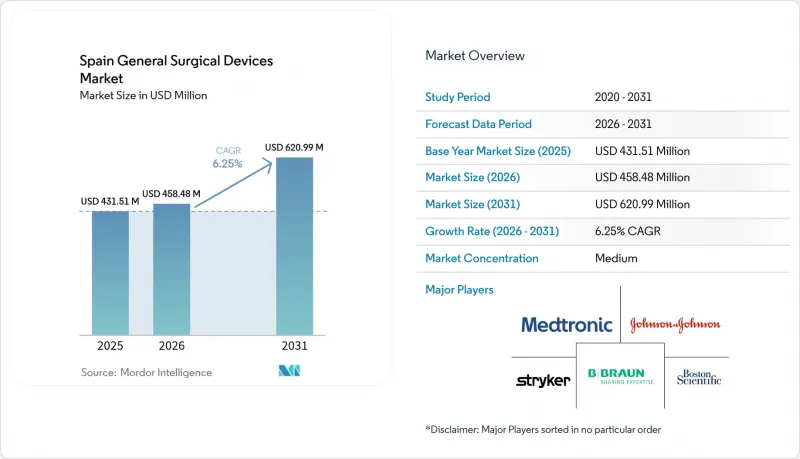
본 보고서는 제품별(휴대형 기기, 복강경용 기기, 전기 수술용 기기, 상처 봉합용 기기 등), 수술 기법별(개복 수술, 최소 침습 수술), 용도별(산부인과·비뇨기과, 심장내과 등), 그리고 최종 사용자별(병원, 외래수술센터(ASC) 등)로 분류되어 있습니다. 시장 예측은 금액(달러) 기준으로 제시되어 있습니다.
스페인의 일반외과용 의료기기 시장 동향 및 인사이트
최소 침습 수술에 대한 수요 증가
스페인의 외과 의료 양상은 각 전문 분야에서 최소 침습 수술이 보급됨에 따라 패러다임 전환을 겪고 있으나, 그 도입률에는 지역 간 큰 격차가 나타납니다. 이러한 도입 상황의 편차는 수술 기구와 함께 종합적인 교육 프로그램을 제공할 수 있는 의료기기 제조업체에게 시장 기회를 창출하고 있습니다. 팬데믹 이후 수술 재개에 관한 지침에 따르면, 스페인에서 시행되는 수술의 85%는 외래 환경으로 전환이 가능한 것으로 나타났습니다. 이러한 추세로 인해 스페인의 일반외과용 의료기기 시장에서 특수 트로카, 에너지 기기, 로봇 스테이플러에 대한 수요가 증가하고 있습니다.
외과적 개입이 필요한 만성 질환의 부담 증가
스페인의 인구 통계학적 변화에 따라 모든 연령대에서 만성 질환 유병률이 상승하고 있으며, 이로 인해 외과적 개입에 대한 지속적인 수요가 발생하고 있습니다. 이러한 추세는 외래 환경에서 복잡한 수술을 가능하게 하는 특수 외과용 의료기기에 대한 수요를 견인하고 있습니다. 발렌시아의 종양학 외래 프로그램에서는 기존 유방 수술의 72.8%가 대체되고 있어, 의료기기의 회전율 상승을 촉진하고 있습니다. Varipulse 카테터와 같은 전기생리학적 혁신은 스페인에서 확대되고 있는 심혈관 질환의 진료 부담에 대응하고 있습니다.
특정 최소 침습 수술(MIS)에 대한 제한적인 보험 급여
스페인의 보험 환급 체계는 최소 침습 수술 도입에 큰 장벽이 되고 있습니다. DRG(진단 관련 군) 기반 지불 제도에서는 첨단 외과용 의료기기에 드는 초기 비용의 높이를 병원 측에 충분히 보상하지 못하고 있기 때문입니다. ‘RedETS’와 같은 실세계 증거(RWE) 프로그램은 병원 참여 확보에 따른 높은 장벽으로 인해 진전이 더딘 상태이며, 보험 적용 범위 확대를 둘러싼 불확실성이 장기화되고 있습니다.
부문 분석
핸드헬드 기구는 개복 수술과 최소 침습 수술 모두에서 범용성이 높아, 2025년에는 스페인의 일반외과용 의료기기 시장 점유율의 30.74%를 차지했습니다. 일회용 가위, 집게 및 절개기는 감염 관리 목표를 달성하면서도 지방 병원에게도 비용 효율적인 선택지가 되고 있습니다. 전기 수술 플랫폼은 전국 수술 부위 감염률 4.51%를 억제하기 위한 일회용 펜슬형 기구의 채택에 힘입어 연평균 성장률(CAGR) 7.82%로 확대되고 있습니다. 리콜이 마무리되고 사용 설명서 업데이트를 통해 뇌졸중 위험이 감소함에 따라, 스페인 일반외과 기기 시장에서 전기 수술 기기 시장 규모는 꾸준히 성장할 것으로 예측됩니다.
스페인의 복강경 타워, 상처 봉합 키트 및 신형 일회용 십이지장 내시경은 전문적인 틈새 시장을 형성하고 있습니다. EXALT Model D는 간 이식 경과 관찰을 수행하는 참조 센터에 도입되어 고위험 환자군에서 그 가치를 입증하고 있습니다. 일회용 제품에 교육 및 사후 서비스 지원을 결합할 수 있는 제조업체는 조달 입찰에서 유리한 입지를 점하고 있습니다.
2025년, 스페인의 일반외과용 의료기기 시장에서 최소 침습 수술은 69.52%의 점유율을 차지하며 연평균 성장률(CAGR) 7.28%로 확대되고 있습니다. 팬데믹 기간 동안 권장된 외래 진료 모델로 인해, 수술의 최대 85%에서 외래 진료 흐름이 정착되었습니다. 스페인의 일반외과용 의료기기 시장의 최소 침습 시스템은 일측 서혜부 탈장 복구술에서 로봇 콘솔의 평균 수술 시간이 현재 37분인 점 덕분에 혜택을 보고 있습니다.
한편, 개복 수술은 외상, 복잡한 종양 수술 및 여러 부위에 걸친 수술을 수행함으로써 30.48%의 점유율을 유지하고 있습니다. 로봇 수술 장비를 도입하지 않은 소규모 병원의 외과의사들은 개선된 핸드헬드 세트와 에너지 기기에 의존하고 있습니다. 복강경 수술의 보급을 촉진하기 위해 지역 간 연수 프로그램이 시범적으로 실시되고 있으며, 의료 서비스가 부족한 주에서 최소 침습적 접근법의 스페인의 일반외과용 의료기기 시장 점유율 확대를 목표로 하고 있습니다.
기타 혜택:
- 엑셀 형식 시장 예측(ME) 시트
- 3개월간의 애널리스트 지원
자주 묻는 질문
목차
제1장 서론
제2장 조사 방법
제3장 주요 요약
제4장 시장 구도
제5장 시장 규모와 성장 예측
제6장 경쟁 구도
제7장 시장 기회와 향후 전망
LSH 26.09.10According to Mordor Intelligence, the Spain general surgical devices market size was valued at USD 431.51 million in 2025 and estimated to grow from USD 458.48 million in 2026 to reach USD 620.99 million by 2031, at a CAGR of 6.25% during the forecast period (2026-2031).
This report is Segmented by Product (Handheld Devices, Laparoscopic Devices, Electrosurgical Devices, Wound Closure Devices, and More), Procedure Approach (Open Surgery, and Minimally Invasive Surgery), Application (Gynecology and Urology, Cardiology, and More) and End User (Hospitals, Ambulatory Surgical Centres and More). The Market Forecasts are Provided in Terms of Value (USD).
Spain General Surgical Devices Market Trends and Insights
Rising Demand for Minimally-Invasive Surgeries
Spain's surgical landscape is undergoing a paradigm shift as minimally invasive procedures gain traction across specialties, though adoption rates reveal significant regional disparities. The uneven adoption creates market opportunities for device manufacturers who can provide comprehensive training programs alongside their surgical instruments. Post-pandemic surgical recovery guidelines show that 85% of Spanish procedures can transition to outpatient settings. These trends elevate demand for specialized trocars, energy devices, and robotic staplers within the Spain general surgical devices market.
Growing Burden of Chronic Diseases Requiring Surgical Intervention
Spain's demographic transition is creating sustained demand for surgical interventions as chronic disease prevalence rises across age cohorts. This trend drives demand for specialized surgical devices that enable complex procedures in ambulatory settings. Ambulatory oncology programs in Valencia substitute 72.8% of traditional breast surgeries, promoting high-turnover device use. Electrophysiology innovations such as the Varipulse catheter respond to Spain's expanding cardiovascular workload.
Restrictive Reimbursement for Selected MIS Procedures
Spain's reimbursement framework creates significant barriers to minimally invasive surgery adoption, with DRG-based payment systems failing to adequately compensate hospitals for the higher upfront costs of advanced surgical devices. Real-world evidence programs such as RedETS progress slowly due to hospital recruitment hurdles, prolonging uncertainty around coverage expansion.
Other drivers and restraints analyzed in the detailed report include:
- Aging Population Accelerating Procedure Volumes
- Growth of Inbound Surgical Tourism to Spanish Private Hospitals
- Shortage of Advanced Laparoscopy-Trained Surgeons
For complete list of drivers and restraints, kindly check the Table Of Contents.
Segment Analysis
Handheld instruments captured 30.74% of Spain general surgical devices market share in 2025 owing to universal utility across open and minimally invasive cases. Disposable scissors, forceps, and retractors meet infection-control targets while remaining cost-efficient for regional hospitals. Electrosurgical platforms are expanding at a 7.82% CAGR supported by single-use pencil adoption to curb a 4.51% national surgical site infection rate. Spain general surgical devices market size for electrosurgical equipment is projected to grow steadily as recalls subside and updated instructions mitigate stroke risk.
Spain's laparoscopic towers, wound-closure kits, and novel single-use duodenoscopes create specialist niches. EXALT Model D has entered reference centers for liver transplant follow-up, proving value in high-risk cohorts. Manufacturers able to bundle disposables with training and after-sales support gain traction in procurement tenders.
Minimally invasive surgery commanded 69.52% of the Spain general surgical devices market in 2025 and is rising at a 7.28% CAGR. Ambulatory care models endorsed during the pandemic normalized outpatient pathways for up to 85% of operations. Spain general surgical devices market size for minimally invasive systems benefits from robotic console times that now average 37 minutes for unilateral inguinal hernia repair.
Open surgery preserves a 30.48% share by supporting trauma, complex oncology, and multisite procedures. Surgeons in smaller hospitals without robotic units rely on improved handheld sets and energy devices. Inter-regional training programs are being piloted to increase laparoscopic uptake, aiming to raise Spain general surgical devices market share for minimally invasive approaches in underserved provinces.
Complete Report Scope:
- By Product
- Handheld Devices
- Laparoscopic Devices
- Electrosurgical Devices
- Wound-Closure Devices
- Other Products
- By Procedure Approach
- Open Surgery
- Minimally Invasive Surgery
- By Application
- Gynecology and Urology
- Cardiology
- Orthopedics
- Neurology
- Other Applications
- By End User
- Hospitals
- Ambulatory Surgical Centres
- Other End Users
List of Companies Covered in this Report:
- B. Braun
- Boston Scientific
- Olympus Corp.
- Johnson & Johnson
- Smiths Group
- Medtronic
- Stryker
- Zimmer Biomet
- Karl Storz SE
- Teleflex
- Intuitive Surgical
- Arthrex
- Hologic
- Molnlycke Health Care
- Coloplast
Additional Benefits:
- The market estimate (ME) sheet in Excel format
- 3 months of analyst support
TABLE OF CONTENTS
1 Introduction
- 1.1 Study Assumptions & Market Definition
- 1.2 Scope of the Study
2 Research Methodology
3 Executive Summary
4 Market Landscape
- 4.1 Market Overview
- 4.2 Market Drivers
- 4.2.1 Rising demand for minimally-invasive surgeries
- 4.2.2 Growing burden of chronic diseases requiring surgical intervention
- 4.2.3 Ageing population accelerating procedure volumes
- 4.2.4 Growth of inbound surgical tourism to Spanish private hospitals
- 4.2.5 Shift to single-use instruments to mitigate hospital-acquired-infection risk
- 4.2.6 Expansion of ambulatory surgery centres (ASCs) across autonomous communities
- 4.3 Market Restraints
- 4.3.1 Restrictive reimbursement for selected MIS procedures
- 4.3.2 Stringent regulations
- 4.3.3 Recalls & supply-chain disruptions for electrosurgical generators
- 4.3.4 Shortage of advanced laparoscopy-trained surgeons
- 4.4 Regulatory Landscape
- 4.5 Technological Outlook
- 4.6 Porter's Five Forces Analysis
- 4.6.1 Threat of New Entrants
- 4.6.2 Bargaining Power of Buyers/Consumers
- 4.6.3 Bargaining Power of Suppliers
- 4.6.4 Threat of Substitute Products
- 4.6.5 Intensity of Competitive Rivalry
5 Market Size & Growth Forecasts (Value)
- 5.1 By Product
- 5.1.1 Handheld Devices
- 5.1.2 Laparoscopic Devices
- 5.1.3 Electrosurgical Devices
- 5.1.4 Wound-Closure Devices
- 5.1.5 Other Products
- 5.2 By Procedure Approach
- 5.2.1 Open Surgery
- 5.2.2 Minimally Invasive Surgery
- 5.3 By Application
- 5.3.1 Gynecology and Urology
- 5.3.2 Cardiology
- 5.3.3 Orthopedics
- 5.3.4 Neurology
- 5.3.5 Other Applications
- 5.4 By End User
- 5.4.1 Hospitals
- 5.4.2 Ambulatory Surgical Centres
- 5.4.3 Other End Users
6 Competitive Landscape
- 6.1 Market Concentration
- 6.2 Market Share Analysis
- 6.3 Company Profiles (includes Global level Overview, Market level overview, Core Segments, Financials as available, Strategic Information, Market Rank/Share for key companies, Products & Services, and Recent Developments)
- 6.3.1 B. Braun SE
- 6.3.2 Boston Scientific Corp.
- 6.3.3 Olympus Corp.
- 6.3.4 Johnson & Johnson (Ethicon)
- 6.3.5 Smith & Nephew PLC
- 6.3.6 Medtronic PLC
- 6.3.7 Stryker Corp.
- 6.3.8 Zimmer Biomet Holdings
- 6.3.9 Karl Storz SE
- 6.3.10 Teleflex Inc.
- 6.3.11 Intuitive Surgical Inc.
- 6.3.12 Arthrex GmbH
- 6.3.13 Hologic Inc.
- 6.3.14 Molnlycke Health Care AB
- 6.3.15 Coloplast A/S
7 Market Opportunities & Future Outlook
- 7.1 White-space & Unmet-Need Assessment


