

|
시장보고서
상품코드
2121377
일반 외과용 디바이스 : 시장 점유율 분석, 업계 동향과 통계, 성장 예측(2026-2031년)General Surgical Devices - Market Share Analysis, Industry Trends & Statistics, Growth Forecasts (2026 - 2031) |
||||||
 Mordor Intelligence
Mordor Intelligence에 따르면 일반 외과용 디바이스 시장 규모는 2025년 198억 1,000만 달러, 2026년 213억 2,000만 달러에서 2031년까지 307억 9,000만 달러로 확대하며, 2026-2031년까지 기간에 CAGR 7.62%를 기록할 것으로 예측됩니다.
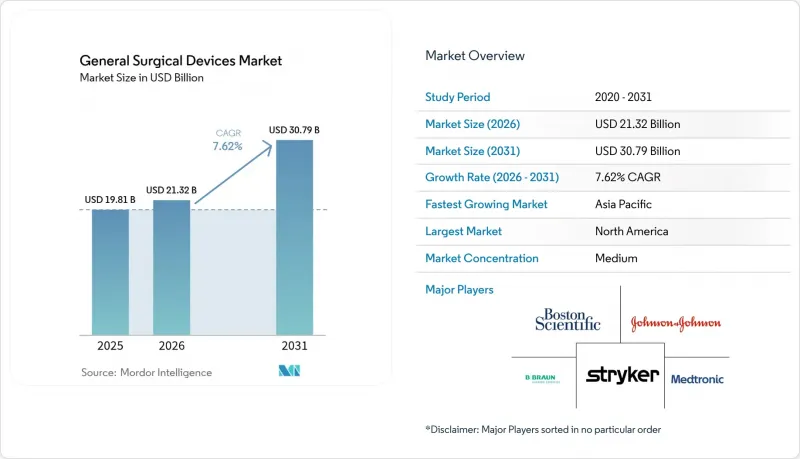
이 보고서는 제품 유형(저침습 수술용 등), 용도(정형외과, 심혈관, 산부인과·비뇨기과, 뇌신경외과 등), 최종사용자(병원, 외래 수술 센터, 전문 클리닉, 학술·연구 기관), 지역(북미, 유럽, 아시아태평양, 중동 및 아프리카, 남미)별로 분류되어 있습니다. 시장 전망은 금액(달러) 기준으로 제시되어 있습니다.
전 세계 일반 외과용 기기 시장의 동향 및 인사이트
전 세계 수술 건수의 증가
세계 인구의 고령화와 만성질환 유병률의 상승이 맞물려 외과적 치료에 대한 수요가 증가하고 있지만, 세계보건기구(WHO)가 정한 ‘인구 10만 명당 연간 5,000건’이라는 기준을 충족하는 국가는 불과 45개국에 불과합니다. 고소득 국가에서는 Intuitive Surgical사가 2024년에 268만 건의 다빈치 수술을 기록하여 전년 대비 17% 증가했으나, 그 대부분을 일반 외과수술이 차지하고 있습니다. 이러한 추세에 따라 병원들은 처리 능력을 유지하기 위해 수술 기구의 품목 구성을 확대하고 자본 예산을 조율할 수밖에 없는 상황입니다. 이에 대응하여 각 제조사들은 수술실을 전면적으로 개조하지 않고도 기존 인프라에 통합할 수 있는 다학제적 트레이와 모듈식 로봇 암을 순차적으로 도입하고 있습니다. 한편, 수술 건수의 증가는 일회용 기구의 경제성을 더욱 높여, 일반 외과용 기기 시장의 성장 기조를 확고히 하고 있습니다.
최소 침습 수술·로봇 수술로의 전환
점점 더 많은 외과의들이 환자의 회복 기간을 단축하고, 진통제 사용량을 줄이며, 당일 퇴원을 가능하게 하기 위해 최소 침습 수술법으로 기울고 있습니다. 5세대 다빈치 플랫폼에 도입된 힘 피드백 기술(조직에 가해지는 압력을 최대 43%까지 감소시킨다는 것을 보여주는 전임상 데이터로 입증됨)은, 그동안 촉각 상실을 우려해 주저하던 의사들의 진입 장벽을 낮추고 있습니다. 하지만 여전히 막대한 설비 투자 비용이 장벽으로 작용하고 있으며, 예측 가능한 수술 건수에 비용을 분산시키는 리스 모델이나 1건당 과금 방식이 도입되고 있습니다. 도입이 확대됨에 따라 일반 외과용 기기 시장에도 파급 효과가 나타나고 있습니다. 로봇 수술의 가동성에 최적화된 보조 포트, 스테이플러, 에너지 기구 등에 대한 수요도 병행하여 증가하고 있습니다.
첨단 시스템의 고액 초기 투자 및 유지비
최고 수준의 로봇 수술 시스템을 도입하려면 초기 비용으로 250만 달러가 필요할 수 있으며, 연간 서비스 계약 비용은 10만 달러에서 20만 달러 사이입니다. 리스나 ‘클릭 단위’ 계약을 통해 초기 부담은 경감되지만, 재무위원회는 여전히 처리 능력 향상으로 인해 그 비용이 상쇄된다는 증거를 요구하고 있습니다. 많은 지역 병원의 경우, 수술대에 설치되는 유형이나 수술대 아래에 수납할 수 있는 싱글 포트형 로봇은 설치 공간의 제약과 설비 투자 부담을 줄일 수 있다는 점에서 매력적인 선택지가 되고 있습니다. 하지만 높은 가격은 여전히 장벽으로 작용하고 있으며, 일반 외과용 기기 시장의 단기적인 성장을 억제하는 요인이 되고 있습니다.
부문 분석
2025년 매출 중 일회용 소모품이 43.78%를 차지하고 있으며, 재처리 위험을 배제하고 무균성을 확보하려는 병원의 노력이 두드러지게 나타나고 있습니다. 이러한 우위는 인증 조사에서 중앙 멸균 워크플로우의 미비점이 지적될 때마다 더욱 강화되어, 관리자들이 일반적인 시술에 맞춰 일회용 키트로 전환하도록 이끌고 있습니다. 로봇 수술용 기구는 현재로서는 절대적인 점유율이 작지만, 2031년까지 연평균 성장률(CAGR) 9.65%로 확대되고 있습니다. 이러한 성장은 힘 피드백 기능을 갖춘 시스템의 도입 대수 확대에 기인하며, 이로 인해 중견 외과의사들에게도 전환이 용이해지고 있습니다. 로봇 수술용 소모품 중 일반 외과용 기기 시장 규모는 콘솔 출하 대수에 비례하여 확대될 것으로 예측됩니다.
성장의 두 번째 축은 초음파 절개, 양극성 밀봉, 실시간 열 모니터링을 융합한 하이브리드 에너지 툴에 있습니다. 존슨앤드존슨의 모듈식 발전기는 카트의 설치 면적을 거의 절반으로 줄여, 공간이 제한된 외래 수술실에 큰 이점이 되고 있습니다. 스마트 스테이플러도 이 경쟁에 합류했습니다. 메드트로닉(Medtronic)의 원형 모델은 적응형 압축 기능과 내장된 누출 검사 기능을 갖추고 있으며, 커넥티드 수술실 내에서 일회용 제품이 데이터 노드가 되는 미래를 예고합니다. 프리미엄 기능이 자본 설비에서 일회용 형태로 전환됨에 따라 가치 인식은 일반 외과용 기기 시장을 계속해서 고급 일회용 제품 쪽으로 기울게 하고 있습니다.
지역별 분석
북미는 1만 대에 육박하는 ‘다빈치(da Vinci)’ 콘솔 도입 실적과 최소 침습 수술을 우대하는 보상 모델에 힘입어 2025년 매출의 41.54%를 차지했습니다. 중규모 병원의 자금 사정 압박은 여전히 지속되고 있지만, 리스 프로그램과 수술대 탑재형 로봇이 그 영향을 완화하고 있습니다. 당일 퇴원이 보험사로부터 지지를 얻으면서 외래 수술 센터가 활기를 띠고 있으며, 이는 일회용 키트 수요를 지원하는 동시에 해당 지역의 일반 외과용 기기 시장의 기반을 공고히 하고 있습니다.
유럽은 로봇 및 하이브리드 에너지 플랫폼 도입이 성숙 단계에 접어든 점에서 이를 뒤따르고 있습니다. EU MDR(의료기기 규정)에 따른 규제 강화로 규정 준수 비용은 상승했으나, 최근 간소화안은 연간 33억 유로의 비용 절감을 목표로 하고 있으며, 신제품 출시를 다시 활성화시킬 가능성이 있습니다. 지속가능성에 대한 요구는 새로운 조달 기준을 가져오고 있으며, 사용 후 플라스틱을 회수하거나 수명 주기 동안 탄소 배출 감축 실적을 입증하는 제조업체가 우대받고 있습니다.
아시아태평양은 연평균 성장률(CAGR) 8.54%를 기록하며 가장 빠르게 성장하는 지역입니다. 정부 자금에 의한 병원 확장과 중산층의 확대가 고객 기반을 넓히고 있는 한편, 현지 생산 노력을 통해 공급업체는 적절한 가격 책정이 가능해졌습니다. 도시 지역의 주요 의료기관에서는 데이터베이스 고성능 시스템이 보급되고 있지만, 예산이 여전히 빠듯한 2차 의료기관에서는 수동식이나 하이브리드식 기기가 여전히 주류를 이루고 있습니다. 라틴아메리카나 중동의 신흥 시장에서도 규모는 작지만 유사한 추세가 나타나고 있으며, 이러한 요인들이 결합되어 일반 외과용 기기 시장을 새로운 영역으로 확장시키고 있습니다.
기타 혜택:
- 엑셀 형식의 시장 예측(ME) 시트
- 3개월간의 애널리스트 지원
자주 묻는 질문
목차
제1장 서론
제2장 조사 방법
제3장 개요
제4장 시장 구도
제5장 시장 규모와 성장 예측
제6장 경쟁 구도
제7장 시장 기회와 향후 전망
KSA 26.09.04According to Mordor Intelligence, the general surgical devices market size is projected to expand from USD 19.81 billion in 2025 and USD 21.32 billion in 2026 to USD 30.79 billion by 2031, registering a CAGR of 7.62% between 2026 to 2031.
This report is Segmented by Product Type (Minimally Invasive, and More), Application (Orthopaedic, Cardiovascular, Gynaecology & Urology, Neurosurgery, and More), End User (Hospitals, Ascs, Specialty Clinics, and Academic & Research Institutes), and Geography (North America, Europe, Asia-Pacific, Middle East & Africa, and South America). Market Forecasts are Provided in Value (USD).
Global General Surgical Devices Market Trends and Insights
Rising Global Surgical Procedure Volumes
An aging world population, coupled with higher chronic-disease prevalence, is driving up the need for operative care, yet only 45 countries meet the World Health Organization's benchmark of 5,000 procedures per 100,000 people each year. In high-income settings, Intuitive Surgical recorded 2.68 million da Vinci procedures during 2024, a 17% year-over-year jump, with general surgery accounting for the lion's share. This momentum is forcing hospitals to broaden instrument portfolios and stretch capital budgets to maintain throughput. Manufacturers, in response, are rolling out multi-specialty trays and modular robotic arms that slot into existing infrastructure without a full operating-room overhaul. Larger case volumes, meanwhile, reinforce the economics of disposables, further anchoring the general surgical devices market in a growth posture.
Shift Toward Minimally Invasive and Robotic Surgeries
More surgeons are gravitating toward minimally invasive techniques to shorten patient recovery, reduce pain medication use, and enable same-day discharge. The arrival of force-feedback technology in the fifth-generation da Vinci platform-validated by preclinical data showing up to 43% less tissue pressure-lowers the barrier for those who previously hesitated over the loss of tactile sensation. Even so, capital intensity remains a gating factor, prompting leasing models and per-procedure billing that distribute costs across predictable caseloads. As deployment widens, the general surgical devices market sees a halo effect: ancillary ports, staplers, and energy instruments optimized for robotic articulation experience parallel growth in demand.
High Capital and Maintenance Costs of Advanced Systems
Acquiring a top-tier robotic suite can require USD 2.5 million up front, while annual service contracts range between USD 100,000 and USD 200,000. Even though leasing and per-click agreements ease the initial burden, finance committees still seek proof that improved throughput offsets the expense. For many community hospitals, table-mounted or single-port robots that tuck under the operating table represent an attractive alternative by trimming floor-space penalties and capital exposure. Nevertheless, the price tag remains a hurdle that tempers near-term growth in the general surgical devices market.
Other drivers and restraints analyzed in the detailed report include:
- Continuous Technological Advancements in Surgical Instruments
- Increasing Preference for Disposable and Single-Use Devices
- Stringent Regulatory and Compliance Requirements
For complete list of drivers and restraints, kindly check the Table Of Contents.
Segment Analysis
Disposable supplies accounted for 43.78% of 2025 revenue, underscoring a hospital's drive to eliminate reprocessing risk and secure sterility assurance. This dominance is reinforced each time accreditation surveys flag lapses in central sterile work-flows, pushing administrators toward single-use kits tailored for common procedures. Robotic instruments, while representing a smaller absolute slice today, are climbing at a 9.65% CAGR to 2031. Their growth depends on the expanding installed base of force-feedback-equipped systems, which makes the transition easier for mid-career surgeons. The general surgical devices market size for robotic consumables is projected to grow in tandem with each console shipped.
A second tier of growth lies in hybrid energy tools that merge ultrasonic cutting, bipolar sealing, and real-time thermal monitoring. Johnson & Johnson's modular generator reduces cart footprints by nearly half, a design win for crowded ambulatory suites. Smart staplers have joined the fray: Medtronic's circular model offers adaptive compression and onboard leak testing, signaling a future in which disposables become data nodes inside connected operating rooms. As premium functions move from capital equipment into single-use formats, value perception continues tilting the general surgical devices market toward advanced disposables.
Complete Report Scope:
- By Product Type
- Minimally Invasive Surgery Instruments
- Robotic-Assisted Surgery Instruments
- Energy-Based Surgery Instruments (RF, Ultrasonic, Laser)
- Open Surgery Instruments
- Disposable / Single-Use Surgical Supplies
- Smart / Sensor-Enabled Instruments
- Other Product Types
- By Application
- Orthopaedic
- Cardiovascular
- Gynaecology & Urology
- Neurosurgery
- Gastrointestinal / Colorectal
- Bariatric & Metabolic
- Thoracic
- Plastic & Reconstructive
- Other Applications
- By End User
- Hospitals
- Ambulatory Surgical Centers
- Specialty Clinics
- Academic & Research Institutes
- Geography
- North America
- United States
- Canada
- Mexico
- Europe
- Germany
- United Kingdom
- France
- Italy
- Spain
- Rest of Europe
- Asia-Pacific
- China
- Japan
- India
- Australia
- South Korea
- Rest of Asia-Pacific
- Middle East & Africa
- GCC
- South Africa
- Rest of Middle East & Africa
- South America
- Brazil
- Argentina
- Rest of South America
- North America
Geography Analysis
North America generated 41.54% of 2025 revenue, supported by nearly 10,000 installed da Vinci consoles and reimbursement models that favor minimally invasive techniques. Capital pressure on midsize hospitals persists, but leasing programs and table-mounted robots soften the blow. Ambulatory centers are flourishing as same-day discharge gains payer support, reinforcing demand for disposable kits and anchoring the general surgical devices market in the region.
Europe follows with the mature adoption of robotic and hybrid-energy platforms. Regulatory strictness under EU MDR raised compliance costs, yet recent simplification proposals aim to cut EUR 3.3 billion a year and could reignite product launches. Sustainability imperatives add a new procurement filter, rewarding manufacturers that backtake used plastics or document lifecycle carbon savings.
Asia-Pacific is the fastest-growing region, with an 8.54% CAGR. Government-funded hospital expansion and a swelling middle class widen the customer base, while localized manufacturing initiatives help vendors strike the right price point. Premium data-enabled systems populate urban referral centers, but manual-hybrid instruments still dominate secondary hospitals where budgets remain tight. Emerging markets in Latin America and the Middle East echo similar dynamics on a smaller scale, collectively nudging the general surgical devices market into new territory.
- Applied Medical Resources
- Arthrex
- B. Braun
- Beckton Dickinson
- Boston Scientific
- CMR Surgical Ltd.
- Conmed
- Erbe Elektromedizin
- Integra LifeSciences
- Intuitive Surgical
- Johnson & Johnson (Ethicon, DePuy Synthes, J&J MedTech)
- Kangji Medical Holdings
- Karl Storz
- Medtronic
- Olympus
- Richard Wolf
- Smiths Group
- Solventum
- Stryker
- Teleflex
- Zimmer Biomet
Additional Benefits:
- The market estimate (ME) sheet in Excel format
- 3 months of analyst support
TABLE OF CONTENTS
1 Introduction
- 1.1 Study Assumptions & Market Definition
- 1.2 Scope of the Study
2 Research Methodology
3 Executive Summary
4 Market Landscape
- 4.1 Market Overview
- 4.2 Market Drivers
- 4.2.1 Rising Global Surgical Procedure Volumes
- 4.2.2 Shift Toward Minimally Invasive and Robotic Surgeries
- 4.2.3 Continuous Technological Advancements in Surgical Instruments
- 4.2.4 Expansion of Healthcare Infrastructure in Emerging Markets
- 4.2.5 Increasing Preference for Disposable and Single-Use Devices
- 4.2.6 Growing Investments in Smart and Connected Operating Rooms
- 4.3 Market Restraints
- 4.3.1 High Capital and Maintenance Costs of Advanced Systems
- 4.3.2 Stringent Regulatory and Compliance Requirements
- 4.3.3 Cybersecurity Risks in Networked Surgical Equipment
- 4.3.4 Shortage of Skilled Surgeons for Next-Generation Technologies
- 4.4 Value / Supply-Chain Analysis
- 4.5 Regulatory Landscape
- 4.6 Technological Outlook
- 4.7 Porter's Five Forces Analysis
- 4.7.1 Bargaining Power Of Suppliers
- 4.7.2 Bargaining Power Of Buyers
- 4.7.3 Threat Of New Entrants
- 4.7.4 Threat Of Substitutes
- 4.7.5 Intensity Of Competitive Rivalry
5 Market Size & Growth Forecasts (Value, USD)
- 5.1 By Product Type
- 5.1.1 Minimally Invasive Surgery Instruments
- 5.1.2 Robotic-Assisted Surgery Instruments
- 5.1.3 Energy-Based Surgery Instruments (RF, Ultrasonic, Laser)
- 5.1.4 Open Surgery Instruments
- 5.1.5 Disposable / Single-Use Surgical Supplies
- 5.1.6 Smart / Sensor-Enabled Instruments
- 5.1.7 Other Product Types
- 5.2 By Application
- 5.2.1 Orthopaedic
- 5.2.2 Cardiovascular
- 5.2.3 Gynaecology & Urology
- 5.2.4 Neurosurgery
- 5.2.5 Gastrointestinal / Colorectal
- 5.2.6 Bariatric & Metabolic
- 5.2.7 Thoracic
- 5.2.8 Plastic & Reconstructive
- 5.2.9 Other Applications
- 5.3 By End User
- 5.3.1 Hospitals
- 5.3.2 Ambulatory Surgical Centers
- 5.3.3 Specialty Clinics
- 5.3.4 Academic & Research Institutes
- 5.4 Geography
- 5.4.1 North America
- 5.4.1.1 United States
- 5.4.1.2 Canada
- 5.4.1.3 Mexico
- 5.4.2 Europe
- 5.4.2.1 Germany
- 5.4.2.2 United Kingdom
- 5.4.2.3 France
- 5.4.2.4 Italy
- 5.4.2.5 Spain
- 5.4.2.6 Rest of Europe
- 5.4.3 Asia-Pacific
- 5.4.3.1 China
- 5.4.3.2 Japan
- 5.4.3.3 India
- 5.4.3.4 Australia
- 5.4.3.5 South Korea
- 5.4.3.6 Rest of Asia-Pacific
- 5.4.4 Middle East & Africa
- 5.4.4.1 GCC
- 5.4.4.2 South Africa
- 5.4.4.3 Rest of Middle East & Africa
- 5.4.5 South America
- 5.4.5.1 Brazil
- 5.4.5.2 Argentina
- 5.4.5.3 Rest of South America
- 5.4.1 North America
6 Competitive Landscape
- 6.1 Market Concentration
- 6.2 Market Share Analysis
- 6.3 Company Profiles (Includes Global-Level Overview, Market-Level Overview, Core Segments, Financials As Available, Strategic Information, Market Rank/Share For Key Companies, Products & Services, And Recent Developments)
- 6.3.1 Applied Medical Resources Corp.
- 6.3.2 Arthrex Inc.
- 6.3.3 B. Braun SE
- 6.3.4 Becton, Dickinson & Co.
- 6.3.5 Boston Scientific Corporation
- 6.3.6 CMR Surgical Ltd.
- 6.3.7 Conmed Corporation
- 6.3.8 Erbe Elektromedizin GmbH
- 6.3.9 Integra LifeSciences Corporation
- 6.3.10 Intuitive Surgical Inc.
- 6.3.11 Johnson & Johnson (Ethicon, DePuy Synthes, J&J MedTech)
- 6.3.12 Kangji Medical Holdings
- 6.3.13 Karl Storz SE & Co. KG
- 6.3.14 Medtronic plc
- 6.3.15 Olympus Corporation
- 6.3.16 Richard Wolf GmbH
- 6.3.17 Smith & Nephew plc
- 6.3.18 Solventum
- 6.3.19 Stryker Corporation
- 6.3.20 Teleflex Incorporated
- 6.3.21 Zimmer Biomet Holdings Inc.
7 Market Opportunities & Future Outlook
- 7.1 White-Space & Unmet-Need Assessment


