

|
시장보고서
상품코드
2120597
가스 센서 : 시장 점유율 분석, 업계 동향 및 통계, 성장 예측(2026-2031년)Gas Sensors - Market Share Analysis, Industry Trends & Statistics, Growth Forecasts (2026 - 2031) |
||||||
 Mordor Intelligence
Mordor Intelligence에 의하면, 가스 센서 시장 규모는 2025년 16억 7,000만 달러로 평가되었습니다. 2026년에는 18억 6,000만 달러로 확대되어 2031년까지 29억 9,000만 달러에 이를 것으로 예상되고 2026-2031년에 걸쳐 CAGR 9.96%로 성장할 전망입니다.
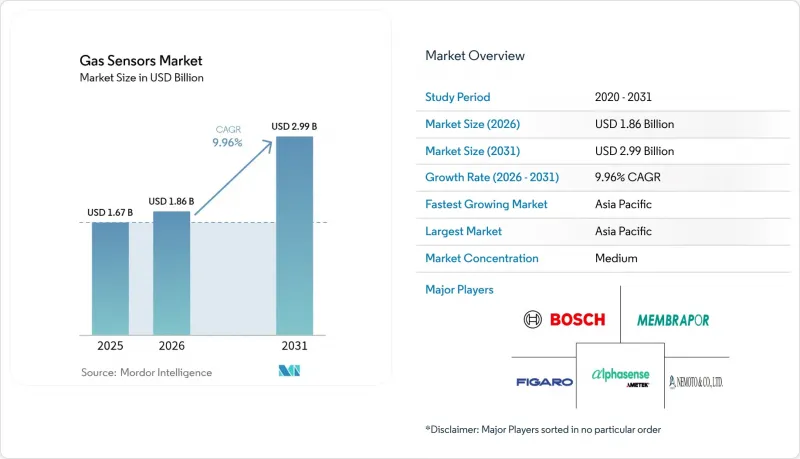
본 보고서는 가스 유형별(산소, 일산화탄소, 이산화탄소, 질소산화물, 탄화수소, 기타 가스), 기술별(전기화학식, 광이온화식, 기타), 폼 팩터별(고정형·현장 설치형, 기타),연결 방식별(유선, 무선), 최종 이용 산업별(산업 안전, 자동차, 기타), 지역별로 분류되어 있습니다. 시장 예측은 금액(달러) 기준으로 제시되어 있습니다.
세계의 가스 센서 시장 동향 및 인사이트
자동차 온보드 진단 시스템(OBD) 규제 강화
2025년 7월에 시행되는 유로 7 규정에 따르면, 차량의 전체 수명 기간 동안 허용되는 질소산화물 배출 한도가 10mg km-1로 낮아져, 자동차 제조업체들은 자가 진단 기능을 통한 이중화 기능을 갖춘 듀얼 NOx 프로브를 탑재해야만 합니다. 미국에서는 EPA Tier 3에 따라 차량군 평균 NOx 배출량이 30mg mile-1로 강화되었으며, 중국의 국가 VI-b 기준도 유사한 임계값을 채택하고 있어, 이를 합치면 연간 약 9,000만 대의 소형 차량이 대상이 됩니다. 현재 Tier 1 공급업체들은 850°C의 배기 가스를 견디고 5초 이하의 응답 시간을 확보할 수 있는 지르코니아 셀을 지정하고 있습니다. 수주량 증가로 인해 평균 판매 가격은 압박을 받고 있지만, 한편으로는 총 수요 대수도 증가하고 있습니다. NOx, 암모니아 슬립, 탄화수소를 동시에 측정하는 멀티 가스 모듈이 등장하여 배선 및 ECU 비용 절감이 진행되고 있습니다.
IoT를 활용한 공기질 모니터링 도입
각 도시에서는 주민 10만 명당 1곳의 규제 기준을 충족하는 측정소 체제에서 1km²당 10-50개의 저비용 노드를 배치하는 그리드 밀도로 전환되고 있으며, 실시간으로 초국지적인 지도가 생성되고 있습니다. 유럽연합(EU)은 2024년 PM2.5의 연간 기준치를 10µg/m³, NO₂를 20µg/m³로 낮춘 데 따라, 밀라노, 바르샤바,아테네에서는 보완적인 전기화학적 방식과 NDIR 방식 측정 어레이의 도입이 진행되고 있습니다. 중국에서는 자동 측정소의 수가 5,000곳을 넘어섰으며, 2027년까지 추가로 2,000곳의 마을·촌 단위 노드를 설치할 계획입니다. 인도는 2025년까지 기준을 충족하지 못한 132개 도시에 걸친 네트워크 구축을 위해 220억 루피(2억 6,500만 달러)를 예산에 편성했습니다. Siemens, ABB, Teledyne의 각 플랫폼은 데이터를 클라우드 대시보드에 업로드하여 드리프트 보정을 수행함으로써 현장 서비스 방문 횟수를 25% 줄이고 있습니다.
혼합 가스 매트릭스에서 10ppm 이하의 교차 감도와 관련된 과제
백금계 CO 셀은 수소에 대해 CO 감도의 약 50%로 반응하는 반면, H2S 셀은 SO2에 대해 20-30%의 교차 반응을 보입니다. 이로 인해 용도에 따른 검증에 막대한 비용이 소요되어 프로젝트 예산이 25% 증가할 가능성이 있습니다. MOS 센서는 더 넓은 간섭 대역을 가지고 있으며, ISO 17025는 단일 가스의 교정만을 대상으로 하고 있기 때문에 최종 사용자는 독자적인 검사 체계를 설계해야 합니다. Alphasense는 2025년에 과도적인 오감지를 줄여주는 칼만 필터가 탑재된 프런트엔드 칩을 출시했으나, 이로 인해 모듈당 15-30달러의 비용이 증가했습니다.
부문별 분석
산소 프로브는 람다 제어, 산업용 연소 조정, 인공호흡기에서의 범용적인 사용으로 인해 2025년 매출의 28.19%를 차지했습니다. 산소 감지용 가스 센서 시장 규모는 -40°C에서 850°C 범위에서 1% 이하의 정확도를 실현하는 지르코니아 셀에 의해 계속해서 뒷받침되고 있습니다. VOC 및 메탄을 포함한 탄화수소는 OGMP 2.0에 따라 업스트림 시설에서 분기별 조사가 의무화됨에 따라 연평균 성장률(CAGR) 11.77%로 확대되고 있으며, 이는 광이온화 검출기 및 오픈 패스 레이저 분광기의 판매를 뒷받침하고 있습니다.
전해조나 연료전지차에서 수소 농도가 높은 주변 환경으로 인해, 70바에서 10ppm 이하를 측정할 수 있는 미량 산소·질소 센서에 대한 수요가 증가하고 있습니다. CO₂ 센서는 실내 농도를 800ppm 이하로 유지하는 HVAC 개조 공사의 혜택을 받았습니다. 질소산화물 프로브는 유로 7 도입 이후 급증했으나, 단가는 45달러에서 38달러로 하락했습니다. 방폭 인클로저에 수납되어 출하되는 SO₂, NH₃, Cl₂ 모듈의 경우 여전히 고가 대가 유지되고 있습니다.
전기화학식 장치는 단일 가스 환경에서 높은 선택성을 바탕으로 2025년 시장 규모의 35.45%를 차지했습니다. MEMS 광학 어레이는 웨어러블 기기나 스마트폰에 탑재될 수 있는 3mm 크기의 패키지에 마이크로 미러와 적외선 감지기를 통합하고 있으며, 연평균 성장률(CAGR) 11.95%로 성장하고 있습니다. 디스크리트 설계에 비해 평균 판매 가격(ASP)이 높은 수준을 유지하고 있어, MEMS 모듈의 가스 센서 시장 점유율은 확대되고 있습니다.
PID 방식의 기기는 위험물 대응 팀을 위한 틈새 제품으로 남아 있지만, MOS 부품은 부품 원가가 가장 낮은 반면, 습도 변동으로 인해 드리프트가 발생하기 쉬워 빈번한 제로 조정이 필요합니다. NDIR은 15년의 수명으로 인해 50-150달러의 가격 책정이 정당화되는 환경 관측소의 CO2 및 탄화수소 분석에 여전히 필수적입니다. 주거용 메탄 경보기에서는 여전히 촉매 비드가 주류를 이루고 있지만, 실리콘 중독 문제로 인해 고급 사양의 설치 사례에서는 적외선 방식으로의 전환이 진행되고 있습니다.
지역별 분석
아시아태평양은 2025년 매출의 36.12%를 차지했으며, 연평균 성장률(CAGR) 11.59%를 나타낼 것으로 예측되어, 이는 지역별로는 가장 높은 성장 속도입니다. 중국에서는 5,000곳 이상의 정부 대기질 관측소가 가동 중이며, 2027년까지 2,000곳의 도시·마을 수준 관측소를 추가할 예정입니다. 각 관측소에는 연간 드리프트율 10% 이하라는 사양이 정해져 있습니다. 인도는 ‘국가 청정 공기 프로그램’에 따라 220억 루피(2억 6,500만 달러)를 예산으로 편성하고, 화력 발전소에 NDIR 방식의 SO2 및 NOx 프로브 채택을 의무화하고 있습니다. 일본은 2030년까지 수소 충전소 1,000곳 설치를 목표로 하고 있으며, ISO 19881 인증을 획득한 촉매 비드식 감지기 수요를 뒷받침하고 있습니다. 한편, 한국의 ‘그린 뉴딜’에서는 무선 센서 그리드를 갖춘 스마트 팩토리에 1조 8,000억 원을 배정하고 있습니다.
북미는 2025년 매출의 약 28%를 차지했습니다. OSHA(미국 산업안전보건청)에 의한 황화수소 허용 농도 강화로 인해 플랜트 전반에 걸쳐 감지기의 도입이 진행되었으며, 인플레이션 억제법(Inflation Reduction Act)에 따른 수소 크레딧(3달러/kg)이 미량 산소 센서가 필요한 15GW를 초과하는 전해조 프로젝트를 촉진했습니다. 캐나다의 메탄 규제에서는 분기별 누출 검사가 의무화되어 있으며, 멕시코에서는 1,200곳의 점오염원에 걸쳐 지속적인 모니터링이 확대되었습니다.
2025년, 유럽의 점유율은 약 24%였습니다. EU가 PM2.5와 NO2의 규제치를 하향 조정함에 따라, 남부 수도권에서는 고밀도 IoT 노드의 도입이 시급해졌습니다. 독일은 연속 배출 규제를 중규모 연소 시설로 확대하여 8,000건의 신규 설치가 추가되었습니다. 영국은 2021년 환경법에 따라 PM2.5에 대한 법적 구속력이 있는 목표치를 설정했으며, 프랑스는 모든 학교에 실내 공기 모니터링을 도입했습니다.
중동 및 아프리카는 매출의 8% 가까이를 차지했습니다. 사우디 아람코(Saudi Aramco)의 자프라 가스전에서는 유정 전체에 H2S 측정 네트워크가 설치되었으며, 아랍에미리트(UAE)에서는 2025년에 150곳의 환경 측정소가 설치되었습니다. 남아프리카공화국에서는 광산의 디젤 미립자 배출 기준이 하향 조정되었으며, BLE 태그를 활용한 개보수 작업이 진행되었습니다.
남미는 매출의 4%를 차지했으며, 브라질의 사탕수수 에탄올 복합 시설과 아르헨티나의 바카 무에르타 셰일가스 채굴장이 성장을 주도했습니다. 이 두 시설에서는 현재 압축기 스키드에 고정식 메탄 및 CO 감지기를 설치하는 것이 의무화되어 있습니다.
기타 혜택
- 엑셀 형식 시장 예측(ME) 시트
- 3개월간의 애널리스트 지원
자주 묻는 질문
목차
제1장 서론
제2장 조사 방법
제3장 주요 요약
제4장 시장 구도
제5장 시장 규모 및 성장 예측
제6장 경쟁 구도
제7장 시장 기회 및 향후 전망
KTH 26.09.04According to Mordor Intelligence, the gas sensors market size is expected to increase from USD 1.67 billion in 2025 to USD 1.86 billion in 2026 and reach USD 2.99 billion by 2031, growing at a CAGR of 9.96% over 2026-2031.

This report is Segmented by Gas Type (Oxygen, Carbon Monoxide, Carbon Dioxide, Nitrogen Oxides, Hydrocarbons, and More Gases), Technology (Electrochemical, Photo-Ionisation, and More), Form Factor (Fixed/In-Situ, and More), Connectivity (Wired, Wireless), End-Use Industry (Industrial Safety, Automotive, and More), and Geography. Market Forecasts are Provided in Terms of Value (USD).
Global Gas Sensors Market Trends and Insights
Stricter Vehicle On-Board Diagnostics
Euro 7 rules effective July 2025 cut allowable nitrogen-oxide slip to 10 mg km-1 for the full vehicle life, forcing automakers to install dual NOx probes with self-diagnostic redundancy. In the United States, EPA Tier 3 tightened fleet-average NOx to 30 mg mile-1, while China's National VI-b mirrors the same thresholds, together covering close to 90 million light-duty vehicles per year. Tier-1 suppliers now specify zirconia cells that survive 850 °C exhaust streams and deliver sub-5 s response. Larger order volumes are compressing average selling prices but are also boosting total unit demand. Multi-gas modules that simultaneously read NOx, ammonia slip, and hydrocarbons are emerging to trim wiring and ECU costs.
IoT-Enabled Air-Quality Monitoring Rollouts
Cities are moving from one regulatory-grade station per 100 000 residents to grid densities of 10-50 low-cost nodes km-2, generating hyperlocal maps in real time. The European Union cut annual PM2. 5 limits to 10 µg m-3 and NO2 to 20 µg m-3 in 2024, prompting Milan, Warsaw, and Athens to deploy supplementary electrochemical and NDIR arrays. China has surpassed 5 000 automated stations and plans another 2 000 township nodes by 2027. India budgeted INR 22 billion (USD 265 million) in 2025 for networks across 132 non-attainment cities. Platforms from Siemens, ABB, and Teledyne upload data to cloud dashboards that apply drift correction, trimming field service visits by 25%.
Sub-10 ppm Cross-Sensitivity Challenges in Mixed Gas Matrices
Platinum-based CO cells respond to hydrogen at about 50% of CO sensitivity, while H2S cells cross-respond 20-30% to SO2, leading to costly application-specific validation that can add 25% to project budgets. MOS sensors have even wider interference bands, and ISO 17025 covers only single-gas calibrations, leaving end users to design custom test regimes. Alphasense released a Kalman-filter front-end chip in 2025 that cuts transient false positives yet adds USD 15-30 to each module.
Other drivers and restraints analyzed in the detailed report include:
- Surging Demand from Hydrogen Production and Fuel-Cell Value Chain
- Workplace Safety Mandates
- Silicon Supply Volatility Inflating Wafer Prices
For complete list of drivers and restraints, kindly check the Table Of Contents.
Segment Analysis
Oxygen probes delivered 28.19% of 2025 revenue thanks to universal use in lambda control, industrial combustion tuning, and ventilators. The gas sensors market size for oxygen detection remains buoyed by zirconia cells that achieve sub-1% accuracy across -40 °C to 850 °C. Hydrocarbons, including VOCs and methane, are advancing at an 11.77% CAGR because OGMP 2.0 compels quarterly surveys at upstream sites, boosting sales of photo-ionization detectors and open-path laser spectrometers.
Hydrogen-rich atmospheres in electrolyzers and fuel-cell vehicles are pushing demand for trace oxygen and nitrogen sensors able to measure below 10 ppm at 70 bars. CO2 sensors benefited from HVAC retrofits that hold in-room levels under 800 ppm. Nitrogen-oxide probes rose sharply after Euro 7 but saw unit price erosion from USD 45 to 38. Premium pricing persists for SO2, NH3, and Cl2 modules that ship in explosion-proof enclosures.
Electrochemical devices held 35.45% of 2025 value, backed by high selectivity in single-gas contexts. MEMS-optical arrays are climbing at an 11.95% CAGR, integrating micro-mirrors and IR detectors within 3 mm packages that fit wearables and phones. The gas sensors market share of MEMS modules is widening as ASPs stay high relative to discrete designs.
PID instruments remain niche for hazmat teams, whereas MOS parts offer the lowest bill-of-materials but drift under humidity swings, requiring frequent zeroing. NDIR remains indispensable for CO2 and hydrocarbon analysis in ambient stations where 15-year lifetimes justify USD 50-150 pricing. Catalytic beads still dominate residential methane alarms, though silicone poisoning is nudging premium installations toward infrared options.
Complete Report Scope:
- By Gas Type
- Oxygen
- Carbon Monoxide (CO)
- Carbon Dioxide (CO?)
- Nitrogen Oxides (NO?)
- Hydrocarbons (VOC/CH?)
- Other Gases (SO?, H?S)
- By Technology
- Electrochemical
- Photo-Ionisation (PID)
- Solid-State / MOS
- Catalytic Bead
- Non-Dispersive Infra-Red (NDIR)
- MEMS-Semiconductor Optical
- By Form Factor
- Fixed / In-Situ Modules
- Portable / Hand-Held Devices
- Wearable Badges / Patches
- By Connectivity
- Wired (4-20 mA, CAN, RS-485)
- Wireless (BLE, NB-IoT, LoRaWAN)
- By End-Use Industry
- Industrial Safety and Process (Oil and Gas, Chemicals)
- Automotive Powertrain and HVAC
- Building Automation / Smart Homes
- Medical and Life-Science Equipment
- Food, Beverage and Cold-Chain Logistics
- Environmental Monitoring and Smart City Nodes
- By Geography
- North America
- United States
- Canada
- Mexico
- South America
- Brazil
- Argentina
- Europe
- Germany
- United Kingdom
- France
- Russia
- Asia-Pacific
- China
- Japan
- India
- South Korea
- Middle East and Africa
- Middle East
- United Arab Emirates
- Saudi Arabia
- Africa
- South Africa
- Rest of Africa
- Middle East
- North America
Geography Analysis
Asia-Pacific generated 36.12% of 2025 revenue and is forecast to grow at an 11.59% CAGR, the fastest regional pace. China operates more than 5 000 government air-quality stations and will add 2 000 township nodes by 2027, each specified for <10% annual drift. India budgeted INR 22 billion (USD 265 million) under its National Clean Air Programme, mandating NDIR SO2 and NOx probes in thermal plants. Japan aims for 1 000 hydrogen stations by 2030, boosting demand for catalytic bead detectors certified to ISO 19881, while South Korea's Green New Deal earmarked KRW 1.8 trillion for smart factories with wireless sensor grids.
North America provided roughly 28% of 2025 turnover. OSHA's stricter hydrogen-sulfide limits triggered plant-wide badge issuance, and the Inflation Reduction Act's USD 3 kg-1 hydrogen credit stimulated more than 15 GW of electrolyzer projects needing trace oxygen sensors. Canada's methane rule mandates quarterly leak checks, while Mexico expanded continuous monitoring across 1 200-point sources.
Europe held about 24% share in 2025. The EU cut PM2. 5 and NO2 limits, forcing southern capitals to deploy dense IoT nodes. Germany extended continuous emission rules to medium combustion plants, adding 8 000 new installations. The United Kingdom fixed a binding PM2. 5 target under the Environment Act 2021, and France introduced indoor-air monitoring in all schools.
Middle East and Africa contributed close to 8% of revenue. Saudi Aramco's Jafurah gas field is fitting H2S networks across wellheads, and the UAE installed 150 ambient stations in 2025. South Africa lowered diesel particulate limits in mines, prompting retrofits with BLE badges.
South America accounted for 4% of revenue, led by Brazil's sugarcane ethanol complexes and Argentina's Vaca Muerta shale pads, both of which now mandate fixed methane and CO detectors on compressor skids.
- Robert Bosch GmbH
- Honeywell International Inc. - City Technology
- Dragerwerk AG & Co. KGaA
- Figaro Engineering Inc.
- Sensirion Holding AG
- AlphaSense Inc.
- Amphenol SGX Sensortech Ltd.
- Membrapor AG
- Nemoto and Co., Ltd.
- Niterra Co., Ltd. (NGK-NTK)
- Delphi Technologies (BorgWarner Inc.)
- Senseair AB (Asahi Kasei Microdevices)
- Dynament Ltd.
- Siemens AG - BT Sensors
- ABB Ltd. - Ability Gas Analytics
- Yokogawa Electric Corporation
- Emerson Electric Co. - Rosemount
- Teledyne FLIR LLC
- General Electric Company - Panametrics
- Zhengzhou Winsen Electronics Technology Co., Ltd.
- NevadaNano Inc.
- MSA Safety Incorporated
Additional Benefits:
- The market estimate (ME) sheet in Excel format
- 3 months of analyst support
TABLE OF CONTENTS
1 INTRODUCTION
- 1.1 Study Assumptions and Market Definition
- 1.2 Scope of the Study
2 RESEARCH METHODOLOGY
3 EXECUTIVE SUMMARY
4 MARKET LANDSCAPE
- 4.1 Market Overview
- 4.2 Market Drivers
- 4.2.1 Stricter Vehicle On-Board Diagnostics (Euro 7, EPA Tier 3)
- 4.2.2 Workplace Safety Mandates (OSHA, REACH, ISO 45001)
- 4.2.3 IoT-Enabled Air-Quality Monitoring Roll-Outs (Smart Cities)
- 4.2.4 Surging Demand from Hydrogen Production and Fuel-Cell Value Chain
- 4.2.5 Emerging Methane-Leak Detection Rules for Oil and Gas (OGMP 2.0)
- 4.2.6 Miniaturised MEMS-Based Multi-Gas Arrays (< 3 mm) Driving ASP Uplift
- 4.3 Market Restraints
- 4.3.1 Sub-10 ppm Cross-Sensitivity Challenges in Mixed-Gas Matrices
- 4.3.2 Silicon Supply Volatility Inflating Wafer Prices
- 4.3.3 Lack of Global Calibration Standards Hampers Interchangeability
- 4.3.4 Cost Pressure from Low-End Chinese Electrochemical Suppliers
- 4.4 Industry Value-Chain Analysis
- 4.5 Regulatory Landscape
- 4.6 Technological Outlook
- 4.7 Impact of Macroeconomic Factors on the Market
- 4.8 Porter's Five Forces Analysis
- 4.8.1 Bargaining Power of Suppliers
- 4.8.2 Bargaining Power of Buyers
- 4.8.3 Threat of New Entrants
- 4.8.4 Threat of Substitutes
- 4.8.5 Intensity of Competitive Rivalry
5 MARKET SIZE AND GROWTH FORECASTS (VALUE)
- 5.1 By Gas Type
- 5.1.1 Oxygen
- 5.1.2 Carbon Monoxide (CO)
- 5.1.3 Carbon Dioxide (CO?)
- 5.1.4 Nitrogen Oxides (NO?)
- 5.1.5 Hydrocarbons (VOC/CH?)
- 5.1.6 Other Gases (SO?, H?S)
- 5.2 By Technology
- 5.2.1 Electrochemical
- 5.2.2 Photo-Ionisation (PID)
- 5.2.3 Solid-State / MOS
- 5.2.4 Catalytic Bead
- 5.2.5 Non-Dispersive Infra-Red (NDIR)
- 5.2.6 MEMS-Semiconductor Optical
- 5.3 By Form Factor
- 5.3.1 Fixed / In-Situ Modules
- 5.3.2 Portable / Hand-Held Devices
- 5.3.3 Wearable Badges / Patches
- 5.4 By Connectivity
- 5.4.1 Wired (4-20 mA, CAN, RS-485)
- 5.4.2 Wireless (BLE, NB-IoT, LoRaWAN)
- 5.5 By End-Use Industry
- 5.5.1 Industrial Safety and Process (Oil and Gas, Chemicals)
- 5.5.2 Automotive Powertrain and HVAC
- 5.5.3 Building Automation / Smart Homes
- 5.5.4 Medical and Life-Science Equipment
- 5.5.5 Food, Beverage and Cold-Chain Logistics
- 5.5.6 Environmental Monitoring and Smart City Nodes
- 5.6 By Geography
- 5.6.1 North America
- 5.6.1.1 United States
- 5.6.1.2 Canada
- 5.6.1.3 Mexico
- 5.6.2 South America
- 5.6.2.1 Brazil
- 5.6.2.2 Argentina
- 5.6.3 Europe
- 5.6.3.1 Germany
- 5.6.3.2 United Kingdom
- 5.6.3.3 France
- 5.6.3.4 Russia
- 5.6.4 Asia-Pacific
- 5.6.4.1 China
- 5.6.4.2 Japan
- 5.6.4.3 India
- 5.6.4.4 South Korea
- 5.6.5 Middle East and Africa
- 5.6.5.1 Middle East
- 5.6.5.1.1 United Arab Emirates
- 5.6.5.1.2 Saudi Arabia
- 5.6.5.2 Africa
- 5.6.5.2.1 South Africa
- 5.6.5.2.2 Rest of Africa
- 5.6.5.1 Middle East
- 5.6.1 North America
6 COMPETITIVE LANDSCAPE
- 6.1 Market Concentration
- 6.2 Strategic Moves
- 6.3 Market Share Analysis
- 6.4 Company Profiles (includes Global Level Overview, Market Level Overview, Core Segments, Financials as available, Strategic Information, Market Rank/Share, Products and Services, Recent Developments)
- 6.4.1 Robert Bosch GmbH
- 6.4.2 Honeywell International Inc. - City Technology
- 6.4.3 Dragerwerk AG & Co. KGaA
- 6.4.4 Figaro Engineering Inc.
- 6.4.5 Sensirion Holding AG
- 6.4.6 AlphaSense Inc.
- 6.4.7 Amphenol SGX Sensortech Ltd.
- 6.4.8 Membrapor AG
- 6.4.9 Nemoto and Co., Ltd.
- 6.4.10 Niterra Co., Ltd. (NGK-NTK)
- 6.4.11 Delphi Technologies (BorgWarner Inc.)
- 6.4.12 Senseair AB (Asahi Kasei Microdevices)
- 6.4.13 Dynament Ltd.
- 6.4.14 Siemens AG - BT Sensors
- 6.4.15 ABB Ltd. - Ability Gas Analytics
- 6.4.16 Yokogawa Electric Corporation
- 6.4.17 Emerson Electric Co. - Rosemount
- 6.4.18 Teledyne FLIR LLC
- 6.4.19 General Electric Company - Panametrics
- 6.4.20 Zhengzhou Winsen Electronics Technology Co., Ltd.
- 6.4.21 NevadaNano Inc.
- 6.4.22 MSA Safety Incorporated
7 MARKET OPPORTUNITIES AND FUTURE OUTLOOK
- 7.1 White-Space and Unmet-Need Assessment


