

|
시장보고서
상품코드
2121441
미국의 가스센서 : 시장 점유율 분석, 업계 동향과 통계, 성장 예측(2026-2031년)United States Gas Sensors - Market Share Analysis, Industry Trends & Statistics, Growth Forecasts (2026 - 2031) |
||||||
 Mordor Intelligence
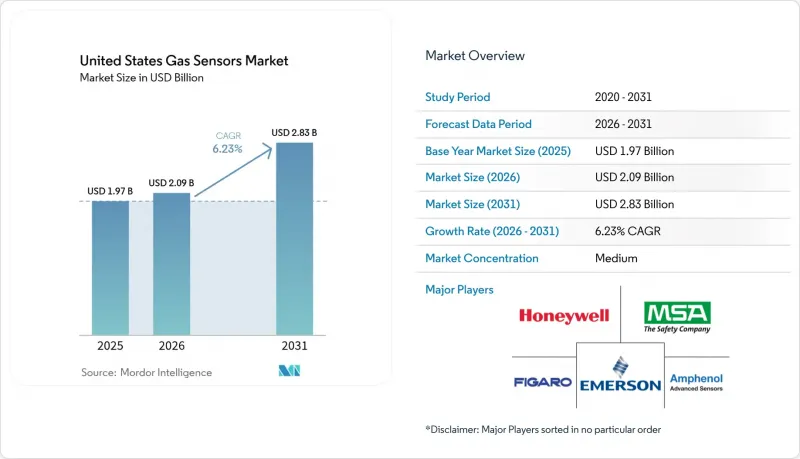
Mordor Intelligence에 의하면, 2026년 미국의 가스센서 시장 규모는 20억 9,000만 달러로 추정되며, 2025년 19억 7,000만 달러에서 2031년에는 28억 3,000만 달러에 달할 것으로 예측됩니다.
또한 2026-2031년 연평균 성장률(CAGR)은 6.23%를 기록할 전망입니다.
본 보고서는 유형별(유선, 무선), 가스 유형별(산소, 일산화탄소 등), 기술별(전기화학식, 광이온화 검출기(PID) 등), 용도별(의료 및 헬스케어, 빌딩 자동화 등)로 분류되어 있습니다. 시장 예측은 금액(달러) 기준으로 제시되어 있습니다.
미국 가스 센서 시장 동향 및 인사이트
OSHA 및 EPA 규정 준수가 산업 수요를 견인
메탄 및 유독 가스 배출에 관한 규제가 개정됨에 따라, 플랜트는 더 낮은 임계값에서 누출을 검증해야 할 의무가 있으며, 하루 최대 2만 5,000달러의 벌금이 부과될 수 있습니다. 따라서 시설에서는 10억 분의 1(ppb) 수준의 농도를 감지할 수 있는 멀티 가스 어레이에 투자하고 있으며, 이는 규정 준수를 넘어서는 공정 제어의 가치를 제공합니다. 현재 엔지니어링 팀은 위험 수준에 도달했을 때 자동으로 정지하는 안전 계장 시스템과 연동되는 감지기를 사양서에 포함시키고 있으며, 이 기능을 통해 대응 시간이 단축되고 법적 책임 위험도 경감됩니다. 규정 준수와 관련된 지출은 텍사스주, 루이지애나주, 펜실베이니아주의 석유 및 가스·화학 산업 클러스터에서 가장 많으며, 공급업체에게 안정적인 수익원이 되고 있습니다. 대량 구매자들은 규제 보고를 간소화하는 교정 프로그램이나 클라우드 기반 감사 추적을 통해 지원되는 제품 라인을 선호합니다.
HVAC/실내 공기질(IAQ) 분야로의 적용 확대(ASHRAE 62.1)
2024년 ASHRAE 62.1 개정으로 CO₂ 측정기의 정확도 목표가 상향 조정됨에 따라, 건물 운영자들은 구형 장비를 첨단 광학식 또는 전기화학식 장치로 교체하고 있습니다. 현재 사무실 건물, 병원, 학교에서는 가스 측정값을 공조 설비와 연동하여 재실자 수에 따라 환기를 제어하는 시스템이 도입되어, 에너지 절약과 건강 기준 간의 균형을 맞추고 있습니다. 포트폴리오 소유주들은 실내 공기 데이터를 임차인의 정착을 뒷받침하는 편의 시설로 간주하고 있으며, 가스 센서는 뒷전으로 밀려나 있던 설비에서 웰니스 브랜딩의 가시적인 요소로 격상되었습니다. 도입이 가장 활발한 곳은 북동부와 캘리포니아주로, 이 지역에서는 주 정부의 인센티브와 지속가능성 관련 의무가 맞물려 도입이 촉진되고 있습니다. 시스템 통합사업자는 센서와 분석 대시보드를 세트로 구성하여, 장애 알림과 환기 스코어카드를 한 화면에서 제공합니다.
높은 교정 및 유지보수 비용
분기별 교정 절차에는 전용 시험 가스, 훈련을 받은 직원, 그리고 가동 중단 시간이 필요하며, 이로 인해 수명 주기 소유 비용이 설비 비용의 40%에 달할 가능성이 있습니다. 소규모 시설에서는 점검 주기를 늘리는 경우가 많아, 오경보나 미검출 누출의 위험이 발생하여 안전에 대한 투자가 무용지물이 될 우려가 있습니다. 제조업체 측은 자가 교정 기능이 탑재된 센서나 원격 진단 기능으로 대응하고 있지만, 장비 가격은 상승하고 있어 구매자는 초기 비용 절감과 지속적인 인건비 사이의 균형을 신중하게 검토할 수밖에 없습니다. 지방 지역의 기술자 부족이 이러한 부담을 더욱 심화시키고 있어, 일부 운영자는 센서, 유지보수, 규정 준수 관련 서류 작성을 패키지로 묶은 유지보수 계약을 외부에 위탁하고 있습니다.
부문 분석
유선식 카테고리는 2025년 미국 가스 센서 시장에서 53.42%의 점유율을 유지했습니다. 이는 무정전 전원 공급 장치와 페일세이프 통신이 필요한 공정 산업 수요에 힘입은 결과입니다. 이러한 장비는 일반적으로 분산형 제어 시스템에 직접 연결되어 위험 구역에서의 규정 준수를 확실하게 보장합니다. 한편, 무선 노드는 배터리 수명을 5년 이상 연장하는 저전력 광역 통신 기술의 지원에 힘입어 연평균 성장률(CAGR) 11.12%로 성장하고 있습니다. 시설 관리자들은 턴어라운드 기간 중이나 배선 비용이 터무니없이 비싸지는 구식 건물에서 임시 설치를 가능하게 하는 메쉬 네트워크를 도입하고 있습니다. 무선 특유의 유연성 덕분에 센서를 세밀하게 배치할 수 있게 되어, 환기 상황을 보다 상세하게 파악하고자 하는 다층 학교나 병원에서 감지 범위가 확대되고 있습니다. 통합 업체들은 무선 가스 데이터와 재실 현황, 에너지 지표를 결합하여, 안전을 넘어 운영 효율에 이르기까지 이어지는 부가가치 제안을 패키지로 구성하고 있습니다.
무선 옵션의 부상은 서비스 모델도 변화시키고 있습니다. 각 벤더사는 현재 하드웨어, 네트워크 연결, 분석 대시보드를 단일 계약으로 묶은 구독형 패키지를 제공합니다. 이러한 변화로 인해 설비 투자 예산이 절감되며, 새로운 센서가 등장하더라도 지속적인 업그레이드가 가능해집니다. 미국 내 무선 설치와 관련된 가스 센서 시장 규모가 확대됨에 따라, 조달 팀은 수명 주기 가치와 소프트웨어 기능을 중시하는 총 소유 비용(TCO) 평가로 초점을 옮기고 있습니다. 고위험 구역에서는 유선 시스템이 여전히 표준으로 자리 잡고 있는 반면, 지출을 최적화하기 위해 클래스 I 디비전 1 구역에는 상설 유선 감지기를, 위험도가 낮은 공간에는 무선 장치를 결합한 하이브리드 아키텍처가 등장하고 있습니다.
2025년, 전기화학식 셀은 CO, H2S, NO2에 대한 입증된 정확도로 미국 가스 센서 시장 점유율의 31.08%를 차지했습니다. 클래스 I 환경에서의 가연성 가스 감지에서는 촉매 비드 방식이 여전히 주류로 남아 있었지만, HVAC 제어 분야의 CO₂ 감지에서는 NDIR 광학 방식이 인기를 끌었습니다. PID는 위험물 대응 및 산업 위생 캠페인에서의 VOC 모니터링이라는 틈새 역할을 수행했습니다.
MEMS MOS 장치는 반도체 생산에 따른 단가 비용 절감과 동전 크기의 패키지에서 다중 가스 식별이 가능해짐에 따라, 2026년부터 2031년까지 연평균 성장률(CAGR) 12.74%를 기록할 전망입니다. 머신러닝 알고리즘이 교차 감도를 보정함으로써, 단일 칩이 상황에 맞는 정확도로 메탄, 수소, 휘발성 유기 화합물을 식별할 수 있게 됩니다. 단독 작업자의 안전 확보를 목적으로 하는 웨어러블 기기나 민용 전자기기에는 이러한 칩이 내장되어 있어, 위험한 환경을 실시간으로 사용자에게 경고합니다. MEMS로의 전환을 통해 전력 소비도 감소하여 무선 노드의 배터리 수명이 연장될 뿐만 아니라, 잦은 배터리 교체를 줄이겠다는 지속가능성 목표에도 부합합니다.
기타 혜택:
- 엑셀 형식 시장 예측(ME) 시트
- 3개월간의 애널리스트 지원
자주 묻는 질문
목차
제1장 서론
제2장 조사 방법
제3장 주요 요약
제4장 시장 구도
제5장 시장 규모와 성장 예측
제6장 경쟁 구도
제7장 시장 기회와 향후 전망
LSH 26.09.09According to Mordor Intelligence, the United States gas sensors market size in 2026 is estimated at USD 2.09 billion, growing from 2025 value of USD 1.97 billion with 2031 projections showing USD 2.83 billion, growing at 6.23% CAGR over 2026-2031.

This report is Segmented by Type (Wired, Wireless), Gas Type (Oxygen, Carbon Monoxide and More), Technology (Electrochemical, Photo-Ionisation Detector (PID) and More), Application (Medical and Healthcare, Building Automation and More). The Market Forecasts are Provided in Terms of Value (USD).
United States Gas Sensors Market Trends and Insights
OSHA and EPA Compliance Driving Industrial Demand
Regulatory updates on methane and toxic gas emissions require plants to verify leaks at lower thresholds and carry penalties that can reach USD 25,000 per day. Facilities therefore invest in multi-gas arrays that detect parts-per-billion concentrations, adding process-control value beyond compliance. Engineering teams are now specifying detectors that integrate with safety-instrumented systems to automate shutdowns when hazardous levels arise, a capability that shortens response time and limits liability exposure. Compliance spending is heaviest in oil, gas, and chemical clusters across Texas, Louisiana, and Pennsylvania, securing a reliable revenue stream for suppliers. Large buyers prefer product lines supported by calibration programs and cloud-based audit trails that simplify regulatory reporting.
Growing HVAC / IAQ Adoption (ASHRAE 62.1)
The 2024 update to ASHRAE 62.1 tightened accuracy targets for CO2 meters, prompting building operators to swap older hardware for advanced optical or electrochemical devices. Office towers, hospitals, and schools now integrate occupancy-based ventilation controls that link gas readings to air-handling units, balancing energy savings with health criteria. Portfolio owners see indoor-air data as an amenity that supports tenant retention, elevating gas sensors from back-of-house equipment to a visible part of wellness branding. Strongest adoption is in the Northeast and California, where state incentives pair with sustainability mandates. System integrators bundle sensors with analytics dashboards to provide fault alerts and ventilation scorecards in a single view.
High Calibration & Maintenance Costs
Quarterly calibration protocols require specialty test gas, trained staff, and downtime that can push lifetime ownership costs to 40% of equipment spend. Smaller plants often delay service intervals, risking false alarms or undetected leaks that undermine safety investments. Manufacturers respond with self-calibrating cells and remote diagnostics, yet capital prices rise, forcing buyers to weigh upfront savings against recurring labour. Skill shortages in rural regions worsen the burden, prompting some operators to outsource maintenance contracts that bundle sensors, service, and compliance documentation.
Other drivers and restraints analyzed in the detailed report include:
- Automotive Cabin-Air Quality & Emissions Monitoring
- Edge-AI and IoT-Enabled Predictive Maintenance
- Methane-Leak Rules Under IIJA Pipelines Program
- Sensor Price Commoditisation
For complete list of drivers and restraints, kindly check the Table Of Contents.
Segment Analysis
The wired category maintained a 53.42% position in the United States gas sensors market during 2025, anchored by process industries that require uninterrupted power and fail-safe communication. These installations typically connect directly to distributed control systems, ensuring compliance in hazardous zones. However, wireless nodes are growing at an 11.12% CAGR, propelled by low-power wide-area technologies that stretch battery life to more than five years. Facility managers deploy mesh networks that allow temporary placement during turnarounds or in legacy buildings where cabling is cost prohibitive. Wireless flexibility supports granular sensor placement, elevating coverage in multi-story schools and hospitals that seek better ventilation insight. Integrators combine wireless gas data with occupancy and energy metrics, bundling value propositions that extend beyond safety into operational efficiency.
The rise of wireless options also reshapes service models. Vendors now offer subscription packages that wrap hardware, network connectivity, and analytics dashboards in single agreements. This shift reduces capital budgets and enables evergreen upgrades when new sensors emerge. As the United States gas sensors market size relevant to wireless installations climbs, procurement teams pivot toward total-cost evaluations that emphasize lifetime value and software functionality. While wired systems will remain standard in high-risk areas, hybrid architectures emerge, pairing permanent wired detectors in Class I Division 1 zones with wireless devices in less hazardous spaces to optimize spend.
Electrochemical cells held 31.08% of the United States gas sensors market share in 2025 due to their proven accuracy for CO, H2S, and NO2. Catalytic-bead designs persisted as the go-to choice for combustible gases in Class I environments, while NDIR optics gained popularity for CO2 in HVAC controls. PIDs served niche roles monitoring VOCs during hazmat response and industrial hygiene campaigns.
MEMS MOS devices are on track to post 12.74% CAGR growth between 2026 and 2031 as semiconductor production reduces per-unit costs and enables multi-gas identification in coin-sized packages. Machine-learning algorithms compensate for cross-sensitivity, letting a single die discriminate among methane, hydrogen, and volatile organics with contextual accuracy. Wearables for lone-worker safety and consumer electronics integrate these chips to alert users to hazardous environments in real time. The migration to MEMS also lowers power draw, extending battery life in wireless nodes and aligning with sustainability objectives that discourage frequent battery swaps.
Complete Report Scope:
- By Type
- Wired
- Wireless
- By Gas Type
- Oxygen
- Carbon Monoxide
- Carbon Dioxide
- Nitrogen Oxide
- Hydrocarbon
- Others
- By Technology
- Electrochemical
- Photo-Ionisation Detector (PID)
- Solid-State / MOS
- Catalytic Bead
- Infra-Red (NDIR)
- Semiconductor
- By Application
- Medical and Healthcare
- Building Automation
- Industrial Safety and Process
- Food and Beverage
- Automotive
- Transportation and Logistics
- Other Applications
List of Companies Covered in this Report:
- Honeywell International Inc.
- Sensirion AG
- Amphenol Advanced Sensors
- Figaro Engineering Inc.
- Emerson Electric Co.
- MSA Safety Inc.
- Robert Bosch GmbH
- City Technology Ltd
- Renesas Electronics Corp.
- AMS OSRAM AG
- Trolex Ltd
- Sensata Technologies
- Draeger Safety AG
- NevadaNano
- Aeroqual Ltd
- SPEC Sensors LLC
- AlphaSense Inc.
- Figaro USA Inc.
- Membrapor AG
- Cubic Sensor and Instrumentation
Additional Benefits:
- The market estimate (ME) sheet in Excel format
- 3 months of analyst support
TABLE OF CONTENTS
1 INTRODUCTION
- 1.1 Study Assumptions and Market Definition
- 1.2 Scope of the Study
2 RESEARCH METHODOLOGY
3 EXECUTIVE SUMMARY
4 MARKET LANDSCAPE
- 4.1 Market Overview
- 4.2 Market Drivers
- 4.2.1 OSHA and EPA compliance driving industrial demand
- 4.2.2 Growing HVAC / IAQ adoption (ASHRAE 62.1)
- 4.2.3 Automotive cabin-air quality and emissions monitoring
- 4.2.4 Edge-AI and IoT-enabled predictive maintenance
- 4.2.5 Hydrogen refueling leak-detection roll-out
- 4.2.6 Methane-leak rules under IIJA pipelines program
- 4.3 Market Restraints
- 4.3.1 High calibration and maintenance costs
- 4.3.2 Sensor price commoditisation
- 4.3.3 Domestic MEMS-fab capacity bottlenecks
- 4.3.4 Cyber-security worries for cloud-connected sensors
- 4.4 Value / Supply-Chain Analysis
- 4.5 Regulatory Landscape
- 4.6 Technological Outlook
- 4.7 Porter's Five Forces Analysis
- 4.7.1 Threat of New Entrants
- 4.7.2 Bargaining Power of Buyers
- 4.7.3 Bargaining Power of Suppliers
- 4.7.4 Threat of Substitutes
- 4.7.5 Intensity of Competitive Rivalry
- 4.8 Pandemic and Macroeconomic Impact Assessment
5 MARKET SIZE AND GROWTH FORECASTS (VALUE)
- 5.1 By Type
- 5.1.1 Wired
- 5.1.2 Wireless
- 5.2 By Gas Type
- 5.2.1 Oxygen
- 5.2.2 Carbon Monoxide
- 5.2.3 Carbon Dioxide
- 5.2.4 Nitrogen Oxide
- 5.2.5 Hydrocarbon
- 5.2.6 Others
- 5.3 By Technology
- 5.3.1 Electrochemical
- 5.3.2 Photo-Ionisation Detector (PID)
- 5.3.3 Solid-State / MOS
- 5.3.4 Catalytic Bead
- 5.3.5 Infra-Red (NDIR)
- 5.3.6 Semiconductor
- 5.4 By Application
- 5.4.1 Medical and Healthcare
- 5.4.2 Building Automation
- 5.4.3 Industrial Safety and Process
- 5.4.4 Food and Beverage
- 5.4.5 Automotive
- 5.4.6 Transportation and Logistics
- 5.4.7 Other Applications
6 COMPETITIVE LANDSCAPE
- 6.1 Market Concentration
- 6.2 Strategic Moves
- 6.3 Market Share Analysis
- 6.4 Company Profiles (includes Global level Overview, Market level overview, Core Segments, Financials as available, Strategic Information, Market Rank/Share for key companies, Products and Services, and Recent Developments)
- 6.4.1 Honeywell International Inc.
- 6.4.2 Sensirion AG
- 6.4.3 Amphenol Advanced Sensors
- 6.4.4 Figaro Engineering Inc.
- 6.4.5 Emerson Electric Co.
- 6.4.6 MSA Safety Inc.
- 6.4.7 Robert Bosch GmbH
- 6.4.8 City Technology Ltd
- 6.4.9 Renesas Electronics Corp.
- 6.4.10 AMS OSRAM AG
- 6.4.11 Trolex Ltd
- 6.4.12 Sensata Technologies
- 6.4.13 Draeger Safety AG
- 6.4.14 NevadaNano
- 6.4.15 Aeroqual Ltd
- 6.4.16 SPEC Sensors LLC
- 6.4.17 AlphaSense Inc.
- 6.4.18 Figaro USA Inc.
- 6.4.19 Membrapor AG
- 6.4.20 Cubic Sensor and Instrumentation
7 MARKET OPPORTUNITIES & FUTURE OUTLOOK
- 7.1 White-space and Unmet-Need Assessment


