

|
시장보고서
상품코드
2123002
가스 센서, 감지기 및 분석기 시장 : 점유율 분석, 업계 동향과 통계, 성장 예측(2026-2031년)Gas Sensor, Detector And Analyzer - Market Share Analysis, Industry Trends & Statistics, Growth Forecasts (2026 - 2031) |
||||||
 Mordor Intelligence
Mordor Intelligence에 의하면, 가스 센서, 감지기 및 분석기 시장 규모는 2025년 49억 3,000만 달러에서 2026년에는 52억 1,000만 달러로 확대되어 2026-2031년까지 CAGR 5.59%로 성장을 지속하여, 2031년까지 68억 4,000만 달러에 이를 것으로 예측됩니다.
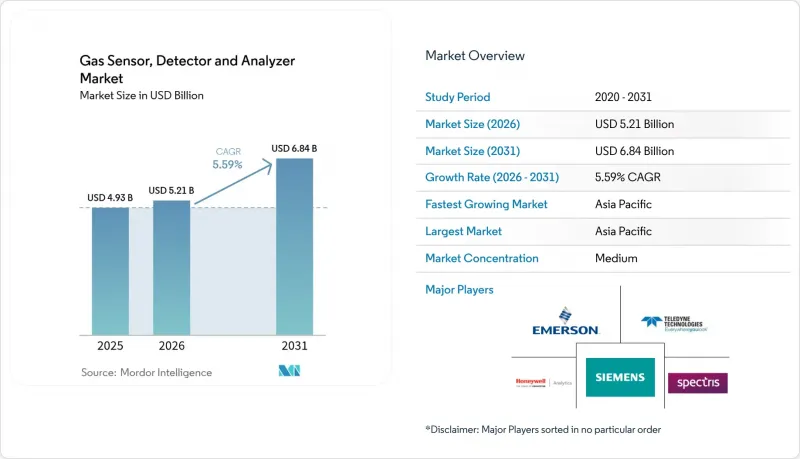
본 보고서는 제품 카테고리(가스 분석 장치, 가스 센서, 가스 감지기), 기술(전기화학, 상자성, 기타), 통신 유형(유선, 무선), 최종 사용자 산업(석유 및 가스, 금속 및 광업, 유틸리티·발전, 의약품, 식음료, 기타), 지역별로 분류되어 있습니다. 시장 전망은 금액(달러) 기준으로 제시되어 있습니다.
전 세계 가스 센서, 감지기 및 분석 장치 시장 동향 및 인사이트
직업적 위험에 대한 안전 의식 고조
직장 내 사망 사고에 대한 사회적 관심이 높아짐에 따라, 산업 사업자들은 지속적인 감지를 표준 업무 절차에 포함시키고 있습니다. OSHA(미국 노동안전보건청)의 기록에 따르면, 2024년에는 5,190명의 근로자가 사망했으며, 그중 8%는 가스 노출이 원인이었습니다. 현재 보험사들은 인증된 감지 네트워크가 도입될 경우 보험료를 최대 25% 할인해 주는 서비스를 제공하고 있어, 규제 준수가 직접적인 비용 절감책이 되고 있습니다. 또한 규제 적용 범위가 식품 가공 공장 등 ‘기존과는 다른’ 환경으로 확대됨에 따라, 처음 구매하는 기업들도 가스 센서, 감지기 및 분석기 시장에 진입할 수밖에 없게 되었습니다. 그 결과, 수요는 산발적인 구매 주기에서 기업 전체의 안전 KPI와 연계된 계획적인 도입으로 전환되고 있습니다.
휴대용 멀티 가스 감지기의 보급
2024년 국제소방장협회가 모든 긴급 대응 팀에 도입을 권장함에 따라, 휴대용 멀티 가스 감지기는 특수 장비에서 초기 대응에 필수적인 장비로 전환되었습니다. 현재의 장비는 교차 감도를 2% 이하로 억제한 6가지 가스 감지 어레이를 탑재하고 있어, 소방관이나 유지보수 작업자가 위험을 실시간으로 확인할 수 있게 되었습니다. 배터리 구동 시간이 72시간으로 연장되어 근무 중 가동 중단 시간이 해소되었을 뿐만 아니라, GPS 및 휴대전화 회선을 통한 데이터 전송 기능 덕분에 각 작업자가 이동식 센서 노드 역할을 수행할 수 있게 되었습니다. 이러한 이용 형태의 변화로 인해, 특히 급성장 중인 동남아시아 건설 산업을 중심으로 두 자릿수 판매 대수가 지속적으로 유지되고 있습니다.
초기 설치 및 교정에 드는 높은 비용
공장 전체를 커버하는 유선 감지 네트워크의 도입 비용은 2만 5,000-7만 5,000달러에 달하며, 연간 교정 계약으로 인해 소유 비용이 20-30% 추가됩니다. 신흥 아시아 공장의 40%는 다른 자본 프로젝트에 예산이 배정되어 있어 업그레이드를 미루고 있습니다. 구독 모델이 점차 보급되면서 도입 비용을 최대 70%까지 절감할 수 있지만, 많은 소규모 사업자들은 규제 당국이 개입하기 전까지는 가스 모니터링을 여전히 선택적 조치로 간주하고 있습니다.
부문 분석
금액 기준으로 볼 때, 2025년에는 센서가 가스 센서, 감지기 및 분석기 시장의 47.33% 점유율을 차지할 것으로 보이며, 이는 분산형 아키텍처 내의 플러그 앤 플레이 호환성을 반영한 것입니다. 이 부문은 구조적 개조 없이 기계 패널에 직접 통합할 수 있는 MEMS 감지기의 소형화에 힘입어 2031년까지 연평균 성장률(CAGR) 6.62%를 나타낼 것으로 예측됩니다. 감지기는 밀폐 공간에서의 경보나 소방관용 키트에서 여전히 중요한 역할을 수행하는 반면 및 분석 장치는 100만분의 1 단위의 정밀도가 요구되는 실험실이나 배기가스 보고 부문에서 주류를 이루고 있습니다. 현재 각 제조업체는 이러한 경계를 허물고, IEC 62990을 준수하며 범용 슬롯인 사용이 가능한 하이브리드 모듈을 제공하고 있으며, 이러한 움직임은 ‘센서 퍼스트’ 설계 접근 방식을 강화할 것으로 예측됩니다.
2세대 플랫폼은 경보 기능 및 분석 기능, 클라우드 게이트웨이를 단일 하우징에 통합하여 설치 시간을 35% 단축합니다. 소규모 공급업체들도 개방형 표준 프로토콜을 활용하여 Tier 1 모니터링 시스템과 원활하게 통합되는 틈새 분석기를 판매할 수 있게 되어, 벤더 종속성에 대한 우려가 완화되고 있습니다. 이러한 상호 운용성 덕분에 조달 방식이 일회성 감지기 주문에서 전사적 프레임워크 계약으로 전환되고 있으며, 그 결과 가스 센서, 감지기 및 분석기 시장에서 평균 계약 금액이 점차 증가하고 있습니다.
전기화학식 스택은 레거시 도입 환경에서 여전히 비용 대비 성능이 뛰어나기 때문에 가스 센서, 감지기 및 분석기 시장 규모의 37.08%를 계속 차지하고 있습니다. 반도체 어레이가 단기적인 혁신을 주도하고 있으며, 작동 내구성은 연평균 성장률(CAGR) 5.66%, 소비 전력은 1밀리와트 이하를 실현하고 있습니다. 비분산형 적외선(NDIR) 헤드는 식품 포장에서의 CO2 미량 검출이라는 틈새 시장에서 확고한 입지를 유지하고 있는 반면, 상자성 루프는 비활성화 시스템에서 산소의 순도를 보호하고 있습니다. 촉매 비드는 본질 안전 규격이 선택성 문제를 상회하는 탄화수소 환경에서 여전히 널리 채택되고 있습니다.
고급 광음향 셀은 현재로서는 비싸지만, 컴팩트한 설치 면적에서 다중 가스 감지 기능을 제공합니다. 이 부문의 특허 출원 건수는 2024년에 45% 증가하여 연구 개발 투자의 확대를 뒷받침하고 있습니다. 규제 당국도 이에 주목하고 있으며, 작년에 EPA는 의무적인 누출 조사용으로 몇 가지 새로운 센서 화학 기술을 승인했습니다. 컨소시엄 참여 기업들은 배터리 수명 목표가 5년을 초과하고 교정 주기가 연 1회로 연장됨에 따라, 최종 사용자가 이러한 솔리드 스테이트형 센서를 단계적으로 도입해 나갈 것으로 예상하고 있습니다.
지역별 분석
아시아태평양은 2025년 매출의 35.42%를 차지하며 연평균 성장률(CAGR) 5.86%로 확대되고 있습니다. 중국에서는 GB/T 50493-2024가 시행되어 화학 제조업체에 다중 감지 네트워크 설치가 의무화되어 있습니다. 한편, 인도에서는 개정된 공장법에 따라 위험물 취급 시설에서의 실시간 모니터링이 의무화되었습니다. Figaro Engineering 등 일본의 OEM 업체들은 전력 소비를 30% 절감하는 MEMS 센서를 수출하고 있으며, 이로 인해 비용 효율을 중시하는 동남아시아의 중소기업에서 도입이 가속화되고 있습니다. 한국의 조선소에서는 염수 분무에 내성이 있는 선박용 감지기가 도입되고 있으며, 호주의 지하 광산에서는 암반에 의한 RF 감쇠를 극복하기 위해 장거리 메시 네트워크가 채택되고 있습니다.
북미에서는 신규 도입보다는 기존 장비의 교체에 따른 안정적인 수요가 나타나고 있습니다. OSHA(미국 직업안전보건청)의 밀폐 공간 관련 규정에 따라 휴대용 감지기 수요는 견조한 추세를 보이고 있으며, 캐나다의 오일샌드 사업자들은 -40°C에서도 작동 가능한 견고한 분석 장치를 필요로 하고 있습니다. 미국에서 조만간 시행될 메탄 관련 법에 따라 분기별 누출 조사가 의무화됨에 따라, 광학 이미저 및 고정밀 분석 장치에 대한 지속적인 수주가 예상됩니다. 또한, 멕시코에서 성장을 거듭하고 있는 자동차 산업 클러스터에서는 도장 공장의 환기 시스템에 CO 및 NO₂ 측정 어레이가 도입되어, 이는 판매 대수의 점진적인 증가에 기여하고 있습니다.
유럽에서는 거의 연속적인 배기가스 모니터링이 중시되고 있습니다. NOx 스크러버를 갖춘 발전소는 2024년 ‘산업 배출 지침’에 따라 배기가스 농도를 15ppm 이하로 유지하고 있음을 확인해야 합니다. 독일에서는 센서 출력을 인더스트리 4.0 플랫폼에 통합하여, 용광로 정지를 방지하는 예측 유지보수 알고리즘에 정보를 제공합니다. 영국의 해상 풍력 발전소에서는 모노파일 그라우팅 시공 중 H2S 모니터링이 요구되고 있는 반면, 폴란드의 구리 광산에서는 생산의 중심이 배터리용 금속으로 전환됨에 따라 방폭형 감지기가 채택되고 있습니다. 남미, 중동 및 아프리카도 시장을 구성하고 있으며, 남미는 구리 및 리튬 프로젝트, 중동 및 아프리카는 정유시설 확장 및 가스 구동식 해수 담수화 플랜트가 주요 성장 동력으로 작용하고 있습니다.
기타 혜택
- 엑셀 형식 시장 예측(ME) 시트
- 3개월간의 애널리스트 지원
자주 묻는 질문
목차
제1장 서론
제2장 조사 방법
제3장 주요 요약
제4장 시장 구도
제5장 시장 규모와 성장 예측
제6장 경쟁 구도
제7장 시장 기회와 향후 전망
JHS 26.09.09According to Mordor Intelligence, the gas sensor, detector, and Analyzer Market size is expected to grow from USD 4.93 billion in 2025 to USD 5.21 billion in 2026 and is forecast to reach USD 6.84 billion by 2031 at 5.59% CAGR over 2026-2031.

This report is Segmented by Product Category (Gas Analyzers, Gas Sensors, and Gas Detectors), Technology (Electrochemical, Paramagnetic, and More), Communication Type (Wired, and Wireless), End-User Industry (Oil and Gas, Metals and Mining, Utilities and Power Generation, Pharmaceuticals, Food and Beverage, and More), and Geography. The Market Forecasts are Provided in Terms of Value (USD).
Global Gas Sensor, Detector And Analyzer Market Trends and Insights
Increasing Safety Awareness Regarding Occupational Hazards
Rising public scrutiny of workplace fatalities has prompted industrial operators to incorporate continuous detection into their standard operating procedures. OSHA recorded 5,190 worker deaths in 2024, with exposure to gases accounting for 8% of those incidents. Insurance carriers now offer discounts of up to 25% on premiums when certified detection networks are installed, making compliance a direct cost-saving measure. Expanded mandates also reach "non-traditional" settings such as food processing plants, forcing first-time buyers to enter the gas sensor, detector, and analyzer market. Demand therefore shifts from episodic purchase cycles to programmatic rollouts tied to enterprise-wide safety KPIs.
Proliferation of Handheld Multigas Detectors
Portable multigas units have transitioned from specialty gear to first-response essentials following the International Association of Fire Chiefs' endorsement in 2024 for all emergency teams. Current devices feature six-gas arrays with cross-sensitivity trimmed to below 2%, enabling firefighters and maintenance crews to validate hazards in real-time. Battery life now stretches to 72 hours, eliminating mid-shift downtimes, while GPS and cellular backhauls convert each worker into a mobile sensing node. This behavioral shift supports sustained double-digit unit volumes, especially across fast-growing Southeast Asian construction sectors.
High Initial Installation and Calibration Costs
A full-plant wired detection grid can cost USD 25,000-75,000, and annual calibration contracts add 20-30% to ownership outlays. Forty percent of factories in emerging Asia defer upgrades because budgets are exhausted by other capital projects. Subscription models are gaining traction, trimming entry costs by as much as 70%, yet many small operators still treat gas monitoring as discretionary until regulators intervene.
Other drivers and restraints analyzed in the detailed report include:
- Rising Stringency of Emission Control Regulations
- Growing Adoption of IoT-Enabled Gas Monitoring Solutions
- Limited Sensor Selectivity Leading to Cross-Sensitivity Errors
For complete list of drivers and restraints, kindly check the Table Of Contents.
Segment Analysis
In value terms, sensors captured 47.33% of the gas sensor, detector, and analyzer market share in 2025, reflecting their plug-and-play compatibility within distributed architectures. The segment is expected to grow at a 6.62% CAGR to 2031, driven by the miniaturization of MEMS detectors that can be embedded directly into machinery panels without requiring structural retrofits. Detectors sustain relevance for confined-space alerts and firefighter kits, whereas analyzers dominate lab and emissions-reporting contexts that demand parts-per-million precision. Manufacturers now collapse these boundaries, offering hybrid modules under IEC 62990 for universal slot-in use, a move expected to reinforce sensor-first design approaches.
Second-generation platforms fold alarms, analytics, and cloud gateways into a single housing, cutting installation hours by 35%. Smaller vendors can now exploit open-standard protocols to sell niche analyzers that integrate seamlessly with tier-one supervisory systems, thereby reducing vendor lock-in concerns. This interoperability steers procurement away from one-off detector orders toward enterprise-wide framework agreements, and the gas sensor, detector, and analyzer market, therefore, inches toward larger average contract values.
Electrochemical stacks still hold 37.08% of the gas sensor, detector, and analyzer market size because their cost-performance ratio remains favorable in legacy deployments. Nevertheless, semiconductor arrays are driving near-term innovation, with a 5.66% CAGR in operational durability and sub-milliwatt power budgets. Non-dispersive infrared heads maintain a stronghold niche for CO2 trace detection in food packaging, while paramagnetic loops safeguard oxygen purity in inerting systems. Catalytic beads endure in hydrocarbon environments, where intrinsically safe ratings outweigh selectivity concerns.
Advanced photoacoustic cells, although currently more expensive, offer multi-gas capabilities with compact footprints; patent filings for this class increased by 45% in 2024, underscoring the heightened R&D investments. Regulatory bodies are noticing: the EPA cleared several novel sensor chemistries for mandated leak surveys last year. Consortia expect end users to phase in these solid-state variants as battery life targets extend beyond five years and calibration cycles widen to annual intervals.
Complete Report Scope:
- By Product Category
- Gas Analyzers
- Gas Sensors
- Gas Detectors
- By Technology
- Electrochemical
- Paramagnetic
- Zirconia
- Non Dispersive Infrared
- Semiconductor
- Photoionization
- Catalytic
- Photoacoustic
- Other Technology
- By Communication Type
- Wired
- Wireless
- By End-User Industry
- Oil and Gas
- Chemicals and Petrochemicals
- Water and Wastewater Treatment
- Metals and Mining
- Utilities and Power Generation
- Pharmaceuticals
- Food and Beverage
- Other End-User Industry
- By Geography
- North America
- United States
- Canada
- Europe
- Germany
- United Kingdom
- France
- Italy
- Spain
- Rest of Europe
- Asia Pacific
- China
- Japan
- India
- South Korea
- Australia
- Rest of Asia Pacific
- South America
- Brazil
- Argentina
- Rest of South America
- Middle East
- Saudi Arabia
- United Arab Emirates
- Turkey
- Rest of Middle East
- Africa
- South Africa
- Nigeria
- Rest of Africa
- North America
Geography Analysis
Asia Pacific controlled 35.42% of 2025 revenue and is advancing at a 5.86% CAGR. China enforces GB/T 50493-2024, which compels chemical producers to install multi-point detection networks, while India's amended Factories Act mandates real-time monitoring in hazardous units. Japanese OEMs, such as Figaro Engineering, export MEMS sensors that reduce power consumption by 30%, thereby accelerating adoption among cost-sensitive Southeast Asian SMEs. South Korea's shipyards deploy marine-grade detectors resistant to salt spray, and Australia's underground mines opt for long-range mesh networks to overcome rock-mass RF attenuation.
North America shows replacement-driven stability rather than first-time adoption. OSHA's confined-space code ensures the health of portable detector volumes, and Canada's oil-sands operators require ruggedized analyzers capable of operating at -40 °C. Upcoming U.S. methane legislation will enforce quarterly leak surveys, ensuring sustained orders for optical imagers and high-accuracy analyzers. Mexico's growing automotive clusters are also installing CO and NO2 arrays in paint-shop ventilation, adding incremental unit sales.
Europe emphasizes near-continuous emissions monitoring. Power generators equipped with NOx scrubbers must verify exhaust levels of less than 15 ppm under the 2024 Industrial Emissions Directive. Germany integrates sensor outputs into Industry 4.0 platforms, feeding predictive maintenance algorithms that prevent furnace trips. The United Kingdom's offshore wind farms require H2S monitoring during monopile grouting, while Poland's copper mines adopt flameproof detectors as production pivots to battery metals. South America, the Middle East, and Africa round out the landscape, with the former driven by copper and lithium projects, and the latter by refinery expansions and gas-powered desalination plants.
- Emerson Electric Company
- Teledyne Technologies Incorporated
- Siemens Aktiengesellschaft
- Spectris plc (Servomex Group Limited)
- Honeywell Analytics Inc.
- Draegerwerk Aktiengesellschaft and Co. KGaA
- Industrial Scientific Corporation
- MSA Safety Incorporated
- Crowcon Detection Instruments Limited
- Yokogawa Electric Corporation
- Control Instruments Corporation
- Membrapor AG
- Senseair AB
- Eaton Corporation plc
- GfG Gesellschaft fuer Geratebau mbH
- Figaro Engineering Inc.
- Robert Bosch GmbH
- Thermo Fisher Scientific Inc.
- Detector Electronics Corporation
- Alphasense Limited
- California Analytical Instruments, Inc.
- Testo SE and Co. KGaA
- Trolex Ltd.
- Bacharach Inc.
- MKS Instruments Inc.
- RKI Instruments Inc.
- HORIBA Ltd.
- SGX Sensortech Limited
- AFRISO-Euro-Index GmbH
- General Electric Company
- NGK Spark Plug Co., Ltd.
- BorgWarner Inc. (Delphi Technologies)
- Denso Corporation
Additional Benefits:
- The market estimate (ME) sheet in Excel format
- 3 months of analyst support
TABLE OF CONTENTS
1 INTRODUCTION
- 1.1 Study Assumptions and Market Definition
- 1.2 Scope of the Study
2 RESEARCH METHODOLOGY
3 EXECUTIVE SUMMARY
4 MARKET LANDSCAPE
- 4.1 Market Overview
- 4.2 Market Drivers
- 4.2.1 Increasing Safety Awareness Regarding Occupational Hazards
- 4.2.2 Proliferation of Handheld Multigas Detectors
- 4.2.3 Rising Stringency of Emission Control Regulations Across Industries
- 4.2.4 Growing Adoption of IoT-Enabled Gas Monitoring Solutions
- 4.2.5 Rapid Expansion of Green Hydrogen Production Facilities
- 4.2.6 Miniaturization of Photoacoustic Spectroscopy Sensors for Indoor Air Quality
- 4.3 Market Restraints
- 4.3.1 High Initial Installation and Calibration Costs
- 4.3.2 Limited Sensor Selectivity Leading to Cross-Sensitivity Errors
- 4.3.3 Shortage of Skilled Calibration Technicians in Emerging Economies
- 4.3.4 Data Security Concerns in Cloud-Connected Detection Networks
- 4.4 Industry Value Chain Analysis
- 4.5 Regulatory Landscape
- 4.6 Technological Outlook
- 4.7 Porter's Five Forces Analysis
- 4.7.1 Bargaining Power of Suppliers
- 4.7.2 Bargaining Power of Buyers
- 4.7.3 Threat of New Entrants
- 4.7.4 Threat of Substitutes
- 4.7.5 Intensity of Competitive Rivalry
- 4.8 Impact of Macroeconomic Factors
- 4.9 Investment Analysis
- 4.10 Assessment of the Impact of COVID-19 on the Industry
5 MARKET SIZE AND GROWTH FORECASTS (VALUE)
- 5.1 By Product Category
- 5.1.1 Gas Analyzers
- 5.1.2 Gas Sensors
- 5.1.3 Gas Detectors
- 5.2 By Technology
- 5.2.1 Electrochemical
- 5.2.2 Paramagnetic
- 5.2.3 Zirconia
- 5.2.4 Non Dispersive Infrared
- 5.2.5 Semiconductor
- 5.2.6 Photoionization
- 5.2.7 Catalytic
- 5.2.8 Photoacoustic
- 5.2.9 Other Technology
- 5.3 By Communication Type
- 5.3.1 Wired
- 5.3.2 Wireless
- 5.4 By End-User Industry
- 5.4.1 Oil and Gas
- 5.4.2 Chemicals and Petrochemicals
- 5.4.3 Water and Wastewater Treatment
- 5.4.4 Metals and Mining
- 5.4.5 Utilities and Power Generation
- 5.4.6 Pharmaceuticals
- 5.4.7 Food and Beverage
- 5.4.8 Other End-User Industry
- 5.5 By Geography
- 5.5.1 North America
- 5.5.1.1 United States
- 5.5.1.2 Canada
- 5.5.2 Europe
- 5.5.2.1 Germany
- 5.5.2.2 United Kingdom
- 5.5.2.3 France
- 5.5.2.4 Italy
- 5.5.2.5 Spain
- 5.5.2.6 Rest of Europe
- 5.5.3 Asia Pacific
- 5.5.3.1 China
- 5.5.3.2 Japan
- 5.5.3.3 India
- 5.5.3.4 South Korea
- 5.5.3.5 Australia
- 5.5.3.6 Rest of Asia Pacific
- 5.5.4 South America
- 5.5.4.1 Brazil
- 5.5.4.2 Argentina
- 5.5.4.3 Rest of South America
- 5.5.5 Middle East
- 5.5.5.1 Saudi Arabia
- 5.5.5.2 United Arab Emirates
- 5.5.5.3 Turkey
- 5.5.5.4 Rest of Middle East
- 5.5.6 Africa
- 5.5.6.1 South Africa
- 5.5.6.2 Nigeria
- 5.5.6.3 Rest of Africa
- 5.5.1 North America
6 COMPETITIVE LANDSCAPE
- 6.1 Market Concentration
- 6.2 Strategic Moves
- 6.3 Market Share Analysis
- 6.4 Company Profiles (includes Global level Overview, Market level overview, Core Segments, Financials as available, Strategic Information, Market Rank/Share for key companies, Products and Services, and Recent Developments)
- 6.4.1 Emerson Electric Company
- 6.4.2 Teledyne Technologies Incorporated
- 6.4.3 Siemens Aktiengesellschaft
- 6.4.4 Spectris plc (Servomex Group Limited)
- 6.4.5 Honeywell Analytics Inc.
- 6.4.6 Draegerwerk Aktiengesellschaft and Co. KGaA
- 6.4.7 Industrial Scientific Corporation
- 6.4.8 MSA Safety Incorporated
- 6.4.9 Crowcon Detection Instruments Limited
- 6.4.10 Yokogawa Electric Corporation
- 6.4.11 Control Instruments Corporation
- 6.4.12 Membrapor AG
- 6.4.13 Senseair AB
- 6.4.14 Eaton Corporation plc
- 6.4.15 GfG Gesellschaft fuer Geratebau mbH
- 6.4.16 Figaro Engineering Inc.
- 6.4.17 Robert Bosch GmbH
- 6.4.18 Thermo Fisher Scientific Inc.
- 6.4.19 Detector Electronics Corporation
- 6.4.20 Alphasense Limited
- 6.4.21 California Analytical Instruments, Inc.
- 6.4.22 Testo SE and Co. KGaA
- 6.4.23 Trolex Ltd.
- 6.4.24 Bacharach Inc.
- 6.4.25 MKS Instruments Inc.
- 6.4.26 RKI Instruments Inc.
- 6.4.27 HORIBA Ltd.
- 6.4.28 SGX Sensortech Limited
- 6.4.29 AFRISO-Euro-Index GmbH
- 6.4.30 General Electric Company
- 6.4.31 NGK Spark Plug Co., Ltd.
- 6.4.32 BorgWarner Inc. (Delphi Technologies)
- 6.4.33 Denso Corporation
7 MARKET OPPORTUNITIES AND FUTURE OUTLOOK
- 7.1 White-Space and Unmet-Need Assessment


