
|
시장보고서
상품코드
2120619
인도의 진단용 영상 장비 : 시장 점유율 분석, 업계 동향 및 통계, 성장 예측(2026-2031년)India Diagnostic Imaging Equipment - Market Share Analysis, Industry Trends & Statistics, Growth Forecasts (2026 - 2031) |
||||||
 Mordor Intelligence
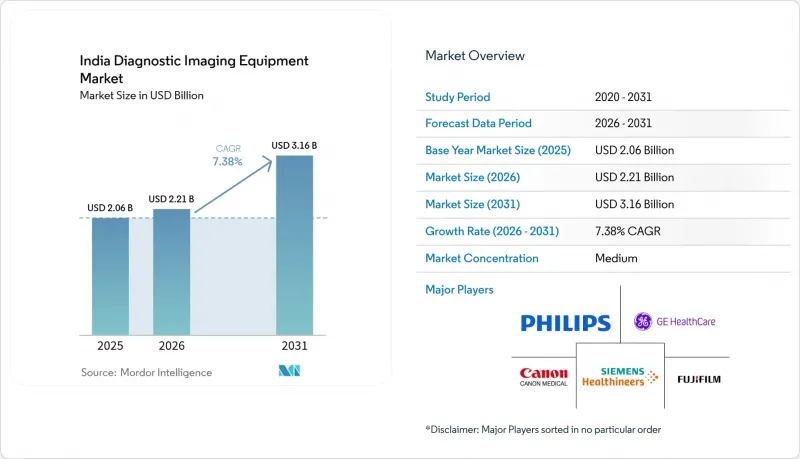
Mordor Intelligence에 의하면, 인도의 진단용 영상 장비 시장 규모는 2025년에 20억 6,000만 달러로 평가되었습니다. 2026년 22억 1,000만 달러에서 2031년까지 31억 6,000만 달러에 이를 것으로 예상되며, 예측 기간(2026-2031년) CAGR은 7.38%를 나타낼 전망입니다.
본 보고서는 모달리티별(MRI, 컴퓨터 단층촬영(CT), 초음파, X선, 핵의학 영상 진단, 기타 모달리티), 휴대성별(고정형 시스템, 모바일·핸드헬드 시스템), 용도별(순환기과, 종양학, 기타), 최종 사용자별(병원, 영상진단센터, 기타), 지역별(북인도, 기타)로 분류되어 있습니다. 시장 예측은 금액(달러) 기준으로 제시되어 있습니다.
인도의 진단용 영상 장비 시장 동향 및 인사이트
만성 질환 증가
현재 인도 성인의 11.4%가 당뇨병을 앓고 있으며, 고혈압 유병률은 35.5%에 달할 전망입니다. 또한, 암 발생률은 2031년까지 인구 10만 명당 549건으로 증가할 것으로 예측됩니다. 이러한 수치는 조기 병변 감지 및 치료 효과 모니터링이 가능한 CT 혈관조영술, 다상 MRI, PET-CT 워크플로우에 대한 지속적인 수요를 의미합니다. 의료 기관은 단일 모달리티 검사실에서 종양학 및 심대사 질환의 진료 과정을 효율화하는 통합형 스위트로 전환하고 있으며, 고슬라이스 CT 및 3T MRI에 대한 설비 투자가 가속화되고 있습니다. 60세 이상 여성에서 비감염성 질환의 유병률이 높은 것으로 밝혀짐에 따라, 성별에 따른 영상 진단 프로토콜이 등장하고 있으며, 이는 스캐너의 처리 능력 계획 및 코일 재고 관리에 영향을 미치고 있습니다. 따라서 만성 질환의 급증은 인도 영상 진단 장비 시장 전체의 조달 정책을 재편하고 있습니다.
고령 인구 증가
60세 이상 인도인의 수는 꾸준히 증가하고 있으며, 특히 남부와 서부 주에서는 평균 수명이 길어지고 있습니다. 노화에 따른 근골격계 퇴행, 신경퇴행성 질환, 심혈관 리모델링에는 저선량으로 편안함을 최적화한 영상 진단 시스템이 요구되고 있습니다. 병원에서는 장시간 검사를 견디기 어려울 수 있는 허약한 환자를 대응하기 위해, 이중 에너지 X선 흡수 측정법(DXA), 저대비 심장 CT, 저소음 MRI 시퀀싱를 도입하고 있습니다. 이에 따라 각 벤더사는 넓은 보어 직경, 소음 저감 소프트웨어, 자동 위치 조정 등 환자 중심의 인체공학을 중시하고 있으며, 이러한 요소들은 현재 인도의 진단용 영상 장비 시장에서 경쟁하기 위해 필수적인 요소가 되었습니다.
높은 장비 비용 및 검사 비용
MRI 및 CT 스캐너는 중규모 병원의 장비 예산의 20-25%를 차지할 가능성이 있기 때문에 자본 집약성은 여전히 큰 장벽으로 남아 있습니다. 소규모 의료 기관은 중고 장비 유통 시장(규모 1억 8,000만 달러)에 의존하고 있으며, 이는 현재 의료기기 거래 전체의 10%에 해당합니다. 이해관계자들은 X선 장비 및 진단 키트에 대한 GST(상품 및 서비스세) 인하를 지속적으로 요구하고 있으며, 세율 인하가 보급을 촉진할 것이라고 주장하고 있습니다. 수입품보다 30-50% 저렴한 국산 MRI 프로토타입이 해결책이 될 것으로 보이지만, 그 보급 확대는 입증된 임상 성능과 사후 서비스 체계에 달려 있으며, 이러한 요인들이 여전히 인도의 진단용 영상 장비 시장의 보급을 저해하고 있습니다.
부문별 분석
X선 시스템은 응급 의료 및 1차 진료에서의 높은 보급률 덕분에 2025년 인도의 진단용 영상 장비 시장에서 28.74%의 점유율을 유지했습니다. 한편, 2차 및 3차 의료시설에서 심장 칼슘 점수 측정, 외상 영상 진단, 종양 병기 분류 프로토콜이 보급됨에 따라 컴퓨터 단층 촬영(CT)은 8.62%라는 가장 높은 연평균 성장률(CAGR)을 나타낼 전망입니다. 검출기 가격 하락과 영상 선명도 향상으로 촉진된 디지털 방사선 촬영으로의 전환이 아날로그 시스템을 빠르게 대체하고 있는 반면, AI 알고리즘을 통해 골절 감지 및 결핵 선별 검사가 자동화되었습니다. 또한 델리의 AIIMS(인도 의료 연구소)에서 임상 검증이 예정된 국산 1.5T 프로토타입의 도입도 촉진요인이 되어, 고자기장 MRI 설치 대수도 증가하고 있습니다. 이로 인해 스캔 비용이 30% 이상 절감되어, 이 부문에서 인도의 진단용 영상 장비 시장 규모가 확대될 가능성이 있습니다.
CT 공급업체들은 스펙트럼 영상 진단, 금속 아티팩트 저감, 원격 진단 서비스를 패키지로 제공하는 사례가 늘어나고 있으며, 이를 통해 가동 중단 시간이 단축되고 검사 1건당 비용 효율성이 향상되고 있습니다. 핵의학은 3차 암 치료 거점에 한정된 틈새 영역에 머물러 있지만, 정밀 종양학이 보급됨에 따라 PET-CT에 대한 수요는 증가하고 있습니다. 초음파 검사는 산부인과, 소화기내과, 응급 평가 분야에서 여전히 첫 번째 선택 검사법이지만, 병원 외 진료 부문에서는 휴대용 프로브가 보급되고 있습니다. 전반적으로, 검사 방법의 구성 변화는 기술의 고도화와 합리적인 가격이 현재 인도 진단용 영상 장비 시장 전체의 자본 예산을 공동으로 결정하고 있음을 여실히 보여줍니다.
2025년 인도의 진단용 영상 장비 시장 규모 중 고정형 장비가 82.05%를 차지했으며, 이는 입원 환자의 영상 진단 및 외상 치료를 목적으로 한 수십 년에 걸친 인프라의 역사를 반영하고 있습니다. 그러나 농촌 지역을 순회하는 정부의 이동 진료차와 기업의 건강 증진 프로그램의 뒷받침으로, 모바일형 및 핸드헬드형 기기는 연평균 성장률(CAGR) 7.86%로 급성장하고 있습니다. 휴대용 초음파 검사는 소아 폐렴에서 99.11%의 민감도를 보여 흉부 X선 검사를 능가하며, 휴대용 진단 기기의 임상적 유용성을 입증하고 있습니다. 카트형 초음파 장치와 이동식 DR 장치에는 현재 핫스팟 연결 기능이 탑재되어 있어, 이미지를 클라우드 PACS로 전송하여 즉시 판독할 수 있게 되었습니다.
배터리 밀도, 무선 데이터 전송, 견고한 케이스 분야의 기술 발전으로 인해 재난 현장 및 스포츠 의료 분야에서의 도입이 확대되고 있습니다. 세계 펀드(Global Fund)가 휴대용 X선 솔루션을 권장함에 따라 이 카테고리의 정당성이 더욱 높아지고 있습니다. 장기적으로는 모바일 스캐너의 활용을 통해 과도한 부담을 안고 있는 3차 의료 기관의 영상 진단 부담이 경감되고, 인도의 영상 진단 장비 시장이 새로운 지역으로 확대되는 동시에 자산의 ROI도 향상될 것입니다.
기타 혜택
- 엑셀 형식 시장 예측(ME) 시트
- 3개월간의 애널리스트 지원
자주 묻는 질문
목차
제1장 서론
제2장 조사 방법
제3장 주요 요약
제4장 시장 구도
제5장 시장 규모 및 성장 예측
제6장 경쟁 구도
제7장 시장 기회 및 향후 전망
KTH 26.09.04According to Mordor Intelligence, the India diagnostic imaging equipment market size was valued at USD 2.06 billion in 2025 and estimated to grow from USD 2.21 billion in 2026 to reach USD 3.16 billion by 2031, at a CAGR of 7.38% during the forecast period (2026-2031).
This report is Segmented by Modality (MRI, Computed Tomography, Ultrasound, X-Ray, Nuclear Imaging, Other Modalities), Portability (Fixed Systems, Mobile and Hand-Held Systems), Application (Cardiology, Oncology, and More), End User (Hospitals, Diagnostic Imaging Centers, and More), and Regional Zone (North India, and More). The Market Forecasts are Provided in Terms of Value (USD).
India Diagnostic Imaging Equipment Market Trends and Insights
Rise in Chronic Diseases
Diabetes now affects 11.4% of Indian adults, while hypertension touches 35.5%, and cancer incidence is forecast to increase to 549 per 100,000 inhabitants by 2031. These numbers translate into sustained need for CT angiography, multiphase MRI, and PET-CT workflows capable of detecting early lesions and monitoring therapy response. Providers are shifting from single-modality rooms to integrated suites that streamline oncologic and cardiometabolic pathways, accelerating capital expenditure on high-slice CT and 3 T MRI. Gender-specific imaging protocols are emerging as women above 60 years show higher non-communicable disease prevalence, influencing scanner throughput planning and coil inventory. The chronic disease surge is therefore rewiring procurement decisions across the India diagnostic imaging equipment market.
Growing Geriatric Population
The number of Indians aged 60 years and above is climbing steadily, with higher life expectancy concentrated in southern and western states. Age-related musculoskeletal degeneration, neuro-degenerative conditions, and cardiovascular remodeling demand low-dose, comfort-optimized imaging systems. Hospitals are adding dual-energy X-ray absorptiometry, low-contrast cardiac CT, and silent MRI sequences to accommodate frail patients who may not tolerate lengthy procedures. In turn, vendors emphasize patient-centric ergonomics such as wide bores, noise-reduction software, and automated positioning, hallmarks now critical to competing in the India diagnostic imaging equipment market.
High Equipment & Procedure Costs
Capital intensity remains a formidable hurdle as MRI and CT scanners can consume 20-25% of a mid-size hospital's equipment budget. Smaller facilities rely on a USD 180 million secondary market for pre-owned units, which now equals 10% of overall medical equipment trade. Stakeholders continue to lobby for GST cuts on X-ray and diagnostic kits, arguing that a lower tax slab would widen adoption. Indigenous MRI prototypes priced 30-50% below imports promise relief, but scale-up hinges on validated clinical performance and after-sales networks, factors that still temper diffusion in the India diagnostic imaging equipment market.
Other drivers and restraints analyzed in the detailed report include:
- AI-Enabled and Advanced Imaging Adoption
- Insurance Expansion & PPP Programs
- Shortage of Skilled Radiologists & Technicians
For complete list of drivers and restraints, kindly check the Table Of Contents.
Segment Analysis
X-ray systems retained 28.74% share of the India diagnostic imaging equipment market in 2025 thanks to ubiquity in emergency and primary care. Computed tomography, however, is projected to post the fastest 8.62% CAGR as cardiac calcium scoring, trauma imaging, and oncology staging protocols proliferate in secondary and tertiary centers. Digital radiography upgrades, driven by lower detector prices and sharper images, are rapidly supplanting analog systems, while AI algorithms now automate fracture detection and tuberculosis screening. High-field MRI installations are also climbing, aided by domestic 1.5 T prototypes slated for clinical validation at AIIMS Delhi, which could shrink scan fees by over 30% and amplify the India diagnostic imaging equipment market size within the segment.
CT vendors increasingly bundle spectral imaging, metal-artifact reduction, and remote service diagnostics, reducing downtime and improving cost-per-study economics. Nuclear medicine retains a niche footprint confined to tertiary oncology hubs, yet PET-CT demand rises as precision oncology gains traction. Ultrasound remains the modality of choice for obstetrics, gastroenterology, and emergency evaluations, but handheld probes are gaining ground in out-of-hospital care. Overall, modality mix evolution underscores how technological sophistication and affordability now co-determine capital budgets across the India diagnostic imaging equipment market.
Fixed installations accounted for 82.05% of the India diagnostic imaging equipment market size in 2025, reflecting decades-old infrastructure geared to inpatient imaging and trauma care. Yet mobile and handheld devices are escalating at an 7.86% CAGR, buoyed by government vans serving rural districts and corporate wellness camps. Handheld ultrasound offers 99.11% sensitivity for pediatric pneumonia, surpassing chest X-ray and validating portable diagnostics' clinical utility. Cart-based ultrasound and mobile DR units now include hotspot connectivity, funneling images to cloud PACS for instant reads.
Advances in battery density, wireless data transfer, and rugged casings have broadened deployment in disaster zones and sports medicine. Global Fund endorsements of portable X-ray solutions further legitimize the category. Over time, utilization of mobile scanners redeploys imaging load away from overburdened tertiary centers, expanding the India diagnostic imaging equipment market into new geographies while improving asset ROI.
Complete Report Scope:
- By Modality
- MRI
- Low-Field (< 1.5 T)
- Standard (1.5-3 T)
- High-Field (3 T & above)
- Computed Tomography
- <=64-Slice CT
- >64-Slice CT
- Ultrasound
- Cart-based
- Portable/Hand-held
- X-Ray
- Analog
- Digital
- Nuclear Imaging
- PET
- SPECT
- Other Modalities (Mammography, Fluoroscopy, etc.)
- MRI
- By Portability
- Fixed Systems
- Mobile and Hand-held Systems
- By Application
- Cardiology
- Oncology
- Neurology
- Orthopedics
- Gastroenterology
- Gynecology & Obstetrics
- Other Applications
- By End User
- Hospitals
- Diagnostic Imaging Centers
- Specialty Clinics & Other End Users
- By Regional Zone
- North India
- South India
- West India
- East & North-East India
List of Companies Covered in this Report:
- GE Healthcare
- Siemens Healthineers
- Koninklijke Philips
- FUJIFILM
- Canon
- Shimadzu
- Mindray
- Samsung Medison Co. Ltd.
- Esaote S.p.A.
- Carestream Health
- Agfa-Gevaert
- United Imaging Healthcare Co. Ltd.
- Hologic
- Wipro GE Healthcare Pvt Ltd.
- Trivitron Healthcare Pvt Ltd.
- BPL Medical Technologies Pvt Ltd.
- Voxelgrids Innovations Pvt Ltd.
- J. Mitra & Co. Pvt Ltd. (imaging contrast media)
- Neusoft Medical Systems Co. Ltd.
Additional Benefits:
- The market estimate (ME) sheet in Excel format
- 3 months of analyst support
TABLE OF CONTENTS
1 Introduction
- 1.1 Study Assumptions & Market Definition
- 1.2 Scope of the Study
2 Research Methodology
3 Executive Summary
4 Market Landscape
- 4.1 Market Overview
- 4.2 Market Drivers
- 4.2.1 Rise in Prevalence of Chronic Diseases
- 4.2.2 Growing Geriatric Population
- 4.2.3 Increased Adoption of Advanced Imaging Technologies
- 4.2.4 Government Insurance & PPP Thrust on Diagnostics
- 4.2.5 Expansion of Teleradiology & Cloud-Based PACS in Tier-2/3 Cities
- 4.2.6 Production-Linked-Incentive (PLI) Scheme Boosting Local Manufacture
- 4.3 Market Restraints
- 4.3.1 High Equipment & Procedure Costs
- 4.3.2 Shortage Of Skilled Radiologists & Technicians
- 4.3.3 Fragmented Regulatory Approval Timelines for Indigenous Devices
- 4.3.4 Supply-Chain Vulnerability for Critical Inputs (E.G., Liquid Helium)
- 4.4 Value / Supply-Chain Analysis
- 4.5 Regulatory Landscape
- 4.6 Technological Outlook
- 4.7 Porter's Five Forces Analysis
- 4.7.1 Threat of New Entrants
- 4.7.2 Bargaining Power of Buyers
- 4.7.3 Bargaining Power of Suppliers
- 4.7.4 Threat of Substitutes
- 4.7.5 Intensity of Competitive Rivalry
5 Market Size & Growth Forecasts (Value)
- 5.1 By Modality
- 5.1.1 MRI
- 5.1.1.1 Low-Field (< 1.5 T)
- 5.1.1.2 Standard (1.5-3 T)
- 5.1.1.3 High-Field (3 T & above)
- 5.1.2 Computed Tomography
- 5.1.2.1 <=64-Slice CT
- 5.1.2.2 >64-Slice CT
- 5.1.3 Ultrasound
- 5.1.3.1 Cart-based
- 5.1.3.2 Portable/Hand-held
- 5.1.4 X-Ray
- 5.1.4.1 Analog
- 5.1.4.2 Digital
- 5.1.5 Nuclear Imaging
- 5.1.5.1 PET
- 5.1.5.2 SPECT
- 5.1.6 Other Modalities (Mammography, Fluoroscopy, etc.)
- 5.1.1 MRI
- 5.2 By Portability
- 5.2.1 Fixed Systems
- 5.2.2 Mobile and Hand-held Systems
- 5.3 By Application
- 5.3.1 Cardiology
- 5.3.2 Oncology
- 5.3.3 Neurology
- 5.3.4 Orthopedics
- 5.3.5 Gastroenterology
- 5.3.6 Gynecology & Obstetrics
- 5.3.7 Other Applications
- 5.4 By End User
- 5.4.1 Hospitals
- 5.4.2 Diagnostic Imaging Centers
- 5.4.3 Specialty Clinics & Other End Users
- 5.5 By Regional Zone
- 5.5.1 North India
- 5.5.2 South India
- 5.5.3 West India
- 5.5.4 East & North-East India
6 Competitive Landscape
- 6.1 Market Concentration
- 6.2 Market Share Analysis
- 6.3 Company Profiles (includes Global level Overview, Market level overview, Core Segments, Financials as available, Strategic Information, Market Rank/Share for key companies, Products & Services, and Recent Developments)
- 6.3.1 GE HealthCare
- 6.3.2 Siemens Healthineers AG
- 6.3.3 Koninklijke Philips N.V.
- 6.3.4 Fujifilm Holdings Corporation
- 6.3.5 Canon Medical Systems Corp.
- 6.3.6 Shimadzu Corporation
- 6.3.7 Shenzhen Mindray Bio-Medical Electronics Co., Ltd
- 6.3.8 Samsung Medison Co. Ltd.
- 6.3.9 Esaote S.p.A.
- 6.3.10 Carestream Health Inc.
- 6.3.11 Agfa-Gevaert Group
- 6.3.12 United Imaging Healthcare Co. Ltd.
- 6.3.13 Hologic Inc.
- 6.3.14 Wipro GE Healthcare Pvt Ltd.
- 6.3.15 Trivitron Healthcare Pvt Ltd.
- 6.3.16 BPL Medical Technologies Pvt Ltd.
- 6.3.17 Voxelgrids Innovations Pvt Ltd.
- 6.3.18 J. Mitra & Co. Pvt Ltd. (imaging contrast media)
- 6.3.19 Neusoft Medical Systems Co. Ltd.
7 Market Opportunities & Future Outlook
- 7.1 White-space & Unmet-need Assessment