|
시장보고서
상품코드
2113622
독일의 영상 진단 징비 : 시장 점유율 분석, 업계 동향 및 통계, 성장 예측(2026-2031년)Germany Diagnostic Imaging Equipment - Market Share Analysis, Industry Trends & Statistics, Growth Forecasts (2026 - 2031) |
||||||
 Mordor Intelligence
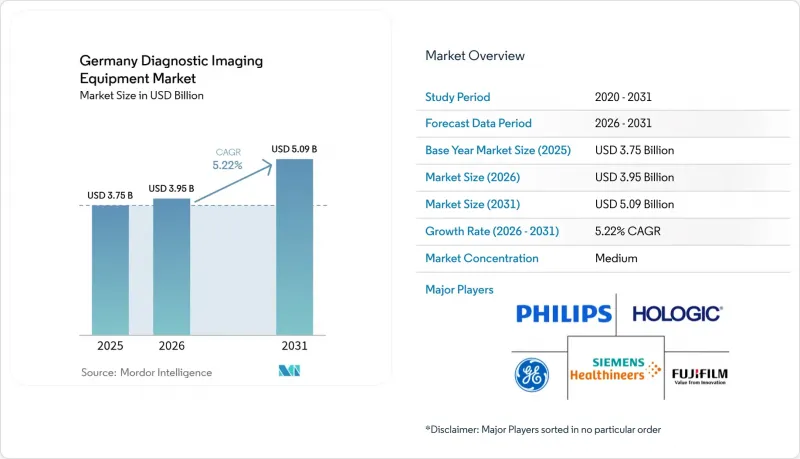
Mordor Intelligence에 의하면, 독일의 영상 진단 징비 시장 규모는 2025년에 37억 5,000만 달러, 2026년 39억 5,000만 달러에서 2031년까지 50억 9,000만 달러에 이를 것으로 예측되며, 예측 기간(2026년-2031년) CAGR은 5.22%를 기록할 전망입니다.
본 보고서는 모달리티(MRI, 컴퓨터 단층촬영(CT), 초음파, X선(디지털 및 아날로그), 핵의학 영상진단(PET/SPECT) 등),휴대성(고정형 시스템, 이동형 및 핸드헬드형 시스템), 용도(순환기, 종양학, 신경학 등), 그리고 최종 사용자(병원, 영상진단센터 등)별로 분류되어 있습니다. 시장 예측은 금액(달러)으로 표시되어 있습니다.
독일 영상진단기기 시장 동향 및 인사이트
만성 질환 부담 증가
암, 당뇨병, 심혈관 질환의 유병률 상승으로 인해 시장 전반에 걸쳐 장기적인 영상 진단 수요가 확보되고 있습니다. 자궁경부암은 이러한 추세를 여실히 보여주고 있습니다. 연간 4,666건의 신규 진단 사례가 발생하며, 침윤성 종양의 76.5%가 HPV-16/18 감염에 기인하기 때문에 정확한 선별 검사가 필수적입니다. 국내 유방촬영술의 감도가 69.9%에서 71.7%에 그치고 있다는 사실은 병변 감지 정확도를 높이고 위음성을 줄이는 AI 기반 영상 처리 기술의 필요성을 부각시키고 있습니다. 만성 질환의 치료 경로는 현재 경시적인 영상 진단에 의존하고 있으며, 이로 인해 장비의 정기적인 갱신이 필수적입니다. 따라서 병원이나 외래 진료 센터는 영상 진단 장비를 단순한 설비 투자가 아닌 수익을 지키기 위한 인프라로 간주하고 있어, 경제 전반이 변동하는 시기에도 안정적인 수주가 유지되고 있습니다.
첨단 기술 도입 확대
40억 유로 규모의 ‘Hospital Future Fund’는 AI, 상호 운용성, 클라우드 아키텍처를 통합한 디지털 인프라 구매를 가속화하고 있습니다. DigitalRadar가 1,624개 병원을 대상으로 실시한 벤치마크 조사에 따르면, 디지털화 점수의 평균이 100점 만점에 33.3점인 것으로 밝혀져 대폭적인 개선의 여지가 있음을 보여주었습니다. Philips의 클라우드 영상 진단 플랫폼 ‘HealthSuite’와 NEXUS/CHILI 및 deepc와의 판매 제휴는 확장성이 뛰어난 AI 파이프라인이 현재 조달에 큰 영향을 미치고 있음을 뒷받침합니다. 의료 기관들은 단순히 화질 향상뿐만 아니라, 2024년 ‘디지털법(Digital-Gesetz)’에서 의무화한 전자 차트와의 원활한 데이터 교환을 목적으로 첨단 영상 진단 장비를 도입하고 있습니다.
방사선 피폭량에 대한 우려와 규제 강화
독일의 ‘방사선 보호 규정(Strahlenschutzverordnung)’에서는 연간 피폭 선량 제한이 정해져 있으며, 모든 검사에서 선량의 정당화와 최적화가 요구되고 있습니다. 이에 따라 의료 기관은 자동 선량 추적 기능을 갖춘 고성능 스캐너 도입을 서두르고 있습니다. 지멘스 헬스인어즈(Siemens Healthineers)의 광자 계수 CT는 진단 정확도를 유지하면서 저선량 성능을 실현함으로써, 공급업체가 어떻게 차별화를 꾀하고 있는지를 보여줍니다. 규정 준수는 특히 통합 정보 시스템을 갖추지 않은 시설에서 비용과 운영상의 복잡성을 증가시켜, 가치가 낮은 적응증에 대한 검사 빈도를 감소시킬 가능성이 있습니다.
부문 분석
2025년, X선은 독일의 영상 진단 징비 시장에서 26.78%의 점유율을 유지했습니다. 이는 모든 병원이 외상이나 일상적인 흉부 검사에서 X선 촬영에 의존하고 있기 때문입니다. 한편, MRI는 심장 및 신경 분야에서의 검사 건수를 늘리고 있으며, 6.18%의 연평균 성장률(CAGR)을 기록하며 2031년까지 주요 성장 동력으로서의 입지를 확고히 하고 있습니다. 지멘스 헬스인어즈는 인기가 높은 1.5테슬라 부문에서 ‘Magnetom Flow’ 플랫폼을 확충하고, AI를 활용한 워크플로우 자동화를 도입함으로써 검사 시간 단축과 적응증 확대를 도모하고 있습니다. 또한 GE 헬스케어가 독일에 전용 센터를 건설하는 등, 테라노스틱스를 통한 PET/SPECT의 부활로 인해 모달리티의 구성은 더욱 다양해지고 있습니다.
독일의 영상진단기기 시장에서는 현재 모달리티의 평가 기준이 영상의 선명도뿐만 아니라, 전자의무기록 및 AI를 통한 의사결정 지원과의 통합성까지 확대되고 있습니다. 초음파 진단의 보급은 응급실이나 지방 진료소에 영상 진단을 제공하는 휴대용 기기에 의해 촉진되고 있는 반면, 유방 촬영술은 디지털 검출기나 프로그램의 감도를 높이는 컴퓨터 지원 검출(CAD)을 통해 현대화가 진행되고 있습니다. 전반적으로, 모달리티 포트폴리오는 기준이 되는 서비스 수준을 확보하는 고처리량 X선실과 추가 환급을 확보하는 프리미엄 MRI 스위트로 계속 나뉘고 있으며, 이를 통해 의료 기관의 유형에 관계없이 균형 잡힌 설비 투자 프로파일이 유지되고 있습니다.
2025년 독일의 영상 진단 징비 시장 규모에서 고정형 시스템이 79.65%를 차지했습니다. 이는 대규모 의료 기관이 여전히 처리 효율성 측면에서 실내 설치형 CT 및 MRI를 선호하기 때문입니다. 그럼에도 불구하고 인력 부족으로 인해 현장 진단(point-of-care)의 매력이 높아지고 있어, 이동식 및 핸드헬드형 시스템의 연평균 성장률(CAGR)은 6.55%로 성장을 지속하고, 있습니다. 지멘스 헬스인어즈(Siemens Healthineers)의 ‘SOMATOM On.site CT’는 환자를 이송할 필요 없이 중환자실에서 영상 진단을 가능하게 하며, 기술자의 시간을 절약해 주는 원격 조작 옵션을 갖추고 있습니다.
AI가 내장된 휴대용 초음파 진단 장치는 자동 측정을 수행하고 결과를 클라우드 아카이브에 직접 공유할 수 있게 되어, 텔레매틱스 인프라와 관련된 독일의 디지털 헬스 의료비 상환 체계에 부합합니다. 휴대용 스캐너는 고정형 장치 시장을 잠식하기보다는 이를 보완하는 역할을 하고 있으며, 사례 구성의 변동에 대응하기 위해 병원이 두 가지 유형을 모두 구매하는 이중 전략의 추세가 나타나고 있습니다.
기타 혜택:
- 엑셀 형식 시장 예측(ME) 시트
- 3개월간의 애널리스트 지원
자주 묻는 질문
목차
제1장 서론
제2장 조사 방법
제3장 주요 요약
제4장 시장 구도
제5장 시장 규모와 성장 예측
제6장 경쟁 구도
제7장 시장 기회와 향후 전망
LSH 26.08.25According to Mordor Intelligence, the Germany diagnostic imaging equipment market size was valued at USD 3.75 billion in 2025 and estimated to grow from USD 3.95 billion in 2026 to reach USD 5.09 billion by 2031, at a CAGR of 5.22% during the forecast period (2026-2031).
This report is Segmented by Modality (MRI, Computed Tomography (CT), Ultrasound, X-Ray (Digital & Analog), Nuclear Imaging (PET / SPECT), and More), Portability (Fixed Systems and Mobile and Hand-Held Systems), Application (Cardiology, Oncology, Neurology, and More), and End-User (Hospitals, Diagnostic Imaging Centres, and More). The Market Forecasts are Provided in Terms of Value (USD).
Germany Diagnostic Imaging Equipment Market Trends and Insights
Growing burden of chronic diseases
Rising prevalence of cancer, diabetes, and cardiovascular disease secures long-run imaging demand across the market. Cervical cancer illustrates the dynamic: 4,666 new diagnoses appear annually, and HPV-16/18 infections account for 76.5% of invasive tumors, making precise screening indispensable. National mammography sensitivity between 69.9% and 71.7% underscores the need for AI-enabled enhancement that improves lesion detection and reduces false-negatives. Chronic-disease care pathways now rely on longitudinal imaging, securing recurring equipment upgrades. Hospitals and outpatient centers therefore consider imaging hardware as revenue-protective infrastructure rather than discretionary capital, reinforcing steady orders even during broader economic volatility
Increased adoption of advanced technologies
The EUR 4 billion Hospital Future Fund accelerates digital infrastructure purchases that integrate AI, interoperability, and cloud architectures. DigitalRadar benchmarking of 1,624 hospitals revealed a mean digitization score of 33.3/100, exposing significant upgrade headroom. Philips' HealthSuite cloud imaging platform and NEXUS/CHILI's distribution pact with deepc confirm that scalable AI pipelines now influence procurement. Institutions adopt advanced modalities not merely for image quality but for seamless data exchange with electronic patient records mandated by the 2024 Digital-Gesetz.
Radiation-dose concerns & stricter regulation
Germany's Strahlenschutzverordnung enforces annual dose limits that require justification and optimization for every examination, pushing providers toward premium scanners with automated dose-tracking. Siemens Healthineers' photon-counting CT illustrates how vendors differentiate through low-dose performance while preserving diagnostic fidelity. Compliance adds cost and operational complexity, especially for facilities without integrated informatics, and may reduce examination frequency for low-value indications.
Other drivers and restraints analyzed in the detailed report include:
- Rapidly ageing population demanding early diagnosis
- Government grants for rural teleradiology roll-out
- High equipment cost & reimbursement gaps
For complete list of drivers and restraints, kindly check the Table Of Contents.
Segment Analysis
X-Ray retained 26.78% of Germany Diagnostic Imaging Equipment market share in 2025 because every hospital relies on radiography for trauma and routine chest studies. MRI, however, is boosting volumes in cardiac and neuro applications, and its 6.18% CAGR positions it as the primary growth engine through 2031. Siemens Healthineers expands its Magnetom Flow platform in the popular 1.5 Tesla segment, adding AI-enabled workflow automation that cuts exam times and broadens referral indications. PET/SPECT resurrection through theranostics further diversifies modality mix as GE Healthcare builds a dedicated center in Germany.
The Germany Diagnostic Imaging Equipment market now values modalities not only for image clarity but for how they integrate with electronic patient records and AI decision support. Ultrasound adoption benefits from hand-held devices that bring imaging to emergency rooms and rural clinics, while mammography modernizes through digital detectors and computer-aided detection that lift program sensitivity. Overall, modality portfolios continue to split between high-throughput X-Ray rooms that secure baseline service levels and premium MRI suites that capture incremental reimbursement, sustaining balanced capital investment profiles across provider types.
Fixed systems commanded 79.65% of the Germany Diagnostic Imaging Equipment market size in 2025 because large institutions still favor room-based CTs and MRIs for throughput efficiency. Nonetheless, mobile and hand-held systems post a 6.55% CAGR as workforce shortages make point-of-care diagnostics attractive. Siemens Healthineers' SOMATOM On.site CT allows intensive-care imaging without patient transport and provides remote control options that save technologist time.
Hand-held ultrasound units embedded with AI now generate automated measurements and share results directly to cloud archives, aligning with Germany's digital-health reimbursement framework for telematics infrastructure. Portable scanners complement rather than cannibalize fixed installations, revealing a dual-track procurement trend where hospitals purchase both categories to match case-mix variability.
Complete Report Scope:
- By Modality
- MRI
- Computed Tomography (CT)
- Ultrasound
- X-Ray (Digital & Analog)
- Nuclear Imaging (PET / SPECT)
- Mammography
- Fluoroscopy & C-arms
- By Portability
- Fixed Systems
- Mobile and Hand-held Systems
- By Application
- Cardiology
- Oncology
- Neurology
- Orthopaedics
- Obstetrics & Gynaecology
- Gastro-Urology
- Other Applications
- By End-User
- Hospitals
- Diagnostic Imaging Centres
- Ambulatory Surgery Centres
- Speciality Clinics & Others
List of Companies Covered in this Report:
- Siemens Healthineers
- Koninklijke Philips
- GE Healthcare
- Canon
- FUJIFILM
- Agfa-Gevaert
- Esaote
- Hologic
- Shimadzu
- SAMSUNG (SamsungHealthcare.com)
- Carestream Health
- Mindray
- Ziehm Imaging
- United Imaging Healthcare Co. Ltd.
- Neusoft Medical Systems Co. Ltd.
- Planmeca
- Koning Health
- Guerbet SA
- Bracco
Additional Benefits:
- The market estimate (ME) sheet in Excel format
- 3 months of analyst support
TABLE OF CONTENTS
1 Introduction
- 1.1 Study Assumptions & Market Definition
- 1.2 Scope of the Study
2 Research Methodology
3 Executive Summary
4 Market Landscape
- 4.1 Market Overview
- 4.2 Market Drivers
- 4.2.1 Growing burden of chronic diseases
- 4.2.2 Increased adoption of advanced technologies
- 4.2.3 Rapidly ageing population demanding early diagnosis
- 4.2.4 Government grants for rural teleradiology roll-out
- 4.2.5 Private-equity consolidation of imaging centres
- 4.2.6 Expansion of national cancer-screening programs
- 4.3 Market Restraints
- 4.3.1 Radiation-dose concerns & stricter regulation
- 4.3.2 High equipment cost & reimbursement gaps
- 4.3.3 Radiologist shortage causing under-utilisation
- 4.3.4 Data-privacy hurdles hindering large-scale AI training & image sharing
- 4.4 Pricing Analysis
- 4.5 Regulatory Landscape
- 4.6 Technological Outlook
- 4.7 Porter's Five Forces Analysis
- 4.7.1 Threat of New Entrants
- 4.7.2 Bargaining Power of Buyers
- 4.7.3 Bargaining Power of Suppliers
- 4.7.4 Threat of Substitutes
- 4.7.5 Intensity of Competitive Rivalry
5 Market Size & Growth Forecasts (Value)
- 5.1 By Modality
- 5.1.1 MRI
- 5.1.2 Computed Tomography (CT)
- 5.1.3 Ultrasound
- 5.1.4 X-Ray (Digital & Analog)
- 5.1.5 Nuclear Imaging (PET / SPECT)
- 5.1.6 Mammography
- 5.1.7 Fluoroscopy & C-arms
- 5.2 By Portability
- 5.2.1 Fixed Systems
- 5.2.2 Mobile and Hand-held Systems
- 5.3 By Application
- 5.3.1 Cardiology
- 5.3.2 Oncology
- 5.3.3 Neurology
- 5.3.4 Orthopaedics
- 5.3.5 Obstetrics & Gynaecology
- 5.3.6 Gastro-Urology
- 5.3.7 Other Applications
- 5.4 By End-User
- 5.4.1 Hospitals
- 5.4.2 Diagnostic Imaging Centres
- 5.4.3 Ambulatory Surgery Centres
- 5.4.4 Speciality Clinics & Others
6 Competitive Landscape
- 6.1 Market Concentration
- 6.2 Market Share Analysis
- 6.3 Company Profiles (includes Global level Overview, Market level overview, Core Segments, Financials as available, Strategic Information, Market Rank/Share for key companies, Products & Services, and Recent Developments)
- 6.3.1 Siemens Healthineers AG
- 6.3.2 Koninklijke Philips N.V.
- 6.3.3 GE HealthCare
- 6.3.4 Canon Medical Systems Corporation
- 6.3.5 Fujifilm Holdings Corporation
- 6.3.6 Agfa-Gevaert Group
- 6.3.7 Esaote SpA
- 6.3.8 Hologic Inc.
- 6.3.9 Shimadzu Corporation
- 6.3.10 SAMSUNG (SamsungHealthcare.com)
- 6.3.11 Carestream Health
- 6.3.12 Shenzhen Mindray Bio-Medical Electronics Co., Ltd
- 6.3.13 Ziehm Imaging GmbH
- 6.3.14 United Imaging Healthcare Co. Ltd.
- 6.3.15 Neusoft Medical Systems Co. Ltd.
- 6.3.16 Planmeca Oy
- 6.3.17 Koning Health
- 6.3.18 Guerbet SA
- 6.3.19 Bracco Imaging SpA
7 Market Opportunities & Future Outlook
- 7.1 White-space & Unmet-Need Assessment