|
시장보고서
상품코드
2113328
유럽의 영상 진단 : 시장 점유율 분석, 업계 동향과 통계, 성장 예측(2026-2031년)Europe Diagnostic Imaging - Market Share Analysis, Industry Trends & Statistics, Growth Forecasts (2026 - 2031) |
||||||
 Mordor Intelligence
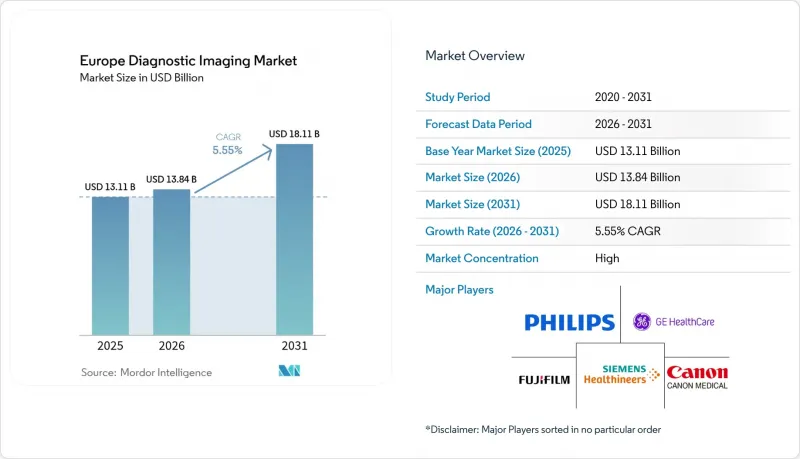
Mordor Intelligence에 따르면 유럽의 영상 진단 시장 규모는 2025년에 131억 1,000만 달러로 평가되며, 2026년 138억 4,000만 달러에서 2031년까지 181억 1,000만 달러에 달할 것으로 예측되며, 예측 기간(2026-2031년) 동안 CAGR은 5.55%가 될 전망입니다.
본 보고서는 모달리티(MRI, CT, 초음파, X선, 핵의학 영상 진단, 투시 검사 및 C-암, 유방촬영술), 휴대성(고정식 시스템, 모바일 및 핸드헬드 시스템), 용도(순환기과, 종양과, 신경과, 정형외과, 기타), 최종사용자(병원, 영상 진단센터, 기타)별로 분류되어 있습니다. 시장 예측은 금액(달러) 기준으로 제시되어 있습니다.
유럽 영상 진단 시장의 동향 및 인사이트
만성 질환 유병률과 유럽 인구의 고령화
유럽의 65세 이상 인구 비율은 2023년 21%에서 2050년까지 29%로 급증할 전망이며, 이로 인해 매년 종양학, 순환기학, 근골격계 검사 건수가 수백만 건 증가할 것으로 보입니다. 암 신규 발병 건수는 이미 연간 447만 건을 넘어섰으며, 북유럽과 서유럽 국가에서는 체계적인 선별 검진 덕분에 조기 발견이 진전되고 있습니다. 이에 반해 병원 측은 하루 검사 건수가 많더라도 서브밀리미터급 해상도를 실현할 수 있는 다목적 스캐너를 우선적으로 도입하고 있습니다. 각 벤더사는 허약한 환자라도 영상 품질을 저하시키지 않는 와이드 보어 MRI나 저선량 CT 제품 라인을 전개하며, 이러한 수요의 급증에 대응하고 있습니다. 또한, 만성 질환 관리 프로그램 역시 외래 환자의 영상 진단 의뢰를 지속적으로 증가시키고 있어, 의뢰 의사 간 영상 공유를 효율화하는 확장성이 높고 클라우드에 연결된 시스템으로의 조달 정책 전환이 진행되고 있습니다.
영상 진단 분야의 지속적인 기술 혁신
광자 계수형 CT는 기존 검출기에 비해 최대 4배 높은 공간 해상도와 대폭 낮아진 방사선 피폭 선량을 실현하고 있어, 이탈리아의 산 라파엘레 병원 등 여러 시설에서 조기 도입이 진행되고 있습니다. Siemens Healthineers의 헬륨 프리 MRI 플랫폼에서 AI 지원 재구성을 통해 검사 시간이 30% 단축되어 일일 스캔 건수가 증가하고, 예약 대기 시간이 완화되고 있습니다. 프랑스는 의료 AI에 15억 유로를 배정하고 있으며, 초기 실증 실험에서 AI 지원 유방촬영술을 통한 종양 검출률이 28% 향상된 것으로 나타났습니다. 이러한 획기적인 진보로 인해 예산이 빠듯한 환경에서도 모달리티 교체가 진행되고 있습니다. 이는 운영 비용 절감이 초기 도입 시의 가격 프리미엄을 상쇄하기 때문입니다. 각 벤더들은 반복적인 작업을 자동화하고 원격 판독을 지원하는 구독형 AI 제품군을 하드웨어와 결합하여 제공하고 있습니다.
첨단 영상 진단 장비의 높은 초기 투자 비용과 총 소유 비용
광자 계수형 CT나 3T MRI 장비는 대당 100만 달러를 초과하는 경우가 있으며, 연간 유지보수 계약료는 구매 가격의 10%에 달하는 경우가 많습니다. EU의 MDR(의료기기 규정) 준수를 위해서는, 클래스 III 의료기기의 경우 5만 달러를 초과하는 추가적인 시장 출시 전 비용이 발생하며, 이는 시장 출시까지의 기간을 연장시킬 가능성이 있습니다. 이로 인해 제조사의 수익 창출이 지연될 뿐만 아니라, 의료 기관의 조기 도입도 제한될 우려가 있습니다. 소규모 클리닉의 경우, 고정 보수 제도 하에서 이러한 지출을 정당화하기 어려워 의료 서비스 제공에 있어 지역 간 격차가 더욱 확대될 우려가 있습니다.
부문 분석
X선은 외상 및 1차 진료에서의 광범위한 이용에 힘입어 2025년 유럽 영상 진단 시장에서 35.02%라는 최대 점유율을 유지했습니다. 이러한 우위는 중기 전망 기간 동안 안정적으로 유지될 것으로 보이지만, MRI의 연평균 성장률(CAGR) 7.12%는 가장 빠른 성장 궤적을 보이고 있으며, 이는 대량의 극저온 냉각제 물류를 불필요하게 하고 수명주기 동안의 배출량을 줄여주는 헬륨 프리 자석 기술에 힘입은 것입니다. 또한, 병변의 보다 상세한 특성 파악을 요구하는 종양학의 병기 분류 프로토콜에 따라 광자 계수형 CT의 출하대수도 증가하고 있습니다. 초음파 진단은 심장, 산부인과, 현장 진료(point-of-care) 분야에서 여전히 필수적이며, 벨기에 응급실의 80%에서는 이미 병상 옆에서 환자 분류를 위해 휴대용 스캐너가 사용되고 있습니다. 핵의학 영상 진단은 테라노스틱스(치료와 진단을 통합한 의료) 요법에 통합되어 있으며, 디지털 유방촬영술에서는 암 검출 감도를 높이는 AI 기반 의사결정 지원이 활용되고 있습니다.
MRI 시장 점유율 확대에 따라, 공급업체들의 연구개발 예산은 첨단 코일, 움직임 보정, 압축 센싱 기술로 전환되고 있습니다. X선 제조사들은 AI 기반 골절 감지 기능과 듀얼 에너지 기능을 통합하여 이에 대응하고 있습니다. CT 공급업체들은 엄격해지는 방사선 규제에 대응하기 위해 피폭 선량 추적 대시보드를 번들로 제공하고 있습니다. 하드웨어, 소프트웨어, 서비스로 구성된 종합적인 모달리티 생태계를 제공하는 각 부문의 기업들은 지속적인 수익원을 확보하고, 유럽 영상 진단 시장에서 고객 충성도를 높이고 있습니다.
고정식 시스템은 여전히 도입 대수의 78.61%를 차지하고 있으며, 높은 처리량이 필요한 종양 센터나 외상 센터에 있어 필수적인 존재입니다. 이러한 검사실에는 천장 매달기형 검출기, 64슬라이스 CT, 3테슬라 MRI가 설치되어 있으며, 이들이 다학제 협업의 거점 역할을 하고 있습니다. 그러나 의료 모델의 변화로 인해 기동성이 높은 솔루션이 중요시되면서, 모바일 및 핸드헬드 시스템 시장은 연평균 성장률(CAGR) 6.82%로 확대되고 있습니다. 일반 개업의나 응급구조사들이 구급차나 지방 클리닉에서 환자 분류를 신속하게 진행할 수 있는 포켓 사이즈 기기를 도입함에 따라, 유럽 영상 진단 시장 내 휴대용 초음파 기기의 시장 규모는 2031년까지 12억 9,000만 달러를 넘어설 것으로 예측됩니다. 컴팩트한 MRI 개발을 위해 Chipiron이 1,700만 달러의 자금을 조달한 것은, 이동성이 가져오는 파괴적 혁신의 가능성에 대한 투자자들의 신뢰를 뒷받침하고 있습니다.
모바일 CT와 C-암 역시 환자의 이동 없이 신속한 영상 진단이 요구되는 수술실 확장 및 외상 소생 구역의 요구와 부합합니다. 각 벤더는 감염 방지 프로토콜을 지원하기 위해 배터리 구동 시간 연장, 무선 데이터 전송, 항균성 케이스 개선에 주력하고 있습니다. 한편, 리스 업체들은 특히 소규모 병원의 경우 초기 투자 장벽을 해소해 주는 ‘스캔당 과금’ 모델을 제공하고 있으며, 이는 유럽 영상 진단 시장 전반에 걸친 확산을 촉진하고 있습니다.
기타 혜택
- 엑셀 형식의 시장 예측(ME) 시트
- 3개월간의 애널리스트 지원
자주 묻는 질문
목차
제1장 소개
제2장 조사 방법
제3장 주요 요약
제4장 시장 구도
제5장 시장 규모와 성장 예측
제6장 경쟁 구도
제7장 시장 기회와 향후 전망
KSM 26.08.25According to Mordor Intelligence, the Europe diagnostic imaging market size was valued at USD 13.11 billion in 2025 and estimated to grow from USD 13.84 billion in 2026 to reach USD 18.11 billion by 2031, at a CAGR of 5.55% during the forecast period (2026-2031).
This report is Segmented by Modality (MRI, CT, Ultrasound, X-Ray, Nuclear Imaging, Fluoroscopy and C-Arms and Mammography), Portability (Fixed Systems and Mobile and Hand-Held Systems), Application (Cardiology, Oncology, Neurology, Orthopedics, and More), and End-User (Hospitals, Diagnostic Imaging Centres, and More). The Market Forecasts are Provided in Terms of Value (USD).
Europe Diagnostic Imaging Market Trends and Insights
Prevalence of chronic diseases and an aging European population
Europe's over-65 cohort is on track to jump from 21% in 2023 to 29% by 2050, translating into millions more oncology, cardiology, and musculoskeletal scans each year. Cancer incidence already exceeds 4.47 million new cases annually, with Northern and Western countries detecting disease earlier thanks to organized screening. Hospitals respond by prioritizing multipurpose scanners that handle high daily volumes yet deliver sub-millimetric resolution. Vendors cater to this surge with wider bore MRI and low-dose CT lines that preserve image quality for frail patients. Chronic disease management programs also drive sustained outpatient imaging referrals, re-orienting procurement toward scalable, cloud-connected systems that streamline image sharing among referring physicians.
Continuous technology innovation in imaging
Photon-counting CT provides up to four-fold higher spatial resolution and significantly lower radiation dose than conventional detectors, winning early adopters at sites such as San Raffaele Hospital in Italy. AI-aided reconstruction on Siemens Healthineers' Helium-free MRI platform cuts exam times by 30%, enabling more scans per day and easing scheduling backlogs. France earmarked EUR 1.5 billion for healthcare AI, and early pilots show a 28% improvement in tumor detection with AI-assisted mammography. These breakthroughs spark modality replacement even in budget-tight environments because operational savings offset frontline price premiums. Vendors complement hardware with subscription-based AI suites that automate repetitive tasks and support remote reading.
High capital and total-cost-of-ownership for advanced imaging equipment
Photon-counting CT and 3 T MRI units can top USD 1 million apiece, while annual service contracts often equal 10% of purchase price. EU MDR compliance adds incremental pre-market expenditure exceeding USD 50,000 for Class III devices and can lengthen time-to-market, delaying revenue realization for manufacturers and limiting early access for providers. Smaller clinics struggle to justify such outlays under fixed reimbursement, potentially widening geographic gaps in care.
Other drivers and restraints analyzed in the detailed report include:
- Rising healthcare infrastructure investment and hospital modernization programs
- Growing adoption of minimally invasive, image-guided procedures across specialties
- Persistent shortage of radiologists and imaging technologists
For complete list of drivers and restraints, kindly check the Table Of Contents.
Segment Analysis
X-ray retained the largest slice of the Europe diagnostic imaging market at 35.02% in 2025, anchored by ubiquitous use in trauma and primary care. That dominance is stable through mid-term forecasts, but MRI's 7.12% CAGR represents the fastest lane, supported by helium-free magnet technology that removes bulk cryogen logistics and trims lifecycle emissions. Photon-counting CT shipments also accelerate thanks to oncology staging protocols demanding finer lesion characterization. Ultrasound remains indispensable in cardiac, obstetric, and point-of-care settings; 80% of Belgian emergency departments already use portable scanners for bedside triage. Nuclear imaging slots into theranostic regimens, while digital mammography enjoys AI decision support that lifts cancer detection sensitivity.
MRI's share growth reshapes vendor R&D budgets toward advanced coils, motion correction, and compressed sensing. X-ray manufacturers counter by integrating AI fracture detection and dual-energy functionality. CT suppliers bundle dose-tracking dashboards to satisfy tightening radiation governance. Segment players that deliver comprehensive modality ecosystems-hardware, software, and service-capture recurring revenue themes and deepen account stickiness within the Europe diagnostic imaging market.
Fixed systems still represent 78.61% of installed base and remain indispensable for high-throughput oncology and trauma centers. These suites house ceiling-suspended detectors, 64-slice CT, and 3 T MRI that anchor multidisciplinary hubs. Yet shifting care models favor agile solutions, propelling mobile and handheld systems at 6.82% CAGR. The Europe diagnostic imaging market size for portable ultrasound is projected to climb above USD 1.29 billion by 2031 as general practitioners and paramedics adopt pocket devices that expedite triage in ambulances and rural clinics. Chipiron's USD 17 million funding to engineer compact MRI underlines investor belief in mobility's disruptive potential.
Mobile CT and C-arms also align with surgical suite expansion and trauma resuscitation bays that demand rapid imaging without patient transfer. Vendors refine battery life, wireless data transfer, and antimicrobial casings to support infection-control protocols. Meanwhile, leasing firms offer pay-per-scan models that remove upfront capital hurdles, especially for small hospitals, and fuel broader diffusion across the Europe diagnostic imaging market.
Complete Report Scope:
- By Modality
- MRI
- < 1.5 T
- 1.5-3 T
- > 3 T
- CT
- <= 16-slice
- 64-slice
- >= 128-slice & photon-counting
- Ultrasound
- 2-D
- 3-D/4-D
- Hand-held & POCUS
- X-ray
- Analog
- Digital (DDR/DR)
- Nuclear Imaging
- PET
- SPECT
- Fluoroscopy and C-arms
- Mammography
- MRI
- By Portability
- Fixed Systems
- Mobile and Hand-held Systems
- By Application
- Cardiology
- Oncology
- Neurology
- Orthopedics
- Gastroenterology
- Women's Health & OB-GYN
- Other Applications
- By End User
- Hospitals
- Diagnostic Imaging Centers
- Other End Users
- By Country
- Germany
- United Kingdom
- France
- Italy
- Spain
- Rest of Europe
List of Companies Covered in this Report:
- Siemens Healthineers
- Koninklijke Philips
- GE Healthcare
- Canon
- FUJIFILM
- Esaote
- Hologic
- Shimadzu
- Carestream Health
- Koning Health
- Agfa-Gevaert
- SAMSUNG (SamsungHealthcare.com)
- Mindray
- United Imaging Healthcare Co. Ltd.
- Ziehm Imaging
- Planmeca
- Guerbet SA
- BC Group DMS Imaging
- Bracco
- Neusoft
Additional Benefits:
- The market estimate (ME) sheet in Excel format
- 3 months of analyst support
TABLE OF CONTENTS
1 Introduction
- 1.1 Study Assumptions & Market Definition
- 1.2 Scope of the Study
2 Research Methodology
3 Executive Summary
4 Market Landscape
- 4.1 Market Overview
- 4.2 Market Drivers
- 4.2.1 Prevalence of chronic diseases and an aging European population
- 4.2.2 Continuous technology innovation in imaging
- 4.2.3 Rising healthcare infrastructure investment and hospital modernization programs
- 4.2.4 Growing adoption of minimally invasive, image-guided procedures across specialties
- 4.2.5 Expansion of outpatient and mobile imaging service models for greater access
- 4.2.6 Government initiatives promoting early diagnosis and digital health integration
- 4.3 Market Restraints
- 4.3.1 High capital and total-cost-of-ownership for advanced imaging equipment
- 4.3.2 Persistent shortage of radiologists and imaging technologists
- 4.3.3 Stringent EU regulatory landscape prolonging approvals
- 4.3.4 Uncertainity in Reimbursement policies within public healthcare systems
- 4.4 Regulatory Landscape
- 4.5 Technological Outlook
- 4.6 Porter's Five Forces Analysis
- 4.6.1 Threat of New Entrants
- 4.6.2 Bargaining Power of Buyers
- 4.6.3 Bargaining Power of Suppliers
- 4.6.4 Threat of Substitutes
- 4.6.5 Intensity of Competitive Rivalry
5 Market Size & Growth Forecasts (Value)
- 5.1 By Modality
- 5.1.1 MRI
- 5.1.1.1 < 1.5 T
- 5.1.1.2 1.5-3 T
- 5.1.1.3 > 3 T
- 5.1.2 CT
- 5.1.2.1 <= 16-slice
- 5.1.2.2 64-slice
- 5.1.2.3 >= 128-slice & photon-counting
- 5.1.3 Ultrasound
- 5.1.3.1 2-D
- 5.1.3.2 3-D/4-D
- 5.1.3.3 Hand-held & POCUS
- 5.1.4 X-ray
- 5.1.4.1 Analog
- 5.1.4.2 Digital (DDR/DR)
- 5.1.5 Nuclear Imaging
- 5.1.5.1 PET
- 5.1.5.2 SPECT
- 5.1.6 Fluoroscopy and C-arms
- 5.1.7 Mammography
- 5.1.1 MRI
- 5.2 By Portability
- 5.2.1 Fixed Systems
- 5.2.2 Mobile and Hand-held Systems
- 5.3 By Application
- 5.3.1 Cardiology
- 5.3.2 Oncology
- 5.3.3 Neurology
- 5.3.4 Orthopedics
- 5.3.5 Gastroenterology
- 5.3.6 Women's Health & OB-GYN
- 5.3.7 Other Applications
- 5.4 By End User
- 5.4.1 Hospitals
- 5.4.2 Diagnostic Imaging Centers
- 5.4.3 Other End Users
- 5.5 By Country
- 5.5.1 Germany
- 5.5.2 United Kingdom
- 5.5.3 France
- 5.5.4 Italy
- 5.5.5 Spain
- 5.5.6 Rest of Europe
6 Competitive Landscape
- 6.1 Market Concentration
- 6.2 Market Share Analysis
- 6.3 Company Profiles (includes Global level Overview, Market level overview, Core Segments, Financials as available, Strategic Information, Market Rank/Share for key companies, Products & Services, and Recent Developments)
- 6.3.1 Siemens Healthineers AG
- 6.3.2 Koninklijke Philips N.V.
- 6.3.3 GE HealthCare
- 6.3.4 Canon Medical Systems Corporation
- 6.3.5 Fujifilm Holdings Corporation
- 6.3.6 Esaote SpA
- 6.3.7 Hologic Inc.
- 6.3.8 Shimadzu Corporation
- 6.3.9 Carestream Health
- 6.3.10 Koning Health
- 6.3.11 Agfa-Gevaert Group
- 6.3.12 SAMSUNG (SamsungHealthcare.com)
- 6.3.13 Shenzhen Mindray Bio-Medical Electronics Co., Ltd
- 6.3.14 United Imaging Healthcare Co. Ltd.
- 6.3.15 Ziehm Imaging GmbH
- 6.3.16 Planmeca Oy
- 6.3.17 Guerbet SA
- 6.3.18 BC Group DMS Imaging
- 6.3.19 Bracco Imaging SpA
- 6.3.20 Neusoft Medical Systems Co., Ltd.
7 Market Opportunities & Future Outlook
- 7.1 White-space & Unmet-Need Assessment