|
시장보고서
상품코드
2113419
미국의 영상 진단 : 시장 점유율 분석, 업계 동향과 통계, 성장 예측(2026-2031년)United States Diagnostic Imaging - Market Share Analysis, Industry Trends & Statistics, Growth Forecasts (2026 - 2031) |
||||||
 Mordor Intelligence
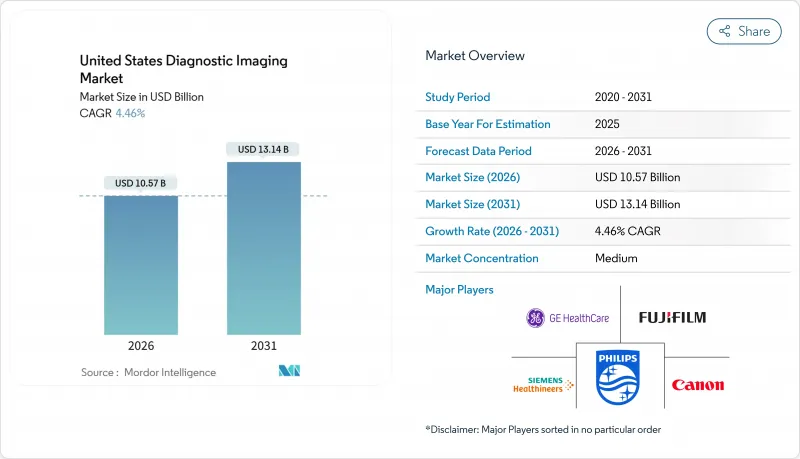
Mordor Intelligence에 따르면 미국의 영상 진단 시장 규모는 2026년에 105억 7,000만 달러로 추정되며, 예측 기간(2026-2031년) 동안 CAGR 4.46%를 기록하며 2031년에는 131억 4,000만 달러에 달할 것으로 전망됩니다.
본 보고서는 제품·서비스별(영상 진단 시스템 및 기기 [X선, 초음파, MRI, CT, 핵의학, 유방촬영, 투시 장치 및 C-암], 소모품 및 부속품, 소프트웨어 및 서비스), 용도별(순환기, 종양학 등), 최종사용자별(병원 등), 기술별(AI 지원, 기존형)로 분류되어 있습니다. 시장 예측은 금액(달러) 기준으로 제시되어 있습니다.
미국 영상 진단 시장의 동향 및 인사이트
AI를 활용한 워크플로우 및 영상 해석 도입
방사선 의학 알고리즘에 대한 FDA 승인 건수는 2024년에 87건에 달하여 2023년 대비 40% 증가했습니다. 의료 시스템에서는 이러한 도구를 도입함으로써 방사선과 의사의 시간을 수익성이 높은 중재 치료 사례에 재분배하고 있습니다. Aidoc사의 트리아지 플랫폼은 뇌졸중 프로토콜에서 ‘내원부터 진단까지’ 소요되는 시간을 30% 단축합니다. 기존 PACS에는 맞춤형 API가 필요하고, 지역 병원에는 출력 결과를 현장에서 검증할 정보과학 팀이 부족하기 때문에 시스템 통합은 여전히 걸림돌로 남아 있습니다. FDA는 현재 인구통계학적 특성에 따라 계층화된 성능 지표를 요구하고 있으며, 이러한 변경으로 인해 신청 절차는 장기화되지만 스캐너 내에 AI를 내장하는 벤더에게는 유리하게 작용합니다. 그 결과, 플랫폼 제조사들은 알고리즘을 하드웨어에 번들로 제공하고 서비스 계약을 고정화함으로써 미국 영상 진단 시장의 규모를 확대하고 있습니다.
영상 검사 건수의 외래 및 당일 진료 시설로의 이동
외래 수술 센터에서는 병원 외래 진료 부문에 비해 스캔 1건당 비용을 30-40% 낮게 유지하며 영상 진단 서비스를 제공함으로써, 메디케어 어드밴티지(Medicare Advantage)를 통해 환자를 유치하고 있습니다. 이에 따라 2031년까지 연평균 성장률(CAGR)은 13.32%에 달할 것으로 전망됩니다. 2025년 ‘시설 중립형 지불 제도’의 확대로 인해 요추 MRI 1건당 이익 폭은 300달러에서 약 50달러로 축소되어 병원 경영에 압박을 가하고 있습니다. 현재 독립형 시설이 병원 외에서 이루어지는 영상 진단의 22%를 차지하고 있으며, 이는 2020년의 18%에서 증가한 수치입니다. 특히 ‘필요 증명서(Certificate-of-Need)’ 법을 폐지한 주에서 성장이 두드러집니다. 병원 측은 자사가 소유한 클리닉을 병원 외 진료 부문으로 전환함으로써 대응하고 있으나, CMS(미국 의료보험·의료서비스센터)가 거리 관련 정의를 엄격히 적용한 결과, 기존 시설의 8%가 병원 요금 적용 대상에서 제외되면서 이러한 변화가 미국의 영상 진단 시장을 재편하고 있습니다.
방사선과 전문의 및 방사선사 부족
2034년까지 3만 5,600명의 방사선과 의사가 부족할 것으로 예상되며, 이와 병행하여 2025년에는 1만 2,000명의 방사선사 자리가 채워지지 않을 전망입니다. 이로 인해 검사 1건당 75-150달러의 원격 판독에 대한 의존도가 높아지고 있습니다. 방사선과 의사의 42%가 번아웃으로 고통받고 있으며, 그 주요 원인은 과도한 진료 건수와 행정 업무에 있습니다. AI를 활용한 분류로 판독 시간은 10-15% 단축되지만, 여전히 인간의 감독이 필요합니다. CMS의 인턴 보조금 상한선 규제는 여전히 지속되고 있으며, 업무 범위 확대에 대해서는 각 주에서 반대가 제기되고 있어, 이로 인해 인력 부족이 장기화되면서 미국 영상 진단 시장의 발전을 저해하고 있습니다.
부문 분석
소프트웨어 및 서비스 분야는 연평균 성장률(CAGR) 16.73%로 성장할 것으로 예상되며, 이는 미국 영상 진단 시장에서 가장 빠른 성장세를 보이는 분야입니다. 클라우드 PACS, AI를 활용한 트라이아지, 그리고 예측 유지보수 구독 서비스는 인력 부족에 직면한 병원들에게 매력적인 솔루션입니다. 영상 진단 시스템 및 장비는 50만-300만 달러 규모의 MRI 및 CT 장비를 핵심으로 하여, 2025년 매출의 84.25%를 계속 차지할 것으로 전망됩니다. 교체 주기 연기로 인해 하드웨어 성장세는 둔화되고 있지만, 서비스 계약은 증가하고 있습니다.
GE 헬스케어의 ‘CareIntellect’를 통한 예측 유지보수는 가동 중단 시간을 30% 줄이고, 스캐너 1대당 연간 5만 달러의 비용 절감을 실현하고 있습니다. 지멘스의 ‘AI-Rad Companion’은 판독 시간을 4분으로 단축하여, 자원 부족으로 어려움을 겪는 방사선과 팀을 지원하고 있습니다. 휴대용 X선 장비와 핸드헬드 초음파 장비를 통해 초급 수준의 영상 진단이 보편화되는 한편, ‘Cancer Moonshot’ 이니셔티브에 힘입은 PET의 확대가 틈새 시장인 하이엔드 수요를 유지하며 미국 영상 진단 시장의 수익원을 형성하고 있습니다.
순환기 분야는 2025년 검사 건수의 33.63%를 차지하고 있으며, 이는 관상동맥 질환 및 심부전 관리가 널리 이루어지고 있음을 반영합니다. 신경과는 혈액 검사를 통한 알츠하이머병 마커가 환자를 아밀로이드 PET 검사로 유도함에 따라 2031년까지 연평균 성장률(CAGR) 15.18%로 성장할 것으로 예측되며, 이는 미국 영상 진단 시장에서 가장 빠른 성장 속도입니다. 종양학 분야는 폐암 검진 기준이 확대됨에 따라 대상 성인 환자 수가 2배인 1,450만 명에 달한 혜택을 보고 있습니다.
근골격계 MRI는 메디케어의 보상 삭감에 직면해 있으며, 검사 기관들은 수익성이 높은 관절 검사로 전환하고 있습니다. 여성 건강 검진 분야에서는 유방촬영술 권장 연령이 낮아짐에 따라, 토모신테시스 도입률이 기관의 75%까지 상승했습니다. 장기 코로나(Long COVID)의 영향으로 호흡기과 업무 흐름에서는 고해상도 CT가 계속해서 활용되고 있습니다. AI를 활용한 폐 결절 진단 도구는 위음성률을 20% 감소시키지만, PACS와의 통합에 자금이 필요하여 미국 영상 진단 시장 내 도입 속도의 편차를 부각시키고 있습니다.
기타 혜택:
- 엑셀 형식의 시장 예측(ME) 시트
- 3개월간 애널리스트 지원
자주 묻는 질문
목차
제1장 소개
제2장 조사 방법
제3장 주요 요약
제4장 시장 구도
제5장 시장 규모와 성장 예측
제6장 경쟁 구도
제7장 시장 기회와 향후 전망
KSM 26.08.25According to Mordor Intelligence, the United States diagnostic imaging market size is estimated at USD 10.57 billion in 2026, and is expected to reach USD 13.14 billion by 2031, at a CAGR of 4.46% during the forecast period (2026-2031).
This report is Segmented by Product and Services (Imaging Systems and Equipment [X-Ray, Ultrasound, MRI, CT, Nuclear Medicine, Mammography, Fluoroscopy & C-Arms], Consumables and Accessories, Software and Services), Application (Cardiology, Oncology, and More), End User (Hospitals, and More), and Technology (AI-Enabled, Conventional). Market Forecasts are Provided in Terms of Value (USD).
United States Diagnostic Imaging Market Trends and Insights
AI-Driven Workflow and Image Interpretation Adoption
FDA clearances for radiology algorithms climbed to 87 in 2024, a 40% jump over 2023. Health systems deploy these tools to reallocate radiologist time toward higher-revenue interventional cases. Aidoc's triage platform cuts door-to-diagnosis time in stroke protocols by 30%. Integration remains a hurdle because legacy PACS need custom APIs, and community hospitals lack informatics teams to validate outputs locally. The FDA now requires demographic-stratified performance metrics, a change that lengthens submissions but favors vendors embedding AI inside scanners. Consequently, platform manufacturers bundle algorithms with hardware, locking in service contracts and extending the reach of the United States diagnostic imaging market.
Shift of Imaging Volumes to Outpatient and Ambulatory Settings
Ambulatory surgical centers deliver imaging at 30-40% lower cost per scan than hospital outpatient departments, attracting Medicare Advantage steerage that drives 13.32% CAGR through 2031. Site-neutral payment expansion in 2025 collapsed a USD 300 margin gap per lumbar spine MRI to roughly USD 50, pressuring hospital economics. Freestanding centers now perform 22% of non-hospital imaging, up from 18% in 2020, with growth strongest in states that repealed Certificate-of-Need laws. Hospitals respond by converting owned clinics into off-campus departments, but CMS tightened distance definitions, rendering 8% of legacy sites ineligible for hospital rates, a shift reshaping the United States diagnostic imaging market.
Shortage of Radiologists and Technologists
A projected 35,600-radiologist gap by 2034 coincides with 12,000 unfilled technologist roles in 2025, raising reliance on USD 75-150 per-study teleradiology. Burnout affects 42% of radiologists, primarily from case overload and administrative tasks. AI triage saves 10-15% reading time but still demands human oversight. CMS caps on residency funding persist, and scope-of-practice expansions face state opposition, prolonging workforce scarcity that restrains the United States diagnostic imaging market.
Other drivers and restraints analyzed in the detailed report include:
- Rapid Penetration of Portable and Handheld Ultrasound/X-ray Systems
- CMS Site-Neutral Payment Expansion Favoring Lower-Cost Imaging Sites
- Prolonged FDA Clearance Cycle for AI Algorithms and Novel Modalities
For complete list of drivers and restraints, kindly check the Table Of Contents.
Segment Analysis
Software and Services is projected to grow at a 16.73% CAGR, the quickest stride within the United States diagnostic imaging market. Cloud PACS, AI triage, and predictive-maintenance subscriptions appeal to hospitals facing workforce shortages. Imaging Systems and Equipment still accounts for 84.25% of 2025 revenue, anchored by MRI and CT units that cost USD 500,000-3 million. Deferred replacement cycles temper hardware growth but augment service contracts.
Predictive maintenance via GE HealthCare's CareIntellect curbs downtime by 30%, trimming USD 50,000 annually per scanner. Siemens' AI-Rad Companion cuts reading time to four minutes, supporting under-resourced radiology groups. Portable X-ray and handheld ultrasound commoditize entry-level imaging, while Cancer Moonshot-backed PET expansion maintains niche high-end demand, shaping revenue streams within the United States diagnostic imaging market.
Cardiology captured 33.63% of 2025 procedures, reflecting prevalent coronary disease and heart failure management. Neurology, driven by blood-based Alzheimer's markers funneling patients to amyloid-PET, is forecast to grow at a 15.18% CAGR through 2031, the fastest pace in the United States diagnostic imaging market. Oncology benefits from broadened lung-screening criteria that doubled the eligible cohort to 14.5 million adults.
Musculoskeletal MRI faces Medicare fee cuts, pushing centers toward higher-margin joints. Women's health imaging gains from earlier mammography age recommendations, raising tomosynthesis adoption to 75% of sites. Long-COVID keeps high-resolution CT in pulmonology workflows. AI lung-nodule tools trim false negatives by 20% yet require PACS integration funding, illustrating divergent adoption speeds inside the United States diagnostic imaging market.
Complete Report Scope:
- By Product and Services
- Imaging Systems and Equipments
- X-ray
- Ultrasound
- Magnetic Resonance Imaging (MRI)
- Computed Tomography (CT)
- Nuclear Medicine
- Mammography
- Fluoroscopy & C-arms
- Consumables and Accessories
- Software and Services
- Imaging Systems and Equipments
- By Application
- Cardiology
- Oncology
- Neurology & Neurodegenerative Disorders
- Orthopedics & Musculoskeletal
- Gastroenterology & Hepatology
- Women's Health & Obstetrics/Gynecology
- Pulmonology & Thoracic Imaging
- By End User
- Hospitals
- Independent Diagnostic Imaging Centers (IDTFs)
- Ambulatory Surgical Centers
- Physician Offices & Clinics
- Veterans Affairs & Federal Facilities
- Research Institutes & CROs
- By Technology
- AI-Enabled
- Conventional Systems
List of Companies Covered in this Report:
- Agfa-Gevaert
- Akumin Inc.
- Canon
- Carestream Health (Onex)
- Esaote
- FUJIFILM
- GE Healthcare
- Hitachi Healthcare
- Hologic
- Konica Minolta
- Koninklijke Philips
- KUB Technologies
- Mindray Medical
- MinXray
- RadNet Inc.
- Samsung Group
- Shimadzu Medical Systems
- Siemens Healthineers
- US Radiology Specialists
Additional Benefits:
- The market estimate (ME) sheet in Excel format
- 3 months of analyst support
TABLE OF CONTENTS
1 Introduction
- 1.1 Study Assumptions & Market Definition
- 1.2 Scope of the Study
2 Research Methodology
3 Executive Summary
4 Market Landscape
- 4.1 Market Overview
- 4.2 Market Drivers
- 4.2.1 AI-Driven Workflow & Image Interpretation Adoption
- 4.2.2 Shift Of Imaging Volumes to Outpatient & Ambulatory Settings
- 4.2.3 Rapid Penetration of Portable & Handheld Ultrasound/X-Ray Systems
- 4.2.4 CMS Site-Neutral Payment Expansion Favoring Lower-Cost Imaging Sites
- 4.2.5 Reimbursement Incentives for Low-Dose & Value-Based Imaging
- 4.2.6 Federal Investments in Cancer & Neurodegenerative Diagnostics (Cancer Moonshot 2.0, ARPA-H)
- 4.3 Market Restraints
- 4.3.1 Shortage of Radiologists & Technologists
- 4.3.2 Prolonged FDA Clearance Cycle for AI Algorithms & Novel Modalities
- 4.3.3 Capital-Intensive Nature of High-End MRI/CT Systems
- 4.3.4 Price Transparency & No-Surprises Act Squeezing Provider Margins
- 4.4 Value / Supply-Chain Analysis
- 4.5 Regulatory Landscape
- 4.6 Technological Outlook
- 4.7 Porter's Five Forces Analysis
- 4.7.1 Threat of New Entrants
- 4.7.2 Bargaining Power of Buyers/Consumers
- 4.7.3 Bargaining Power of Suppliers
- 4.7.4 Threat of Substitute Products
- 4.7.5 Intensity of Competitive Rivalry
5 Market Size & Growth Forecasts (Value in USD)
- 5.1 By Product and Services
- 5.1.1 Imaging Systems and Equipments
- 5.1.1.1 X-ray
- 5.1.1.2 Ultrasound
- 5.1.1.3 Magnetic Resonance Imaging (MRI)
- 5.1.1.4 Computed Tomography (CT)
- 5.1.1.5 Nuclear Medicine
- 5.1.1.6 Mammography
- 5.1.1.7 Fluoroscopy & C-arms
- 5.1.2 Consumables and Accessories
- 5.1.3 Software and Services
- 5.1.1 Imaging Systems and Equipments
- 5.2 By Application
- 5.2.1 Cardiology
- 5.2.2 Oncology
- 5.2.3 Neurology & Neurodegenerative Disorders
- 5.2.4 Orthopedics & Musculoskeletal
- 5.2.5 Gastroenterology & Hepatology
- 5.2.6 Women's Health & Obstetrics/Gynecology
- 5.2.7 Pulmonology & Thoracic Imaging
- 5.3 By End User
- 5.3.1 Hospitals
- 5.3.2 Independent Diagnostic Imaging Centers (IDTFs)
- 5.3.3 Ambulatory Surgical Centers
- 5.3.4 Physician Offices & Clinics
- 5.3.5 Veterans Affairs & Federal Facilities
- 5.3.6 Research Institutes & CROs
- 5.4 By Technology
- 5.4.1 AI-Enabled
- 5.4.2 Conventional Systems
6 Competitive Landscape
- 6.1 Market Concentration
- 6.2 Market Share Analysis
- 6.3 Company Profiles (includes Global level Overview, Market level overview, Core Segments, Financials as available, Strategic Information, Market Rank/Share for key companies, Products & Services, and Recent Developments)
- 6.3.1 Agfa-Gevaert Group
- 6.3.2 Akumin Inc.
- 6.3.3 Canon Medical Systems
- 6.3.4 Carestream Health (Onex)
- 6.3.5 Esaote SpA
- 6.3.6 Fujifilm Healthcare
- 6.3.7 GE Healthcare
- 6.3.8 Hitachi Healthcare
- 6.3.9 Hologic Inc.
- 6.3.10 Konica Minolta Inc.
- 6.3.11 Koninklijke Philips N.V.
- 6.3.12 KUB Technologies
- 6.3.13 Mindray Medical
- 6.3.14 MinXray Inc.
- 6.3.15 RadNet Inc.
- 6.3.16 Samsung Medison
- 6.3.17 Shimadzu Medical Systems
- 6.3.18 Siemens Healthineers
- 6.3.19 US Radiology Specialists
7 Market Opportunities & Future Outlook
- 7.1 White-space & Unmet-Need Assessment