

|
시장보고서
상품코드
2120644
아프리카의 농약 : 시장 점유율 분석, 업계 동향과 통계, 성장 예측(2026-2031년)Africa Agrochemicals - Market Share Analysis, Industry Trends & Statistics, Growth Forecasts (2026 - 2031) |
||||||
 Mordor Intelligence
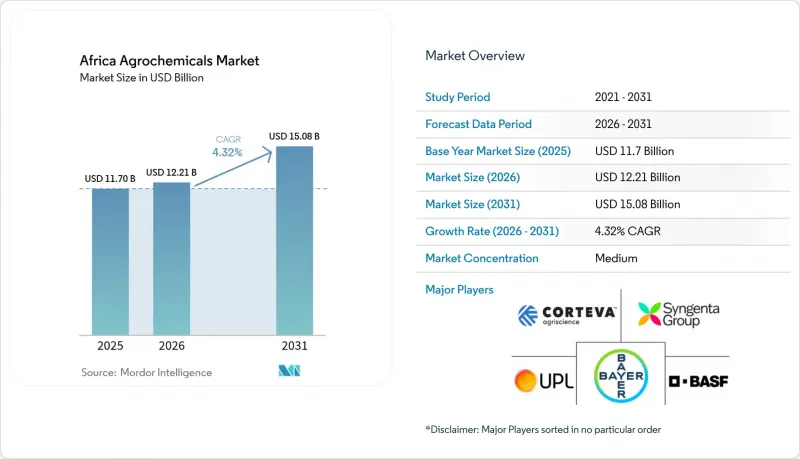
Mordor Intelligence에 의하면, 아프리카의 농약 시장 규모는 2025년 117억 달러에서 2026년에는 122억 1,000만 달러에 이르고, 2026-2031년 CAGR 4.32%로 성장을 지속하여, 2031년까지 150억 8,000만 달러에 달할 것으로 예측됩니다.
본 보고서는 제품 유형(비료, 농약, 보조제, 식물 성장 조절제), 용도(곡물, 콩류·유지종자, 과일 및 채소, 상업용 작물), 지역(이집트, 모로코, 탄자니아, 남아프리카 등)별로 분류되어 있습니다. 시장 전망은 금액(달러) 기준으로 제시되어 있습니다.
아프리카의 농약 시장 동향 및 인사이트
기후 변화로 인한 해충 및 병해 위협 증가
기상 패턴의 변동으로 인해 아프리카의 여러 국가에서 가을 군충과 같은 침입 해충의 확산이 확대되어 옥수수 수확량에 심각한 영향을 미치고 있습니다. 곡물 생산 지역의 스트리가 잡초 확산은 계속해서 수확에 영향을 미치고 있으며, 농가들은 통합적인 화학적 해충 방제 프로그램을 시행하고 있습니다. 케냐, 가나, 에티오피아에서는 긴급 대응 프로토콜이 수립되어 있으며, 지역 기관들이 해충 감시 네트워크를 조정하고 있습니다. 농업 관련 기업들은 해충 유충을 표적으로 하는 정밀 살충제 개발을 가속화하고 있으며, 디지털 모니터링 플랫폼이 농가에게 실시간 경보를 제공합니다. 이러한 요인들이 아프리카의 농약 시장의 지속적인 성장을 견인하고 있습니다. 또한, 종자 처리용 화학 물질 및 농민 대상 교육 프로그램에 대한 투자로 인해 시장은 더욱 탄력을 받고 있습니다. 민관 파트너십을 통해 농민들이 새로운 작물 보호 솔루션을 더 쉽게 이용할 수 있게 되었습니다.
인구 증가로 식량 수요 격차 확대
소규모 농가들이 권장량보다 적은 양의 농약을 사용하고 있어 농업 생산성은 여전히 제한적입니다. 나이지리아, 에티오피아, 탄자니아에서는 도시로의 인구 유출로 인해 농업 노동력이 감소하고 있어 큰 제약에 직면해 있습니다. 정부의 이니셔티브에는 수확량 증대를 위한 국내 비료 생산 및 관개 인프라 투자가 포함됩니다. 에티오피아의 관개 확대 프로그램은 저지대의 생산성 향상과 수입 의존도 감소에 중점을 두고 있습니다. 식량 수요 증가는 비료, 농약, 식물 성장 조절제와 같은 아프리카의 농약 시장을 지속적으로 견인하고 있습니다. 농업 유통업체 네트워크의 확대와 이동형 자문 서비스의 전개로 인해 농가들이 농업 자재와 지식을 더 쉽게 확보할 수 있게 되었습니다. 농가들은 변화하는 기상 조건에 대응하기 위해 기후 변화에 강한 농약 솔루션을 점점 더 많이 채택하고 있습니다.
소규모 농가에게는 감당하기 힘든 치솟는 농약 가격
내륙국의 운송비는 최종 소매 가격의 최대 50%를 차지하고 있으며, 에티오피아에서는 최근 비료 가격이 대폭 상승했습니다. 케냐에서는 2025년도 재정 법안을 통해 농약에 16%의 부가가치세(VAT)를 부과하는 방안이 제안되어 있어, 이로 인해 생산 비용이 크게 증가할 가능성이 있습니다. 2024년 중반 나이지리아에서 기록적인 식량 인플레이션이 발생함에 따라 각 가구는 소득의 상당 부분을 식비에 지출할 수밖에 없게 되었고, 농업 투자에 할당되는 자금이 감소했습니다. 농가들은 주로 주 단위로 높은 이자를 부과하는 비공식 대출업자에 의존하는 경우가 많아, 그 결과 부채의 악순환이 발생하며 아프리카의 농약 시장의 성장을 저해하고 있습니다. 이러한 경제적 부담 문제로 인해 효과적인 작물 보호 제품의 도입이 저해되고, 수확량이 최적 수준에 미치지 못해 식량 안보 문제가 지속되고 있습니다.
부문 분석
2025년, 아프리카의 농약 시장에서 비료는 50.55%의 점유율을 차지했습니다. 이는 광범위한 토양 영양 결핍을 해결하고 다양한 농업 생태 지역의 농업 생산성을 뒷받침하는 역할을 합니다. 질소계 비료는 여전히 곡물 생산에 필수적이지만, 인산계 및 칼륨계 비료는 균형 잡힌 영양 프로그램을 통해 채택이 확대되고 있습니다. 디지털 보조금의 전자 바우처나 창고 수령 증서에 기반한 신용 제도는 자금 측면의 장벽을 완화하고 적시에 비료를 시비할 수 있게 해줍니다.
식물 성장 조절제는 스트레스 내성, 뿌리 발달, 수확량 잠재력을 향상시키는 영양소의 채택 확대에 힘입어 연평균 성장률(CAGR) 6.8%로 성장을 지속하고, 있습니다. 농약은 아프리카 전역에서 큰 판매량을 유지하고 있으며, 노동력 부족과 내성 잡초의 발생으로 인해 제초제가 시장을 독점하고 있습니다. 기후 변화와 관련된 해충의 대량 발생으로 살충제 수요가 증가하는 한편, 원예 지역에서는 살균제 사용이 확대되고 있습니다. 보조제는 규모는 작은 부문이지만, 정밀 살포 장비의 보급에 따라 엽면 피복률 향상과 탱크 혼합의 간소화를 실현하는 첨단 제제가 요구됨에 따라 그 중요성이 높아지고 있습니다.
기타 혜택:
- 엑셀 형식 시장 예측(ME) 시트
- 3개월간의 애널리스트 지원
자주 묻는 질문
목차
제1장 서론
제2장 조사 방법
제3장 주요 요약
제4장 시장 구도
제5장 시장 규모와 성장 예측
제6장 경쟁 구도
제7장 시장 기회와 향후 전망
LSH 26.09.08According to Mordor Intelligence, the Africa agrochemicals market size is expected to grow from USD 11.7 billion in 2025 to USD 12.21 billion in 2026 and is forecast to reach USD 15.08 billion by 2031 at 4.32% CAGR over 2026-2031.
This report is Segmented by Product Type (Fertilizers, Pesticides, Adjuvants, and Plant Growth Regulators), by Application (Grains and Cereals, Pulses and Oilseeds, Fruits and Vegetables, and Commercial Crops), and by Geography (Egypt, Morocco, Tanzania, South Africa, and More). The Market Forecasts are Provided in Terms of Value (USD).
Africa Agrochemicals Market Trends and Insights
Climate-driven Rise in Pest and Disease Pressure
Variable weather patterns have increased the spread of invasive pests like fall armyworm across multiple African nations, significantly impacting maize yields. Striga weed infestations in cereal-growing regions continue to affect harvests, leading farmers to implement integrated chemical control programs. Kenya, Ghana, and Ethiopia have established emergency response protocols, while regional organizations coordinate pest surveillance networks. Agricultural companies have accelerated the development of precision insecticides targeting pest larvae, and digital monitoring platforms provide real-time alerts to farmers. These factors drive sustained growth in the Africa agrochemicals market. The market gains additional momentum through investments in seed treatment chemicals and farmer education programs. Public-private partnerships are improving farmer access to new crop protection solutions.
Population Growth Accelerating Food-demand Gap
Agricultural productivity remains limited as smallholder farmers use agrochemicals below recommended levels. Nigeria, Ethiopia, and Tanzania experience significant constraints due to urban migration, reducing the agricultural workforce. Government initiatives include investments in domestic fertilizer production and irrigation infrastructure to improve yields. Ethiopia's irrigation expansion program focuses on increasing lowland productivity and decreasing import dependence. Growing food demand continues to drive the African agrochemicals market for fertilizers, pesticides, and plant growth regulator products. The expansion of agricultural dealer networks and mobile advisory services helps improve farmers' access to inputs and knowledge. Farmers increasingly adopt climate-resilient agrochemical solutions to address changing weather conditions.
High Agrochemical Prices Unaffordable to Smallholders
Transport costs in landlocked countries account for up to 50% of final retail prices, while Ethiopia experienced significant increases in fertilizer prices in recent years. Kenya's proposed 16% VAT on agrochemicals through the 2025 Finance Bill may substantially increase production costs. Nigeria's record-high food inflation in mid-2024 forced households to spend most of their income on food, reducing funds available for farm investments. Farmers often turn to informal lenders charging high weekly interest rates, creating debt cycles that limit growth in the Africa agrochemicals market. The resulting affordability issues reduce the adoption of effective crop protection products, leading to suboptimal yields and continued food security challenges.
Other drivers and restraints analyzed in the detailed report include:
- Government Subsidy Programs for Fertilizer and Pesticide Adoption
- Expansion of Warehouse-receipt Financing Unlocking Working-capital for Inputs
- Fragmented and Stringent Regulatory Approval Timelines
For complete list of drivers and restraints, kindly check the Table Of Contents.
Segment Analysis
Fertilizers held 50.55% of the Africa agrochemicals market share in 2025, addressing widespread soil nutrient deficiencies and supporting agricultural productivity across various agroecological zones. Nitrogen-based formulations remain essential for cereal production, while phosphatic and potassic fertilizers gain adoption through balanced nutrition programs. Digital subsidy e-vouchers and warehouse-receipt credit systems reduce financial barriers and enable timely fertilizer application.
Plant growth regulators demonstrate a 6.8% CAGR, driven by increased adoption of nutrients that improve stress tolerance, root development, and yield potential. Pesticides maintain significant volume across Africa, with herbicides dominating due to labor shortages and resistant weed populations. Insecticide demand increases in response to climate-related pest outbreaks, while fungicide use expands in horticultural regions. Adjuvants, though a smaller segment, grow in importance as precision spraying equipment requires advanced formulations for improved leaf coverage and simplified tank mixing.
Complete Report Scope:
- By Product Type
- Fertilizers
- Nitrogenous
- Phosphatic
- Potassic
- Pesticides
- Herbicides
- Insecticides
- Fungicides
- Adjuvants
- Plant Growth Regulators
- Fertilizers
- By Application
- Grains and Cereals
- Pulses and Oilseeds
- Fruits and Vegetables
- Commercial Crops (Sugarcane, Cotton, and Others)
- By Geography
- Egypt
- Morocco
- Algeria
- Kenya
- Tanzania
- Ethiopia
- South Africa
- Zambia
- Zimbabwe
- Nigeria
- Ghana
- DR Congo
- Rest of Africa
List of Companies Covered in this Report:
- Bayer AG
- Syngenta Group
- Corteva Agriscience
- BASF SE
- FMC Corporation
- UPL Limited
- Yara International ASA
- Sumitomo Chemical Co., Ltd.
- Gowan Company (Isagro S.r.l.)
- Rovensa S.A (Partners Group)
- Sasol Limited
- Twiga Chemical Industries Ltd. (AJ Group)
- OCP Group
- Indorama Corporation
- Albaugh LLC
Additional Benefits:
- The market estimate (ME) sheet in Excel format
- 3 months of analyst support
TABLE OF CONTENTS
1 Introduction
- 1.1 Study Assumptions and Market Definition
- 1.2 Scope of the Study
2 Research Methodology
3 Executive Summary
4 Market Landscape
- 4.1 Market Overview
- 4.2 Market Drivers
- 4.2.1 Climate-driven Rise in Pest and Disease Pressure
- 4.2.2 Population Growth Accelerating Food-demand Gap
- 4.2.3 Government Subsidy Programs for Fertilizer and Pesticide Adoption
- 4.2.4 Mechanization and Precision-ag Adoption Boosting Agrochemical Efficiency
- 4.2.5 Expansion of Warehouse-receipt Financing Unlocking Working-capital for Inputs
- 4.2.6 Emergence of Private-label Agro-retail Chains Improving Last-mile Distribution
- 4.3 Market Restraints
- 4.3.1 High Agrochemical Prices Unaffordable to Smallholders
- 4.3.2 Fragmented and Stringent Regulatory Approval Timelines
- 4.3.3 Proliferation of Counterfeit Agrochemicals Eroding Farmer Trust
- 4.3.4 Organic and Residue-free Export Crop Programs Curbing Synthetic Usage
- 4.4 Regulatory Landscape
- 4.5 Technological Outlook
- 4.6 Porter's Five Forces Analysis
- 4.6.1 Threat of New Entrants
- 4.6.2 Bargaining Power of Buyers
- 4.6.3 Bargaining Power of Suppliers
- 4.6.4 Threat of Substitutes
- 4.6.5 Intensity of Competitive Rivalry
5 Market Size and Growth Forecasts (Value)
- 5.1 By Product Type
- 5.1.1 Fertilizers
- 5.1.1.1 Nitrogenous
- 5.1.1.2 Phosphatic
- 5.1.1.3 Potassic
- 5.1.2 Pesticides
- 5.1.2.1 Herbicides
- 5.1.2.2 Insecticides
- 5.1.2.3 Fungicides
- 5.1.3 Adjuvants
- 5.1.4 Plant Growth Regulators
- 5.1.1 Fertilizers
- 5.2 By Application
- 5.2.1 Grains and Cereals
- 5.2.2 Pulses and Oilseeds
- 5.2.3 Fruits and Vegetables
- 5.2.4 Commercial Crops (Sugarcane, Cotton, and Others)
- 5.3 By Geography
- 5.3.1 Egypt
- 5.3.2 Morocco
- 5.3.3 Algeria
- 5.3.4 Kenya
- 5.3.5 Tanzania
- 5.3.6 Ethiopia
- 5.3.7 South Africa
- 5.3.8 Zambia
- 5.3.9 Zimbabwe
- 5.3.10 Nigeria
- 5.3.11 Ghana
- 5.3.12 DR Congo
- 5.3.13 Rest of Africa
6 Competitive Landscape
- 6.1 Market Concentration
- 6.2 Strategic Moves
- 6.3 Market Share Analysis
- 6.4 Company Profiles (Includes Global level Overview, Market Level Overview, Core Segments, Financials as Available, Strategic Information, Market Rank/Share for Key Companies, Products and Services, and Recent Developments)
- 6.4.1 Bayer AG
- 6.4.2 Syngenta Group
- 6.4.3 Corteva Agriscience
- 6.4.4 BASF SE
- 6.4.5 FMC Corporation
- 6.4.6 UPL Limited
- 6.4.7 Yara International ASA
- 6.4.8 Sumitomo Chemical Co., Ltd.
- 6.4.9 Gowan Company (Isagro S.r.l.)
- 6.4.10 Rovensa S.A (Partners Group)
- 6.4.11 Sasol Limited
- 6.4.12 Twiga Chemical Industries Ltd. (AJ Group)
- 6.4.13 OCP Group
- 6.4.14 Indorama Corporation
- 6.4.15 Albaugh LLC


