
|
시장보고서
상품코드
2120760
모바일 분석 : 시장 점유율 분석, 업계 동향과 통계, 성장 예측(2026-2031년)Mobile Analytics - Market Share Analysis, Industry Trends & Statistics, Growth Forecasts (2026 - 2031) |
||||||
 Mordor Intelligence
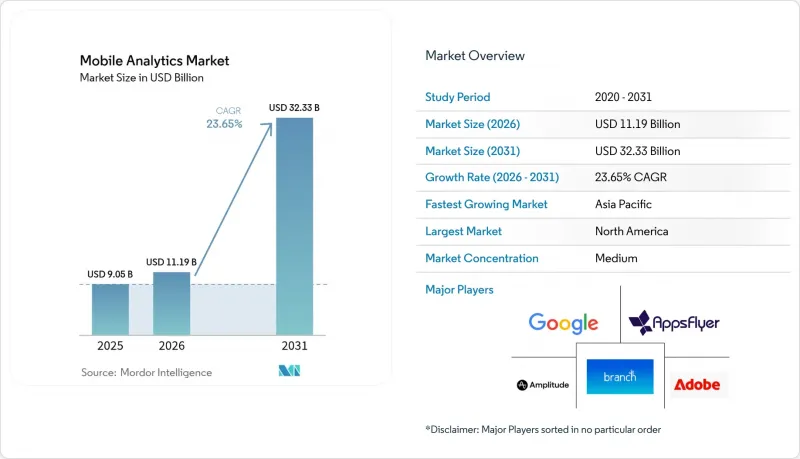
Mordor Intelligence에 의하면, 모바일 분석 시장 규모는 2025년에 90억 5,000만 달러로 평가되었고, 2026년 111억 9,000만 달러에서 2031년까지 323억 3,000만 달러에 이를 것으로 예측되며, 예측 기간(2026-2031년) CAGR은 23.65%를 기록할 전망입니다.
본 보고서는 구성 요소(소프트웨어, 서비스), 분석 유형(용도 분석, 캠페인 분석, 서비스 분석, 인앱 행동 분석), 도입 형태(클라우드, On-Premise), 조직 규모(대기업, 중소기업), 최종 사용자 산업(은행, 금융서비스 및 보험(BFSI), 미디어 및 엔터테인먼트 등) 및 지역별로 분류되어 있습니다. 시장 전망은 금액(달러) 기준으로 제시되어 있습니다.
세계 모바일 분석 시장 동향 및 인사이트
스마트폰의 보급으로 엑사바이트 규모의 행동 데이터가 생성되고 있습니다.
2024년, 전 세계 스마트폰 사용자 수는 68억 명에 달하며, 각 기기는 매달 약 2.5GB의 행동 신호를 전송하고 있습니다. 탭, 스크롤, 위치 정보 전송과 같은 지속적인 데이터 스트림을 통해 기업은 고객의 여정을 세밀하게 파악할 수 있게 되었으며, 5G 대역폭 덕분에 실시간 추론이 가능해졌습니다. 현재 소매 앱에서는 스크롤 속도 등 미세한 동작을 분석하여 최대 89%의 정확도로 구매 의도를 예측했습니다. 지연을 줄이고 개인정보를 보호하기 위해 기기 에지에서의 처리가 보급되고 있으며, 각 벤더들은 로컬 연산이 가능한 경량 SDK를 제공합니다. 이러한 SDK는 성능을 저하시키지 않으면서 데이터 전송량을 줄이고, 점점 더 엄격해지는 개인정보 보호 규제를 준수함으로써 엣지 분석을 모바일 분석 시장의 주요 가치 창출 요인으로 확고히 자리매김하고 있습니다.
모바일 커머스 거래의 폭발적인 성장
2024년, 모바일 커머스는 전 세계 전자상거래 거래액의 58.9%를 차지할 것으로 예상되며, 앱 내 실시간 고객 행동 추적이 매우 중요시되고 있습니다. 중국에서만 2024년에 49조 2,000억 달러 규모의 모바일 결제가 처리되어, 부정 행위 감지 및 멀티 터치 어트리뷰션에 대한 수요를 뒷받침하고 있습니다. 소셜 커머스와 라이브 스트리밍 쇼핑은 표준 웹 도구로는 파악할 수 없을 정도로 복잡하고 급속한 구매 경로를 만들어내고 있습니다. 각 벤더들은 채팅, 동영상, 앱 내 스토어에 걸친 구매 경로를 몇 초 만에 통합하는 전용 모듈을 제공함으로써 이에 대응하고 있으며, 옴니채널 성장 전략에서 모바일 분석 시장의 전략적 중요성을 더욱 높이고 있습니다.
GDPR(EU 개인정보보호규정) 및 CCPA와 같은 엄격한 데이터 개인정보 보호 규정
기업들은 모바일 분석 스택을 GDPR(EU 개인정보보호규정)에 부합하는 상태로 유지하기 위해 연간 약 130만 달러를 할당하고 있습니다. 캘리포니아주의 CCPA는 이러한 의무를 미국의 주요 시장으로 확대하고 있으며, 브라질과 인도에서도 유사한 법률이 제정되고 있습니다. 각 벤더는 차등 프라이버시(differential privacy)와 연합 학습(federated learning)을 통합하여 모델이 분산형 데이터에서 작동하도록 함으로써 원시 데이터 수집을 최소화하고 있습니다. 구글의 안드로이드용 ‘프라이버시 샌드박스(Privacy Sandbox)’는 이러한 전환을 상징하며, 앱 간 식별자를 집계된 신호로 대체하고 있습니다. 규정 준수는 진입 장벽을 높이고 모바일 분석 시장의 달성 가능한 성장 곡선을 낮추는 한편, ‘프라이버시 바이 디자인(Privacy by Design)’ 엔지니어링을 습득한 플랫폼을 차별화하는 결과로 이어지고 있습니다.
부문 분석
소프트웨어 제품은 2025년 매출의 68.62%를 차지하며, 모바일 분석 시장에서 대다수 구매자에게 기본적인 진입점으로서의 역할을 강조하고 있습니다. 많은 기업은 대규모 코딩 없이도 기존 데이터 레이크나 마케팅 클라우드에 연결할 수 있는 시각적이고 셀프 서비스 방식의 대시보드를 선호합니다. 그러나 규제 복잡성과 SDK 통합에 따른 과제가 증가함에 따라 컨설팅 및 매니지드 서비스의 중요성이 커지고 있으며, 이 부문은 2031년까지 연평균 성장률(CAGR) 25.4%를 나타낼 것으로 예측됩니다. 구현 파트너는 레거시 추적 환경의 마이그레이션, 개인정보 보호 모델 도입, 실시간 개인화 엔진의 튜닝을 지원합니다. 이는 사내 팀이 대응할 자원이 부족한 경우가 많은 업무입니다. 은행업 등 규제가 엄격한 업계에서는 외부 전문가가 데이터 수집 범위를 축소하면서도 예측 정확도를 유지하는 GDPR(EU 개인정보보호규정)을 준수하는 퍼널을 설계합니다.
매니지드 서비스는 유지보수, 데이터 엔지니어링, 실험 지원을 구독 형식으로 패키지화하여 중소기업의 기술 인력 부족 문제를 해결하고 있습니다. 그 결과, 핵심 소프트웨어가 여전히 예산의 주요 항목을 차지하고 있음에도 불구하고, 서비스 수익은 모바일 분석 시장에서 점유율을 확대되고 있습니다. 각 벤더는 산업별 플레이북(예: HIPAA 준수를 가속화하는 의료 산업용 템플릿)을 통해 차별화를 꾀하고 있습니다. 이러한 동향은 향후 플랫폼 라이선스에 성과 기반 서비스 계약이 결합되어 모바일 분석 시장 전체에서 혼합 수익 모델이 강화될 것임을 시사합니다.
용도 분석은 디지털 팀에게 친숙한 획득, 유지, 전환 지표에 초점을 맞추고 있어 2025년에는 34.98%의 점유율을 차지했습니다. 그 뒤를 이어 캠페인 분석과 서비스 분석이 뒤를 이으며, 광고 어트리뷰션 및 고객 지원 최적화를 뒷받침하고 있습니다. 그러나 기업들이 표면적인 지표만으로는 중요한 의도의 신호를 놓칠 수 있다는 사실을 점차 깨닫고 있어, 인앱 행동 분석이 연평균 성장률(CAGR) 24.1%로 가장 빠르게 성장하고 있습니다. 스트리밍 서비스는 재생 시작 후 30초 이내에 시청 중단을 감지하고 대체 컨텐츠를 푸시함으로써 참여도를 23% 향상시키고 있습니다. 게임 스튜디오는 손가락 압력 패턴을 분석하여 난이도 곡선을 실시간으로 조정함으로써 수익화의 기반을 다지고 있습니다.
머신러닝 모델이 성숙해지면서 미세한 제스처, 컨텍스트 전환, 세션 진행 속도를 높은 신뢰도로 해석할 수 있게 되었습니다. 그 결과, 행동 분석은 단순한 진단에서 예측적 조정으로 진화하여 모바일 분석 시장에서 가치 창출의 초석으로 자리매김하고 있습니다. 도입이 확대됨에 따라 행동 분석과 AI 기반 개인화의 경계가 모호해지고 있으며, 벤더들은 지연 시간 없는 의사 결정을 실현하기 위해 추론 엔진을 SDK에 직접 통합하고 있습니다.
지역별 분석
북미는 확고히 자리 잡은 디지털 광고 생태계, 높은 1인당 모바일 지출, 그리고 견조한 벤처 자금 조달을 바탕으로 2025년 매출의 38.25%를 차지했습니다. 미국 입법자들은 CCPA를 통해 규제 프레임워크를 형성했으며, 이는 ‘프라이버시 바이 디자인(Privacy by Design)’에 기반한 데이터 아키텍처의 전국적인 채택을 촉진했습니다. 캐나다에서는 핀테크 분석이 탄력을 받고 있는 반면, 멕시코에서는 확대되는 전자상거래 기반이 스페인어 대시보드를 현지화하는 벤더들에게 새로운 미개척 시장을 창출하고 있습니다. 이 지역에 풍부한 기술 인력이 존재함에 따라 엣지 AI 실험이 가속화되고 있으며, 모바일 분석 시장에서의 리더십이 더욱 공고해지고 있습니다.
아시아태평양은 2031년까지 연평균 성장률(CAGR) 24.05%로 가장 빠른 성장세를 기록하고 있습니다. 중국, 인도, 동남아시아에서는 보급률이 85%를 넘어섰으며, ‘디지털 인디아’와 같은 정부 주도 정책이 모바일 우선 시민 서비스를 추진하고 있습니다. 중국의 대형 소셜 커머스 기업들은 페타바이트 규모의 분석이 필요한 음성, 동영상, 채팅 데이터를 수집하고 있는 반면, 인도의 UPI 프레임워크는 결제 데이터 증가를 뒷받침하고 있습니다. 일본과 한국은 5G를 활용하여 저지연 게임 분석을 실현하고 있으며, 호주는 은행 및 여행 앱에서의 고객 경험(CX) 최적화에 주력하고 있습니다. 데이터 보호 규제의 불균일성이 통합의 장벽이 되고 있는 반면, 현지 호스팅을 확보한 국경 간 제공업체들이 시장 점유율을 확대하고 있어, 아시아태평양이 모바일 분석 시장의 주요 성장 동력임이 부각되고 있습니다.
유럽은 GDPR(EU 개인정보보호규정)에 따른 엄격한 감독 하에서 꾸준히 성장하고 있으며, 고도의 동의 관리 기능을 갖춘 벤더들이 우위를 점하고 있습니다. 독일은 커넥티드카 앱에 통합된 산업용 IoT 분석의 선구자이며, 영국은 오픈 뱅킹 동향을 활용하고, 프랑스는 미디어 스트리밍 분석 분야에서 혁신을 이루고 있습니다. 러시아는 데이터 현지화를 의무화하고 있으며, 생태계를 격리함으로써 국내 기업에 진입의 여지를 마련하고 있습니다. 지역 전체의 연평균 성장률(CAGR)은 둔화되고 있지만, 유럽의 정책적 영향력은 전 세계 로드맵을 주도하고 있으며, EU 고객을 위해 개발된 규정 준수 기능이 모바일 분석 시장의 다른 지역에서도 표준으로 자리 잡고 있습니다.
기타 혜택:
- 엑셀 형식 시장 예측(ME) 시트
- 3개월간의 애널리스트 지원
자주 묻는 질문
목차
제1장 서론
제2장 조사 방법
제3장 주요 요약
제4장 시장 구도
제5장 시장 규모와 성장 예측
제6장 경쟁 구도
제7장 시장 기회와 향후 전망
LSHAccording to Mordor Intelligence, the mobile analytics market size was valued at USD 9.05 billion in 2025 and estimated to grow from USD 11.19 billion in 2026 to reach USD 32.33 billion by 2031, at a CAGR of 23.65% during the forecast period (2026-2031).
This report is Segmented by Component (Software, Services), Analytics Type (Application-Analytics, Campaign-Analytics, Service-Analytics, In-App Behavioral Analytics), Deployment Mode (Cloud, On-Premise), Organisation Size (Large Enterprises, Small and Medium Enterprises), End-User Vertical (BFSI, Media and Entertainment, and More), and Geography. The Market Forecasts are Provided in Terms of Value (USD).
Global Mobile Analytics Market Trends and Insights
Smartphone proliferation generates exabytes of behavioral data.
Global smartphone users reached 6.8 billion in 2024, each device emitting roughly 2.5 GB of behavioral signals per month. Continuous streams of taps, scrolls, and location pings give enterprises fine-grained views of customer journeys, and 5G bandwidth makes real-time inference feasible. Retail apps now mine micro-gestures such as scroll velocity to predict purchase intent with up to 89% accuracy. Processing at device edge is gaining ground to reduce latency and safeguard privacy, prompting vendors to ship lightweight SDKs capable of local computation. These SDKs shrink data transfer volumes and meet tightening privacy mandates while keeping performance intact, cementing edge analytics as a key value driver for the mobile analytics market.
Explosive growth of mobile-commerce transactions
Mobile commerce generated 58.9% of global e-commerce value in 2024, placing heavy emphasis on real-time journey tracking within apps. China alone processed USD 49.2 trillion in mobile payments in 2024, fueling demand for fraud detection and multi-touch attribution. Social commerce and live-stream shopping create complex, rapid funnels that standard web tools cannot map. Vendors respond with specialized modules that stitch together purchase pathways across chat, video, and in-app stores within seconds, reinforcing the strategic relevance of the mobile analytics market to omnichannel growth agendas.
Stringent data-privacy regulations such as GDPR and CCPA
Enterprises allocate about USD 1.3 million per year to keep mobile analytics stacks GDPR-ready. California's CCPA extends similar duties to large U.S. markets, while Brazil and India draft parallel laws. Vendors embed differential privacy and federated learning so models run on decentralized data, minimizing raw collection. Google's Privacy Sandbox for Android exemplifies this pivot, replacing cross-app identifiers with aggregated signals. Compliance lifts barriers to entry and trims the attainable growth curve for the mobile analytics market, even as it differentiates platforms that master privacy-by-design engineering.
Other drivers and restraints analyzed in the detailed report include:
- Rapid enterprise shift to cloud-native analytics platforms
- Rising mobile advertising budgets are driving demand for in-app insights.
- Apple's App Tracking Transparency limits attribution data.
For complete list of drivers and restraints, kindly check the Table Of Contents.
Segment Analysis
Software products contributed 68.62% of 2025 revenue, underscoring their role as the default entry point for most buyers in the mobile analytics market. Many enterprises favor visual, self-service dashboards that plug into existing data lakes and marketing clouds without extensive coding. Yet rising regulatory complexity and SDK integration pain points elevate consulting and managed services, propelling the segment at 25.4% CAGR to 2031. Implementation partners help migrate legacy tracking setups, deploy privacy-preserving models, and tune real-time personalization engines, workstreams that internal teams often lack bandwidth for. For heavily regulated sectors such as banking, external experts design GDPR-compliant funnels that retain predictive strength while lowering data collection footprints.
Managed services address skill shortages for SMEs by bundling maintenance, data engineering, and experimentation support under subscription. As a result, services revenue captures an expanding slice of the mobile analytics market, even though core software still anchors budget line items. Vendors differentiate via industry playbooks-for instance, healthcare templates that expedite HIPAA alignment. The trend suggests a future where outcome-based service contracts accompany platform licenses, reinforcing mixed-revenue models across the mobile analytics market.
Application-analytics held a 34.98% share in 2025, thanks to its focus on acquisition, retention, and conversion metrics familiar to digital teams. Campaign analytics and service analytics follow, supporting ad attribution and customer support optimization. However, in-app behavioral analytics is scaling fastest at 24.1% CAGR as enterprises recognize that surface metrics miss crucial intent cues. Streaming services detect abandonment within 30 seconds of playback and push alternate content to improve engagement by 23%. Gaming studios read finger-pressure patterns to tune difficulty curves in real time, anchoring monetization.
Machine learning models have matured to interpret micro-gestures, context switching, and session cadence with high reliability. Consequently, behavioral analytics graduates move from mere diagnostics to predictive orchestration, positioning it as a cornerstone of value creation in the mobile analytics market. As adoption widens, the boundary blurs between behavioral analytics and AI-driven personalization, prompting vendors to bake inference engines directly into SDKs for latency-free decisioning.
Complete Report Scope:
- By Component
- Software
- Services
- By Analytics Type
- Application-Analytics
- Campaign-Analytics
- Service-Analytics
- In-App Behavioral Analytics
- By Deployment Mode
- Cloud
- On-Premise
- By Organisation Size
- Large Enterprises
- Small and Medium Enterprises (SMEs)
- By End-User Vertical
- Retail and E-commerce
- Banking, Financial Services and Insurance (BFSI)
- Government and Public Sector
- Information Technology and Telecommunications
- Media and Entertainment
- Travel and Hospitality
- Healthcare and Life-Sciences
- By Geography
- North America
- United States
- Canada
- Mexico
- Europe
- Germany
- United Kingdom
- France
- Russia
- Rest of Europe
- Asia-Pacific
- China
- Japan
- India
- South Korea
- Australia
- Rest of Asia-Pacific
- Middle East and Africa
- Middle East
- Saudi Arabia
- United Arab Emirates
- Rest of Middle East
- Africa
- South Africa
- Egypt
- Rest of Africa
- Middle East
- South America
- Brazil
- Argentina
- Rest of South America
- North America
Geography Analysis
North America produced 38.25% of 2025 revenue owing to entrenched digital ad ecosystems, high mobile spend per capita, and robust venture funding. U.S. lawmakers shaped the regulatory agenda through CCPA, which spurred nationwide adoption of privacy-by-design data architectures. Canada shows momentum in fintech analytics, while Mexico's expanding e-commerce base creates new white space for vendors that localize Spanish-language dashboards. The region's deep technical workforce accelerates experimentation with edge AI, reinforcing its leadership in the mobile analytics market.
Asia-Pacific registers the fastest expansion at 24.05% CAGR through 2031. Penetration surpasses 85% in China, India, and Southeast Asia, and government schemes such as Digital India promote mobile-first citizen services. China's social-commerce giants capture streams of voice, video, and chat that require petabyte-scale analytics, while India's UPI framework fuels payment data growth. Japan and South Korea leverage 5G to power low-latency gaming insights, and Australia emphasizes CX optimization for banking and travel apps. Fragmented data-protection rules create integration hurdles, yet cross-border providers that secure localized hosting win share, highlighting Asia-Pacific as the prime acceleration engine in the mobile analytics market.
Europe grows steadily under tight GDPR oversight, favoring vendors with advanced consent orchestration. Germany pioneers industrial IoT analytics embedded in connected-car apps, the U.K. capitalizes on open banking trends, and France innovates in media streaming intelligence. Russia enforces compulsory data localization, isolating its ecosystem and opening room for domestic players. Despite a slower regional CAGR, Europe's policy influence steers global roadmaps, making compliance features developed for EU clients standard elsewhere within the mobile analytics market.
- Adobe Inc.
- Alphabet Inc. (Google LLC)
- Amplitude, Inc.
- AppsFlyer Ltd.
- Branch Metrics, Inc.
- CleverTap Pvt. Ltd.
- Contentsquare SAS
- Data.ai Inc. (App Annie)
- Heap Inc.
- International Business Machines Corporation (IBM)
- Localytics (Upland Software, Inc.)
- Meta Platforms, Inc.
- Microsoft Corporation
- Mixpanel, Inc.
- MoEngage, Inc.
- Oracle Corporation
- OXFORD University Press (Adjust GmbH) - Adjust
- Piwik PRO Sp. z o.o.
- Salesforce, Inc. (Tableau Mobile)
- Snowplow Analytics Ltd.
Additional Benefits:
- The market estimate (ME) sheet in Excel format
- 3 months of analyst support
TABLE OF CONTENTS
1 INTRODUCTION
- 1.1 Study Assumptions and Market Definition
- 1.2 Scope of the Study
2 RESEARCH METHODOLOGY
3 EXECUTIVE SUMMARY
4 MARKET LANDSCAPE
- 4.1 Market Overview
- 4.2 Market Drivers
- 4.2.1 Smart-phone proliferation generates exabytes of behavioral data
- 4.2.2 Explosive growth of mobile-commerce transactions
- 4.2.3 Rapid enterprise shift to cloud-native analytics platforms
- 4.2.4 Rising mobile advertising budgets driving demand for in-app insights
- 4.2.5 AI-powered predictive analytics enabling hyper-personalization
- 4.2.6 On-device, privacy-preserving analytics frameworks gain traction
- 4.3 Market Restraints
- 4.3.1 Stringent data-privacy regulations such as GDPR and CCPA
- 4.3.2 High risk of mobile data security breaches
- 4.3.3 Apple's App Tracking Transparency limits attribution data
- 4.3.4 SDK fragmentation causing app-performance overhead
- 4.4 Industry Value / Supply-Chain Analysis
- 4.5 Regulatory Landscape and Standards
- 4.6 Technological Outlook (Edge and AI analytics)
- 4.7 Porter's Five Forces Analysis
- 4.7.1 Bargaining Power of Suppliers
- 4.7.2 Bargaining Power of Buyers
- 4.7.3 Threat of New Entrants
- 4.7.4 Threat of Substitutes
- 4.7.5 Intensity of Competitive Rivalry
5 MARKET SIZE AND GROWTH FORECASTS (VALUE)
- 5.1 By Component
- 5.1.1 Software
- 5.1.2 Services
- 5.2 By Analytics Type
- 5.2.1 Application-Analytics
- 5.2.2 Campaign-Analytics
- 5.2.3 Service-Analytics
- 5.2.4 In-App Behavioral Analytics
- 5.3 By Deployment Mode
- 5.3.1 Cloud
- 5.3.2 On-Premise
- 5.4 By Organisation Size
- 5.4.1 Large Enterprises
- 5.4.2 Small and Medium Enterprises (SMEs)
- 5.5 By End-User Vertical
- 5.5.1 Retail and E-commerce
- 5.5.2 Banking, Financial Services and Insurance (BFSI)
- 5.5.3 Government and Public Sector
- 5.5.4 Information Technology and Telecommunications
- 5.5.5 Media and Entertainment
- 5.5.6 Travel and Hospitality
- 5.5.7 Healthcare and Life-Sciences
- 5.6 By Geography
- 5.6.1 North America
- 5.6.1.1 United States
- 5.6.1.2 Canada
- 5.6.1.3 Mexico
- 5.6.2 Europe
- 5.6.2.1 Germany
- 5.6.2.2 United Kingdom
- 5.6.2.3 France
- 5.6.2.4 Russia
- 5.6.2.5 Rest of Europe
- 5.6.3 Asia-Pacific
- 5.6.3.1 China
- 5.6.3.2 Japan
- 5.6.3.3 India
- 5.6.3.4 South Korea
- 5.6.3.5 Australia
- 5.6.3.6 Rest of Asia-Pacific
- 5.6.4 Middle East and Africa
- 5.6.4.1 Middle East
- 5.6.4.1.1 Saudi Arabia
- 5.6.4.1.2 United Arab Emirates
- 5.6.4.1.3 Rest of Middle East
- 5.6.4.2 Africa
- 5.6.4.2.1 South Africa
- 5.6.4.2.2 Egypt
- 5.6.4.2.3 Rest of Africa
- 5.6.4.1 Middle East
- 5.6.5 South America
- 5.6.5.1 Brazil
- 5.6.5.2 Argentina
- 5.6.5.3 Rest of South America
- 5.6.1 North America
6 COMPETITIVE LANDSCAPE
- 6.1 Market Concentration
- 6.2 Strategic Moves (M&A, Funding, Partnerships)
- 6.3 Market Share Analysis
- 6.4 Company Profiles (includes Global level Overview, Market level overview, Core Segments, Financials as available, Strategic Information, Market Rank/Share, Products and Services, Recent Developments)
- 6.4.1 Adobe Inc.
- 6.4.2 Alphabet Inc. (Google LLC)
- 6.4.3 Amplitude, Inc.
- 6.4.4 AppsFlyer Ltd.
- 6.4.5 Branch Metrics, Inc.
- 6.4.6 CleverTap Pvt. Ltd.
- 6.4.7 Contentsquare SAS
- 6.4.8 Data.ai Inc. (App Annie)
- 6.4.9 Heap Inc.
- 6.4.10 International Business Machines Corporation (IBM)
- 6.4.11 Localytics (Upland Software, Inc.)
- 6.4.12 Meta Platforms, Inc.
- 6.4.13 Microsoft Corporation
- 6.4.14 Mixpanel, Inc.
- 6.4.15 MoEngage, Inc.
- 6.4.16 Oracle Corporation
- 6.4.17 OXFORD University Press (Adjust GmbH) - Adjust
- 6.4.18 Piwik PRO Sp. z o.o.
- 6.4.19 Salesforce, Inc. (Tableau Mobile)
- 6.4.20 Snowplow Analytics Ltd.
7 MARKET OPPORTUNITIES AND FUTURE OUTLOOK
- 7.1 White-Space and Unmet-Need Assessment