|
시장보고서
상품코드
2120762
북미의 농업기계 : 시장 점유율 분석, 업계 동향과 통계, 성장 예측(2026-2031년)North America Agricultural Machinery - Market Share Analysis, Industry Trends & Statistics, Growth Forecasts (2026 - 2031) |
||||||
 Mordor Intelligence
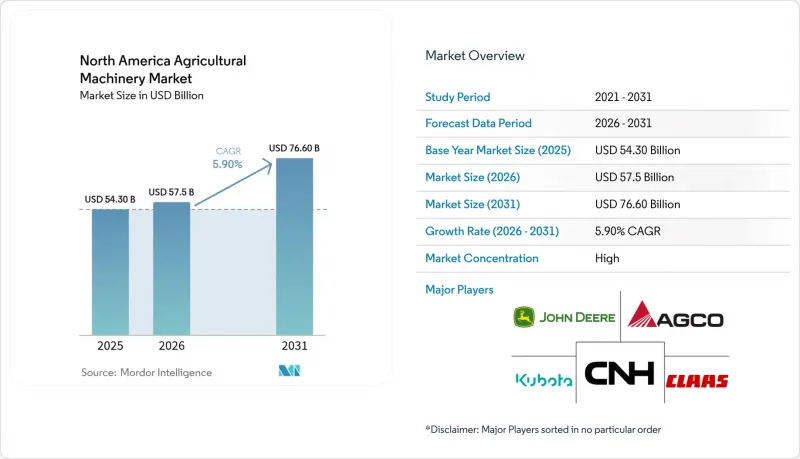
Mordor Intelligence에 따르면 북미의 농업기계 시장 규모는 2025년 543억 달러, 2026년 575억 달러에서 2031년까지 766억 달러로 확대될 것으로 예측되며, 2026년부터 2031년까지 연평균 성장률(CAGR)은 5.90%가 될 전망입니다.
본 보고서는 종류별(트랙터, 농업용 기기, 관개 기계, 수확 기계, 건초·사료용 기계, 기타) 및 지역별(미국, 캐나다, 멕시코, 기타 북미 국가)로 분류되어 있습니다. 시장 예측은 금액(달러)으로 표시되어 있습니다.
북미 농업기계 시장의 동향 및 인사이트
견조한 농업 소득 전망과 보조금 프로그램
농작물 수입이 감소 추세를 보이고 있음에도 불구하고, 연방 정부의 지원 프로그램이 계속해서 농업기계 수요를 뒷받침하고 있습니다. 2022년 3월, 캐나다 정부는 농업기계의 혁신과 기술에 투자하고, 설비 투자를 유지하는 데 있어 공공 자금의 역할을 강화했습니다. 기후 변화 대책에 중점을 둔 배분을 포함한 정부의 직접 지급은 농산물 가격이 하락하고 있음에도 불구하고, 생산자가 투자를 유지할 수 있도록 완충재 역할을 해왔습니다. 농업법(Farm Bill)에서는 작물 보험에 대한 보조금이 연장되었으며, 질소 유출을 줄이는 정밀 농업용 장비에 대한 대상별 보조금이 도입되었습니다. 이를 통해 GPS 유도식 파종기나 가변 시비기의 실질 비용이 낮아졌습니다. 캐나다 역시 프레리 지역 생산자의 소득을 안정화시키는 프로그램을 통해 유사한 추세를 보이고 있습니다. 한편, 멕시코의 경우 소규모 농가의 기계화에 막대한 자금이 배정되어 주요 농업 주들이 특히 큰 혜택을 보고 있습니다. 보조금을 통한 자금 사정 개선으로 농가들이 오래된 트랙터를 정밀 농업용 차량으로 교체함에 따라 교체 주기가 단축되고 있습니다.
심화되는 인력 부족과 임금 상승
농업 노동 시장은 급격히 위축되고 있으며, 많은 생산자들이 인력 확보를 가장 큰 제약요인으로 꼽고 있습니다. 농장의 평균 임금은 계속 상승하고 있는 반면, 계절 근로자 비자 심사 지연으로 인해 채용까지 걸리는 기간이 길어지고 있습니다. 미국 농업기계공업협회(AEM)에 따르면, 사륜구동 트랙터의 판매 대수는 2022년 3,466대에서 2023년 4,564대로 31.7% 증가했으며, 이는 노동력 부족을 보완하기 위한 기계화 도입이 진행되고 있음을 반영합니다. 이러한 임금 상승 압력은 채소 수확, 과수원 관리, 가축 관리와 같은 노동 집약적 분야에 특히 큰 영향을 미치고 있으며, 자율주행 트랙터, 제초 로봇, 자가 주행 사료 수확기의 도입을 촉진하고 있습니다. 캐나다도 유사한 제약에 직면해 있어, 각 주에서는 수확기에 작업 인력을 유치하기 위한 장려책을 마련하고 있지만, 멕시코에서는 농촌에서 도시로의 인구 유출로 인해 기존의 노동력 기반이 점차 사라지고 있습니다. 협동조합은 자금을 모아 기계를 공동으로 도입하고 있으며, 중규모 농업 경영에 있어 기계화는 생존을 위한 필수 조건이 되고 있습니다.
첨단 농업기계의 높은 초기 비용과 유지비
트랙터, 파종기, 콤바인의 가격 급등은 생산자, 특히 소규모 농가에게 큰 재정적 압박을 가하고 있습니다. 최신 정밀 농업용 장비는 구입 가격이 비싼 데다, 소프트웨어 구독료와 고가의 교체 부품으로 인한 유지비가 추가적인 부담이 되고 있습니다. 소규모 농가에게는 보조금이 포함된 대출이 없다면, 소형 기계조차 감당하기 어려울 정도로 비싸질 수 있습니다. 그 결과, 광대한 경작 면적에서 비용을 분산할 수 있는 대규모 농장과 투자 타당성 확보에 어려움을 겪는 소규모 생산자 간의 기술 격차가 확대되고 있습니다. 이러한 상황으로 인해 효율화 및 정밀 농업의 이점을 통해 투자 회수가 가능한 대규모 농장을 중심으로 시장 성장이 집중되고 있습니다.
부문 분석
기종별로 보면 2025년 북미 농업기계 시장 규모에서 트랙터는 47.3%의 시장 점유율을 차지했습니다. 트랙터는 다양한 농업 시스템에서 필수적인 역할을 수행하고 있으며, 여전히 파종 작업의 기반이 되고 있습니다. 미국 농업기계 제조업체 협회(AEM)에 따르면, 2022년부터 2023년까지 100 HP 이상의 트랙터 및 4WD 트랙터의 소매 판매 대수는 각각 5.2%와 31.7% 증가했습니다. 이 부문은 철저한 실증 시험을 통해 실제 가동 시간이 입증되었으며, 무인 경작에 대한 회의적인 시각이 누그러진 자율주행 기술 개선의 혜택을 받고 있습니다. 이러한 혁신을 통해 트랙터는 효율성과 생산성을 향상시키는 정밀 기술을 통합하며 기계화의 핵심적인 역할을 담당하고 있음이 부각되고 있습니다. 이러한 우위는 농장이 다양한 작업을 수행할 수 있는 다목적 장비를 계속해서 우선시하는 동시에, 연결성과 운영 제어를 강화하는 새로운 디지털 플랫폼에도 지속적으로 적응하고 있음을 보여줍니다.
관개 기계는 2026년부터 2031년까지 연평균 성장률(CAGR) 6.4%를 기록하며 가장 높은 성장률을 보일 것으로 예측됩니다. 북미 전역에서 물 부족 완화 프로젝트가 확대됨에 따라 관개 설비에 대한 수요가 증가세를 보이고 있으며, 멕시코에서는 센터 피벗 방식으로의 전환이 진행되어 도입이 가속화되고 있습니다. 이 부문은 지속가능한 물 관리와 기후 변화에 대한 내성에 대한 수요에 힘입어 다른 카테고리를 상회하는 성장이 예상됩니다. 정밀 관개 시스템은 디지털 모니터링 도구와의 통합이 진행되고 있어, 농가들은 수확량을 유지하면서 물 사용을 최적화할 수 있게 되었습니다. 이러한 성장 추세는 관개 기계가 단순한 보조 기능에서 전략적 투자로 진화하며, 농업기계 수요에서 가장 활기찬 분야 중 하나로 자리매김하고 있음을 반영합니다.
기타 혜택:
- 엑셀 형식의 시장 예측(ME) 시트
- 3개월간의 애널리스트 지원
자주 묻는 질문
목차
제1장 소개
제2장 조사 방법
제3장 주요 요약
제4장 시장 구도
제5장 시장 규모와 성장 예측
제6장 경쟁 구도
제7장 시장 기회와 향후 전망
KSM 26.09.02According to Mordor Intelligence, the North America agricultural machinery market size is projected to expand from USD 54.3 billion in 2025 and USD 57.5 billion in 2026 to USD 76.6 billion by 2031, registering a 5.90% CAGR between 2026 to 2031.
This report is Segmented by Type (Tractor, Equipment, Irrigation Machinery, Harvesting Machinery, Haying and Forage Machinery, and Other Types) and by Geography (United States, Canada, Mexico, and Rest of North America). The Market Forecasts are Provided in Terms of Value (USD).
North America Agricultural Machinery Market Trends and Insights
Robust Farm-Income Outlook and Subsidy Programs
Federal support programs continue to underpin machinery demand even as crop receipts soften. In March 2022, the Government of Canada invested in agricultural machinery innovation and technology, reinforcing the role of public funding in sustaining capital expenditure. Direct government payments, including climate-focused allocations, have provided a cushion that allowed producers to maintain investment despite lower crop prices. The Farm Bill extended crop insurance subsidies and introduced targeted grants for precision equipment that reduce nitrogen runoff, lowering the effective cost of GPS-guided planters and variable-rate spreaders. Canada mirrors this pattern through programs that stabilized income for prairie growers, while Mexico's initiatives allocated significant funding to smallholder mechanization, disproportionately benefiting key agricultural states. Subsidy-driven liquidity compresses replacement cycles, as operators trade in older tractors for precision-ready fleets.
Rising Labor Scarcity and Wage Inflation
Agricultural labor markets have tightened sharply, with many producers ranking workforce availability as their primary constraint. Average farm wages have continued to climb, while seasonal visa processing delays have extended hiring timelines. According to the Association of Equipment Manufacturers (AEM), sales of 4WD tractors increased by 31.7%, from 3,466 units in 2022 to 4,564 in 2023, reflecting the increasing adoption of mechanization to offset labor shortages. This wage pressure disproportionately affects labor-intensive segments such as vegetable harvesting, orchard management, and livestock handling, driving adoption of autonomous tractors, robotic weeders, and self-propelled forage harvesters. Canada faces parallel constraints, with provinces offering incentives to attract operators during harvest, while Mexico's rural-to-urban migration is eroding the traditional labor pool. Cooperatives are pooling capital for shared machinery fleets, making mechanization a survival imperative for mid-sized operations.
High Upfront and Maintenance Costs of Advanced Machinery
The rising cost of tractors, planters, and combines has placed significant financial pressure on producers, particularly smaller operators. Modern precision equipment carries high purchase prices, while maintenance expenses add further strain through software subscriptions and premium replacement parts. For smallholders, even compact machinery can be prohibitively expensive without subsidized financing. The result is a widening technology gap between large-scale farms, which can spread costs across extensive acreage, and smaller producers, who struggle to justify investments. This dynamic concentrates market growth among larger operations that can achieve payback through efficiency gains and precision farming benefits.
Other drivers and restraints analyzed in the detailed report include:
- Precision-Agriculture Adoption Accelerating Equipment Replacement
- Climate-Smart Grants Driving Low-Emission Equipment
- Volatile Commodity Prices Curbing Capital Expenditure (CapEx) Cycles
For complete list of drivers and restraints, kindly check the Table Of Contents.
Segment Analysis
By type, tractors accounted for market share of 47.3% of the North America agricultural machinery market size in 2025. Tractors remain the backbone of crop operations, reflecting their indispensable role across diverse farming systems. According to the Association of Equipment Manufacturers (AEM), retail sales of tractors above 100 HP and 4WD tractors increased by 5.2% and 31.7% respectively from 2022 to 2023. The segment benefits from autonomous retrofits that have been tested extensively, validating real-world uptime and reducing skepticism about driverless tillage. These innovations highlight tractors as the central hub of mechanization, integrating precision technologies that improve efficiency and productivity. Their dominance underscores how farms continue to prioritize versatile equipment capable of handling multiple tasks, while also adapting to new digital platforms that enhance connectivity and operational control.
Irrigation machinery is projected to post the fastest 6.4% CAGR from 2026 to 2031. Irrigation equipment is gaining momentum as water-scarcity mitigation projects expand across North America, with center-pivot conversions accelerating adoption in Mexico. This segment is anticipated to outpace other categories, driven by the need for sustainable water management and climate resilience. Precision irrigation systems are increasingly integrated with digital monitoring tools, enabling farmers to optimize water use while maintaining yields. The growth trajectory reflects how irrigation machinery is evolving from a support function into a strategic investment, positioning itself as one of the most dynamic areas of agricultural equipment demand.
Complete Report Scope:
- By Type
- Tractor
- Less Than 40 HP
- 40 to 100 HP
- More than 100 HP
- 4WD Tractors
- Equipment
- Plows
- Harrows
- Cultivators and Tillers
- Other Equipment
- Irrigation Machinery
- Sprinkler
- Drip
- Other Irrigation
- Harvesting Machinery
- Combine Harvesters
- Forage Harvesters
- Other Harvesting
- Haying and Forage Machinery
- Mowers
- Balers
- Other Haying and Forage
- Other Types
- Tractor
- By Geography
- United States
- Canada
- Mexico
- Rest of North America
List of Companies Covered in this Report:
- Deere & Company
- CNH Industrial N.V.
- AGCO Corporation
- Kubota Corporation
- CLAAS KGaA mbH
- Mahindra & Mahindra Limited
- Netafim Inc.
- Lindsay Corporation
- Trimble Inc.
- Horsch Maschinen GmbH
- KUHN SAS
- Bernard Krone Holding SE & Co. KG
- The Toro Company
- Vermeer Corporation
- J.C. Bamford Excavators Ltd.
Additional Benefits:
- The market estimate (ME) sheet in Excel format
- 3 months of analyst support
TABLE OF CONTENTS
1 Introduction
- 1.1 Study Assumptions and Market Definition
- 1.2 Scope of the Study
2 Research Methodology
3 Executive Summary
4 Market Landscape
- 4.1 Market Overview
- 4.2 Market Drivers
- 4.2.1 Robust farm-income outlook and subsidy programs
- 4.2.2 Rising labor scarcity and wage inflation
- 4.2.3 Precision-agriculture adoption accelerating equipment replacement
- 4.2.4 Original Equipment Manufacturer (OEM) embedded-finance boosting purchasing power
- 4.2.5 Subscription-based machinery access models
- 4.2.6 Climate-Smart grants driving low-emission equipment
- 4.3 Market Restraints
- 4.3.1 High upfront and maintenance costs of advanced machinery
- 4.3.2 Volatile commodity prices curbing capital expenditure (CapEx) cycles
- 4.3.3 Interest-rate-driven credit tightening at the farm level
- 4.3.4 Battery-grade semiconductor supply constraints for e-tractors
- 4.4 Regulatory Landscape
- 4.5 Technological Outlook
- 4.6 Porter's Five Forces
- 4.6.1 Bargaining Power of Suppliers
- 4.6.2 Bargaining Power of Buyers
- 4.6.3 Threat of New Entrants
- 4.6.4 Threat of Substitute Products
- 4.6.5 Intensity of Competitive Rivalry
5 Market Size and Growth Forecasts (Value)
- 5.1 By Type
- 5.1.1 Tractor
- 5.1.1.1 Less Than 40 HP
- 5.1.1.2 40 to 100 HP
- 5.1.1.3 More than 100 HP
- 5.1.1.4 4WD Tractors
- 5.1.2 Equipment
- 5.1.2.1 Plows
- 5.1.2.2 Harrows
- 5.1.2.3 Cultivators and Tillers
- 5.1.2.4 Other Equipment
- 5.1.3 Irrigation Machinery
- 5.1.3.1 Sprinkler
- 5.1.3.2 Drip
- 5.1.3.3 Other Irrigation
- 5.1.4 Harvesting Machinery
- 5.1.4.1 Combine Harvesters
- 5.1.4.2 Forage Harvesters
- 5.1.4.3 Other Harvesting
- 5.1.5 Haying and Forage Machinery
- 5.1.5.1 Mowers
- 5.1.5.2 Balers
- 5.1.5.3 Other Haying and Forage
- 5.1.6 Other Types
- 5.1.1 Tractor
- 5.2 By Geography
- 5.2.1 United States
- 5.2.2 Canada
- 5.2.3 Mexico
- 5.2.4 Rest of North America
6 Competitive Landscape
- 6.1 Market Concentration
- 6.2 Strategic Moves
- 6.3 Market Share Analysis
- 6.4 Company Profiles (Includes Global Level Overview, Market Level Overview, Core Segments, Financials as Available, Strategic Information, Market Rank/Share for Key Companies, Products and Services, and Recent Developments)
- 6.4.1 Deere & Company
- 6.4.2 CNH Industrial N.V.
- 6.4.3 AGCO Corporation
- 6.4.4 Kubota Corporation
- 6.4.5 CLAAS KGaA mbH
- 6.4.6 Mahindra & Mahindra Limited
- 6.4.7 Netafim Inc.
- 6.4.8 Lindsay Corporation
- 6.4.9 Trimble Inc.
- 6.4.10 Horsch Maschinen GmbH
- 6.4.11 KUHN SAS
- 6.4.12 Bernard Krone Holding SE & Co. KG
- 6.4.13 The Toro Company
- 6.4.14 Vermeer Corporation
- 6.4.15 J.C. Bamford Excavators Ltd.