
|
시장보고서
상품코드
2121272
유럽의 계약 포장 : 시장 점유율 분석, 업계 동향과 통계, 성장 예측(2026-2031년)Europe Contract Packaging - Market Share Analysis, Industry Trends & Statistics, Growth Forecasts (2026 - 2031) |
||||||
 Mordor Intelligence
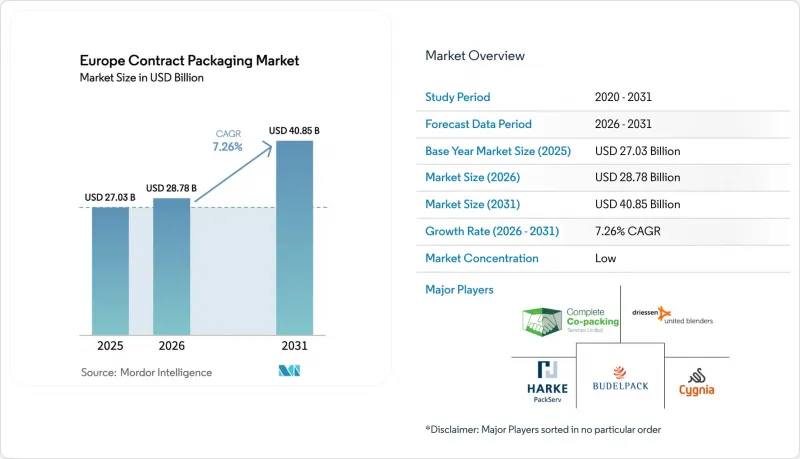
Mordor Intelligence에 의하면, 유럽 수탁 포장 시장 규모는 2025년 270억 3,000만 달러에서 2026년에는 287억 8,000만 달러로 확대되어 2031년까지 408억 5,000만 달러에 이를 것으로 예상되고 있어 2026-2031년 CAGR 7.26%를 기록할 전망입니다.
본 보고서는 서비스 유형(1차 포장, 2차 포장, 3차 포장), 포장 형태(경질 포장, 연질 포장), 기술(기존 수동 라인, 반자동 라인, 완전 자동/로봇 대응 라인), 최종 사용자 산업(식품, 의약품 등), 국가별로 분류되어 있습니다. 시장 전망은 금액(달러) 기준으로 제시되어 있습니다.
유럽 위탁 포장 시장 동향 및 인사이트
전자상거래 주문 처리량 증가
식료품, 건강 보조제, 고급 음료가 직배송 모델로 전환됨에 따라 2025년 한 해 동안 온라인 소매 소포 발송량이 급증했습니다. ‘피킹, 충전, 출하’ 서비스를 제공하는 위탁 포장 업체들은 주문 건수가 두 자릿수 성장을 기록했으며, 이에 따라 상자 크기를 표준화하거나, 주문형 라벨 인쇄기를 도입하거나, 최종 공정에서 맞춤화를 위한 셀을 추가하는 움직임이 나타났습니다. 중견 기업들은 계절적 유연성 확보와 설비 투자 회피를 이유로 자체 생산 라인 구축 대신 외부 위탁을 선택했습니다. 소포 처리 속도가 향상됨에 따라 운송업체의 규정 준수를 유지하기 위해서는 자동 계량·검사·라벨 부착 모듈이 필수적입니다. 독일, 네덜란드, 프랑스의 소포 분류 센터 근처에 거점을 둔 공급업체들은 라스트 마일 요금 절감이라는 혜택을 누리고 있습니다.
DTC 브랜드의 급증
2025년에는 480개 이상의 신규 DTC 브랜드가 지역별 온라인 상점을 개설하여 건강, 미용, 친환경 홈케어와 같은 틈새 시장을 공략했습니다. 이 창업자들은 소량 조립이 필요한 가변 수량의 골판지 상자나 인플루언서용 키트를 선호하며, 여기에는 키트 조립 설명서나 QR 코드가 포함된 삽입물이 동봉됩니다. 2차 포장, 주문 처리, 반품 처리를 통합할 수 있는 위탁 포장 업체는 정기적인 상품 재진열을 포함한 다년 계약을 수주했습니다. 구독 박스 큐레이터들 역시 삽입물 인쇄 및 데이터 기반 개인화에 대한 수요를 가속화했으며, 그 결과 소량 주문의 리드타임은 3일 이하로 단축되었습니다. 사모펀드의 자금 유입이 이러한 출시 주기를 뒷받침하는 가운데, 실시간 주문 현황 API를 통합한 코패커 기업들은 재주문 점유율을 확보하고 있습니다.
EU의 엄격한 ‘포장 폐기물 지침’ 목표
개정된 지침에 따르면, 생산자는 2030년까지 1인당 포장 폐기물을 15% 감축하고 재활용률 65%를 달성해야 합니다. 이러한 의무로 인해 브랜드들은 과잉 포장을 줄이게 되었고, 그 결과 계약 포장업체를 거치는 물량이 직접적으로 감소하고 있습니다. 또한, 향후 도입될 에코모듈레이션 요금으로 인해 재활용이 불가능한 형태에 요금이 부과됨에 따라, 공동 포장 업체들은 신축 허용도가 제한된 새로운 기재나 더 얇은 두께에 대응할 수 있도록 설비를 재조정해야만 합니다. 규정 준수 감시 및 보고는 특히 중소규모 시설에서 관리상의 부담을 가중시키고 있습니다. 이 규정은 혁신을 가속화하는 한편, 컨버터가 재활용 소재 함유율에 대한 확정된 사양을 기다리는 동안 투자를 지연시키는 요인이 되기도 합니다.
부문 분석
2차 포장은 2025년 유럽 위탁 포장 시장 점유율의 41.23%를 차지하며 가장 높은 조립량을 기록했습니다. 이러한 우위는 바코드가 부착된 상자, 보안 씰, 판촉용 오버랩에 대한 소매업체 및 전자상거래 사업자의 지속적인 수요를 반영합니다. 2026년에는 브랜드 포트폴리오의 SKU 수가 증가함에 따라 자동 카톤 포장 및 수축 밴딩 시스템에 대한 수요가 계속 높아질 것으로 예측됩니다. 2차 포장 워크플로는 정기적인 수주, 높은 노동 집약성, 그리고 최종 단계에서의 패키지 차별화 여지가 있어 여전히 매력적인 분야입니다. 각 공급업체는 라인의 유연성을 강화하고 있으며, 30분 이내에 형식을 전환할 수 있는 로봇식 픽 앤 플레이스 장비를 추가 장착하여 여러 고객을 지원하는 홀에서 운영이 가능하도록 하고 있습니다.
팔레타이징 및 스트레치 후드 포장을 포함한 3차 공정은 연평균 성장률(CAGR) 8.34%로, 다른 모든 서비스 계층을 상회하는 성장이 예상됩니다. 이러한 상승 추세는 통합형 창고 관리의 보급 확대 및 옴니채널 소매업체가 선호하는 혼합 SKU 팔레트 구성으로의 전환과 일치합니다. 비전 가이드 툴링을 갖춘 로봇 구동 팔레트 셀은 생산성 향상과 작업 환경 개선을 지원합니다. 위탁 포장 업체들은 가동 중단 시간을 줄여주는 예측 유지보수 대시보드를 판매하고 있으며, 적시(JIT) 보충 압박에 시달리는 소비재(FMCG) 고객들에게 어필하고 있습니다. 그 결과, 3차 물류 처리량이 사내 물류의 점유율을 서서히 잠식할 것으로 예상되며, 이는 전문 풀필먼트 파트너를 선호하는 유럽 위탁 포장 시장의 추세를 더욱 강화할 것입니다.
2025년 유럽의 계약 포장 시장 규모에서 유리병, 알루미늄 캔, 고밀도 폴리에틸렌(HDPE) 용기 등의 경질 용기가 52.32%의 점유율을 차지하며 시장을 주도했습니다. 음료 충전, 퍼스널케어 제품 병입, 의약품 블리스터 포장은 제품 보호와 투여 정확도 확보를 위해 경질 용기 시스템에 의존하고 있습니다. 클린룸이나 저온 충전 인프라를 보유한 위탁 포장 업체는 진입 장벽이 높아 안정적인 처리량을 유지하고 있습니다. 또한, 독일의 반환형 유리병 순환 시스템 덕분에 충전 라인의 가동률이 향상되고 있습니다. 브랜드 소유주들은 프리미엄화 및 폐쇄형 순환 체계 내에서의 실제 재활용 가능성과 인식되는 재활용 가능성을 이유로 여전히 경질 포장을 선호하고 있습니다.
반면, 유연 소재는 가장 빠르게 성장하는 부문이 될 전망이며, 2026년부터 2031년까지 연평균 성장률(CAGR) 8.84%로 확대될 것으로 예측됩니다. 재밀봉 가능한 파우치, 스탠드업 스파우트, 사셰는 재료 사용량과 운송 중량을 줄여 소매업체의 지속가능성 평가 기준을 충족합니다. 산성 식품 및 의약품 분말에 대한 이온 이동 안전성을 인증받은 필름을 취급하는 위탁 포장 업체들은 수년에 걸친 수주를 확보하고 있습니다. 디지털 파우치 인쇄의 도입으로 지역 및 언어의 차이에 따른 소량 생산이 가능해져, 유연한 마케팅 프로그램이 강화되고 있습니다. 따라서 연포장재 시장 점유율은 경질 포장재와의 격차를 좁힐 것으로 예측되며, 유럽의 전체 위탁 포장 시장에서 다양화가 더욱 진행될 것으로 전망됩니다.
기타 혜택:
- 엑셀 형식 시장 예측(ME) 시트
- 3개월간의 애널리스트 지원
자주 묻는 질문
목차
제1장 서론
제2장 조사 방법
제3장 주요 요약
제4장 시장 구도
제5장 시장 규모와 성장 예측
제6장 경쟁 구도
제7장 시장 기회와 향후 전망
LSH 26.09.08According to Mordor Intelligence, the Europe contract packaging market size is expected to increase from USD 27.03 billion in 2025 to USD 28.78 billion in 2026 and reach USD 40.85 billion by 2031, growing at a CAGR of 7.26% over 2026-2031.
This report is Segmented by Service Type (Primary Packaging, Secondary Packaging, and Tertiary Packaging), Packaging Format (Rigid Packaging, and Flexible Packaging), Technology (Conventional Manual Lines, Semi-Automated Lines, and Fully Automated/Robotics-Enabled Lines), End-User Industry (Food, Pharmaceuticals, and More), and Country. The Market Forecasts are Provided in Terms of Value (USD).
Europe Contract Packaging Market Trends and Insights
Rising E-commerce Fulfilment Volumes
Online retail parcels jumped throughout 2025 as grocery, health supplements, and premium beverages migrated to direct shipment models. Contract packers that offer pick, fill, and ship services witnessed double-digit order growth, prompting them to standardize box sizes, install print-on-demand labelers, and add late-stage customization cells. Medium enterprises opted to outsource instead of building captive lines, citing the need for seasonal flexibility and avoiding capital outlay. Higher parcel velocity has made automated weigh-check-label modules essential for maintaining carrier compliance. Providers located near parcel sortation centers in Germany, the Netherlands, and France are benefiting from lower last-mile fees.
Proliferation of DTC Brands
More than 480 new DTC labels opened regional web shops in 2025, targeting niche markets in health, beauty, and eco-friendly home care. These founders prefer variable-count cartons and influencer kits that must be assembled in small batches, accompanied by kitting instructions and QR-enabled inserts. Contract packers able to combine secondary packaging, fulfillment, and returns handling gained multi-year contracts that include periodic product restaging. Subscription-box curators also accelerated demand for insert printing and data-driven personalization, resulting in lead times of three days or less for short runs. As private-equity inflows sustain this launch cycle, co-packers that embed real-time order-status APIs are capturing repeat volumes.
Stringent EU Packaging Waste Directive Targets
The revised directive requires producers to reduce packaging waste by 15% per capita by 2030 and to achieve 65% recycling rates. Such mandates prompt brands to reduce over-packaging, thereby directly reducing the volume flowing through contract packers. Additionally, forthcoming eco-modulation fees penalize non-recyclable formats, forcing co-packers to requalify equipment for new substrates and thinner gauges with limited stretch tolerance. Compliance monitoring and reporting add administrative overhead, especially for small and mid-size facilities. While the rule accelerates innovation, it simultaneously delays investment as converters await definitive specifications for recycled content.
Other drivers and restraints analyzed in the detailed report include:
- Retailer Shift to Shelf-Ready Packaging Formats
- Growth of Sustainable Mono-Material Substrates
- Rising Labour Costs in Western Europe
For complete list of drivers and restraints, kindly check the Table Of Contents.
Segment Analysis
Secondary packaging generated the highest volume of assemblies, capturing 41.23% of the Europe contract packaging market share in 2025. The dominance reflects ongoing retailer and e-commerce requirements for bar-coded cartons, security seals, and promotional over-wraps. In 2026, demand for automated cartoning and shrink bundling systems continues to climb as brand portfolios expand their SKU counts. Secondary workflows remain attractive due to recurring orders, high labor content, and the scope for late-stage pack differentiation. Providers are bolstering line flexibility, retrofitting robotic pick-and-place units that switch formats within 30 minutes to serve multi-client halls.
Tertiary operations, encompassing palletizing and stretch-hooding, are forecast to outpace all other service tiers with an 8.34% CAGR. The upswing aligns with wider adoption of integrated warehouse management and the transition to mixed-SKU pallet configurations favored by omnichannel retailers. Robotics-enabled pallet cells equipped with vision-guided tooling support higher output and ergonomic relief. Contract packers are marketing predictive-maintenance dashboards that lower downtime, appealing to fast-moving consumer goods customers under just-in-time restock pressure. Consequently, tertiary volumes are expected to chip away at in-house logistics, reinforcing the Europe contract packaging market narrative of specialized fulfillment partners.
Rigid formats, including glass bottles, aluminum cans, and high-density polyethylene jugs, led with a 52.32% share of the Europe contract packaging market size in 2025. Beverage filling, personal-care bottling, and pharma blistering rely on rigid systems due to product protection and dosing accuracy. Co-packers owning clean-room and cold-fill infrastructure enjoy high barriers to entry, leading to steady throughput. Moreover, returnable glass loops in Germany expand bottling line utilization. Brand owners remain keen on rigid packs for premiumization as well as real and perceived recyclability in closed loops.
Conversely, flexible substrates are set to be the fastest-growing category, advancing at an 8.84% CAGR during 2026-2031. Re-closable pouches, stand-up spouts, and sachets reduce material usage and shipping weight, appealing to retailers' sustainability scorecards. Contract packers that certify migration-safe films for acidic foods and pharma powders are landing multi-year volumes. Integration of digital pouch printing allows shorter runs tied to geographic and language variations, bolstering agile marketing programs. Thus, flexible share is predicted to narrow the gap with rigid formats, reinforcing diversification across the Europe contract packaging market.
Complete Report Scope:
- By Service Type
- Primary Packaging
- Bottling and Filling
- Pouching
- Canning
- Blister Packaging
- Other Primary Packaging
- Secondary Packaging
- Cartoning
- Labeling
- Shrink Wrapping
- Other Secondary Packaging
- Tertiary Packaging
- Palletizing
- Bundling
- Other Tertiary Packaging
- Primary Packaging
- By Packaging Format
- Rigid Packaging
- Flexible Packaging
- By Technology
- Conventional Manual Lines
- Semi-Automated Lines
- Fully Automated / Robotics-Enabled Lines
- By End-user Industry
- Beverages
- Food
- Pharmaceuticals
- Cosmetics and Personal Care
- Other End-user Industries
- By Country
- United Kingdom
- Germany
- France
- Italy
- Spain
- Netherlands
- Rest of Europe
List of Companies Covered in this Report:
- Budelpack Poortvliet BV
- Cygnia Logistics Ltd
- Complete Co-Packing Services Ltd
- Driessen United Blenders BV
- Harke PackServ GmbH
- Kompak Co-Making and Co-Packing
- Marvinpac SA
- NOMI Co-Packing
- Boughey Distribution Ltd
- Total Pack BV
- DHL Supply Chain
- Staci Group
- Sonoco Display and Packaging
- WePack Ltd
- Flexicon Europe Ltd
- MSK Pharmalogistic GmbH
- Groupe LPR (Logistic Packaging Resources)
- Famar SA
- PharmaPac UK Ltd
- Tjoapack Netherlands BV
Additional Benefits:
- The market estimate (ME) sheet in Excel format
- 3 months of analyst support
TABLE OF CONTENTS
1 INTRODUCTION
- 1.1 Study Assumptions and Market Definition
- 1.2 Scope of the Study
2 RESEARCH METHODOLOGY
3 EXECUTIVE SUMMARY
4 MARKET LANDSCAPE
- 4.1 Market Overview
- 4.2 Market Drivers
- 4.2.1 Rising E-commerce Fulfilment Volumes
- 4.2.2 Proliferation of DTC (Direct-to-Consumer) Brands
- 4.2.3 Retailer Shift to Shelf-Ready Packaging Formats
- 4.2.4 Growth of Sustainable Mono-Material Substrates
- 4.2.5 Adoption of Digital Printing for Short-Runs
- 4.2.6 Near-shoring of Supply Chains Post-Brexit
- 4.3 Market Restraints
- 4.3.1 Stringent EU Packaging Waste Directive Targets
- 4.3.2 Rising Labour Costs in Western Europe
- 4.3.3 Competition from In-house Packaging Operations
- 4.3.4 Limited Access to Recycled PCR Material
- 4.4 Industry Value Chain Analysis
- 4.5 Regulatory Landscape
- 4.6 Porter's Five Forces Analysis
- 4.6.1 Bargaining Power of Suppliers
- 4.6.2 Bargaining Power of Buyers
- 4.6.3 Threat of New Entrants
- 4.6.4 Threat of Substitutes
- 4.6.5 Intensity of Competitive Rivalry
- 4.7 Impact of Macroeconomic Factors on the Market
5 MARKET SIZE AND GROWTH FORECASTS (VALUE)
- 5.1 By Service Type
- 5.1.1 Primary Packaging
- 5.1.1.1 Bottling and Filling
- 5.1.1.2 Pouching
- 5.1.1.3 Canning
- 5.1.1.4 Blister Packaging
- 5.1.1.5 Other Primary Packaging
- 5.1.2 Secondary Packaging
- 5.1.2.1 Cartoning
- 5.1.2.2 Labeling
- 5.1.2.3 Shrink Wrapping
- 5.1.2.4 Other Secondary Packaging
- 5.1.3 Tertiary Packaging
- 5.1.3.1 Palletizing
- 5.1.3.2 Bundling
- 5.1.3.3 Other Tertiary Packaging
- 5.1.1 Primary Packaging
- 5.2 By Packaging Format
- 5.2.1 Rigid Packaging
- 5.2.2 Flexible Packaging
- 5.3 By Technology
- 5.3.1 Conventional Manual Lines
- 5.3.2 Semi-Automated Lines
- 5.3.3 Fully Automated / Robotics-Enabled Lines
- 5.4 By End-user Industry
- 5.4.1 Beverages
- 5.4.2 Food
- 5.4.3 Pharmaceuticals
- 5.4.4 Cosmetics and Personal Care
- 5.4.5 Other End-user Industries
- 5.5 By Country
- 5.5.1 United Kingdom
- 5.5.2 Germany
- 5.5.3 France
- 5.5.4 Italy
- 5.5.5 Spain
- 5.5.6 Netherlands
- 5.5.7 Rest of Europe
6 COMPETITIVE LANDSCAPE
- 6.1 Market Concentration
- 6.2 Strategic Moves
- 6.3 Market Share Analysis
- 6.4 Company Profiles (Includes Global Level Overview, Market Level Overview, Core Segments, Financials as Available, Strategic Information, Market Rank/Share, Products and Services, and Recent Developments)
- 6.4.1 Budelpack Poortvliet BV
- 6.4.2 Cygnia Logistics Ltd
- 6.4.3 Complete Co-Packing Services Ltd
- 6.4.4 Driessen United Blenders BV
- 6.4.5 Harke PackServ GmbH
- 6.4.6 Kompak Co-Making and Co-Packing
- 6.4.7 Marvinpac SA
- 6.4.8 NOMI Co-Packing
- 6.4.9 Boughey Distribution Ltd
- 6.4.10 Total Pack BV
- 6.4.11 DHL Supply Chain
- 6.4.12 Staci Group
- 6.4.13 Sonoco Display and Packaging
- 6.4.14 WePack Ltd
- 6.4.15 Flexicon Europe Ltd
- 6.4.16 MSK Pharmalogistic GmbH
- 6.4.17 Groupe LPR (Logistic Packaging Resources)
- 6.4.18 Famar SA
- 6.4.19 PharmaPac UK Ltd
- 6.4.20 Tjoapack Netherlands BV
7 MARKET OPPORTUNITIES AND FUTURE OUTLOOK
- 7.1 White-space and Unmet-Need Assessment