
|
시장보고서
상품코드
2124286
계약 포장 및 풀필먼트 서비스 시장 : 시장 점유율 분석, 업계 동향 및 통계, 성장 예측(2026-2031년)Contract Packaging And Fulfillment Service - Market Share Analysis, Industry Trends & Statistics, Growth Forecasts (2026 - 2031) |
||||||
 Mordor Intelligence
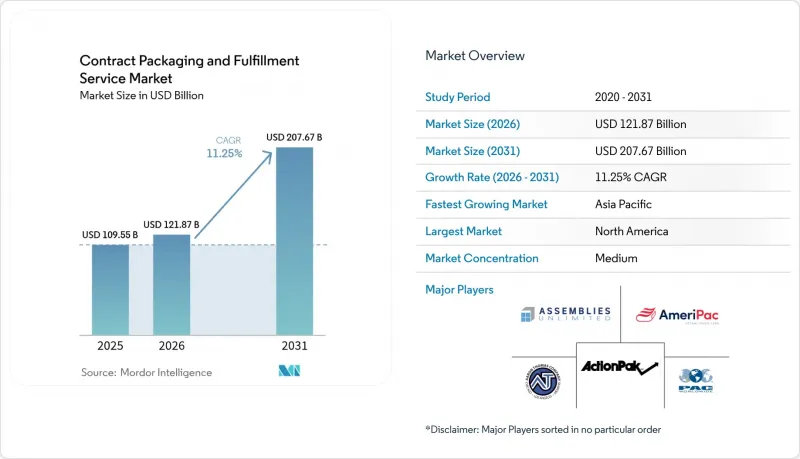
Mordor Intelligence에 의하면, 계약 포장 및 풀필먼트 서비스 시장 규모는 2025년에 1,095억 5,000만 달러로 평가되었고, 2026년 1,218억 7,000만 달러에서 2031년까지 2,076억 7,000만 달러에 이를 것으로 예측되며, 예측 기간(2026-2031년) CAGR은 11.25%를 나타낼 전망입니다.
본 보고서는 포장 재료별(종이 및 판지, 플라스틱, 기타), 서비스 유형별(포장 디자인·시제품 제작, 위탁 포장, 포장 검사, 기타), 최종 사용자별(식품, 음료, 의약품, 기타), 풀필먼트 채널별(B2C 전자상거래, B2B 유통, 소매 재고 보충), 지역별로 분류되어 있습니다. 시장 전망은 금액(달러) 기준으로 제시되어 있습니다.
세계의 계약 포장 및 풀필먼트 서비스 시장 동향과 인사이트
비용 최적화를 위한 비핵심 업무의 아웃소싱
제조업체들은 제한된 자본을 제품 혁신에 집중하는 한편, 포장 라인을 고정 비용을 여러 고객에게 분산시키는 계약업체에 위탁하고 있습니다. 현재 일반적인 브랜드들은 기존의 사내 라인에서 24시간 가동되는 자동화된 멀티 클라이언트 시설로 전환함으로써 15-25%의 비용 절감을 실현하고 있습니다. 제약 기업들이 이러한 변화를 여실히 보여주고 있으며, 카탈렌트(Catalent)와 같은 공급업체들은 블리스터 포장 시리얼화, 콜드체인 조립, GMP 인증 라벨 부착에 대한 생산 능력을 확충하고 있습니다. 비용 절감 외에도 의사결정권자들은 책임 전가를 중요하게 여기고 있습니다. 전문 파트너가 리콜 위험을 부담하고, ISO 문서를 유지하며, 검증된 프로토콜에 따라 검사 장비의 교정을 수행합니다. 2024년 인플레이션에 따른 임금 급등은 이러한 계산을 더욱 가속화시키고 있으며, 사내 공장이 부담해야 하는 인건비, 공과금, 규정 준수 관련 제반 비용과 비교할 때 아웃소싱에 드는 추가 비용은 상대적으로 적게 보입니다. ERP(전사적 자원 관리) 플랫폼과 연동된 첨단 비용 모델링 소프트웨어를 통해 현재는 총 입고 비용 시나리오를 실시간으로 비교할 수 있게 되었으며, 대부분의 중규모 SKU에서 포장 아웃소싱이 재정적으로 더 나은 선택이라는 사실이 밝혀졌습니다.
즉석형 식음료에 대한 수요 증가
도시 지역 소비자들은 분량 관리, 가스 치환, 유통기한 보장이 요구되는 간편식, 밀키트, 1인분 스낵에 매력을 느끼고 있습니다. 2024년에는 즉석식품 카테고리가 18% 성장했으나, 판매 단위가 늘어날수록 기밀 밀봉,가스 치환 또는 레토르트 파우치가 필요해졌으나, 이를 사내에서 처리할 수 있는 브랜드 소유주는 거의 없었습니다. 위탁 포장 업체들은 클린룸 확장, 고속 성형·충진·밀봉 라인, 식품 안전 규제 당국의 요건을 충족하기 위한 실시간 미생물 모니터링을 도입하여 이에 대응했습니다. 방콕에서 호치민시에 이르는 아시아태평양 거점에서는 맞벌이 가구와 테이크아웃 상품을 선호하는 좁은 도시 주방이 주도적인 역할을 하며 가장 두드러진 급증을 보이고 있습니다. 한편, 유럽과 미국의 소매업체들은 알레르기 유발 물질 및 영양 성분에 대한 명확한 표시를 요구하고 있으며, 이에 따라 전문 인쇄업체들은 일련번호가 부여된 가변 데이터를 포장에 직접 인쇄할 수 있는 디지털 인쇄기를 도입하고 있습니다. 기능성 음료와 영양 보충용 구미 수요가 높아지는 가운데, 배리어 필름과 분량에 따른 블리스터 포장이 아웃소싱 수요를 더욱 끌어올리고 있습니다.
엄격한 확대 생산자 책임(EPR) 규제
개정된 유럽 법률에 따라 브랜드 소유자는 회수, 선별, 자원 회수 제도의 비용을 부담해야 할 의무가 있으며, 이로 인해 규정 준수 비용이 포장비의 3-5%를 추가로 부담하게 되었습니다. 수탁 포장업체는 팔레트 단위로 수지 식별 코드, 사용 후 제품 유래 재료 비율, 지리적 배송지 데이터를 파악해야 하며, 위반 시 벌금 부과 대상이 됩니다. 추적 기술인 RFID 태그나 블록체인 원장 도입에는 자본과 숙련된 규정 준수 담당 인력이 필요하지만, 소규모 공급업체는 자금 조달에 어려움을 겪고 있어 시장 점유율은 세계 기업으로 이동하고 있습니다. 미국 4개 주에서 시행되는 유사한 법규와 일본의 시범 프로그램으로 인해 관리상의 부담은 더욱 커지고 있습니다. 그 결과, 국경을 넘는 계약에는 감사 조항, 생애주기 평가(LCA) 결과물, 재활용 검증 등이 포함되면서 협상에 드는 간접비가 증가하고, 프로젝트 착수가 지연되고 있습니다. 비용에 민감한 고객의 경우, 고액의 EPR 수수료가 포장을 많이 사용하는 설계 개념을 재고하게 만드는 요인이 되며, 과징금 적용 등급을 낮출 수 있는 신소재가 등장하기 전까지는 아웃소싱되는 총량이 억제될 것입니다.
부문 분석
플라스틱 수지는 저비용, 가공성, 다양한 차단 성능에 힘입어 2025년에도 위탁 포장·풀필먼트 서비스 시장에서 54.63%의 점유율을 유지했습니다. 그러나 이 부문의 압도적인 지위는 일회용 플라스틱 금지나 재생 원료 함유율 할당 기준과 같은 규제상의 모니터링을 초래하고 있습니다. 수탁 포장 업체들은 향후 도입될 EPR 수수료의 단계별 구분에 부합하는 바이오 폴리에틸렌이나 퇴비화 가능한 폴리젖산 필름을 인증함으로써 리스크를 헤지하고 있습니다. 유리 및 금속 용기는 전통과 재활용성을 강조하는 프리미엄 음료 및 코스메슈티컬 분야에서 부활하고 있지만, 그 무거운 무게로 인해 배출량 목표 달성이 복잡해지고 있습니다. 판지는 전자상거래용 골판지 상자나 성형 섬유제 우편용 용기의 인기에 힘입어, 재생 가능 자원 조달과 가정 쓰레기 수거의 접점에 위치하고 있습니다. 2024년 수지 가격 상승으로 인해 브랜드 소유주들은 포장을 최적화해야 하는 상황에 직면하고 있으며, 경량화에 따른 내천자성을 예측하는 시뮬레이션 소프트웨어에 대한 수요가 증가하고 있습니다.
생분해성·퇴비화 가능한 카테고리는 2031년까지 연평균 성장률(CAGR) 13.22%가 예상되지만, 공급망의 제약은 여전히 남아 있습니다. 발효조 용량 부족, 원료 가격 변동, 폐기물 처리 인프라 미비는 이론상의 지속가능성 이점을 저해할 가능성이 있습니다. 이에 따라 위탁 포장 업체들은 사내에 실험실을 설치하고, 다양한 바이오폴리머 등급에 대해 밀봉 강도, 이원성, 유통 기한을 검사함으로써 식품 안전성을 훼손하지 않도록 보장하고 있습니다. 검사에 성공하면, 고객이 탄소 중립을 내세우는 제품을 요구하는 가운데 공급업체는 프리미엄 가격을 책정할 수 있게 됩니다. 한편, 바이오플라스틱으로는 아직 실현할 수 없는 방습성 블리스터 팩이 필요한 의약품 부문에서는 표준 플라스틱 등급이 여전히 필수적입니다. 따라서 그 발전 방향은 급격한 소재 대체가 아니라, 점진적인 두께 감소, 하이브리드 구조, 순환형 재활용 흐름이 융합된 형태가 될 것입니다.
2025년에는 위탁 포장이 매출의 44.78%라는 최대 점유율을 차지했으나, 가격에 대한 민감도와 자동화의 확산으로 인해 이익률은 압박을 받고 있습니다. 고객은 디자인 사고를 점점 더 중요시하게 되었으며, 공급업체는 소비자 심리, 매장 내 임팩트, 재사용 팁에 정통한 크리에이티브 스튜디오를 육성해야 할 압박을 받고 있습니다. 포장 디자인 및 시제품 제작은 연평균 성장률(CAGR) 12.6%를 나타낼 것으로 예측되며, 이는 단순 노동에서 지적 재산 및 신속한 반복 개발로의 전환을 나타냅니다. 혼합 현실(MR)로 표현된 디지털 트윈을 통해 마케터는 한 장의 다이컷이 인쇄기에 투입되기 전에 매장 조명 아래에서 브랜딩 요소를 미리 확인할 수 있게 되어 의사 결정 주기가 가속화됩니다.
후속 공정에서는 실험실 검증 방식이 점차 보편화되고 있습니다. 진동, 낙하, 압축 검사 장비는 다중 채널 배송 경로를 재현하며, 환경 시험실에서는 포장을 열대 지역의 습도나 북극의 혹한에 노출시킵니다. 전자상거래의 확산에 따라 법적 책임이 커짐에 따라 포장 검사 관련 수익도 확대되고 있습니다. 주문 처리와 연계된 창고 업무는 여전히 필수적이지만, 3PL이 공동 포장 모듈을 사내에서 직접 운영하게 되고 공동 포장 업체가 인접한 보관 공간을 임대하게 됨에 따라 그 경계는 점차 모호해지고 있습니다. 성공의 비결은 컨셉 스케치, 자재 조달, 공정 내 검사, 여러 운송업체를 통한 발송을 하나의 종합적인 서비스 계약 아래 통합하는 데 있습니다. 이러한 광범위한 서비스 제공은 업체 변경의 장벽이 되어, 고객이 다년 계약의 작업 명세서에 서명하도록 유도하며, 공급업체의 현금 흐름을 안정화시킵니다.
지역별 분석
북미는 2025년에도 39.05%의 점유율을 유지했습니다. 이는 해당 지역이 성숙한 온라인 소매 인프라와 사내 직원보다 전문 포장 업체를 우선시하는 엄격한 환경 규제를 모두 갖추고 있기 때문입니다. 시간당 25달러를 초과하는 인건비가 자동화 도입을 뒷받침하고 있으며, 현지 세법에 따른 관대한 감가상각 일정이 지속적인 설비 갱신을 촉진하고 있습니다. 미국에서는 의약품, 고급 스낵, 신속한 공정 전환과 무결점 기준이 요구되는 인기 가전제품에 집중되고 있습니다. 캐나다에서는 전 세계로 제품을 수출하는 천연자원 가공업체들이 수요를 늘리고 있어, 강화된 수출용 목재 상자와 습기에 강한 라인보드가 필요하고 있습니다.
아시아태평양은 2031년까지 연평균 성장률(CAGR) 13.28%라는 가장 높은 성장률을 기록하고 있으며, 이는 중국의 제조업 규모, 인도의 소비자 기반, 동남아시아의 디지털 플랫폼 급성장에 힘입은 것입니다. 지방 자치 단체는 새로운 식품 안전 및 폐기물 감축 지침을 충족하기 위해 공장 설비 현대화를 장려하고 있으며, 이로 인해 비공식 코패킹 거점에서 인증을 받은 거점으로의 전환이 촉진되고 있습니다. 로봇 기술 도입은 유럽과 미국의 기준에는 미치지 못하지만, 정부의 보조금과 추적성을 요구하는 다국적 기업의 감사를 통해 그 도입이 가속화되고 있습니다. 일본과 한국은 출시 후 몇 시간 이내에 전 세계로 출하되는 게임기나 고급 화장품 세트용 자동 키트 조립 분야에서 최첨단을 달리고 있습니다.
유럽은 지속가능성 실증의 장으로서의 입지를 확립하고 있으며, ‘그린 딜’의 틀 아래 크래들-투-크래들 인증과 탄소 라벨링 제도를 선도적으로 도입하고 있습니다. 독일의 자동차 부품 공급업체는 내구성이 뛰어나고 재사용 가능한 완충재에 의존하고 있는 반면, 프랑스의 화장품 제조업체는 퇴비화 가능한 셀룰로오스 필름 창을 지정하고 있습니다. 스칸디나비아 국가들에서는 섬유 기반 병의 시제품 개발이 진행되고 있으며, 서비스 제공업체에게는 다양한 소재에 대한 전문 지식 구축이 요구되고 있습니다. 동유럽은 비용 효율적인 노동력과 중부 유럽 소비 시장과의 근접성을 강점으로 삼아, 브렉시트로 인한 국경 마찰을 피하고자 하는 서유럽 다국적 기업들로부터 그린필드 생산 거점 유치를 성공적으로 이루어내고 있습니다.
기타 혜택
- 엑셀 형식 시장 예측(ME) 시트
- 3개월간의 애널리스트 지원
자주 묻는 질문
목차
제1장 서론
제2장 조사 방법
제3장 주요 요약
제4장 시장 구도
제5장 시장 규모 및 성장 예측
제6장 경쟁 구도
제7장 시장 기회 및 향후 전망
AJY 26.09.11According to Mordor Intelligence, the contract packaging and fulfillment services market size was valued at USD 109.55 billion in 2025 and estimated to grow from USD 121.87 billion in 2026 to reach USD 207.67 billion by 2031, at a CAGR of 11.25% during the forecast period (2026-2031).
This report is Segmented by Packaging Material (Paper and Paperboard, Plastic and More), Service Type (Packaging Design and Prototyping, Contract Packing, Package Testing and More), End-User (Food, Beverage, Pharmaceutical and More), Fulfilment Channel (E-Commerce B2C, B2B Distribution, Retail Replenishment), and Geography. The Market Forecasts are Provided in Terms of Value (USD).
Global Contract Packaging And Fulfillment Service Market Trends and Insights
Outsourcing Non-Core Operations for Cost Optimisation
Manufacturers allocate scarce capital toward product innovation while redirecting packaging lines to contractors that spread fixed costs across multiple clients. A typical brand now realizes 15-25% cost reductions by moving from legacy in-house lines to automated multi-client facilities that operate around the clock. Pharmaceutical companies illustrate the shift, with providers such as Catalent adding capacity for blister serialization, cold-chain assembly, and GMP-certified labeling. Beyond savings, decision makers value liability transfer: specialized partners shoulder recall risks, maintain ISO documentation, and calibrate inspection equipment under validated protocols. Inflation-linked wage spikes in 2024 merely accelerated the calculation, making the outsourcing premium look modest versus the staffing, utilities, and compliance overhead internal plants must carry. Sophisticated cost-modeling software, plugged into enterprise resource planning platforms, now compares total landed cost scenarios in real time and surfaces packaging outsourcing as the financially superior option across most mid-sized SKUs.
Growing F and B Demand for Ready-to-Eat Formats
Urban consumers gravitate toward convenience meals, meal kits, and single-serve snacks that call for portion control, protective atmospheres, and shelf-life assurance. Ready-to-eat categories expanded 18% in 2024, and every incremental unit required hermetic sealing, modified-atmosphere flushing, or retort pouches that few brand owners can support internally. Contract packagers stepped in with clean-room extensions, high-speed form-fill-seal lines, and real-time microbial monitoring to satisfy food-safety regulators. Asia-Pacific hubs from Bangkok to Ho Chi Minh City show the starkest spike, pulled by dual-income households and tight city kitchens that favor grab-and-go offerings. Meanwhile, Western retailers press for clear labeling on allergens and nutrition, prompting specialist printers to add digital presses that deliver serialized, variable data directly on pack. As functional beverages and nutraceutical gummies rise, barrier films and dose-specific blistering drive another layer of outsourcing demand.
Stringent Extended-Producer-Responsibility Rules
Revised European legislation obliges brand owners to finance collection, sorting, and material recovery schemes, pushing compliance costs up by 3-5% of packaging spend. Contract packagers must now capture resin identification codes, post-consumer content ratios, and geographic destination data at pallet level, or risk fines. Tracking technology RFID tags and blockchain registers requires capital and skilled compliance staff that small providers struggle to fund, tilting share toward global players. Similar statutes in four U.S. states and pilot programs in Japan widen the administrative footprint. Cross-border contracts therefore bundle audit clauses, life-cycle-assessment deliverables, and recycling verification, adding negotiation overhead that slows project onboarding. For cost-sensitive clients, high EPR fees can tempt reconsideration of packaging-intensive design concepts, suppressing overall outsourced volume until new materials emerge that lower levy brackets.
Other drivers and restraints analyzed in the detailed report include:
- 3PL Warehousing Entrants Fostering Packaging Innovation
- Subscription-Box D2C Boom Requiring Agile Fulfilment
- Competition from In-House Packaging Lines
For complete list of drivers and restraints, kindly check the Table Of Contents.
Segment Analysis
Plastic resins retained a 54.63% contract packaging and fulfillment services market share in 2025, buoyed by low cost, machinability, and barrier versatility. The segment's commanding position nonetheless invites regulatory scrutiny under single-use-plastics bans and recycled-content quotas. Contract packagers hedge exposure by qualifying bio-based polyethylene and compostable polylactic acid films that align with forthcoming EPR fee tiers. Glass and metal containers resurge in premium beverages and cosmeceuticals that market heritage and recyclability, although their heavier weight complicates emissions targets. Paperboard, boosted by e-commerce cartons and molded-fiber mailers, sits at the nexus of renewable sourcing and curbside recovery. Rising resin prices in 2024 nudged brand owners to right-size packaging, intensifying demand for simulation software that predicts puncture resistance at lower gram weights.
Biodegradable and compostable categories forecast a 13.22% CAGR to 2031, yet supply chain constraints persist. Limited fermenter capacity, feedstock price swings, and inconsistent end-of-life infrastructure can erode theoretical sustainability gains. Contract packagers therefore add in-house laboratories to test seal integrity, migration, and shelf-life across myriad biopolymer grades, ensuring they do not jeopardize food safety. Successful trials position providers to command premium rates as clients chase carbon-neutral claims. Meanwhile, standard plastic grades remain indispensable for pharmaceuticals requiring moisture-barrier blister packs that bioplastics cannot yet match. The evolutionary path thus blends incremental downgauging, hybrid structures, and circular recycling streams rather than an abrupt material substitution.
Contract packing generated the largest 44.78% revenue slice in 2025, but price sensitivity and automation parity compress margins. Customers increasingly reward design thinking, prompting suppliers to cultivate creative studios fluent in consumer psychology, shelf impact, and reuse cues. Packaging design and prototyping is projected to clock a 12.6% CAGR, illustrating the pivot from commodity labor toward intellectual property and rapid iteration. Digital twins, rendered in mixed reality, allow marketers to preview branding elements under store lighting before a single die-cut hits the press, accelerating decision cycles.
Downstream, lab-based validation gains traction. Vibration, drop, and compression rigs mimic multichannel shipping pathways, while environmental chambers expose packs to tropical humidity or arctic freeze. Package-testing revenue thus swells as e-commerce exposure magnifies liability. Fulfillment-linked warehousing remains essential, yet borderlines blur as 3PLs internalize co-pack modules and co-packers lease adjacent storage bays. The winning formula bundles concept sketches, material sourcing, inline inspection, and multicarrier dispatch under one master service agreement. Such breadth erects switching barriers, encouraging clients to sign multi-year statements of work that smooth provider cash flow.
Complete Report Scope:
- By Packaging Material
- Paper and Paperboard
- Plastic
- Glass
- Metal
- Biodegradable / Compostable Materials
- By Service Type
- Packaging Design and Prototyping
- Contract Packing
- Package Testing
- Warehousing and Fulfilment
- Other Service Types
- By End-User
- Food
- Beverage
- Pharmaceutical
- Household and Personal Care
- Other End-Users
- By Fulfilment Channel
- E-commerce B2C
- B2B Distribution
- Retail Replenishment
- By Geography
- North America
- United States
- Canada
- Mexico
- South America
- Brazil
- Argentina
- Chile
- Rest of South America
- Europe
- Germany
- United Kingdom
- France
- Italy
- Spain
- Rest of Europe
- Asia-Pacific
- China
- Japan
- India
- South Korea
- Australia
- Rest of Asia-Pacific
- Middle East and Africa
- Middle East
- Saudi Arabia
- United Arab Emirates
- Turkey
- Rest of Middle East
- Africa
- South Africa
- Nigeria
- Kenya
- Rest of Africa
- Middle East
- North America
Geography Analysis
North America retained a 39.05% share in 2025 as the region couples mature online retail infrastructure with strict environmental regulations that privilege professional packaging specialists over in-house crews. Labor rates above USD 25 per hour spur automation adoption, and generous depreciation schedules under local tax codes encourage continuous capital refresh. U.S. demand centers on pharmaceuticals, premium snacks, and high-velocity consumer electronics requiring fast changeovers and zero-defect standards. Canada supplements volume with natural-resource processors shipping globally, necessitating reinforced export crates and humidity-resilient line boards.
Asia-Pacific records the fastest 13.28% CAGR to 2031, buoyed by China's manufacturing heft, India's consumer base, and Southeast Asia's digital-platform surge. Local authorities incentivize plant upgrades to meet emerging food-safety and waste-reduction directives, fostering a transition from informal to certified co-pack hubs. Robotics adoption lags Western benchmarks but accelerates due to government grants and multinational client audits demanding traceability. Japan and South Korea push the frontier with automated kitting for gaming consoles and luxury beauty sets shipped globally within hours of release.
Europe positions itself as the sustainability test bed, pioneering cradle-to-cradle certifications and carbon-labeling schemes under the Green Deal umbrella. German automotive suppliers rely on durable, reusable dunnage, while French cosmetics houses specify compostable cellulose film windows. Scandinavia pilots fiber-based bottle prototypes, pushing service providers to build multi-material expertise. Eastern Europe offers cost-effective labor pools and proximity to Central European consumption, attracting greenfield capacity from Western multinationals keen to sidestep Brexit border friction.
- Aaron Thomas Company Inc.
- ActionPak Inc.
- Assemblies Unlimited Inc.
- PAC Worldwide Corp.
- AmeriPac LLC
- KANE Logistics LLC
- FW Logistics LLC
- Warren Industries Inc.
- Swan Packaging Fulfillment Inc.
- Multi-Pac Solutions LLC
- Sharp Packaging Services (UDG Healthcare plc)
- Boughey Distribution Ltd
- Budelpack Poortvliet B.V.
- Wasdell Packaging Group Ltd
- Sonoco Products Company
- Deutsche Post DHL Group (DHL Supply Chain)
- Catalent Inc.
- CCL Industries Inc.
- GXO Logistics Inc.
- FedEx Supply Chain Services Inc.
Additional Benefits:
- The market estimate (ME) sheet in Excel format
- 3 months of analyst support
TABLE OF CONTENTS
1 INTRODUCTION
- 1.1 Study Assumptions and Market Definition
- 1.2 Scope of the Study
2 RESEARCH METHODOLOGY
3 EXECUTIVE SUMMARY
4 MARKET LANDSCAPE
- 4.1 Market Overview
- 4.2 Market Drivers
- 4.2.1 Outsourcing non-core operations for cost optimisation
- 4.2.2 Growing FandB demand for ready-to-eat formats
- 4.2.3 3PL warehousing entrants fostering packaging innovation
- 4.2.4 Subscription-box D2C boom requiring agile fulfilment
- 4.2.5 ESG-linked outsourcing to lower Scope-3 emissions
- 4.2.6 AI-driven slotting and personalised packs
- 4.3 Market Restraints
- 4.3.1 Stringent extended-producer-responsibility (EPR) rules
- 4.3.2 Competition from in-house packaging lines
- 4.3.3 Skilled labour shortages in specialised fulfilment centres
- 4.3.4 Recycled-material cost volatility compressing margins
- 4.4 Industry Value Chain Analysis
- 4.5 Regulatory Landscape and Standards
- 4.6 Technological Outlook
- 4.7 Porters Five Forces Analysis
- 4.7.1 Bargaining Power of Suppliers
- 4.7.2 Threat of New Entrants
- 4.7.3 Bargaining Power of Buyers/Consumers
- 4.7.4 Threat of Substitute Products
- 4.7.5 Intensity of Competitive Rivalry
- 4.8 The Impact of Macroeconomic Factors on the Market
5 MARKET SIZE AND GROWTH FORECASTS (VALUE)
- 5.1 By Packaging Material
- 5.1.1 Paper and Paperboard
- 5.1.2 Plastic
- 5.1.3 Glass
- 5.1.4 Metal
- 5.1.5 Biodegradable / Compostable Materials
- 5.2 By Service Type
- 5.2.1 Packaging Design and Prototyping
- 5.2.2 Contract Packing
- 5.2.3 Package Testing
- 5.2.4 Warehousing and Fulfilment
- 5.2.5 Other Service Types
- 5.3 By End-User
- 5.3.1 Food
- 5.3.2 Beverage
- 5.3.3 Pharmaceutical
- 5.3.4 Household and Personal Care
- 5.3.5 Other End-Users
- 5.4 By Fulfilment Channel
- 5.4.1 E-commerce B2C
- 5.4.2 B2B Distribution
- 5.4.3 Retail Replenishment
- 5.5 By Geography
- 5.5.1 North America
- 5.5.1.1 United States
- 5.5.1.2 Canada
- 5.5.1.3 Mexico
- 5.5.2 South America
- 5.5.2.1 Brazil
- 5.5.2.2 Argentina
- 5.5.2.3 Chile
- 5.5.2.4 Rest of South America
- 5.5.3 Europe
- 5.5.3.1 Germany
- 5.5.3.2 United Kingdom
- 5.5.3.3 France
- 5.5.3.4 Italy
- 5.5.3.5 Spain
- 5.5.3.6 Rest of Europe
- 5.5.4 Asia-Pacific
- 5.5.4.1 China
- 5.5.4.2 Japan
- 5.5.4.3 India
- 5.5.4.4 South Korea
- 5.5.4.5 Australia
- 5.5.4.6 Rest of Asia-Pacific
- 5.5.5 Middle East and Africa
- 5.5.5.1 Middle East
- 5.5.5.1.1 Saudi Arabia
- 5.5.5.1.2 United Arab Emirates
- 5.5.5.1.3 Turkey
- 5.5.5.1.4 Rest of Middle East
- 5.5.5.2 Africa
- 5.5.5.2.1 South Africa
- 5.5.5.2.2 Nigeria
- 5.5.5.2.3 Kenya
- 5.5.5.2.4 Rest of Africa
- 5.5.5.1 Middle East
- 5.5.1 North America
6 COMPETITIVE LANDSCAPE
- 6.1 Market Concentration
- 6.2 Strategic Moves
- 6.3 Market Share Analysis
- 6.4 Company Profiles (includes Global level Overview, Market level overview, Core Segments, Financials as available, Strategic Information, Market Rank/Share for key companies, Products and Services, and Recent Developments)
- 6.4.1 Aaron Thomas Company Inc.
- 6.4.2 ActionPak Inc.
- 6.4.3 Assemblies Unlimited Inc.
- 6.4.4 PAC Worldwide Corp.
- 6.4.5 AmeriPac LLC
- 6.4.6 KANE Logistics LLC
- 6.4.7 FW Logistics LLC
- 6.4.8 Warren Industries Inc.
- 6.4.9 Swan Packaging Fulfillment Inc.
- 6.4.10 Multi-Pac Solutions LLC
- 6.4.11 Sharp Packaging Services (UDG Healthcare plc)
- 6.4.12 Boughey Distribution Ltd
- 6.4.13 Budelpack Poortvliet B.V.
- 6.4.14 Wasdell Packaging Group Ltd
- 6.4.15 Sonoco Products Company
- 6.4.16 Deutsche Post DHL Group (DHL Supply Chain)
- 6.4.17 Catalent Inc.
- 6.4.18 CCL Industries Inc.
- 6.4.19 GXO Logistics Inc.
- 6.4.20 FedEx Supply Chain Services Inc.
7 MARKET OPPORTUNITIES AND FUTURE OUTLOOK
- 7.1 White-space and Unmet-Need Assessment