|
시장보고서
상품코드
2124150
미국의 계약 포장 시장 : 점유율 분석, 업계 동향과 통계, 성장 예측(2026-2031년)United States Contract Packaging - Market Share Analysis, Industry Trends & Statistics, Growth Forecasts (2026 - 2031) |
||||||
 Mordor Intelligence
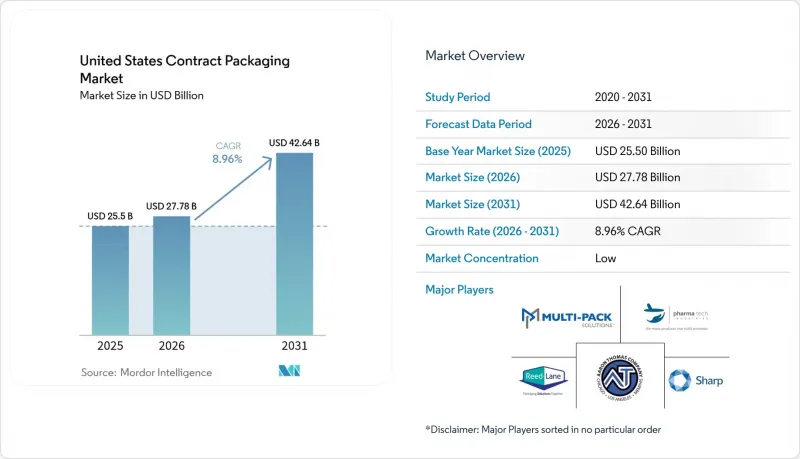
Mordor Intelligence에 의하면, 미국 계약 포장 시장 규모는 2025년에 255억 달러로 평가되었고 2026년 277억 8,000만 달러에서 2031년까지 426억 4,000만 달러에 이를 것으로 예측되며, 예측 기간(2026-2031년) CAGR은 8.96%를 나타낼 전망입니다.
본 보고서는 포장 유형(1차 포장, 2차 포장, 3차 포장), 최종 사용자 산업(식품, 음료, 의약품 등), 제공 서비스(배합·블렌딩, 충전·조립 등), 소재(종이 및 판지, 플라스틱, 금속 등), 자동화 수준(수동, 반자동 등)별로 분류되어 있습니다. 시장 전망은 금액(달러) 기준으로 제시되어 있습니다.
미국 계약 포장 시장 동향 및 인사이트
전자상거래의 급속한 성장이 유연한 공동 포장(코패킹) 수요를 견인
온라인 소매의 급속한 확장은 브랜드 소유주에게 있어 포장의 경제성을 계속해서 재정의하고 있습니다. 부피 중량을 기준으로 하는 배송 정책은 불필요한 공간을 최소화한 형태를 우대하기 때문에 코패커는 1차 및 2차 포장을 더 가볍고 컴팩트한 디자인으로 재설계해야 하는 압박을 받고 있습니다. 2032년까지 647억 8,000만 달러 규모 시장으로 성장할 것으로 예상되는 ‘즉석 음용(RTD) 커피’의 급증은 해당 카테고리 특유의 성장이 유연한 충전 및 라벨링 능력을 필요로 하는 상품 라인 확장을 어떻게 촉진하고 있는지를 보여줍니다. AI를 활용한 수요 예측과 신속한 전환을 결합할 수 있는 계약 포장 업체들은 전자상거래 프로그램에서 더 큰 점유율을 확보하고 있으며, 이는 옴니채널 브랜드에게 미국 계약 포장 시장의 전략적 중요성을 더욱 높이고 있습니다.
의약품·뉴트라슈티컬 분야의 아웃소싱 급증
규제 당국의 감시 강화와 복잡한 바이오의약품 개발 파이프라인의 확장으로 인해 제약사들은 외부 파트너십을 확대해야 하는 상황에 직면해 있습니다. 가상 제약 기업들은 제형, 무균 충전 및 마무리, 일련번호 부여를 단일 워크플로우로 관리할 수 있는 전문 포장 업체를 활용함으로써 개발 비용을 최대 50%까지 절감하고 있습니다. GLP-1 치료제를 위한 정밀한 투여 시스템에 대한 수요는 오염 관리의 장벽을 더욱 높이고 있으며, 노보노르디스크의 41억 달러 규모 노스캐롤라이나 시설과 같은 생산 능력 확대는 미국 계약 포장 시장에 중요한 비즈니스 기회가 되고 있습니다. 그 결과, 부속서 1의 전문 지식과 백신 등급 클린룸 인증을 보유한 계약 포장 업체들은 단순한 공급업체에서 전략적 공급망 파트너로 변모하고 있습니다.
물류 및 콜드체인 비용 상승
홍해와 운하 회랑의 지정학적 혼란으로 인해 현물 운임은 장기 평균을 크게 상회하며, 국내 재고 계획에 변동성을 초래하고 있습니다. 온도 관리가 필요한 분야에서는 냉장 컨테이너 공급이 제한적이어서 바이오의약품 및 고급 식품의 운송 비용이 상승하고, 더 큰 위험에 노출되고 있습니다. 브랜드 소유주는 이러한 비용을 업스트림 단계로 전가하고 있으며, 계약 포장 업체에 대해 운전 자본의 완충 여력을 확대하거나 납기 조건을 재협상할 것을 요구하고 있습니다. 아메리콜드(AmeriCold)가 도입한 것과 같은 AI 기반 수요 예측은 불확실성을 완화하는 데 도움이 되지만, 비용 변동을 완전히 해소할 수는 없어 미국 계약 포장 시장의 이익률 확대를 제약하고 있습니다.
부문 분석
2025년 기준, 1차 포장은 미국 계약 포장 시장 점유율의 55.88%를 차지하고 있으며, 11.25%의 연평균 성장률(CAGR)은 2031년까지 이 부문이 매출 증가분의 대부분을 차지할 것임을 시사합니다. 수요는 주사 키트, 어린이 안전 바이알, 복약 순응도를 모니터링하는 스마트 블리스터 팩에 집중되어 있습니다. 암 치료 및 당뇨병 치료 분야의 개인화 진전에 따라 충전량은 감소하는 반면 SKU 수는 증가하고 있어, 공구 교체가 신속하게 이루어지는 유연성이 높은 충전 라인이 선호되고 있습니다. 2차 포장은 회원제 창고형 매장의 진열 및 소매용 멀티팩 수요에 지속적으로 부응하고 있지만, 각 브랜드가 스마트한 1차 용기에 자본을 투자하고 있어 혁신의 기세는 여전히 낮은 수준에 머물러 있습니다.
또한, 이 부문은 스마트 패키징 기술이 정착되고 있는 분야이기도 합니다. QR 코드를 지원하는 패키지는 원산지 정보를 제공하며, NFC 태그는 실제 세계 증거(RWE) 프로그램을 위한 환자 피드백을 수집합니다. 게레스하이머(Geresheimer)사가 조지아주에서 진행한 1억 8,000만 달러 규모의 확장 투자 등은 의료용 등급 플라스틱 및 사출 성형된 흡입기에 대한 자본 수요가 높음을 여실히 보여주고 있습니다. 그 결과, 미국의 계약 포장 시장에서 1차 포장은 단순한 수동적 용기에서 디지털로 연결된 인터페이스로 진화하고 있습니다.
식품 부문은 2025년에도 35.06%를 차지하며 여전히 최대 수익원이지만, 의약품 부문은 13.74%의 연평균 성장률(CAGR)로 확대되고 있으며, 이는 전체 시장 성장률의 2배에 해당합니다. 이러한 격차는 제약 기업들이 C등급 클린룸과 실시간 환경 모니터링이 필요한 고도로 전문화된 충전·마무리 및 라벨링 공정을 외부에 위탁하려는 경향을 반영하고 있습니다. 개정된 부록 1의 멸균 지침에서는 오염 관리 요건이 강화되어 추가적인 추진력이 더해지고 있습니다.
즉석 식품 및 기능성 음료 제품군은 계속해서 미국 계약 포장 시장에 생산량을 할당하고 있지만, 각 브랜드가 소비자 직접 공급(DTC) 공급망을 성숙시켜 감에 따라 그 성장세는 둔화되고 있습니다. 대조적으로, 일라이 릴리(Eli Lilly)와 노보 노르디스크(Novo Nordisk)가 노스캐롤라이나주에서 진행 중인 수십억 달러 규모의 설비 투자를 통해, 주사제에 대한 새로운 수요의 물결이 지역 공동 포장 파트너들에게로 흘러들고 있습니다. 따라서 예측 기간 동안 의약품 아웃소싱은 미국 계약 포장 시장에 대한 전반적인 기여도 측면에서 식품 부문과의 기존 격차를 좁힐 것으로 예측됩니다.
기타 혜택:
- 엑셀 형식 시장 예측(ME) 시트
- 3개월간의 애널리스트 지원
자주 묻는 질문
목차
제1장 서론
제2장 조사 방법
제3장 주요 요약
제4장 시장 구도
제5장 시장 규모와 성장 예측
제6장 경쟁 구도
제7장 시장 기회와 향후 전망
JHS 26.09.11According to Mordor Intelligence, the United States contract packaging market size was valued at USD 25.50 billion in 2025 and estimated to grow from USD 27.78 billion in 2026 to reach USD 42.64 billion by 2031, at a CAGR of 8.96% during the forecast period (2026-2031).
This report is Segmented by Packaging Type (Primary, Secondary, Tertiary), End-User Industry (Food, Beverage, Pharmaceutical, and More), Service Offering (Formulation and Blending, Filling and Assembly, and More), Material Substrate (Paper and Paperboard, Plastics, Metals, and More), Automation Level (Manual, Semi-Automated, and More). The Market Forecasts are Provided in Terms of Value (USD).
United States Contract Packaging Market Trends and Insights
E-commerce Boom Drives Agile Co-packing Demand
The rapid expansion of online retail continues to rewrite packaging economics for brand owners. Dimensional-weight shipping policies reward formats that minimize wasted air, pushing co-packers to redesign primary and secondary packs for lighter, tighter footprints. A surge in ready-to-drink coffee, projected to be worth USD 64.78 billion by 2032, illustrates how category-specific growth fuels line extensions that require flexible filling and labeling capability. Contract packagers able to combine AI-driven demand forecasting with rapid changeovers capture a larger share of e-commerce programs, reinforcing the strategic relevance of the United States contract packaging market for omnichannel brands.
Pharma and Nutraceutical Outsourcing Surge
Heightened regulatory scrutiny and a pipeline of complex biologics are driving drug makers to expand external partnerships. Virtual pharmaceutical firms have cut development costs by up to 50% by leaning on specialized packagers that can manage formulation, sterile fill-finish, and serialization in one workflow The need for precise dosing systems for GLP-1 therapies further raises the bar for contamination control, turning capacity expansions such as Novo Nordisk's USD 4.1 billion North Carolina facility into anchor opportunities for the United States contract packaging market. As a result, co-packers that hold Annex 1 expertise and vaccine-grade cleanroom certifications are transitioning from transactional vendors to strategic supply-chain partners.
Rising Logistics and Cold-Chain Costs
Geopolitical disruptions in the Red Sea and canal corridors have pushed spot freight rates well above long-term averages, adding volatility to domestic inventory planning. Temperature-controlled segments carry even higher risk, as limited reefer container availability inflates landed costs for biologics and premium food products. Brand owners are passing those expenses upstream, pressuring contract packagers to widen working-capital buffers or renegotiate delivery terms. AI-derived demand forecasts, like those deployed by Americold, help mitigate uncertainty but cannot fully erase cost swings, constraining profit margin expansion within the United States contract packaging market.
Other drivers and restraints analyzed in the detailed report include:
- Labor Shortages Accelerate Robotics Adoption
- FDA FOP Labeling Rule Spurs Relabeling Needs
- High Cap-ex for Automation
For complete list of drivers and restraints, kindly check the Table Of Contents.
Segment Analysis
Primary packaging accounts for 55.88% of United States contract packaging market share in 2025, and its 11.25% CAGR signals that the segment will capture most incremental revenue through 2031. Demand concentrates in injectable kits, child-resistant vials, and smart blister packs that monitor adherence. Increased personalization in oncology and diabetes therapies pushes fill volumes lower and SKU counts higher, favoring agile filling lines with quick-change tooling. Secondary packaging continues to service club-store displays and retail multipacks, yet innovation intensity remains lower as brands channel capital toward intelligent primary containers.
The segment is also where smart packaging technologies take root. QR-enabled packs provide provenance data, while NFC tags collect patient feedback for real-world evidence programs. Investments such as Gerresheimer's USD 180 million expansion in Georgia underline the capital requirements for medical-grade plastics and injection-molded inhalers. As a result, the United States contract packaging market sees primary packaging evolve from a passive enclosure to a digitally connected interface.
The food segment remains the largest revenue contributor at 35.06% in 2025, yet pharmaceuticals are advancing at a 13.74% CAGR, twice the overall market rate. This divergence mirrors drug makers' willingness to outsource highly specialized fill-finish and labeling steps that demand Grade C cleanrooms and real-time environmental monitoring. Updated Annex 1 sterilization guidance adds further impetus by ratcheting up contamination control requirements.
Ready-to-eat and functional beverage lines continue to allocate volume to the United States contract packaging market, but growth moderates as brands mature their direct-to-consumer supply chains. In contrast, Eli Lilly's and Novo Nordisk's multi-billion-dollar North Carolina builds are channeling a fresh wave of injectable demand toward regional co-pack partners. Over the forecast horizon, pharmaceutical outsourcing is therefore expected to narrow the historical gap with food in overall contribution to the United States contract packaging market.
Complete Report Scope:
- By Packaging Type
- Primary
- Secondary
- Tertiary
- By End-user Industry
- Food
- Beverage
- Pharmaceutical
- Home and Personal Care
- Automotive
- Electronics and High-tech
- Pet Food
- Other End-user Industry
- By Service Offering
- Formulation and Blending
- Filling and Assembly
- Packaging and Labeling
- Fulfillment and Logistics
- By Material Substrate
- Paper and Paperboard
- Plastics
- Metals
- Glass
- Biodegradable/Bio-based
- By Automation Level
- Manual
- Semi-automated
- Fully Automated
- Robotics-integrated
List of Companies Covered in this Report:
- Aaron Thomas Company
- Sharp Packaging Services
- Multipack Solutions
- Pharma Tech Industries
- Reed-Lane Inc.
- UNICEP Packaging
- Bell-Carter Packaging
- Jones Packaging Inc.
- Stamar Packaging
- FedEx Supply Chain (GENCO)
- GreenSeed Contract Packaging
- Honeyville Inc.
- Ryder Contract Packaging
- Motion Controls Robotics
- Nulogy Corp.
- Custom Pak Illinois
- Buske Logistics
- Very Good Mfg.
- SMT Packaging
- Thermo Fisher CDMO Services
- Catalent Inc.
Additional Benefits:
- The market estimate (ME) sheet in Excel format
- 3 months of analyst support
TABLE OF CONTENTS
1 INTRODUCTION
- 1.1 Study Assumptions and Market Definition
- 1.2 Scope of the Study
2 RESEARCH METHODOLOGY
3 EXECUTIVE SUMMARY
4 MARKET LANDSCAPE
- 4.1 Market Overview
- 4.2 Market Drivers
- 4.2.1 E-commerce boom drives agile co-packing demand
- 4.2.2 Pharma and nutraceutical outsourcing surge
- 4.2.3 Labor shortages accelerate robotics adoption
- 4.2.4 FDA FOP labeling rule spurs relabeling needs
- 4.2.5 Reshoring incentives lift domestic demand
- 4.2.6 Eco-friendly packaging mandates and preferences
- 4.3 Market Restraints
- 4.3.1 Rising logistics and cold-chain costs
- 4.3.2 High cap-ex for automation
- 4.3.3 Fragmented supplement/FOP compliance burden
- 4.3.4 Brand owners insource core SKUs under inflation
- 4.4 Supply-Chain Analysis
- 4.5 Regulatory Landscape
- 4.6 Technological Outlook
- 4.7 Porter's Five Forces Analysis
- 4.7.1 Bargaining Power of Suppliers
- 4.7.2 Bargaining Power of Buyers
- 4.7.3 Threat of New Entrants
- 4.7.4 Threat of Substitutes
- 4.7.5 Intensity of Rivalry
5 MARKET SIZE AND GROWTH FORECASTS (VALUE)
- 5.1 By Packaging Type
- 5.1.1 Primary
- 5.1.2 Secondary
- 5.1.3 Tertiary
- 5.2 By End-user Industry
- 5.2.1 Food
- 5.2.2 Beverage
- 5.2.3 Pharmaceutical
- 5.2.4 Home and Personal Care
- 5.2.5 Automotive
- 5.2.6 Electronics and High-tech
- 5.2.7 Pet Food
- 5.2.8 Other End-user Industry
- 5.3 By Service Offering
- 5.3.1 Formulation and Blending
- 5.3.2 Filling and Assembly
- 5.3.3 Packaging and Labeling
- 5.3.4 Fulfillment and Logistics
- 5.4 By Material Substrate
- 5.4.1 Paper and Paperboard
- 5.4.2 Plastics
- 5.4.3 Metals
- 5.4.4 Glass
- 5.4.5 Biodegradable/Bio-based
- 5.5 By Automation Level
- 5.5.1 Manual
- 5.5.2 Semi-automated
- 5.5.3 Fully Automated
- 5.5.4 Robotics-integrated
6 COMPETITIVE LANDSCAPE
- 6.1 Market Concentration
- 6.2 Strategic Moves
- 6.3 Market Share Analysis
- 6.4 Company Profiles (includes Global level Overview, Market level overview, Core Segments, Financials as available, Strategic Information, Market Rank/Share for key companies, Products and Services, Recent Developments)
- 6.4.1 Aaron Thomas Company
- 6.4.2 Sharp Packaging Services
- 6.4.3 Multipack Solutions
- 6.4.4 Pharma Tech Industries
- 6.4.5 Reed-Lane Inc.
- 6.4.6 UNICEP Packaging
- 6.4.7 Bell-Carter Packaging
- 6.4.8 Jones Packaging Inc.
- 6.4.9 Stamar Packaging
- 6.4.10 FedEx Supply Chain (GENCO)
- 6.4.11 GreenSeed Contract Packaging
- 6.4.12 Honeyville Inc.
- 6.4.13 Ryder Contract Packaging
- 6.4.14 Motion Controls Robotics
- 6.4.15 Nulogy Corp.
- 6.4.16 Custom Pak Illinois
- 6.4.17 Buske Logistics
- 6.4.18 Very Good Mfg.
- 6.4.19 SMT Packaging
- 6.4.20 Thermo Fisher CDMO Services
- 6.4.21 Catalent Inc.
7 MARKET OPPORTUNITIES AND FUTURE OUTLOOK
- 7.1 White-space and Unmet-Need Assessment